






Abstract
The corrosion behaviour of carbon steel in 55% lithium bromide solution containing a complex organophosphonate–molybdate inhibitor has been studied using weight loss tests, electrochemical measurements, SEM and X-ray photoelectron spectroscopy. The results showed that the species provides an excellent inhibition performance in 55% lithium bromide solution. When its concentration reached 0·8 kg m−3 in 55% lithium bromide+0·07 mol dm−3 lithium hydroxide at 240°C, the carbon steel's corrosion rate decreased to 25·02 μm/year, and the anodic passivation region and the passive current density of carbon steel were ∼700 mV and 1 μA cm−2 respectively. At the same time, the capacitance value of electric double layer decreased, and the charge transfer resistance increased. The compact compound film formed on the surface of carbon steel in the inhibited LiBr solution was mainly composed of iron oxide and molybdenum oxide.
Introduction
In the present era, lithium bromide absorption chillers have been applied widely because of their many excellent characteristics, such as high thermal efficiency, wide heat sources, low energy consumption and zero release.1 – 4 Although lithium bromide solution possesses favourable thermophysical properties, it can also cause serious corrosion problems in structural materials used in cooling systems and heat exchangers, such as carbon steel, stainless steel, copper alloys and titanium.5 The cheapest and efficient corrosion control method is to add inhibitors into the lithium bromide solution,6 – 9 with molybdate being very widely used.10 – 13 However, the solubility of molybdate is low in concentrated lithium bromide solution, and it is difficult to maintain an effective concentration.14 – 18 The solubility of molybdate can be enhanced by some compounds, such as 2-propenoic telomere.19 In this paper, the solubility of sodium molybdate is enhanced by an organophosphonate species, the overall inhibitor being a complex organophosphonate–molybdate (shortened form P–Mo). The inhibition effect of the complex P–Mo inhibitor for carbon steel is studied in 55% lithium bromide solution.
Experimental
Solution and materials
The material tested was carbon steel with the following chemical composition (mass-%): carbon, 0·12; sulphur, 0·02; phosphorus, 0·02; silicon, 0·01; manganese, 0·35; and iron, balance. The test solution was 55% lithium bromide+0·07 mol dm−3 lithium hydroxide solution (shortened form of lithium bromide solution) without and with the complex P–Mo inhibitor. Samples of dimension 30×20×3 mm were used for weight loss tests. The working electrodes (WEs) in electrochemical measurements were covered by Shin-Etsu silicone except for a 1 cm2 working area that was exposed to the solution. All of them were abraded with 600 grit SiC paper and finally rinsed with deionised water and ethanol. Before electrochemical measurements, the WEs were immersed in boiling (145°C) lithium bromide solution with the complex P–Mo inhibitor for 200 h.
Weight loss tests
Weight loss tests were carried out in a stainless steel autoclave with a polytetrafluoroethylene cylinder liner. After weighing, two test specimens were put into the polytetrafluoroethylene cylinder, which contained 100 cm3 lithium bromide solution without and with different concentrations of the complex P–Mo inhibitor. The solution was deoxygenated by nitrogen for 1 h before each experiment. Then, the autoclave was put into a thermostat (Kosumosu AT-S13) at the set temperature for 200 h. After immersing, the specimens were cleaned using 3 mol dm−3 hydrochloric acid for 3 min at room temperature and rinsed using deionised water and ethanol. After drying, two test specimens were weighed. The measured mass losses of the specimens were calibrated against the corrosion rate of uncorroded carbon steel in 3 mol dm−3 hydrochloric acid. These tests were repeated at different temperatures. The overall corrosion rate V was calculated by the following equation (1)

Electrochemical measurements
Electrochemical impedance spectroscopy (EIS) measurements and polarisation curves were carried out in atmospheric pressure at the boiling point (145°C) of the lithium bromide solution without and with 0·8 kg m−3 complex P–Mo inhibitor using a Princeton Applied Research VMP3, which was controlled by EC-lab software. The cell assembly consisted of a carbon steel sheet as the WE, a platinum electrode as the counter electrode and a saturated calomel electrode as the reference electrode. The three-electrode system was immersed in a glass vessel, and the solution was deoxygenated by nitrogen during the whole process. Polarisation curves were measured using a sweep rate of 3·33×10−4 V s−1. The frequency range was from 10 mHz to 100 kHz, and the ac amplitude was 10 mV in the EIS test.
Surface analysis
After the specimen was immersed in the lithium bromide solution with the complex P–Mo inhibitor at 240°C for 200 h, its surface micrograph and element distribution were investigated using scanning electron microscopy (SEM) (JSM-5600LV) and X-ray photoelectron spectroscopy (XPS) (Thermo ESCALAB 250).
Results and discussion
Effect of organophosphonate on solubility of sodium molybdate
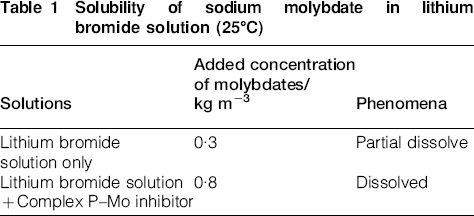
Generally, the solubility of sodium molybdate is low in concentrated lithium bromide solution. However, its solubility may be increased to >0·8 kg m−3 when the complex P–Mo inhibitor is added to lithium bromide solution at room temperature. The results are shown in Table 1.
Solubility of sodium molybdate in lithium bromide solution (25°C)
The base of the complex P–Mo inhibitor is an organophosphonate plus sodium molybdate. Figure 1 shows the chemical formula of the organophosphonate (sodium salt of ethyl-diamine tetramethyl phosphonic acid). This compound is used as an effective corrosion and scale inhibitor and has stability at high temperature and high pH. The surface chemical adsorption of organophosphonate on crystals inhibits nucleation and growth.20 Thus, when the complex P–Mo inhibitor was added to the lithium bromide solution, its precipitation of sodium molybdate is inhibited by the organophosphonate adsorbing on sodium molybdate crystal. The concentration of sodium molybdate can therefore reach 800 kg m−3 in lithium bromide solution under the circumstances.

Chemical formula of organophosphonate
Weight loss tests
Figure 2 shows the corrosion rates of carbon steel in lithium bromide solution at different temperatures with various concentrations of the complex P–Mo inhibitor. It is clear from Fig. 2 that the corrosion rate of carbon steel in the lithium bromide solution increases with increasing temperature from 160 to 240°C. However, at each temperature, the corrosion rate decreases as the concentration of the complex P–Mo inhibitor increases. When the concentration of the complex P–Mo inhibitor is 0·8 kg m−3, the corrosion rate rises from ∼8 to 25 μm/year on increasing the solution temperature from 160 to 240°C. This corrosion rate is much lower than in another research,19 and the results indicate that the complex P–Mo inhibitor gives an excellent inhibition performance at high temperature for carbon steel in lithium bromide solution.
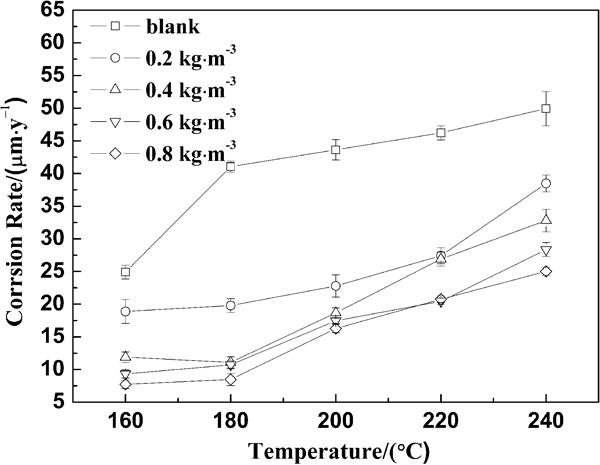
Relationship between corrosion rate and different temperatures with various complex P–Mo inhibitors. Range of temperature is from 160 to 240°C. Concentrations of complex P–Mo inhibitor are 0·2, 0·4, 0·6 and 0·8 kg m−3
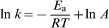
According to the kinetic theory of electrochemical reaction,21 the corrosion rates V of metal in a solution are in connection with the coefficient of reaction rate k and the concentration of reduced form c. Their relationship obeys the following equation (2)

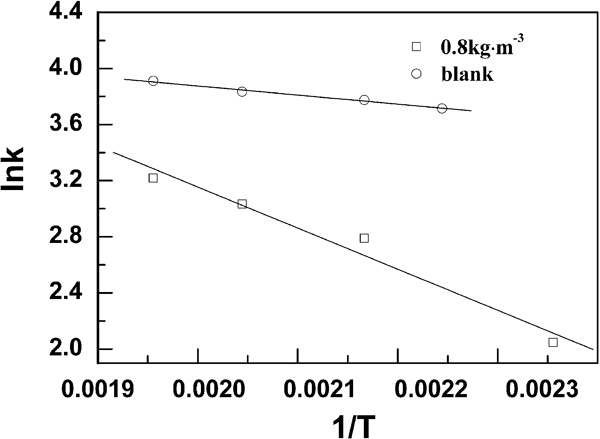
Relationship between ln k and 1/T: curves are relationship between ln k and 1/T without and with 0·8 kg m−3 complex P–Mo inhibitor
At the temperature 160-240°C, the relationship between ln k(ln v) and 1/T approximately abides by linearity relations. The fitted equations of the blank and containing 0·8 kg m−3 complex P–Mo inhibitor are shown in equations (3) and (4)


Parameters of regression between ln k and 1/T
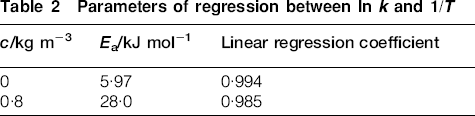
The value of E a is the reflection of the difficult degree of the reaction. The higher the value of E a, the higher the energy barrier of the reaction. It can be seen from Table 2 that the value of E a in the solution with the complex P–Mo inhibitor is higher than that without the inhibitor, and therefore, the corrosion reaction of carbon steel is more difficult in the former. As a result, the complex P–Mo inhibitor effectively inhibits the corrosion reaction of carbon steel in the lithium bromide solution.
Electrochemical behaviour of carbon steel in lithium bromide solution without and with complex P–Mo inhibitor
Electrochemical measurements have been widely used in corrosion research, such as polarisation curve and EIS.22 – 26 Figure 4 indicates the polarisation curves of carbon steel in lithium bromide solution without and with the complex P–Mo inhibitor at 145°C at atmospheric pressure. The cathodic polarisation curves of carbon steel obtained in two environments are similar; however, the anodic polarisation curves are obviously different. When the complex P–Mo inhibitor is added to the lithium bromide solution, the region of anodic passivation of the steel is enlarged from 250 to 700 mV, and its passive current density decreases to ∼1 μAcm−2. The widening of the anodic passivation region and the decrease in the passive current density indicate that the complex P–Mo inhibitor improves the anticorrosion performance of carbon steel in lithium bromide solution.
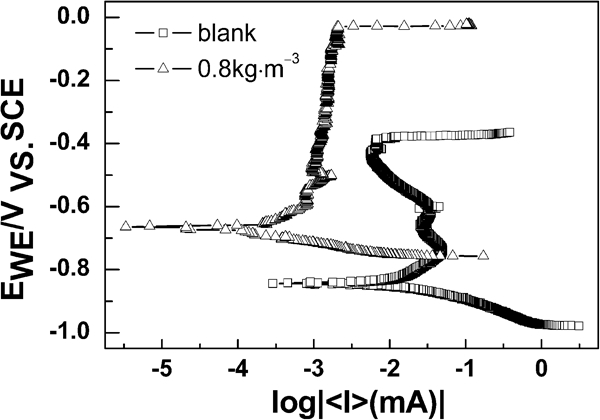
Polarisation curves of carbon steel in lithium bromide solution. Polarisation curves of carbon steel in 55% lithium bromide+0·07 mol dm−3 lithium hydroxide solution were tested at 145°C without and with 0·8 kg m−3 complex P–Mo inhibitor
The Bode plots of carbon steel in the lithium bromide solution without and with the complex P–Mo inhibitor are given in Fig. 5. Impedance magnitude is much larger in the solution with the inhibitor than in the solution without the inhibitor when the frequency was low, but they are almost the same value in the high frequency region. The results are consistent with a decrease in the interfacial capacitance in the presence of the complex P–Mo inhibitor and the formation of passive film. In the event that the impedance is dominated by the capacitance of the space charge layer in the passive film,27 the capacitance value of the space charge layer was much lower than that of the electric double layer. In this situation, the interface capacitance between the metal and the solution is composed of the space charge layer in the passive film and the electric double layer on the solution side, which was connected in series. Thus, the total value of capacitance connected in series is lower than that of normal interface capacitance.28
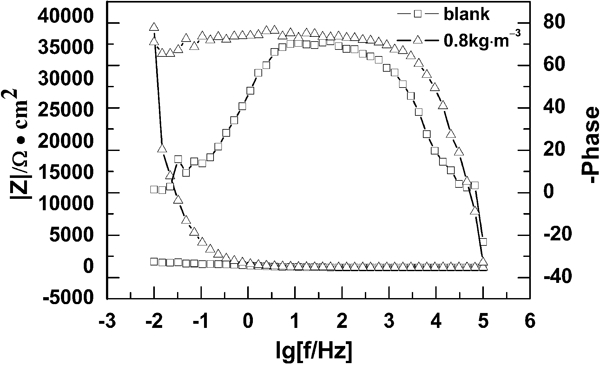
Bode plots of carbon steel in lithium bromide solution. Bode plots of carbon steel in 55% lithium bromide+0·07 mol dm−3 lithium hydroxide solution were tested at 145°C without and with 0·8 kg m−3 complex P–Mo inhibitor
Phase versus log (frequency) plots reveal that there is only one relaxation process in the corrosion process of carbon steel in both inhibited and uninhibited solutions. In the absence of the inhibitor, the phase angle decreases with the decreasing frequency in the low frequency region, which is indicative of a poor corrosion protection performance. However, in the presence of 0·8 kg m−3 complex P–Mo inhibitor, a slight decrease in the phase angle in the low frequency region suggests that the passive film formed on the surface of the carbon steel becomes more compact with improved anticorrosion performance.29
The electric equivalent circuit (see Fig. 6) is used to fit experiment data, to calculate physical parameters concerning and to explain corrosion processes, where R s is the solution resistance, Q is the constant phase angle element and R t is the electric charge transfer resistance. The most widely used is the constant phase element (CPE), which has a non-integer power dependence on the frequency. Its impedance is described by equation (6)

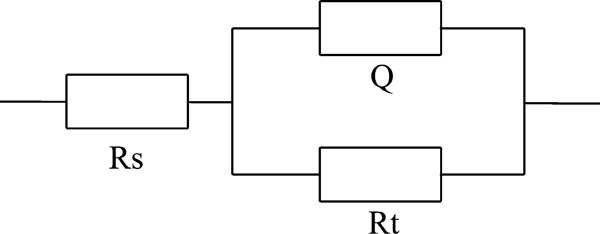
Equivalent circuit model for carbon steel electrodes: electric equivalent circuit was used to fit experiment data, to calculate physical parameters concerning and to explain corrosion processes
Often, a CPE is used in a model in place of a capacitor C dl (double layer capacity) to compensate for non-homogeneity in the system.28 A rough or porous surface can cause a double layer capacitance to appear as a CPE with an n value between 0 and 1. Therefore, n = 0 corresponds to a pure resistor, n = 1 to a pure capacitor and n = 0·5 to a Warburg type impedance. The results of equivalent resistance of carbon steel in lithium bromide solutions are shown in Table 3.
Effect of inhibitor on electrochemical parameters

The data in Table 3 reveal that the capacitance value of the electric double layer decreases and R t increases in the presence of the complex P–Mo inhibitor. The results suggest that the passive film formed on carbon steel increases the energy barrier of corrosion reaction and decreases the rate of corrosion reaction.
Scanning electron microscopy and XPS analysis
Scanning electron microscopy and XPS analyses are used to test the surface morphology and determine the elemental composition of the film formed on carbon steel after immersion in lithium bromide solution with the complex P–Mo inhibitor at 240°C for 200 h. The SEM image is shown in Fig. 7. The SEM image indicates that there is a compact film on the surface of the steel in the presence of the complex P–Mo inhibitor with no corrosion evident.
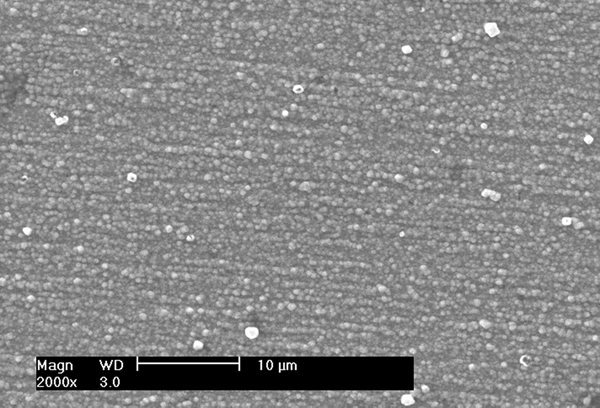
Image (SEM) of carbon steel surface: SEM image of carbon steel surface was obtained after exposure to 55% lithium bromide+0·07 mol dm−3 lithium hydroxide with 0·8 kg m−3 complex P–Mo inhibitor at 240°C for 200 h
The wide scan XPS spectra (Fig. 8) show photoelectron lines at binding energies of ∼232, 284, 530 and 725 eV that can be attributed to Mo3d, C1s, O1s and Fe2p respectively. In the high resolution spectra of Mo3d (Fig. 9), a BE of 232·5 eV for the Mo3d5/2 component was assigned to the fully oxidised Mo(VI) species in MoO3,31,32 and a BE of 229·3 eV for the Mo3d5/2 component was assigned to Mo(IV) in MoO2.33 The peaks at 712·3 and 725·6 eV in the high resolution spectra of Fe2p (Fig. 10) can be attributed to the levels of Fe2p3/2 and Fe2p1/2 respectively.34 It is in agreement with the literature that the peaks shift to higher binding energy and broaden for Fe3O4 because of the appearance of Fe2+(2p3/2) and Fe2+(2p1/2).35,36 The shoulder peak at ∼710 eV provides further evidence of Fe3O4.
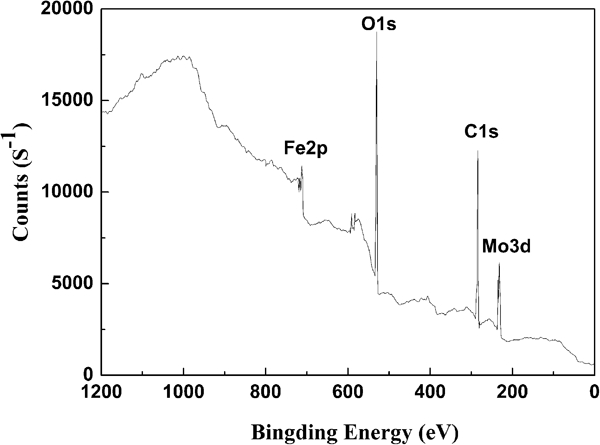
Wide scan XPS spectra of carbon steel surface: XPS spectra of carbon steel surface was obtained after exposure to 55% lithium bromide+0·07 mol dm−3 lithium hydroxide with 0·8 kg m−3 complex P–Mo inhibitor at 240°C for 200 h
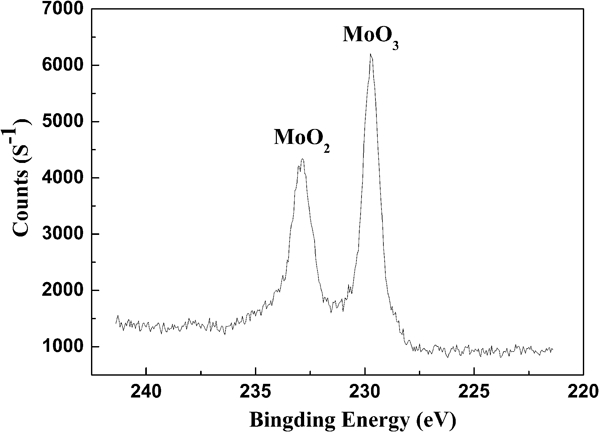
High resolution XPS spectra of Mo3d: high resolution XPS spectra of Mo3d can be used for chemical state analysis of Mo
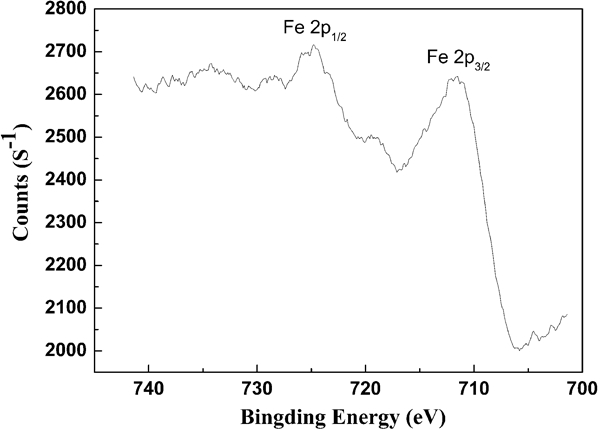
High resolution XPS spectra of Fe2p: high resolution XPS spectra of Fe2p can be used for chemical state analysis of Fe
The results indicate that sodium molybdate took part in the process of film formation, and the film is mainly composed of iron oxide (magnetite) and molybdenum dioxide and trioxide. 18 29 18,29,37
Conclusion
A complex P–Mo inhibitor for carbon steel was studied in 55% lithium bromide solution. The inhibitor consisted of the (sodium salt of ethyl-diamine tetramethyl phosphonic acid) plus sodium molybdate. Not only did the organophosphonate enhance the solubility of molybdate, but it also improved the corrosion inhibition efficiency of the complex inhibitor. A compact passive film forms on carbon steel in the lithium bromide solution with the complex P–Mo inhibitor. Thus, when the solution temperature is increased from 160 to 240°C, the corrosion rate of the steel increases only from ∼8 to 25 μm/year. The anodic passivation region is ∼700 mV, and the passive current density is ∼1 μA cm−2. The capacitance value of electric double layer decreases and the charge transfer resistance increases in the presence of the complex P–Mo inhibitor. The film on the surface of carbon steel in lithium bromide solution with the complex P–Mo inhibitor is mainly composed of magnetite and molybdenum oxide. The inhibition effect of the complex P–Mo inhibitor for carbon steel in lithium bromide solution is excellent. Finally, the cost of the organophosphonate is lower than 2-propenoic telomere, and its inhibition performance is more efficient.