







Abstract
In the present study, plain low carbon steel with 0·033 wt- carbon content was subjected to severe pressure during continuous cooling from austenite region. The pressure increased gradually and then suddenly released by the breakdown of ram under pressure. As a result, a microstructure composed of 80 lath martensite and 20 ferrite was produced. Results showed that the martensite formation is not due to the effect of cooling rate but the effect of hydrostatic pressure on the austenite to ferrite transformation start temperature Ar3.
Introduction
The γ→α transformation start temperature Ar3 decreases with increasing cooling rate.1 Then, at a critical cooling rate corresponding to the nose of ‘c’ curve on a time-temperature-transformation (TTT) diagram, transformation is suppressed. In plain low carbon steels, it was previously demonstrated that very high cooling rates are required to suppress γ→α transformation and produce martensite phase. For example, in low carbon steel with 0·05 wt- carbon content, cooling rates higher than 10 000 K s−1 are required to produce lath martensite.2 These high cooling rates cannot be achieved by normal quenching media like water and brine. Therefore, microstructures obtained after water quenching are always products of diffusional transformation.
2
2,3 Hydrostatic pressure is another important factor that can affect the γ→α transformation temperature.4 The Ae3 temperature decreases with increasing imposed hydrostatic pressure.5 In other words, the austenite phase can be stabilised at lower temperatures compared with normal conditions (P = 0·1 MPa) by imposing hydrostatic pressure. The Ae3 temperature can be measured by the use of the following equation6

By gradual increase of hydrostatic pressure, the Ae3 and Ar3 temperatures decrease progressively. On the other hand, the specimen temperature decreases with time. If the amount of pressure is enough compared with the cooling rate so that the specimen temperature remains greater than Ar3 (P) during the process, then the γ→α transformation is delayed. If this condition lasts up to the time that Ar3 (P) and specimen temperature become lower than Ar1 (P = 1 atm), then full martensite can be formed by the sudden release of hydrostatic pressure. This procedure will be explained using schematic TTT diagrams in conjunction with experimental results, confirming the claimed approach.
Experimental
The chemical composition of the steel used in the present study was Fe–0·033C–0·12Si–0·8Mn–0·008S–0·007P–0·004N (wt-). Cylindrical samples with 40 mm length and 14 mm diameter were cut from the as received plate. The specimens were heated to the selected temperatures (650, 930 and 1000°C) and then inserted into a channel of a cold die, as shown in Fig. 1. Afterwards, a punch was inserted into the channel, and then the samples were subjected to severe compression until the breakdown of ram under pressure. Samples were cooled in contact with die after releasing pressure. Optical microscopy was then used to reveal the final microstructure of the samples. For this reason, samples were cut into two halves, and optical micrographs were taken from the centre of each sample.
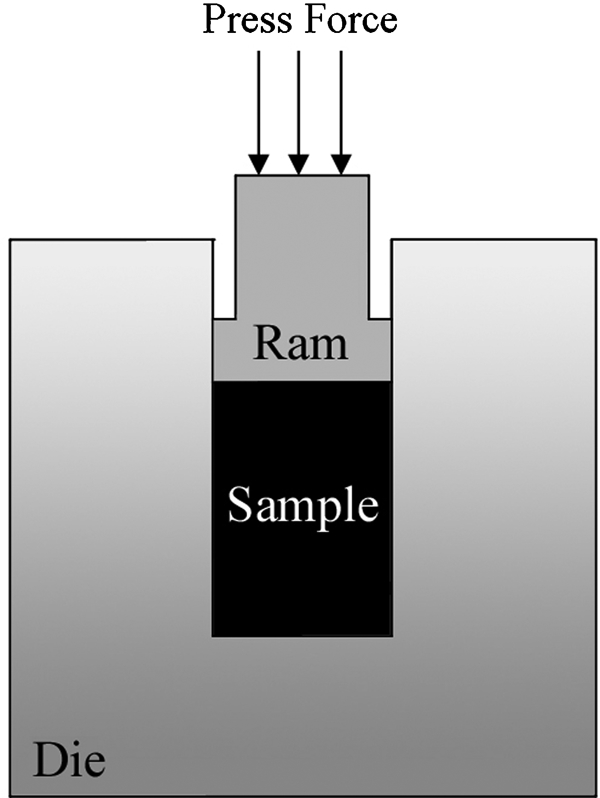
Two-dimensional schematic view of set-up used in present study
Results
Normal transformation
Figure 2a shows the initial microstructure of steel used in the present study. As it is seen, the microstructure is composed of 95 ferrite with mean grain size of 32 μm and the remaining pearlite. Cylindrical specimens with mentioned dimensions were heated to 930°C and cooled at different media after 20 min of soaking. As shown in Fig. 2b, the final microstructure after air cooling is polygonal ferrite with grain size of 21 μm. In addition, microstructure comprising widmanstätten and acicular ferrite was developed after water quenching from 930°C (Fig. 2c). These observations confirm that the hardenability of the present steel is not sufficient enough to produce martensite phase after normal quenching.
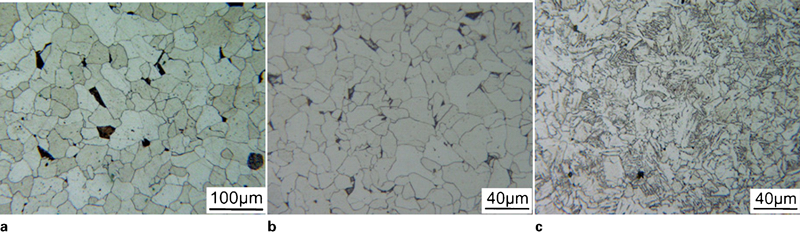
a initial microstructure, b microstructure after air cooling from 930°C and c microstructure after water quenching from 930°C
Transformation under pressure
Figure 3 shows the final microstructures obtained by the mentioned procedure at different starting temperatures (Ts = 650, 930 and 1100°C). As shown, when the starting temperature is selected to be 650°C, a microstructure consisting of polygonal ferrite grains is produced similar to initial or air cooled conditions (Fig. 3a). In contrast, a mixture of 20 grain boundary ferrite and 80 lath martensite is produced when the starting temperature is 930°C (Fig. 3b). The hardness of the dark intergranular phase is ∼320 HV and that of the light grain boundary phase is ∼235 HV. The dark phase is lath martensite, and the light grain boundary phase is ferrite. As it was previously seen, the final microstructure after water quenching is composed of acicular and widmanstätten ferrite. Therefore, the formation of 80 lath martensite in plain low carbon steel with 0·033 wt-C is surprising and could not be attributed to the effect of cooling rate. For further confirmation, a higher starting temperature (Ts = 1100°C) was selected, and the microstructure obtained after processing (Fig. 3c) contains a significant volume fraction of massive-like ferrite and some martensite and/or bainite. It is worth noting that the cooling rate at 1100°C must be higher than 930°C due to the higher temperature difference between the die and the specimen.
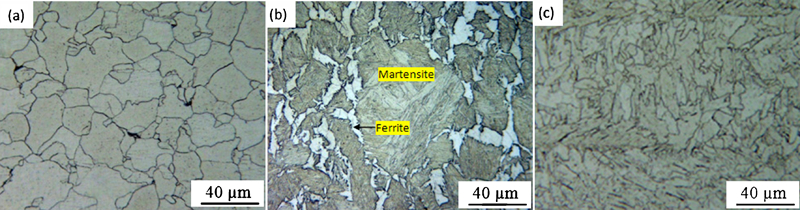
Microstructures produced by cooling under severe pressure at starting temperature of a 650°C, b 930°C and c 1100°C
Discussion
The schematic representation of the mentioned mechanism is shown in Fig. 4. In this process, the γ→α transformation is suppressed due to decreasing Ar3 (P) temperature by imposing hydrostatic pressure during continuous cooling. See before releasing pressure conditions. Then, hydrostatic pressure is released suddenly at the end of the process. If the sample temperature Tf is lower than Ar1 at the moment of releasing pressure, full martensite will be formed (Fig. 4a). Furthermore, a duplex microstructure consisting of martensite and ferrite phases is developed when the sample temperature is between Ar3 and Ar1 (Fig. 4b). This condition is achieved at 930°C in the present work. If the starting temperature is high enough, then the sample temperature Tf right before releasing pressure will be higher than Ar3. In this case, the final microstructure is 100 ferrite phase (Fig. 4c). This case occurred at a preheating temperature of 1100°C. It is worth noting that the key point in the present work is the sudden release of pressure at the end of the process. If pressure is released gradually, then there will be a sufficient time for γ→α transformation to occur during the elapsed time of releasing pressure.
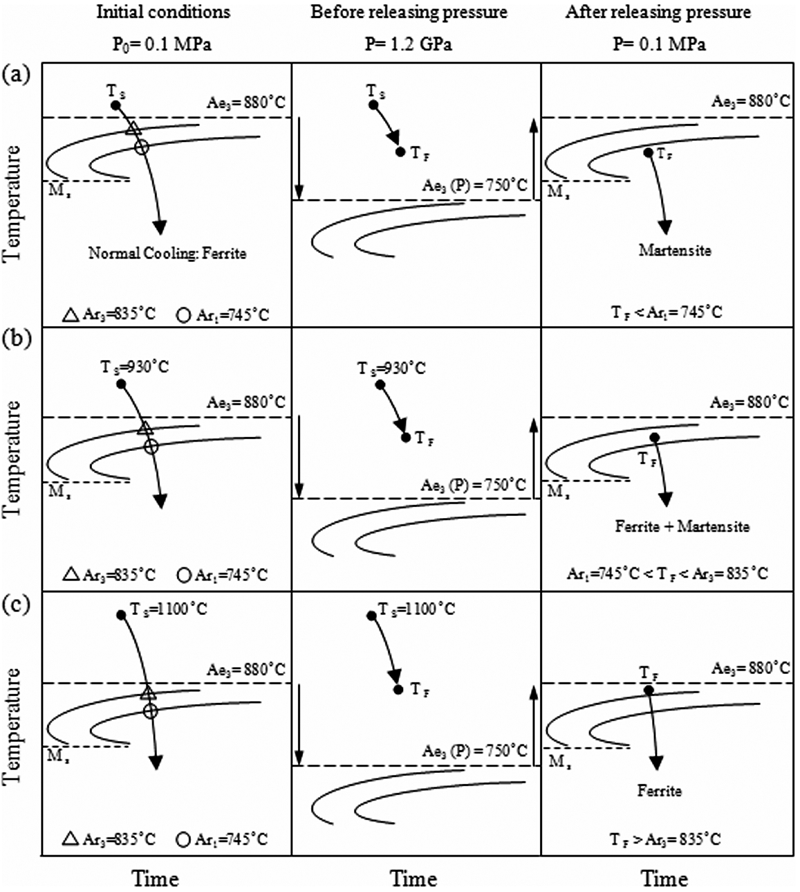
Mechanism of martensite formation in plain low carbon steels by applying hydrostatic pressure during continuous cooling from austenite region
Conclusions
In the present study, hydrostatic pressure was imposed on plain low carbon steel during cooling from the austenite region. A mixture of 80 martensite and 20 ferrite was produced at the starting temperature of 930°C. In contrast, a microstructure consisting of 100 ferrite phase was developed at 1100°C. It was inferred that the martensite phase appeared not due to the effect of cooling rate but due to the effect of hydrostatic pressure on the austenite to ferrite transformation start temperature.
Footnotes
Acknowledgements
The authors thank Mr Naghizadeh and A. Alipour Jahani for their technical aid and preparation of laboratory facilities.