







Abstract
ZnO and ZnAl2O4 coated aluminium borate whisker (ABOw) reinforced pure aluminium composites were fabricated by squeeze casting. The effects of the coatings on the bending properties of the composites were investigated. On the analysis of fractographs, the fracture mechanisms of the composites under bending were also investigated. The results show that both ZnO and ZnAl2O4 coatings of ABOw can significantly increase the bending properties of ABOw reinforced aluminium composite. In ABOw/Al, ABOw/ZnO/Al and ABOw/ZnAl2O4/Al composites, the interface debonding, near interface fracture and near interface fracture and ABOw fracture dominate the fracture of each composite during bending respectively.
Introduction
Aluminium borate whisker (ABOw) reinforced aluminium composites have attracted much interest on account of their excellent mechanical properties and low cost. 1 1,2 Therefore, the composite will possess an optimistic commercial prospect.
The interface between the matrix and the reinforcement plays an important role in the mechanical properties of composites. 3 3,4 In most cases, the interfacial wettability is poor in ABOw reinforced aluminium composites,5 resulting in poor mechanical properties of the composites. Therefore, it is very important to improve the interfacial wettability of the composites.
Reinforcement coating is one of the most effective techniques to improve the interfacial properties of composites.6 Unfortunately, few researches on the coating of ABOw are reported up to now. Gao et al.7 prepared Cu coated ABOw by an electroless plating method. The Cu coating of the whiskers is effective in improving the wettability and controlling the interfacial reaction of the composite, resulting in an obvious improvement of the tensile strength of the composite. However, the process of electroless plating is very complex, and a part of the Cu coating is oxidised during the heating of Cu coated whisker preform. Fei and Li8 prepared NiO coated ABOw by the precipitation method. The reaction of NiO and molten aluminium can improve the wettability of the composite during squeeze casting; however, it is easy to produce an uneven coating on the surface of the whiskers by this method.
The sol–gel method is an advanced technique to synthesise high quality oxide thin films.9 Thus, the interfacial characteristics can be improved using this method. Ding et al.10 prepared Al2O3 coated ABOw by a sol–gel process, although the interfacial reactions of the composite could be hindered significantly, and the coating could not improve the wettability obviously. In addition, a ball milling treatment was used to disperse the coated whiskers. As a result, a large amount of whisker fracture was found, which seriously affected the mechanical properties of the composites. Therefore, it is also necessary to adopt a better process for the dispersion of the coated whiskers.
In our previous study,11 the ZnO and ZnAl2O4 coatings of ABOw were prepared by a sol–gel process and dispersed in water by an ultrasonic vibration technique. In the present paper, the bending properties and fracture mechanisms of ZnO and ZnAl2O4 coated ABOw reinforced aluminium composites are investigated and discussed.
Experimental
ABOw with a diameter of 0·5–1 μm and a length of 10–30 μm were used as reinforcement. The ZnO and ZnAl2O4 coatings of the ABOw were prepared by a sol–gel method and dispersed in water by an ultrasonic dispersion technique to prepare the whisker preform. The detailed coating process can be found in our previous study.11 Pure aluminium was selected as the matrix. The chemical composition of pure aluminium is Al–0·015Si–0·015Fe–0·005Cu (wt-).
The pure aluminium composites reinforced by ABOw with different coatings were fabricated by squeeze casting with a melt pouring temperature of 800°C and mould preheating temperature of 500°C. The volume fraction of ABOw in the composites was ∼20. The initial mass ratio of ZnO and ABOw was 1∶10, and the corresponding abbreviation of the composite separately is ABOw/ZnO/Al and ABOw/ZnAl2O4/Al composite. For comparison, an uncoated ABOw reinforced pure aluminium composite (ABOw/Al) was also prepared.
Bending tests of the composites were carried out on an Instron-1186 tension machine at room temperature with a speed of 0·5 mm min−1. The dimensions of the specimen for three-point bending experiment are shown in Fig. 1. By taking the scattering effect that occurred in the composites into consideration, five specimens were tested to determine the bending properties of each composite.
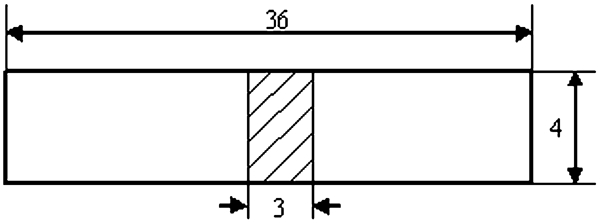
Specimen for three-point bending experiment
The micrographs of the as cast composites were observed with an Olympus GX71 type optical microscope (OM) in a polished state. The bending fractographs of the composites were examined by an S-4300 scanning electron microscope (SEM) with an accelerating voltage of 20 kV.
Results
OM images of composites
The typical OM images of the as cast composites are shown in Fig. 2. It can be found that the distribution of whiskers in each composite is random and homogeneous, and no cluster of whiskers can be seen. This indicates that the ZnO and ZnAl2O4 coatings of ABOw do not affect the dispersive property of the whiskers in the composite greatly.
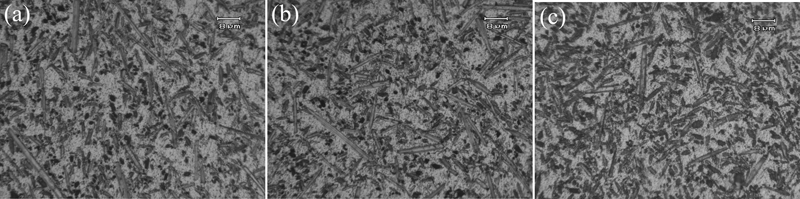
Images (OM) of composites
Bending properties of composites
Figure 3 shows the bending properties of ABOw/Al, ABOw/ZnO/Al and ABOw/ZnAl2O4/Al composites. It can be seen that both ZnO and ZnAl2O4 coatings of ABOw can significantly increase the bending strengths of the composites. The bending strength of the ABOw/Al composite is 430 MPa; however, the bending strength of the ABOw/ZnO/Al and ABOw/ZnAl2O4/Al composites increase to 500 and 450 MPa respectively. In addition, the bending deflection shows a similar variation.

Bending properties of composites
Fractographs of composites
The fractograph of the ABOw/Al composite after the bending test is shown in Fig. 4. It can be observed that many microcracks and microholes are found on the surface of the fractograph in the composite. Meanwhile, the pullout of whiskers with smooth surface is commonly seen on the surface of the fractograph. These may be resulting from the unfilled regions of molten aluminium caused by poor wettability during squeeze casting or interfacial debonding between the whiskers and the matrix during bending.
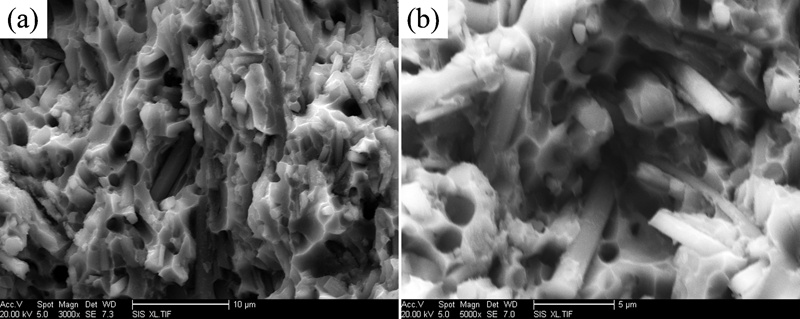
Fractographs (SEM) of ABOw/Al composites
Figure 5 shows the fractograph of the ABOw/ZnO/Al composite after the bending test. It is found that aluminium matrix dimples with large sizes and amount can be clearly seen, and the holes due to the pullout of whiskers are relatively rougher. The amount of pullout of whiskers decreases obviously, and the amount of some fractured whiskers increases compared with that of the ABOw/Al composite. Moreover, many small fractured particles are found at the interface.
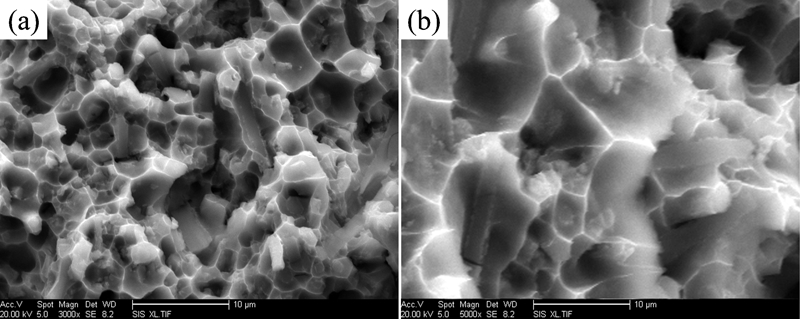
Fractographs (SEM) of ABOw/ZnO/Al composites
Figure 6 shows the fractograph of the ABOw/ZnAl2O4/Al composite after the bending test. It is shown that both aluminium matrix dimples and many fractured whiskers can be seen. In addition, note that the amount of fractured whiskers in the ABOw/ZnAl2O4/Al composite is larger than that in the ABOw/ZnO/Al composite.

Fractographs (SEM) of ABOw/ZnAl2O4/Al composites
Discussion
The bending properties and fracture mechanisms of the composites can be analysed according to the above experimental results. The interfacial bonding strength is weak in the ABOw/Al composite due to the poor wettability.5 Therefore, it is the primary factor responsible for the relatively low bending strength and deflection. Both ZnO and ZnAl2O4 coatings of ABOw can improve the wettability. The increase in wettability is favourable for the increase in interfacial bonding strength,12 so the bending strengths of the composites increase. For the ABOw/ZnO/Al composite, ZnO on the surface of ABOw can react with molten aluminium during squeeze casting to improve the wettability. In addition, the reaction between ZnO and molten aluminium does not destroy the integrity of ABOw during squeeze casting. Therefore, the bonding strength of the interface is high enough to pass load from the matrix to the reinforcement effectively, and the bending strength of the composite improves significantly. For the ABOw/ZnAl2O4/Al composite, ZnAl2O4 nanoparticles with large specific areas on the surface of ABOw can improve the interfacial wettability. However, due to the reaction between ABOw and ZnO during the preparation of the ZnAl2O4 coating of ABOw, the integrity of ABOw is destroyed to some extent, which causes ABOw to be more prone to fracture during bending.8 Therefore, the bending strength of the ABOw/ZnAl2O4/Al composite is lower than that of the ABOw/ZnO/Al composite.
The bending deflection of the composites greatly increases after the coatings. In the ABOw/Al composite, the pullout of ABOw can be clearly seen on the fracture surface, resulting in a lower bending deflection. Therefore, interface debonding is the main fracture mechanism of the ABOw/Al composite. For the ABOw/ZnO/Al composite, the integrity of ABOw is not destroyed, and the coated whiskers can slide in the matrix by consuming the grinding force during bending. The fracture tends to occur at the near interface region of the matrix, thus making it easier to form more dimples rather than the pullout of whiskers on the fracture surfaces. Therefore, the bending deflection of the composite significantly increases. For the ABOw/ZnAl2O4/Al composite, although the coated whiskers can slide in the matrix by consuming the grinding force during bending, the integrity of ABOw is destroyed to some extent. As a result, they can result in large stress concentration and fracture of ABOw during bending, decreasing the bending deflection of the composite to some extent compared with that of the ABOw/ZnO/Al composite.
Conclusions
Both ZnO and ZnAl2O4 coatings of ABOw can significantly increase the bending strength and deflection of the ABOw/Al composite. In the ABOw/Al, ABOw/ZnO/Al and ABOw/ZnAl2O4/Al composites, the interface debonding, near interface fracture and near interface fracture and ABOw fracture dominate the fracture of each composite during bending respectively.
Footnotes
Acknowledgements
The present work was supported by the China Postdoctoral Science Foundation, the Postdoctoral Science Foundation and the Natural Science Foundation of Heilongjiang Province of China.