







Abstract
Solidification, as the key step in physical metallurgy, plays a decisive role in tuning the various properties of materials. From a thermodynamic perspective, the solidification processes can be considered as the evolution of non-equilibrium systems, where the metastable melts become the stable solids with lower free energy. In contrast to equilibrium thermodynamics, which focus on the static equilibrium states, irreversible thermodynamics is a powerful tool to describe the evolution of non-equilibrium systems and has been successfully applied to various fields in materials science. In the present paper, we review the basic philosophy for the phenomenological irreversible thermodynamics, the methods to obtain the governing equations for the evolution of multicomponent solidifying systems and the potential applications to other metallurgical phenomena.
Introduction
Phase transformation, one of the most common phenomena in nature, has been used to tune the properties of materials for decades.1–3 Among the various examples of phase transformations in nature, solidification process, which determines the microstructures (hence physical properties) of the as cast product, has attracted a great deal of attention.2,3 For example, in physical metallurgy, directional solidification via Bridgeman method becomes the focus of numerous researches mainly because such process can produce anisotropic (e.g. columnar 4 or single crystalline 5 microstructure with desirable mechanical properties. In recent years, such technologies are advancing with an unprecedented speed and increasingly complicated processing routes. 6 Despite the successful applications of these technologies, which mainly relies on empirical understandings, 2 the mechanisms of microstructure formation and evolution in solidification (especially rapid solidification) are far from being understood, 6 which further limits the accurate control of the microstructures of the final product.2,3,6
Thermodynamically, a solidifying system lowers its free energy and leads to an energetically more stable system,1,7 which is a typical process of evolving non-equilibrium system. To fully understand these processes, several theoretical methods have been adopted, which can be categorised into the atomistic and continuum approaches basing on whether the system is described as discrete particles or continuum media.8–10 On the one hand, the atomistic approach, e.g. molecular dynamics and Monte Carlo, uses atomic scale potentials and is limited to small time and length scales (e.g. the nanoscale), which is usually complicated and computationally demanding even for small systems.8–11 On the other hand, the continuum approach (e.g. phase field method,12–14 volume averaging method,15,16 cellular automata,17,18 etc.) uses local averaging concept and focuses on the mesoscopic (i.e. the scale of the microstructure) scales rather than the microscopic details. Despite the lack of physical basis, the latter approach can capture the evolution path of the key parameters in the system (e.g. phase fractions, concentrations, etc.) with a relatively simple manner,8–11 thus is popular in materials science. Compared with the former, the continuum approach can model the system with larger time and length scales,8–11 such as overall solidification kinetics19–22 and columnar cellular transition,23,24 where conventional atomistic approaches fail due to their innate time and length scale. Among the continuum scale approaches, the methods based on irreversible thermodynamics start from the basic thermodynamic quantities and offer the unique perspective of entropy production (or free energy dissipation for isothermal cases), which eventually results in the evolution equations for the parameters in the non-equilibrium system.12–24
In the present work, the theoretical framework for the phenomenological irreversible thermodynamics and the method for obtaining governing equations for the non-equilibrium solidifying systems are reviewed. In the section on ‘Formulations for the evolution equations’, the formulism for entropy production and evolution equations for multicomponent non-equilibrium system are reviewed. Then, in the section on ‘Applications of thermodynamic variations in multicomponent alloys’, these approaches are applied to near equilibrium and strongly non-equilibrium phase transforming systems. Finally, the potential applications of irreversible thermodynamics are discussed (section on ‘Conclusion and prospects’).
Formulations for evolution equations
In irreversible thermodynamics, the key to theoretical description of non-equilibrium evolving system is the kinetic equations, i.e. the flux–force relations that govern the dissipation of free energy.25–28 Irrespective of how the independent fluxes are chosen, the entropy production in the system plays the central role, from which the evolution equations are usually obtained.25–28 In the following, the classical way to obtain entropy production in multicomponent non-equilibrium system is outlined, which are further adopted to obtain the evolution equations for non-equilibrium systems using respectively the Onsager relation25,26 and maximal entropy production principle (MEPP).27,28
General formulations
For a general non-equilibrium system, the variation of entropy can be written as a sum of two terms


Since the entropy production is determined by the irreversible transport of mass, energy and momentum (i.e. convection) in the system (phase transformation is excluded here for simplicity), the transport equations thus become crucial for the determination of entropy production. For an n component system with no chemical reaction (typical for metallurgical processes), the conservation of component k results as
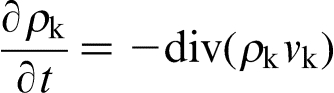

 respectively. For such a system, the first law of thermodynamics (i.e. energy conservation) is given as
26
respectively. For such a system, the first law of thermodynamics (i.e. energy conservation) is given as
26

 is the diffusion flux of component k with respect to the baricentric motion and
  is the force per unit mass exerted on component k.
26
As indicated by the four terms on the right hand side of equation (5), the change of internal energy is caused by heat conduction, work from volume change, viscous and diffusion flow respectively. Combining equations (1)–(5), the entropy production within the system is given as
is the force per unit mass exerted on component k.
26
As indicated by the four terms on the right hand side of equation (5), the change of internal energy is caused by heat conduction, work from volume change, viscous and diffusion flow respectively. Combining equations (1)–(5), the entropy production within the system is given as
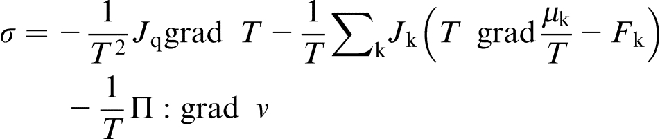
 . Being the key to the phenomenological irreversible thermodynamics, equation (6) not only identifies the fluxes and corresponding driving forces but also provides the basis for the derivation of the flux–force relations, i.e. the governing equation for the evolution of non-equilibrium systems.
Onsager relation
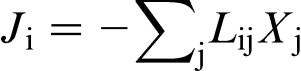
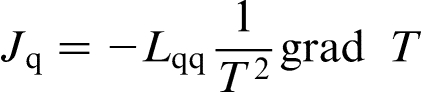
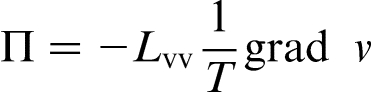
As observed from a large range of experimental studies, the thermodynamic fluxes are related to their corresponding driving forces approximately by linear relations, such as the Fick's law for mass diffusion, the Fourier's law for heat conduction, Ohm's law for electric current, etc. In these cases, there is only one pair of flux and driving force. For a system with multiple dissipative fluxes, assuming the linear correlations, the force–flux relation is given by25,26

Thermodynamic variations
The basic idea behind the thermodynamic variations is that the evolution equations correspond to the extremal of the thermodynamic functional,27,28 which is usually obtained by the variation method. Compared with the method in ‘Onsager relation’, the thermodynamic variations can be adopted for systems with additional constraints, where the Lagrange multiplier method is adopted for the constrained extremal.27,28 Among the thermodynamic variations, the most commonly used is the minimisation of Gibbs free energy, which finds the equilibrium state with lowest free energy.
26
Recently, based on the principle of least dissipation originally proposed by Onsager,
25
a big step toward modelling of irreversible systems is the increasing application of the MEPP.27,28 The basic idea behind MEPP, which has been successfully applied to various physical, chemical and biological processes, is that, during the evolution of non-equilibrium system, the rate of entropy of an isolated system will always be maximised so that the system chooses the shortest possible path. For a non-equilibrium system, the rate of entropy production is expressed by the irreversible fluxes and the corresponding driving force
27
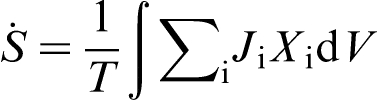
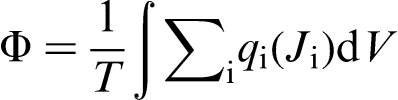

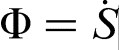 , i.e. the changing rate of the entropy equals the sum of the contrition from the irreversible fluxes.25,27 From equation (13), it is clear that the exact relation between the fluxes and driving forces, determined by qi(Ji) = JiXi(Ji), corresponds to the maximum of the rate of entropy. Svoboda et al. further simplified MEPP with a quadratic qi(Ji) without cross-terms, i.e.
  , and developed the thermodynamic extremal principle.28,34 Owing to the unique form of qi(Ji), the evolution equations of thermodynamic extremal principle also follows the Onsager relation,25,28,29,34 thus reduces to the classical equations for simple systems.
26
Compared with the direct adoption of linear relations in equation (7), MEPP not only provides a systematic methods for the evolution equations of non-equilibrium systems but also outweighs the former by the self-consistent incorporation of the additional constraints in the system,28,29,33,34 thus providing a promising way to model the phase transformations in multicomponent and multiphase systems. In the following, we review recent applications of this scheme for the solidification of multicomponent alloys in metallurgical processes.
, and developed the thermodynamic extremal principle.28,34 Owing to the unique form of qi(Ji), the evolution equations of thermodynamic extremal principle also follows the Onsager relation,25,28,29,34 thus reduces to the classical equations for simple systems.
26
Compared with the direct adoption of linear relations in equation (7), MEPP not only provides a systematic methods for the evolution equations of non-equilibrium systems but also outweighs the former by the self-consistent incorporation of the additional constraints in the system,28,29,33,34 thus providing a promising way to model the phase transformations in multicomponent and multiphase systems. In the following, we review recent applications of this scheme for the solidification of multicomponent alloys in metallurgical processes.
Applications of thermodynamic variations in multicomponent alloys
The theoretical description for phase transformation includes the nucleation and growth (or coarsening) processes, the former of which occurs on the atomic scale, 35 the irreversibility of which is usually discussed within statistical mechanics. 36 In the present work, we focus on the phenomenological methods, and the nucleation process is not discussed. As for growth process, the formulation of the evolution processes mainly focus on the interface migration and diffusion in multi-component systems.37–40 During the growth of the new phase, the evolution of system is mainly driven by two dissipative processes, i.e. diffusion and interface migration, where diffusion occurs in the bulk phases and the interfacial region.37–40 Using different concepts for the interface, the theoretical treatment can be roughly categorised as sharp and thick interface approach.32,37 The former is a geometrical surface with zero thickness; thus, diffusion can only occur across the interface, i.e. mass exchange between the adjacent phases.37–39 Meanwhile, for the latter, diffusion can occur inside the interface.31,37,40,41 Although the two approaches differ in the treatment for the interface, the applications of the basic irreversible thermodynamics are similar, and the following discussions mainly focus on the theoretical treatment of sharp interface. In most conventional solidification processes, e.g. sand casting, the transformation occurs with a relatively slow rate, which can be considered using local equilibrium assumption. 26 However, due to the rapid development of new technologies (e.g. laser processing, 6 deep undercooling,42,43 etc.), the melt solidifies so fast that the deviation from equilibrium can be significant. Therefore, the following sections deal with the solidification cases near equilibrium as well as its extension to strongly non-equilibrium cases.
Near equilibrium formulations
For traditional casting process, although the system is non-equilibrium globally, the local volume in the system can be considered under equilibrium condition, i.e. the local equilibrium.
26
For the local volume near the interface with negligible thermal gradient, the Gibbs free energy rather than entropy is usually used for the formulation. In an arbitrary n component L → S solidifying system Ω with a planar sharp planar interface ΣS/L, the Gibbs free energy density is given as
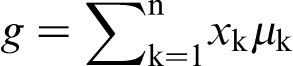
 . For convenience, the molar fraction, rather than weight fraction, is used to couple the model calculation with thermodynamic database.
7
Using the transport theorem for system with sharp interface, the rate of Gibbs free energy
. For convenience, the molar fraction, rather than weight fraction, is used to couple the model calculation with thermodynamic database.
7
Using the transport theorem for system with sharp interface, the rate of Gibbs free energy  follows44,45

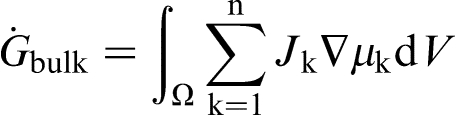

 is the concentration in the liquid at the interface,
  is the chemical potential jump and
  is the diffusion flux across the interface.
Since the Gibbs energy decreases due to the dissipation processes, the rate of Gibbs free energy is constrained by 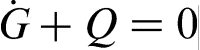 , where the dissipation function Q is given by the sum of the contributions from the bulk phases and interface32,45
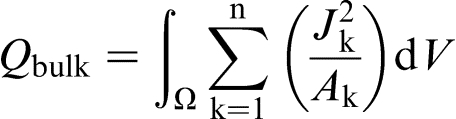

 are the mobilities for interface migration, bulk diffusion and transinterface diffusion.32,45 Then, the evolution equations of the bulk phases system, i.e. the multicomponent diffusion equation, can be obtained by the following variation

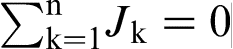 . The resulting diffusion equation is obtained as


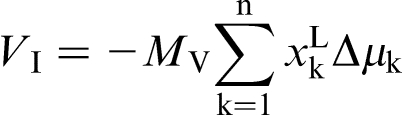

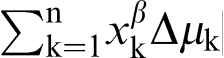 as the thermodynamic driving force, and equation (24) is for solute partitioning across the interface. Note that the basic forms of equations (21) and (24) are similar, which indicates that the transinterface diffusion is a special kind of diffusion.
In the above formulation, the dissipation due to the diffusional fluxes across the interface ( ) is considered, without which the corresponding terms (i.e. second terms in equations (17) and (19) disappear, and the current formulation reduces to that of Refs. 38 and 46. This difference is due to the question whether the Gibbs energy dissipation due to diffusion across the interface, i.e. the solute drag effect, should be considered.
47
To address this issue, Wang et al.
32
compared the calculation results for the solidification of Si–9 at.-As alloy using models without solute drag, with partial and complete solute drag with the experimental study,
48
which leads to the conclusion that the solute drag effect is significant in this system. Furthermore, such phenomena not only occur in solidification but also found during the interface migration in solid state grain growth.
49
Therefore, it is considered reasonable to include these terms in the formulation. As for the thick interface modelling, the diffusion inside the interface has to be considered,37,39,50,51 which corresponds to the dissipation of the transinterface fluxes in the sharp interface formulation.
) is considered, without which the corresponding terms (i.e. second terms in equations (17) and (19) disappear, and the current formulation reduces to that of Refs. 38 and 46. This difference is due to the question whether the Gibbs energy dissipation due to diffusion across the interface, i.e. the solute drag effect, should be considered.
47
To address this issue, Wang et al.
32
compared the calculation results for the solidification of Si–9 at.-As alloy using models without solute drag, with partial and complete solute drag with the experimental study,
48
which leads to the conclusion that the solute drag effect is significant in this system. Furthermore, such phenomena not only occur in solidification but also found during the interface migration in solid state grain growth.
49
Therefore, it is considered reasonable to include these terms in the formulation. As for the thick interface modelling, the diffusion inside the interface has to be considered,37,39,50,51 which corresponds to the dissipation of the transinterface fluxes in the sharp interface formulation.
Strongly non-equilibrium formulations
In the last section, the interface migration is modelled within the classical irreversible thermodynamics with local equilibrium assumption. However, for non-equilibrium solidification such as quenching of the melt, VI can be so large that the diffusion processes can be partially suppressed.
52
As such, the concentrations of the solid deviate from the equilibrium phase diagrams,42,52 and the local equilibrium at the interface is no longer valid.53–59 If the deviation from equilibrium further increases, VI is comparable to the atomic diffusion velocity in the liquid VDL and local non-equilibrium prevails at the interface and in the bulk liquid, which eventually leads to complete solute trapping at VI = VDL.53–59 To account for the local non-equilibrium effect in strongly non-equilibrium processes in multicomponent system, Wang et al.
45
formulated the interface migration processes for strongly non-equilibrium systems according to the extended irreversible thermodynamics,
60
where the Gibbs free energy density is given as
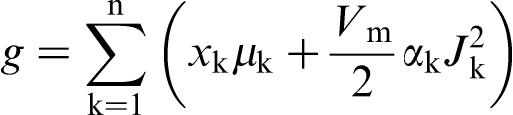

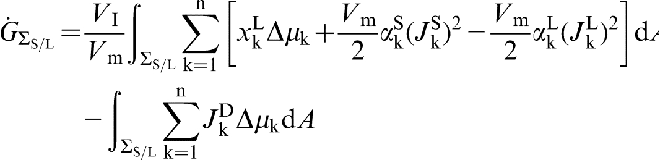

 , in addition to the balance of the fluxes, is also a constraint of the system. Thus, the thermodynamic variation for interface kinetics is given as
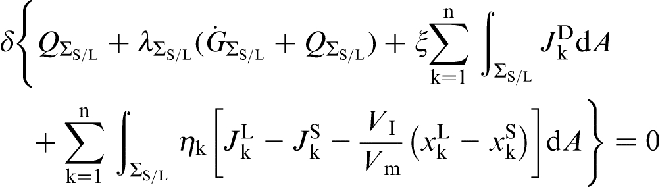


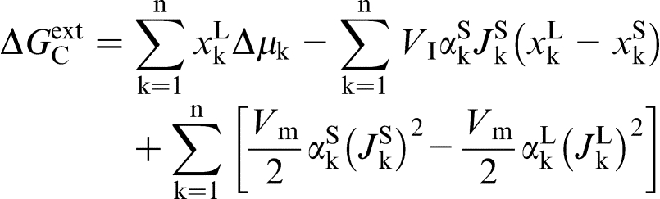

By combining with the thermodynamic database from the CALPHAD method,
61
the Gibbs free energy and the chemical potentials can be obtained, which can be further substituted into the governing equations to determine the evolution of the key parameters in the system. Note that, for local non-equilibrium cases, the thermodynamic database describe the local equilibrium part of Gibbs free energy (i.e. first term in equation (25)); meanwhile, the contributions from the kinetic fluxes can be obtained self-consistently by combining with other kinetic equations.
45
In the following, an example is given, where equations (30) and (31) were calculated for steady state (i.e. without solid state diffusion) interface migration during the solidification of Al–5 at.-Si–1 at.-Cu alloys by coupling with the thermodynamic database from Ref. 62. The other parameters are the same as in Ref. 45. As is shown in Fig. 1, the interface concentrations ( and
and  ) and temperature T approach their equilibrium values in the equilibrium phase diagram when VI → 0, indicating that local equilibrium holds at the interface. As VI increases,
  and
and  decrease and T increases until VI = VDL, where
  and
and  approach the nominal concentrations and complete solute trapping occurs with sudden drop of T. Therefore, the equilibrium and non-equilibrium features of solidification are well reproduced. Further combining with the linear stability analysis and the Ivantsov solution, the model is further used to analyse the interface stability
63
and dendrite growth,
64
where the model calculations agrees well with the dendrite growth experiment in undercooled Ni–Cu–Co concentrated melt and also gain insights into the interaction between solutes during the morphological evolution and dendrite growth processes.63,64
approach the nominal concentrations and complete solute trapping occurs with sudden drop of T. Therefore, the equilibrium and non-equilibrium features of solidification are well reproduced. Further combining with the linear stability analysis and the Ivantsov solution, the model is further used to analyse the interface stability
63
and dendrite growth,
64
where the model calculations agrees well with the dendrite growth experiment in undercooled Ni–Cu–Co concentrated melt and also gain insights into the interaction between solutes during the morphological evolution and dendrite growth processes.63,64
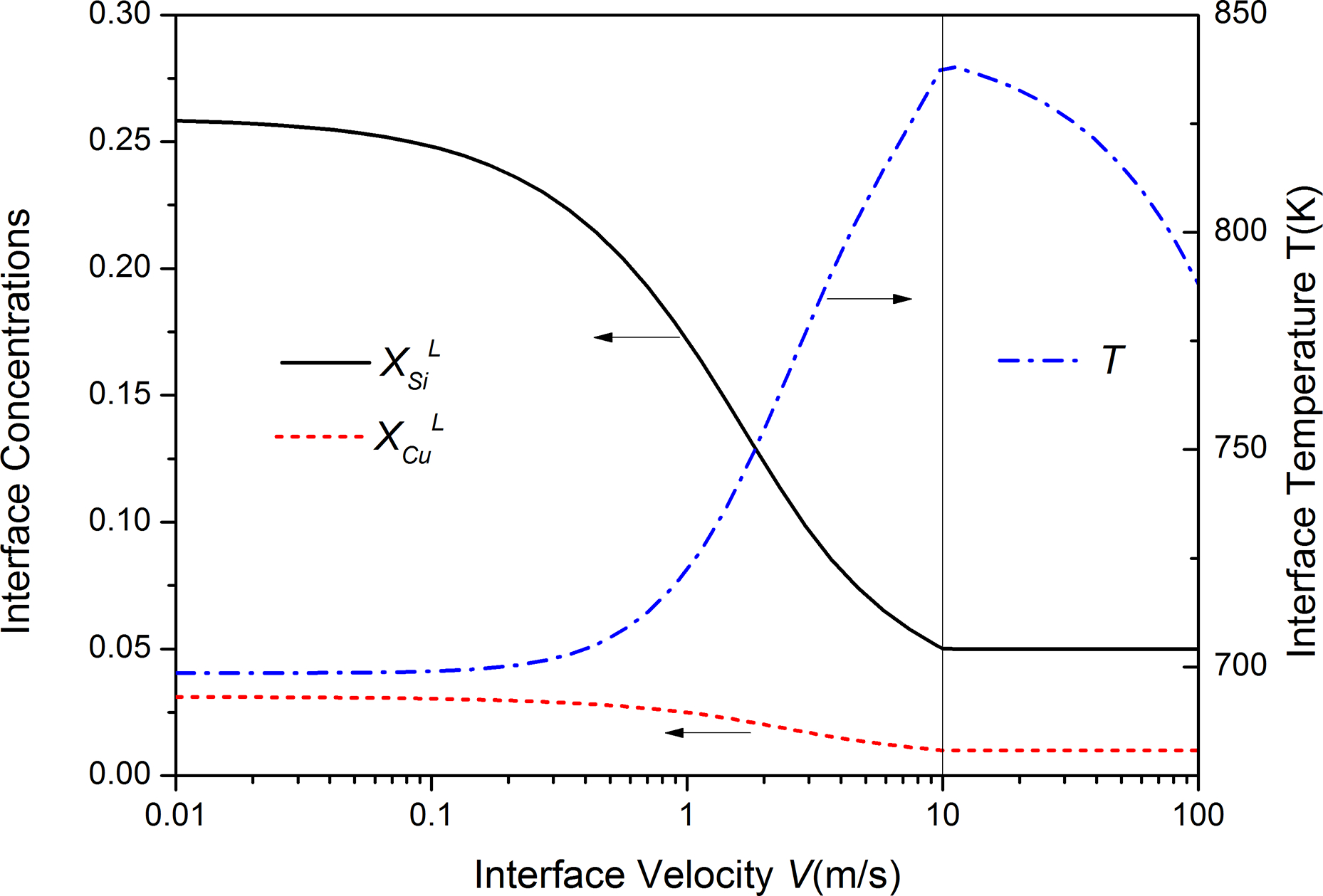
Evolution of interface concentrations and temperature as function of interface velocity for steady state solidification of Al–5 at.-Si–1 at.-Cu alloy
Conclusions and prospects
In the present paper, the basic philosophy of irreversible thermodynamics is outlined, and its application to solidification of multicomponent alloys is reviewed with an emphasis on growth processes. The main conclusions are as follows.
The implementation the rate of entropy (equation (6)) and the Onsager relation (equation (7)) for the evolution equations offers a very simple way for the evolution equations, although the additional constraints in the system cannot be incorporated. Meanwhile, the MEPP offers a self-consistent way to incorporate additional constraints, making it a promising tool for the modeling of complex (e.g. multicomponent multiphase) systems. For the multicomponent phase transforming system under local equilibrium conditions, the evolution equations for the bulk phases and the interface are obtained using MEPP based on classical irreversible thermodynamics. With further deviation from equilibrium, MEPP are combined with extended irreversible thermodynamics for the local non-equilibrium evolution equations, the results of which agree with experimental data can gain more insights into the metallurgical processes.
The application of irreversible thermodynamics offers the unique perspective of free energy dissipation, and the outcomes has helped to improve the design of processing routines in industrial processes (e.g. deformation of materials, microstructure evolution). Although considered a general framework for the evolution of non-equilibrium systems, the applications of irreversible thermodynamics to the metallurgical processes are still limited. In the following, two important open questions are outlined where irreversible thermodynamics can yield promising formulations.
Convection is a very common phenomenon in solidification process and has significant effects on the final microstructures. In solidification processes, convection can be caused by several reasons (e.g. gravity, electromagnetic field, etc.),
2
making it very complicated for theoretical studies. As an irreversible process, convection dissipates free energy by internal friction, which is characterised by viscosity.
30
Therefore, at least for relative simple situations, the interaction between convection and solidification can be modelled by irreversible thermodynamics in principle, where internal friction due to convection is considered as another mechanism for free energy dissipation. In the processing of industrial materials, phase transformation is often accompanied by deformation, e.g. the thermomechanical controlled processing (combining controlled rolling and cooling) for the manufacturing of steels.
65
During the cooling process of austenite, deformation adds the strain energy metastable austenite and induces microscopic defects;
65
the former changes the free energy, while the latter affects mobility of the atoms. From a thermodynamic perspective, deformation changes the driving free energy for transformation and affects the rate of dissipation via the mobility of atoms. Therefore, phase transformation and its interaction with deformation under such complicated conditions can be modelled by irreversible thermodynamics, where the effect of deformation on the free energy and kinetic coefficient for dissipation are incorporated.
Acknowledgements
The authors are grateful to the financial support of the National Basic Research Program of China (grant no. 2011CB610403), the China National Funds for Distinguished Young Scientists (grant no. 51125002), the Natural Science Foundation of China (grant nos. 51431008 and 51134011) and the Fundamental Research Fund of Northwestern Polytechnical University (grant no. JC20120223). K.W. is also grateful to Doctorate Foundation of Northwestern Polytechnical University (grant no. CX 201406).