







Abstract
Surface tensions of Ni3S2, Cu2S and FeS molten phases were measured using an improved sessile drop method in an inert atmosphere of purified argon. The traditional sessile drop method was modified before measurements were obtained. The surface tension values were obtained over a wide range of temperature from their respective melting temperatures to 1300°C. In the temperature range 1000–1300°C, surface tension of molten Ni3S2 decreased linearly with increasing temperature. However, the surface tensions of molten FeS and Cu2S phases were approximately constant over this range of temperature.
Introduction
Physical properties of molten mattes and slags in pyrometallurgy of Cu and Ni play a major role in understanding phase phenomena (Kucharski et al., 1993). For example, surface tension of molten mattes and slags provides a better understanding of metal extraction from their sulphide concentrates. It also enhances understanding of their phase separation, matte entrainment in slag, as well as the corrosion of refractory caused by molten mattes and slag interactions (Kucharski et al., 1993; Ip and Toguri, 1993). During the smelting of sulphides, surface active substances such as silica are introduced into the matte slag system. This reduces the surface energy of most oxides suspended on top as slag. At the same time, the molten matte tends to coalesce as matte drops under the action of surface tension. This action results in the separation of matte and slag but can cause corrosion of refractory lining.
Owing to the complexity of phases involved, as well as challenges encountered in performing experiments at elevated temperatures, surface energy data of Cu and Ni converter molten mattes is scarce (Tokumoto et al., 1972; Kucharski et al., 1993). Surface tension studies using the maximum bubble pressure method have been reported previously on some matte and slag systems (Kucharski et al., 1993). Tokumoto et al. (1972) measured surface tensions and densities of copper mattes using the sessile drop method. In their work, they observed the scarcity of data of molten sulphide mattes (Tokumoto et al., 1972). Sergins et al. (1964) and Zaytsev et al. (1968) reported surface tension values of some binary systems at a single temperature (1250°C).
White (1962), Kozakevitch et al. (1959), Drelich et al. (2002) and Eustathopoulos et al. (1999) reviewed the different methods of surface tension measurements at high temperatures. From their findings, they recommended the gravity distorted drop methods (sessile and pendant drop) for direct measuring of molten metals at high temperatures. The sessile drop method was chosen in this study, owing to its adaptability for measurements at high temperatures. Based on the shape of a sessile drop placed on a horizontal surface, this method allows determination of surface tension and contact angle simultaneously. The other advantage of this method is its accuracy (Drelich et al., 2002), motivated by the improved optical system. Principally, the method involves analysis of the shape of the sessile drop that is placed on a non-reactive horizontal substrate of very low surface roughness (in the order of 0·02 μm) (Nagamori, 1969).
It is recommended that substrates used in sessile drop measurements be poorly wetted by the drop, i.e. they should have a contact angle >90°. Dense alumina used in this study satisfies this condition on the sulphides under investigation with contact angles >100°.
Significant developments in optical systems such as imaging, video recording and processing tools enables use of high resolution image sensors with no geometrical distortion (Carla and Cecchini, 1991; Chiriac et al., 1997). This greatly improves the accuracy of the results obtained. Such an improved sessile drop method was used in this study to measure the temperature dependence of the surface tension of molten sulphides, since the surface tensions of molten Ni3S2, Cu2S and FeS phases are fundamental compositions of typical nickel converter mattes in the nickel smelting process. The method used in this study has never been used before for such measurements.
Experimental
Principle
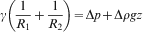
For the sessile drop method, the shape of the drop is resolved using the equilibrium between the forces of capillary and gravity (see Fig. 1). The fundamental equation that describes this equilibrium for surface tension measurements is given as
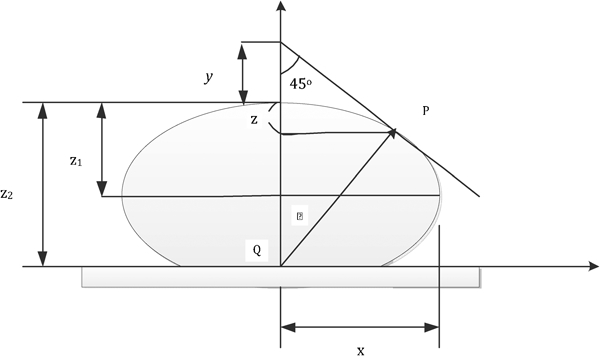
Schematic of meridional section for sessile drop
Calibration is very important for accurate surface tension results. Most calculations using FTA32 software require that the size of the drop in the image must occupy >50% (Dorsey, 1928). Firstly, the sessile drop's equatorial diameter, which is the maximum diameter of the sessile drop and the distance from the top of the drop to the equatorial, are obtained. The density values of phases being studied must be known. Dorsey (1928) deduced the following empirical relation for the surface tension


Specimen, apparatus and procedure
Pure sulphide powders of Ni3S2 (99·99%), Cu2S (99·99%) and FeS (99·95%) (metal basis), at −200, −200 and −100 mesh respectively, employed in our measurements were purchased from Alfer Aesar (UK). The sulphide droplets, whose diameter and length are 6 and 5 mm respectively, were prepared by using a hydraulic press. Substrates of dense alumina (99·95) were used in the experiment. Measurements were performed in an inert atmosphere of purified argon at 20 mL min−1. The purity of the argon gas was 99·999%. The schematic diagram of the experimental set-up is depicted in Fig. 2.
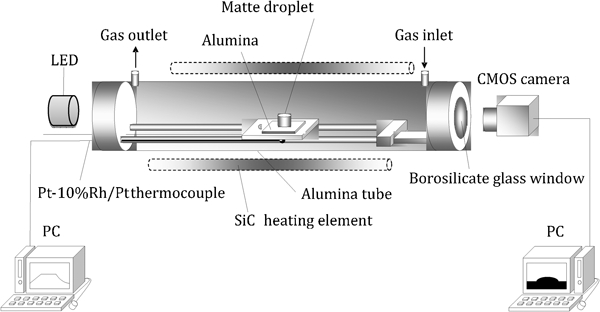
Schematic set-up of experimental apparatus
The experimental set up used in this study is depicted in Fig. 2. It consists of an ENTECH, ETF 50–70/15 – S horizontal tube furnace with tungsten resistance wound on an alumina tube of 100 mm length, with inside diameter of 40 mm. A similar furnace was used by Nakamoto 1969. It is built with SiC elements placed parallel and around the tube. The furnace is designed for performing measurement in high vacuum or inert gas atmosphere at temperatures up to 1500°C. The argon gas used in the experiment was purified using two types of cartridges (Messer, Krefeld, Germany: hydrosorb for moisture removal and oxisorb for oxygen removal). The temperature is measured by an S type (Pt–Pt 10% Rh) thermocouple placed near the sample. The thermocouple was calibrated using pure copper. The system of sample holder, substrate and alloy drop was placed in the hot zone inside the alumina tube using a pulling rod. Thermo profiles were obtained to ensure the droplet was within ±1°C identified zone. It was observed that the length of the uniform temperature zone is ∼100 mm. The sample holder allows movements for horizontal positioning of substrate. For visibility of the droplet and illumination, the furnace tube was fitted with borosilicate glass at both ends. A system's rectangular shield prevents the excessive heat loss from the furnace zone.
The special optical system used was acquired from SKS Vision Systems Oy of Finland. A high definition VISI50 SMART Integrated machine vision sensor was used to record the image of the drop's contour. This is an integrated machine vision sensor for measurement and quality control. It has been mainly used commercially for edge position measurement, center position measurement, width measurement, area measurement, and object counting. Unlike the commonly used CCD cameras, Visi50 utilises a CMOS (complementary metal oxide semiconductors) sensor of 5 megapixels (2560×1920) and high performance DSP (digital signal processor) for image processing tasks. CMOS image sensor technology enables freely programmable measurement and detection of areas (regions of interest). The device can be used as an area or line scan camera. High line resolution enables outstanding measurement accuracy even in line scan applications. Visi50 can work as a fully independent stand-alone measurement, control or guiding device or it can be connected to automation system with versatile input/output interface. Object illumination as an option is performed especially in cases where natural light is insufficient. Object illumination may be performed with integrated light emitting diode (LED) or with other light sources. In our experiments, the device was connected to an automation system and LED light was used for illumination. However, at high temperatures (>1250°C), there was no need for this light, since the molten droplet is visible enough.
VISI50 SMART integrated machine vision sensor comes with a software compatible program which is capable through a specialised video acquisition board to reproduce the images captured on the computer's display, to convert and save them into a standard graphic format in real time, without introducing geometrical distortions. The images can be saved as a movie or separate images. At the same time the computer through the RS-232 serial interface, using a Keithley 2000 digital multimeter, records the value of the measured temperature. The image data obtained are stored to files and used to obtain the values of the surface tension using the geometrical parameters of the drop. For surface tension calculations, FTA32 software program (supplied by Crelab Instruments, Sweden) was used using the dimensions of the droplet at a set magnification. One important parameter, which must be known in calculations of surface tension, is density of matte droplet. Density values used in this study were adapted from the work by Kucharski et al. (1993) (see equations (4)–(6)) (1273<T<1573). Temperature is in kelvins.



At this point, the furnace tube was gas tight sealed. The experiments were conducted under controlled partial pressure of oxygen. A high flow of purified (80 mL min−1) argon gas was flushed in the furnace to remove oxygen and any other possible reactive gas, for 30 min. This flowrate was reduced to 20 mL min−1 during the experiment. The furnace was heated to the set point at a rate of 4°C min−1. The temperature was held for another 30 min at set point to ensure the system had enough time to reach equilibrium. For measurements of surface tension at temperatures >1250°C, there was no need extra illumination as the droplet could be visible without additional light.
Results and Discussion
The melting point for these sulphides was 797°C (Singleton et al., 1991), 1100°C (Chakrabarti et al., 1983) and 1195°C (Waldner and Pelton, 2005) for Ni3S2, Cu2S and FeS respectively. Surface tension dependence on temperature was plotted after the system reached equilibrium. The point where no more changes to the drop profile take place defines this equilibrium. Cooling had an insignificant effect on the drop profile. Though the surface tensions of the molten mattes were measured from their respective melting temperatures, only results in the temperature range 1000–1300°C, which is critical to the smelting and converting, are discussed. The results of the surface tension measurements on molten mattes of Ni3S2, Cu2S and FeS, alloy are shown in Figs. 3–5.
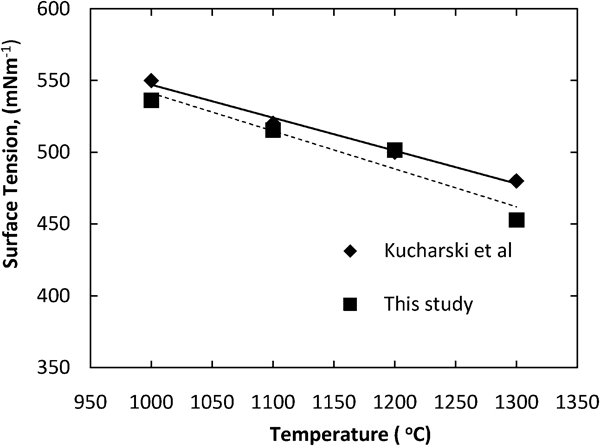
Effect of temperature on surface tension of Ni3S2
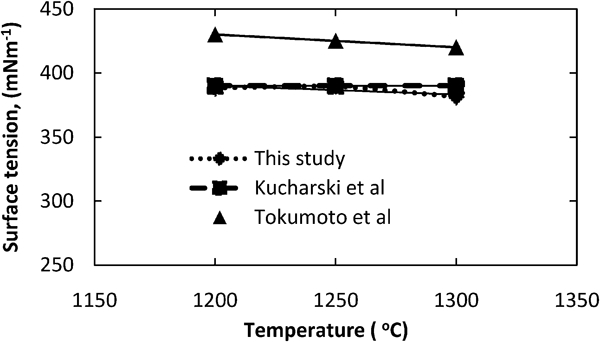
Effect of temperature on surface tension of Cu2S
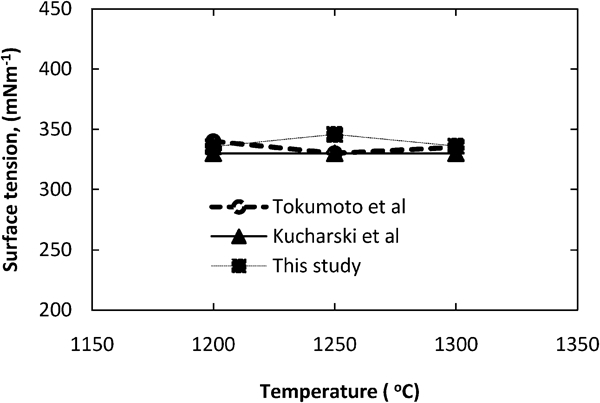
Effect of temperature on surface tension of FeS
Each point on these graphs represents the average value of 10 independently measured values. The average values are shown in Tables 1–3. Owing to the low melting temperature of Ni3S2 (797°C) (Singleton et al., 1991), the lowest temperature point was 1000°C compared to 1200°C for Cu2S and FeS respectively.
Results of surface tension measurements for Ni3S2

*STDEV is the standard deviation of the experimental results.
Results of surface tension measurements for Cu2S

*STDEV is the standard deviation of the experimental results.
Results of surface tension measurements for FeS

*STDEV is the standard deviation of the experimental results.
From Fig. 3 and Table 1, it is clear that for Ni3S2, the surface tension decreased linearly with an increase in temperature (for the temperature range considered). However, for Cu2S (Fig. 4 and Table 2) and FeS (Fig. 5 and Table 3), there is negligible temperature dependency.
The results presented in the Figs. 3–5 are compared with those of Kucharski et al. 1993 (for Ni3S2), and Tokumoto et al. (1972) and Kucharski et al. (1993) (for Cu2S and FeS).
For Ni3S2, the results compared well with those obtained by Kucharski et al. (1993) with a deviation of only ∼5%. This can be attributed to the difference in the methods used. Kucharski used the maximum bubble pressure method to measure the densities and surface tensions of molten mattes. The sessile drop technique has superior accuracy compared to the maximum bubble pressure method. An added advantage from the method used in this study is that of rapid data collection, which provided more points of measurements, improving the accuracy. Drelich et al. (2002) compared the accuracy of various surface tension measurement techniques, in his findings; the accuracy of the maximum bubble pressure method is in the order of 100–300 mN m−1, while that of the sessile drop method is in the order 100 mN m−1. There is good agreement between the results of this study and that of Kucharski et al. (1993) for all sulphides (% error ⩽5·9). However, there is a deviation (∼10%) in the Cu2S measured results to those by Tokumoto et al. (1972). This could be due to the difference in the purity of the substances, as well as the density values used in the calculations. A standard deviation of 22·86 was the highest recorded in the experimental results. The high standard deviation in Cu2S results were caused by poorly shaped profile of the drop at temperatures of ∼1300°C. However, this deviation presents a percentage error of 5·9 which is more accurate than the 10% observed by Tokumoto et al. (1972).
The effect of furnace atmosphere
The main known contaminant to the furnace atmosphere during the sessile drop experiment is oxygen. Oxygen of very small amounts (ppm) leads to the formation of an oxide layer on the droplets and this makes correct measurements impossible and therefore must be kept low. A specific oxygen partial pressure in this environment therefore will give a specific contact angle (Eustapoulos, 1999). At present, contact angle–oxygen partial pressure data are still scarce for most molten metal systems (Eustapoulos et al., 2005). For low oxygen partial pressure environments, sessile drop methods are performed in inert or vacuum atmosphere. But since most inert gases contain small amounts of oxidising gases in the order of Po2 10−5–10−6 atm in 1 atm oxygen gas, they must be purified. In this study, we employed argon gas for an inert atmosphere and was filtered through heated Zr shavings and water using Hydrosorb, keeping the oxidising gases to low levels where they could not affect the experiment.
Control of P2 gas vapour pressure is notably of significance in the sessile drop technique. Achieving a controlled gaseous environment within the test chamber requires it to be leak tight and to be purged with purified inert gas or evacuated. In fact, sometimes it has to be backfilled with an inert gas. This is sufficient for some systems, i.e. the ones in this study. With this view we used argon gas to create this atmosphere and it was used at controlled pressure. We also minimised the time taken for our measurements so as to mitigate the effect of the evaporation on our results.
Conclusion
The surface tensions of Ni3S2, Cu2S and FeS molten phases have been determined using the improved sessile drop technique. Once the modifications were performed on the optical and temperature measurement system, the method was much easier and accurate to use. For all the three sulphides phases, it was found that there is a linear relationship with temperature. The surface tension of the Ni3S2 molten phase decreases linearly with increasing temperature (in the temperature range of 1000–1300°C). The surface tensions of Cu2S and FeS molten phases have negligible dependency on temperature, i.e. the values remained the same at 386·6±5 mN m−1 and 339·33±6 mN m−1 respectively, in the temperature range 1200–1300°C.
Footnotes
Acknowledgements
The authors are grateful to Stellenbosch OSP Funding and Improved Sulfide Smelting (ISS) project of the ELEMET program and Tekes, the Finnish Funding Agency for Technology and Innovation, for financial support.