






Abstract
Carbon black (CB) and carbon nanotubes (CNTs) filled natural rubber (NR) composites were prepared through an ultrasonic assisted latex mixing process. Carbon nanotubes were dispersed into NR latex by ultrasonic irradiation and then the mixed latex were co‐coagulated to obtain the CNTs/NR masterbatch. The structure and properties of the composites were characterised. The results show that the ultrasonic assisted latex mixing process disperses CNTs more uniformly in the matrix than the conventional mixing methods. The well dispersed CNTs and CB exhibited a synergistic reinforcing effect. When the weight ratio of CB/CNTs was 20∶5 (parts per hundred of rubber), the mechanical properties reached the maximum. Dynamical mechanical analysis revealed that with increasing CNT contents, the elastic modulus of composites at room temperature increased, while the maximum loss tangent decreased. Dynamic rheological measurement showed the storage modulus and complex viscosity of rubber composites increased and the shear thinning index decreased with increasing CNT contents.
Introduction
Carbon nanotubes (CNTs)/rubber composites have received more and more attention, due to the unique mechanical and electrical properties of CNTs.1–5 The key issues are:
to break the bundles, agglomerates and entanglement of CNTs in the rubber matrix and overcome the van der Waals force between CNTs
to improve the dispersion and orientation of CNTs with a high aspect ratio in the rubber matrix
to raise the interfacial interaction between rubber and CNTs.6–8
The direct mixing by the conventional twin roll method is difficult to prepare well dispersed CNTs/rubber composites. In order to improve the dispersion of CNTs in the rubber matrix, some methods, such as solution and latex mixing were tried. Fakhru'l‐Razi9 prepared CNTs/ natural rubber (NR) nanocomposites with an improved dispersion and mechanical property by incorporating CNTs in a polymer solution and subsequently evaporating the toxic solvent toluene. Bhattacharyya10 reported a new route to prepare the CNTs/rubber composite. The CNTs was mixed with rubber latex and then coagulated, followed by drying to obtain the composite, which improved the dispersion of CNTs and the mechanical properties.
Ultrasonic irradiation has been widely used to promote the dispersion of nanoparticles in polymer matrix due to its dispersion, crushing and activation.11–15 Ultrasonic cavitation can generate local high temperature, high pressure and high speed microstream. Previously we prepared polymer latex/CNTs composite through ultrasonically initiated in situ emulsion polymerisation. Carbon nanotubes were redispersed at the nanoscale, and at the same time the polymerisation of monomers occurred on the activated CNTs, and thus to get the polymer latex containing well dispersed CNTs.12
In this paper, the NR/carbon black (CB)/CNTs composites were prepared through an ultrasonic assisted latex mixing process. Carbon nanotubes were dispersed in the NR latex by ultrasonic irradiation, and then were co‐coagulated with formic acid to get the uniform CNTs/NR masterbatch. Based on the CNTs/NR masterbatch, the NR/CB/CNTs composites were further obtained through a twin roll process. This process can solve the dispersion problem of CNTs in the rubber matrix. The synergistic reinforcing effects of CB and CNTs were investigated.
Experimental
Materials
Natural rubber (SCR 5) was purchased from Yunnan Natural Rubber Industry Ltd Co. (Kunming, China). Natural rubber latex (solid content: 60 wt‐%) was provided by Chengdu Fangzheng Ltd Co. (China). Emulsifier OP was obtained from Tianjin Kemiou Chemical Reagent Ltd Co. (China). Formic acid was purchased from Tianjin Bodi Chemical Reagent Ltd Co. (China). Carbon black (N330) with a size of 22–24 nm and a surface area of 75–95 m2 g−1 was provided by Institute of Carbon Black (Zigong, China). Hydroxyl multiwalled CNTs with a diameter of 10–20 nm containing ∼3 wt‐% –OH group were obtained from Chengdu Institute of Organic Chemistry, Chinese Academy of Sciences and were used as received. Other reagents including vulcanisation agent sulphur, zinc oxide, accelerator N‐cyclohexyl‐2‐benzothiazole‐sulfenamide and 2‐mercaptobenzothiazole, antioxidant (4010NA), and stearic acid are all commercially available.
Preparation of CNTs/NR masterbatch through ultrasonic assisted latex mixing process
A certain amount of CNTs and emulsifier OP with a CNTs/OP weight ratio of 1∶0·08 were first added into the 60 g distilled water and then was subjected to ultrasonic irradiation for 3 min. Then, the CNTs aqueous dispersion was added into the 16·7 g NR latex with a solid content of 60 wt‐% and then the mixture were subjected to ultrasonic irradiation. The power output of the ultrasonic machine (VCF1500; Sonics & Materials Inc., USA) was set at 900 W and ultrasound frequency is 20 kHz. The probe of the ultrasonic horn was immersed directly in the latex system. The reaction apparatus were shown in a previous literature.11 During the sonication process the thermostated water was circulated to keep the temperature constant. After 6 min ultrasonic irradiation, the mixture was co‐coagulated by adding formic acid drop by drop while stirring. The solid was cut up and washed to neutral with water and then was dried in the vacuum oven (65°C, 24 h) to obtain the well dispersed CNTs/NR masterbatch, which were designated as L‐NRC series. The L‐NRC5, L‐NRC15, L‐NRC25 and L‐NRC35 correspond to the CNTs contents of 5, 15, 25 and 35 wt‐% respectively. The self‐made blank NR without CNTs obtained from the NR latex was designated as L‐NR.
As a comparative experiment, the CNTs/NR masterbatch was also obtained by conventional stirring. The experiment procedure is as follows: a certain amount of CNTs and emulsifier OP with a CNTs/OP weight ratio of 1∶0·08 were first added into the 60 g distilled water and the mixture was added into the NR latex, and then were stirred for 20 min at a rotation speed of 400 rev min−1. The following steps were the same as the above ultrasonic method.
Preparation of CNTs/CB/NR composites
The preparation of CNTs/CB/NR composites were carried out in an open twin roll mill (SK‐160B, China) at room temperature with the friction ratio of 1∶1·2 and nip gap of ∼1 mm. The curing formulas are given in Table 1. First, the stearic acid, antioxidant agents (4010NA), CB and self‐made L‐NR or CNTs/NR composites L‐NRC, which was prepared in the above process, were mixed with commercial NR. And then, other ingredients including sulphur and accelerant were added. The twin roll mixing time was kept constant at 10 min for every sample. The rubber sheet samples were compression moulded at a temperature of 150°C and a pressure of 10 MPa for 4·5 min and then cooled under a pressure of 5 MPa at room temperature for 3 min. The obtained CNTs/CB/NR composites were designated as RC series. The RC0, RC1, RC3, RC5 and RC7 correspond to the CNTs contents of 0, 1, 3, 5 and 7 parts per hundred of rubber (phr). The total amount of CB and CNTs is 25 phr for each sample.
Formula of rubber composites*
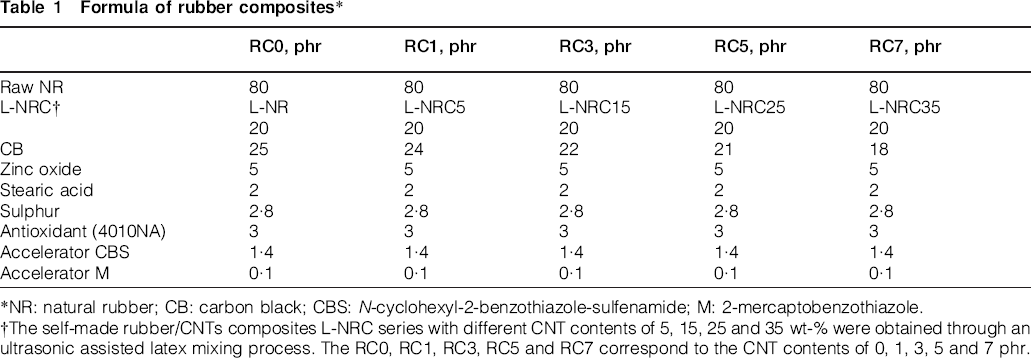
*NR: natural rubber; CB: carbon black; CBS: N‐cyclohexyl‐2‐benzothiazole‐sulfenamide; M: 2‐mercaptobenzothiazole.
†The self‐made rubber/CNTs composites L‐NRC series with different CNT contents of 5, 15, 25 and 35 wt‐% were obtained through an ultrasonic assisted latex mixing process. The RC0, RC1, RC3, RC5 and RC7 correspond to the CNT contents of 0, 1, 3, 5 and 7 phr.
As a control experiment, the CNTs/CB/NR composites were prepared by mixing CNTs, CB and NR straight with a twin roll equipment (SK‐160B, China).
Characterisation
Measurement of mechanical properties
The measurement of mechanical properties was conducted on a universal testing machine (Instron 5567, UK) at room temperature. For tensile tests, the dumbbell shaped specimens were stretched until break at a crosshead rate of 500 mm min−1 according to a Chinese standard GB/T 528‐1998. The stress–strain curves were recorded. The tensile strength, elongation and stress at the 100, 200 and 300% strains were the average values of five specimens.
For tear test, the unnicked 90° angle test pieces with 2 mm thickness were stretched at a crosshead speed of 500 mm min−1 according to a Chinese standard GB/T 529‐1999. Three samples were measured for every case and the average of the values was taken.
For the compression test, the cylinder specimens were compressed at a rate of 10 mm min−1 according to a Chinese standard GB/T 7757‐1993. Four compression cycles were carried out and the last circle was selected to determine the compressive properties. The dimension of the cylinder sample is 12·5 mm in height and 29·0 mm in diameter.
For hysteresis test, according to a China standard HG/T 3101‐1985, the specimens were stretched to an elongation of 500% and retracted at a constant rate of 500 mm min−1. and the stress–strain curves were recorded automatically. The hysteresis losses for a fourth cycle were determined as a ratio of energy losses (area enclosed between the extension and retraction curves) to energy input (area under the extension curve).
Dynamical mechanical analysis
Dynamic mechanical tests were performed on a TA Q800 dynamical mechanical analyser at a frequency of 1 Hz from −95 and 30°C. The heating rate was set at 3°C min−1. The storage modulus E′ and loss factor tan δ were evaluated. The dimension of the rectangle sample strips was 20×4×2 mm.
Scanning electron microscopy (SEM)
An INSPECT F (Fei Company, USA) SEM instrument was utilised to observe the morphologies of the fracture surface of the composite. Specimens were cryogenically fractured in liquid nitrogen and sputter coated with gold before observation.
Measurement of crosslink density
The toluene swelling methods16, 17 were used to determine the crosslink densities of the vulcanizates. The samples were cut into rectangles (10×10×2 mm) and weighed before and after being soaked in toluene for 72 h which ensured equilibrium conditions. The crosslink density was calculated by using the Flory–Rehner equation

Moreover, the swelling ratio can be calculated using the following equation: swelling ratio = (w2−w1)/w1, where w1 and w2 are the weight of dry rubber and swollen rubber respectively.
Dynamic rheological measurement
The rheological measurements were performed on a controlled stress rheometer (Bohlin Gemini 200; Malvern Instruments Ltd, UK) using 25 mm diameter parallel plates. The testing sample discs with a thickness of 1 mm and a diameter of 25 mm were prepared by compression moulding of the extruded pellets at 130°C. The tests were carried out in steady rate and dynamic frequency modes at 130°C. Dynamic shear properties were determined as a function of angular speed of deformation 0·01 to 100 rad s−1 at a small strain amplitude of 1%.
Results and discussion
Dispersion of CNTs in rubber matrix
Natural rubber latex was coagulated with formic acid to obtain the NR which was named L‐NR in this study. The mechanical properties of self‐made L‐NR and the commercial NR were tested, and the results are summarised in Table 2. It is clear that the mechanical properties of self‐made L‐NR were similar with that of NR, which suggested that our coagulation method is feasible to prepare the NR. This is the prerequisite to prepare the CNTs/NR masterbatch with good properties.
Mechanical properties of neat NR and L‐NR

Dispersion of CNTs in rubber matrix is a big issue for CNTs/rubber composites. The uniform dispersion is the key to minimise the presence of stress concentration centres and achieve the efficient load transfer due to a more uniform stress distribution. In this paper, the authors studied the effect of three different dispersion methods, i.e. twin roll mixing, stirring assisted latex mixing and ultrasonic assisted latex mixing, on the dispersion of CNTs in rubber matrix.
The SEM images of the NR/CB/CNTs composites prepared by three methods are shown in Fig. 1. From Fig. 1a, CB can be uniformly dispersed by the twin roll method. But if the CNTs are introduced into the system, there are some agglomerates of CNTs due to the strong van der Waals interaction as shown in Fig. 1b. This suggests that the twin roll method cannot solve the dispersion problem of CNTs.
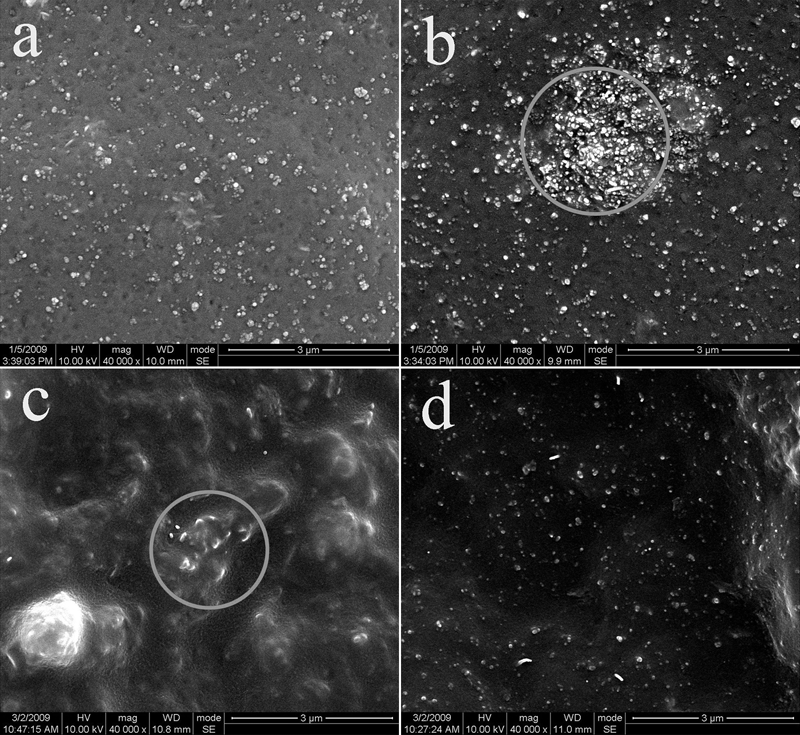
Images (SEM) of NR/CB/CNTs composites prepared by different dispersion methods
If using the stirring assisted latex mixing method, there are still some agglomerates of CNTs as shown in Fig. 1c, which suggesting that conventional stirring has difficulty in attaining the uniform dispersion of CNTs in the nature rubber latex. When ultrasonic assisted latex mixing process is used, the CNTs are uniformly dispersed in the rubber matrix as shown in Fig. 1d, which means it is feasible to prepare the uniform dispersive CNTs/nature rubber composites.
We also prepared the NR/L‐NR/CNTs composites (80∶20∶1) without CB by the above three methods. Figure 2 shows the SEM photos of the rubber composites. The agglomerates of CNTs can be clearly observed by twin roll and stirring assisted latex mixing method as shown in Fig. 2a and b. However, for ultrasonic assisted latex mixing process, almost no agglomerated CNTs can be seen in the fracture surface of the composites as shown in Fig. 2c.
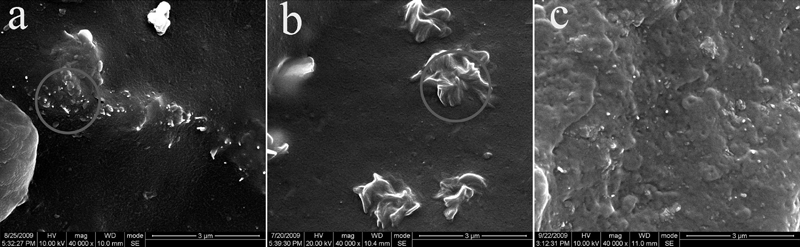
Images (SEM) of NR/L‐NR/CNTs composites without CB prepared by different dispersion methods
Therefore, in this study, the authors mainly focus on NR/CB/CNTs composites which were prepared through the ultrasonic assisted latex mixing process, i.e. RC series samples.
Crosslink density of rubber composites
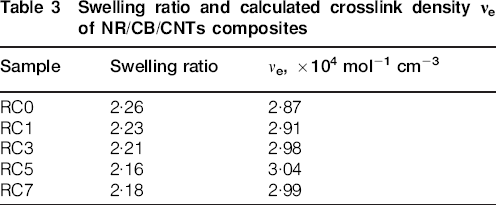
The crosslink densities of the vulcanizates were investigated by the equilibrium swelling method. Table 3 summarises the swelling ratio and the crosslink density of vulcanizates with different CNTs contents. The swelling ratio decreases slightly with increasing the CNTs contents. The crosslink density of vulcanizates has an increase trend with increasing CNTs contents. This can be attributed to the physical crosslink between CNTs and polymer, which immobilises the rubber chains and thus prevents the transportation of solvent.18, 19 It is reasonable to conclude that more fillers in a certain range will lead to a less swelling ratio and a higher crosslink density.20
Swelling ratio and calculated crosslink density νe of NR/CB/CNTs composites
Effect of CNT contents on tensile properties of composites
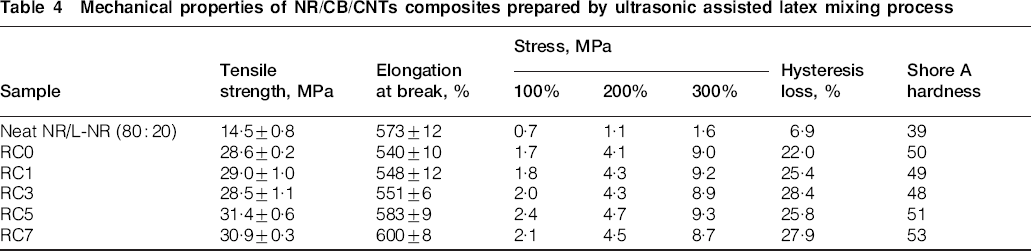
The stress–strain curves for NR/CB/CNTs composites prepared by an ultrasonic assisted latex mixing process are shown in Fig. 3. The tensile properties are listed in Table 4. The neat NR/L‐NR is a control sample. The tensile strength and the stress at 300% strain for NR/CB/CNTs composites increase with increasing the CNT contents when the CNT contents are less than 5 phr. And the elongation at break also increases with increasing the CNT contents. The results suggest that CNTs have the ideal toughening and reinforcing effect for NR/CB/CNTs composites prepared by an ultrasonic assisted latex mixing process. This should be attributed to the uniform dispersion and the interfacial interaction between the CNTs and the NR matrix. The tensile properties decrease slightly when the CNT content is 7 phr, which may be attributed to the poor dispersion which resulted in the stress concentration. The CNTs with high aspect ratios can act as the additional sources of entanglements or physical crosslinking points in the composites. With increasing the CNT contents, the crosslink density increases and the mechanical properties can achieve the optimum at a specific value of crosslink density. The incorporation of CNTs and CB into rubber matrix can simultaneously exhibit a synergistic reinforcing effect. In addition, it can be noted that the hysteresis loss of NR/CB/CNTs composites increased with the incorporation of CNTs. And the Shore A hardness did not change in the data error range with increasing the CNT contents.
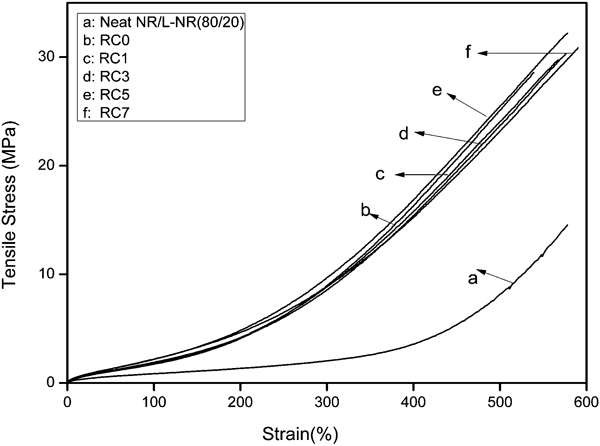
Stress–strain curves of NR/L‐NR/CB/CNTs composites
Mechanical properties of NR/CB/CNTs composites prepared by ultrasonic assisted latex mixing process
Tear strength
Figure 4 shows the tear strength for NR/CB/CNTs composites. The tear strength of the composites increases with the increase in CNT loading and it reaches the maximum value at a 5 phr CNT concentration. Compared with NR/L‐NR/CB composites, the tear strength of the composite filled with 5 phr CNTs enhances ∼37·5%. The increase in the tear strength with CNTs should be attributed to the well dispersed CNTs with high Young's modulus and strength in the rubber matrix.
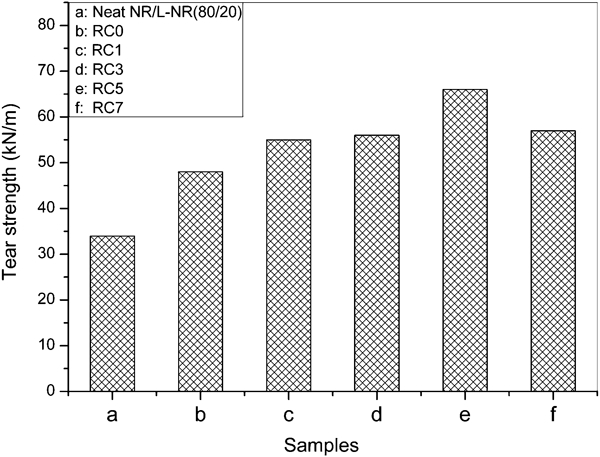
Tear strength for NR/L‐NR/CB/CNTs composites
Compression properties
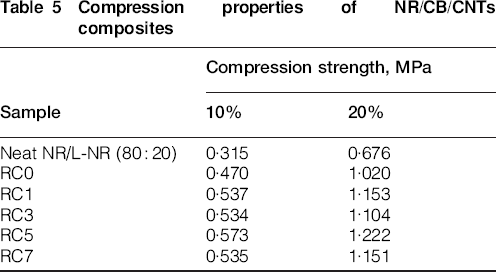
The compressive stress–strain curves of the composites are shown in Fig. 5 and the compression strength data are summarised in Table 5. The compression stress for NR/CB/CNTs composites is higher than that of NR/L‐NR/CB composite without CNTs. At a 5 phr CNT content, the compression strength reaches the maximum. The compression stress of the composite at 7 phr CNTs decreases slightly due to the poor dispersion of CNTs.
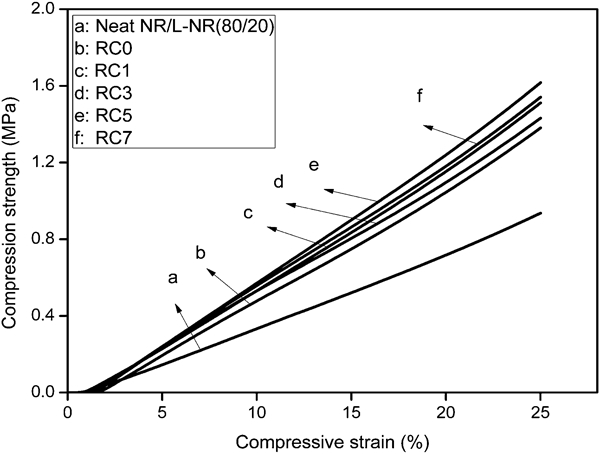
Compressive curves of NR/L‐NR/CB/CNTs composites
Compression properties of NR/CB/CNTs composites
Dynamical mechanical analysis
The dynamic mechanical properties of neat NR/L‐NR, NR/L‐NR/CB composites and NR/CB/CNTs composites were tested at 1 Hz from −95 to 30°C. The storage modulus E′ and damping factor tan δ as a function of temperature are shown in Fig. 6. The storage modulus of the composites at room temperature increased with increasing the CNT contents. The storage modulus reflects the elastic modulus of the rubber materials, which measures the recoverable strain energy in the deformed samples. The high aspect ratio and unique modulus of CNTs enhance the stiffness of the NR composites, which results in an increase in storage modulus of the NR/CB/CNTs composites. At low temperature, the modulus of the composites exhibits a relatively high value, which is attributed to the inherent semicrystalline characteristic, and a small increase in the storage modulus of NR/CB/CNTs composites appears with increasing the CNT contents. tan δ, which represents the ratio of the viscous part to the elastic part (energy loss/energy stored) of the materials. The maximum tan δ corresponding to α relaxation decreases with increasing the CNT contents. The decreasing damping factor may be attributed to the rigidity of CNTs. This result agrees with the usually observed behaviour in particulate composites.21
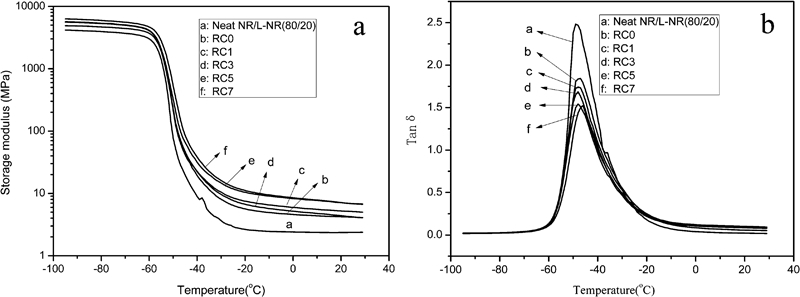
a storage modulus and b loss factor as function of temperature for neat NR and composites with different contents of CNTs
Rheological analysis of NR/L‐NR/CB/CNTs composites
The rheological properties of NR/CB/CNTs composites were tested by dynamic shear mode for storage modulus G′ and complex viscosity η* at different oscillatory angular frequencies. Figure 7 shows the storage modulus G′ versus ω curves for NR/L‐NR/CNTs and NR/CB/CNTs composites by the frequency sweeping method at 130°C. For both NR/L‐NR/CNTs and NR/CB/CNTs composites, the storage modulus G′ increase with increasing CNT contents due to the reinforcing effect of CNTs. The storage modulus shows a monotonic increase with increasing the frequency. In the low frequency region, a more obvious increase of G′ was observed with the increase in CNT concentration. The slope of G′–ω curve in terminal region becomes smaller with the increase of CNT concentration. This low frequency behaviour can be attributed to the nanotube network, which restrains the long range motion of polymer chains. At high frequencies, however, the effect of the nanotubes on the rheological behaviour is relatively weak. This behaviour suggests that the CNTs do not significantly influence the short range dynamics of the rubber chains, particularly on length scales comparable to the entanglement length.22
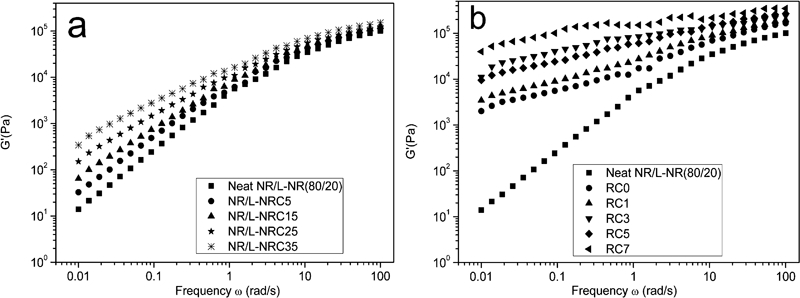
G′ versus ω for NR/L‐NR/CNTs composites with different CNTs contents by frequence sweep method from low to high at 130°C
Figure 8 shows the effect of shear rate on complex viscosity η* for NR/L‐NR/CNTs composites and NR/CB/CNTs composites. It can be seen that at a given shear rate, the complex viscosity increases with the loading levels of CNTs and the shear viscosity decreases with increasing the shear rate. The Newtonian plateau of viscosity curves of composites gradually disappears at low ω region with increasing CNT contents, presenting a pseudoplastic shear thinning behaviour. The reason that the Newtonian plateau disappeared should be the formation of percolated CNT network in NR/L‐NR/CNTs composites.22, 23
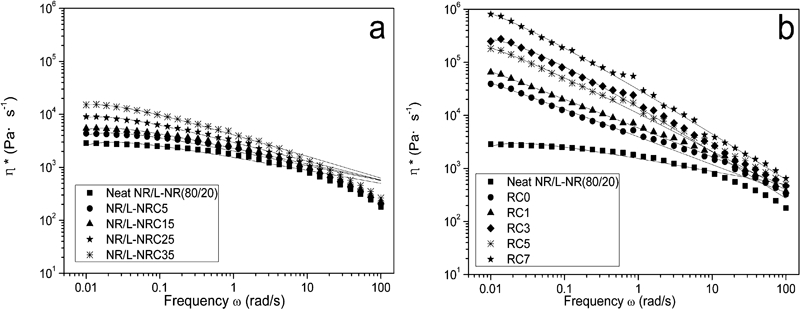
Complex viscosity η* versus shear rate for NR/L‐NR/CB/CNTs composites with different CNTs contents by frequency sweeping method from low to high at 130°C
For NR/CB/CNTs composites, the rheological data can be fitted with very well with the Herschel–Bulkley model as follows24, 25

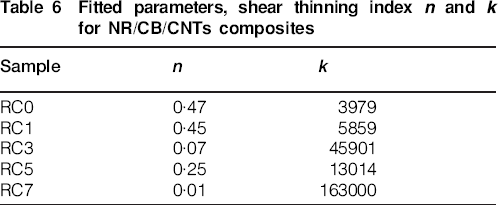
 is the shear rate, k is consistency index and n is the flow behaviour index. Table 6 listed the fitted parameters. The flow behaviour indices are less than 1, which indicates the pseudoplastic, i.e. shear thinning behaviour of these NR systems. A lower n value appeared at a high CNT content, which corresponds to a high shear thinning behaviour.21 The presence of nanotube network interpenetrating into NR matrix contributes to the increase of G′ and viscosity. It is assumed that the distance between CNTs for the rheological percolation is smaller than the radius of gyration of a polymer chain in molten state, thus the nanotubes can be linked by random coils of polymer chain and impede chain mobility, resulting in a change of viscoelasticiy.22 The constant k shows an increase trend with increasing the CNT content. The higher polymer–filler interactions due to CNTs with the high aspect ratio results in a higher constant k for the filled rubber composites.
Fitted parameters, shear thinning index n and k for NR/CB/CNTs composites
Attempts to fit the rheological data of NR/L‐NR/CNTs composites with a power law or Herschel–Bulkley model were unsuccessful. As shown in Fig. 8a, the terminal region of fitted curves according to the Herschel–Bulkley model deviates the experimental values. The reason is under investigation.
Conclusions
Carbon black and hydroxyl multiwalled CNTs filled NR composites were prepared. The dispersion problem of the CNTs in the rubber matrix was overcome through an ultrasonic assisted latex mixing process. It was found that the CNTs/CB/NR composites displayed the toughening and reinforcing effect. The mechanical properties, compression stress and crosslink density of the vulcanizate reach the maximum when the weight ratio of CB/CNTs is 20∶5 (phr). The storage modulus G′ and complex viscosity η* of rubber composites increased, and the shear thinning index n decreased with increasing CNTs contents.
Footnotes
Acknowledgements
This project is supported by the National Basic Research Program of China (973 Program no. 2007CB714701).