







Abstract
Thermoplastic starch/poly(butylene succinate) (TPS/PBS), an entirely biodegradable polymer blend, was prepared by a two-step extrusion method. Maleic anhydride grafted PBS (rPBS) was successfully synthesised as an interfacial compatibiliser. The miscibility, morphology, thermal behaviour and mechanical properties of the TPS/PBS blends were investigated. The results demonstrated that the strength and elongation at break of TPS/PBS blends were greatly increased with the addition of rPBS in PBS blends due to improved interfacial miscibility. Better distribution and smaller phase domain were observed in the blends with higher content of compatibilisers. The water resistance was also enhanced by incorporation of rPBS. It was indicated that compatibilised TPS/PBS blends possessed a combination of good biodegradability, improved strength and high water resistance. TPS/PBS blend was expected to serve as a promising packing material.
Introduction
In recent years, environmental concerns and shortage of petroleum resources have driven efforts on the development of biodegradable and renewable materials, which are known as ‘green materials’. Starch based bioplastics are attractive candidates due to its renewability, low price and abundant availability. However, thermoplastic starch (TPS) is sensitive to humidity and has inferior mechanical properties in comparison with the petroleum based polymers, limiting its applications. 1 To improve the mechanical properties and water resistance of TPS, many methods have been tried, such as modifying the starch structure, 2 blending with biodegradable polymers of PLA,3–6 PCL7–9 or PVA,10, 11 reinforcing by fibres or nanoclays, and adding compatibilisers.
Poly(butylene succinate) (PBS), an available aliphatic polyester, exhibits excellent biodegradability, flexibility and high heat distortion temperature. 12 Great progress has recently been made in renewable based PBS with a breakthrough biotechnology in commercial production. 13 Hence, it is expected to be a promising eco-friendly alternative to blend with starch.
It is well known that mechanical properties decreased obviously by directly blending biopolymers with TPS. The major problem of this blend system is the poor interfacial interaction between hydrophobic biopolymers and hydrophilic TPS. To enhance the interfacial interactions of TPS/PBS blends, reactive compatibilisers are added by forming blocking or grafting copolymer at the surface of the incompatible blends. 14
Maleic anhydride (MAH) is the most commonly used compatibiliser to be grafted onto the polymer backbone. These grafted reactive functional groups can react with the hydroxyl groups of starch to form covalent bonds and thus achieve stronger interfacial adhesion. The grafting of MAH onto PLA was first reported by Carlson et al.15, 16 Michel et al. 17 reported that starch blends composed of MAH-g-PLA exhibited finer dispersed phase in size of 1–3 μm and a dramatic improvement in ductility. Ren et al. 18 showed that the interfacial affinity between TPS and synthetic polyesters was improved by the compatibiliser. Wang et al. 19 concluded that the addition of starch and glycerol led to higher crystallinity and lower crystallisation rate, while the crystal types and crystallite sizes of PBS did not change. Reactive PBS with terminal NCO groups was synthesised and blended with PBS to enhance the miscibility between the two phases. 20 The mechanical properties and water resistance were obviously improved after compatibilisation. Kanitporn et al. 21 demonstrated that starch-g-PBS was a good compatibiliser for PBS and starch by promoting strong interfacial adhesion. Recently, the MAH grafted compatibilising technology had developed maturely. However, few studies focused on the effect of the interfacial compatibiliser MAH-g-PBS on starch/PBS blend properties in detail.
The objectives of the present work were first to synthesise MAH grafted PBS (MAH-g-PBS, rPBS) and then with rPBS as an interfacial compatibiliser to prepare the biodegradable TPS/PBS blends. In addition, the effects of rPBS on the mechanical properties, thermal behaviours, morphology and water absorption of TPS/PBS blends were evaluated.
Experimental
Materials
PBS was purchased from Xinfu Company (Hangzhou, China). Cassava starch was provided by Shengda Co. Ltd (Gansu, China) with 12 wt-% moisture. Glycerol was from Sino Chemical Reagent Co. Ltd. MAH was purchased from Shanghai Ling Feng Chemical Reagent Co. Ltd. Dicumyl peroxide as an initiator was obtained from Aladdin Industrial Corporation (analytical reagent). Chloroform and methanol were supplied by Shanghai Chemical Reagent Co. Ltd.
Fabrication of TPS/PBS blends
Cassava starch and glycerol were mixed in a high speed mixer for 5 min. TPS and TPS/PBS blends were extruded through a co-rotating twin screw extruder (SHJ-20, China) with an L/D ratio of 46. The temperature profiles from feed throat to die were 90–125?. Extruded strips were cut into small cylinders and dried at 80? for 12 h. TPS/PBS blends with different rPBS contents were extruded through the twin screw extruder. Extrusion process parameters were set as described above. Finally, the blends were compression moulded at 135? for 2–5 min at 10 MPa for further experiment.
Fourier transform infrared spectroscopy
Fourier transform infrared spectroscopy (FTIR) of purified PBS and maleated PBS was obtained with a spectrometer Nicolet 6700 (USA).
Nuclear magnetic resonance spectroscopy
Chemical structure of MAH-g-PBS was confirmed by 1H-NMR (nuclear magnetic resonance) at ambient temperature on a 400 MHz Bruker spectrometer.
Mechanical properties
Blends were pressed with a flat sulphuration machine into a sheet, and the mechanical property measurements were performed at room temperature. Tensile strength, modulus and elongation at break were measured on a mechanical tensile tester (CMT6104-SANS, China) according to GB/T 1040-2006 with the crosshead speed of 10 mm min− 1. Each sample was tested five times, and the average values were given.
Differential scanning calorimetry
The melting and crystallisation behaviour of TPS/PBS blends were carried out on a differential scanning calorimeter (DSC, Pyris Diamond, USA). The cold crystallisation temperature (Tc), melting temperature (Tm), crystallisation enthalpy (ΔHc) and melting enthalpy (ΔHm) were determined from the second heating scan. An empty high volume pan was used as a reference.
Dynamic mechanical analysis
Dynamic mechanical analysis (DMA E4000, Rheology, Japan) was used to investigate the glass transition temperature (Tg) and compatibility of TPS/PBS. Glass transition temperature was recorded as a function of temperature.
Water absorption
Specimens (15 mm × 15 mm × 0.5 mm) in a rectangular shape were first dried in a vacuum oven at 60? for 48 h and weighed. The masses of specimens before and after immersion for time i were designated as m0 and mi respectively. Water absorption (W) was calculated as equation (2):

Scanning electron microscope
To obtain the natural fracture surface, samples were kept in the liquid nitrogen to break. The dispersion of the blends was observed with scanning electronic microscopy (SEM, Hitachi H-800, Japan) at an acceleration voltage of 15 kV.
Results and discussion
Characterisation of rPBS
The FTIR spectra of PBS and rPBS are shown in Fig. 1.Three representative absorption peaks at 2950, 1721 and 1162 cm− 1 were observed, which were assigned to the -CH2- stretching, the -C = O stretching vibration and the asymmetric stretching of -CO respectively. 24 Compared with the FTIR spectrum of PBS, a weak absorption peak at 1633 cm− 1 was found in the spectrum of rPBS, which was ascribed to the symmetric stretching of the anhydride groups of MAH. Although the grafting ratio of MAH exhibited infinitesimally due to the low content of MAH, the result was consistent with the neutralisation titration result of Yogaraj et al. 25 This further verified that anhydride groups of MAH had been successfully grafted to the PBS.
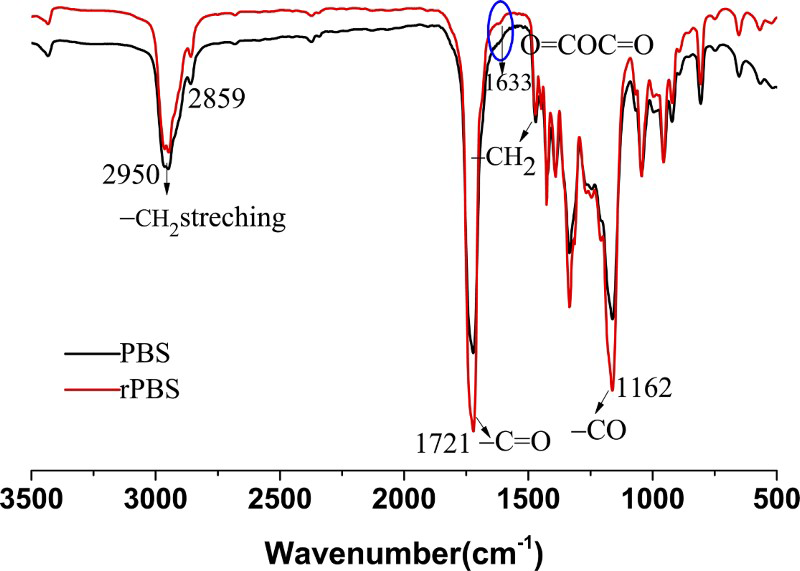
FTIR spectra of MAH-g-PBS (rPBS) and PBS
Figure 2 represents the 1H-NMR spectra of the rPBS and PBS. The signals at 4.12, 1.74 and 2.64 ppm were characteristic protons of PBS molecules. 26 In addition, new peaks at 3.52 and 2.74 ppm were found in rPBS, which can be attributed to the signals from methine and methylene protons of MAH ring. It was indicated that chemical interactions occurred between the MAH and PBS.
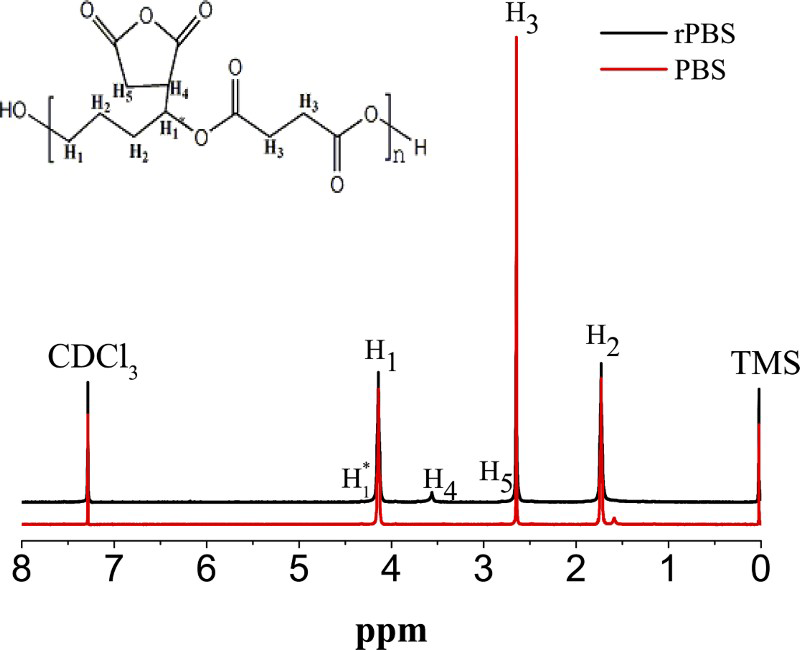
1H-NMR spectra for rPBS and PBS in CDCl3
Mechanical properties
Figure 3 illustrates the mechanical properties of TPS/PBS blends with different contents of rPBS. Without the addition of rPBS, the tensile strength and elongation at break of TPS/PBS (60/40) blend were only 6.4 MPa and 4% respectively. The inferior mechanical properties of TPS/PBS were mainly due to its poor affinity between the hydrophilic TPS and hydrophobic PBS. 27 For starch based TPS/PBS blends, even blended with a certain content of rPBS, the mechanical properties of the TPS/PBS blends were slightly increased. The result suggested that rPBS had little influence on improving the mechanical properties of TPS/PBS blends (rich TPS), which was agreed with the report of Ren et al. 18 It was considered that the amount of compatibilisers was too little to form effective chemical bonds between starch and PBS phase. On the contrary, TPS/PBS (40/60) blends (rich PBS) exhibited a good flexibility with elongation ∼20%, higher than the average value with the same TPS content. 28 More importantly, the tensile strength of TPS/PBS (40/60) blends increased over twofold at the same rPBS content. Interestingly, the mechanical properties of TPS/PBS blends (rich PBS) were improved obviously with the introduction of rPBS. However, the mechanical properties of the TPS/PBS blends (rich PBS) were not altered obviously when rPBS content was further increased from 5% to 10%. The result suggests that rPBS has a good compatibilising effect. Additionally, rPBS and PBS were thermodynamic miscible. Both of them transferred stress effectively and enhanced the interfacial adhesion between PBS and TPS.
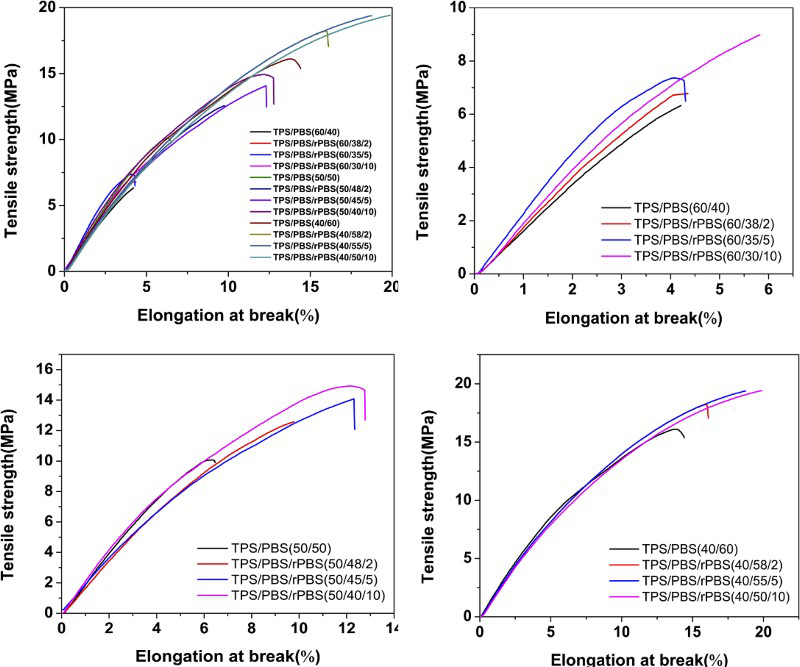
Stress–strain curves of TPS/PBS blend with different contents of rPBS
Thermal properties and crystallisation behaviour
PBS was reported to be a typical semicrystalline polymer. It was said that the physical, mechanical and thermal resistance properties of the polymer were strongly dependent on the solid state morphology and its crystallinity.
12
In fact, the crystallisation of TPS is quite complicated. It also varies with the category of starch, the amount of plasticisers, storage time, temperature and humidity. Figure 4 and Table 1 describe the crystallisation behaviour of PBS, TPS and TPS/PBS blends. No obvious crystallisation behaviour occurred in TPS. This could be attributed to the fact that crystalline particles of starch had been destroyed during the plasticising and shearing process. Hence, the crystals in the blends essentially resulted from PBS phase. Table 1 figures up the crystallinity (Xc %) of PBS, TPS and PBS blends according to equation (3)
29
:
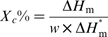
 represent the melting enthalpy of PBS and 100% crystalline PBS respectively, w is the weight fraction of PBS in the blends, and
 (PBS) = 110.5 J g− 1.
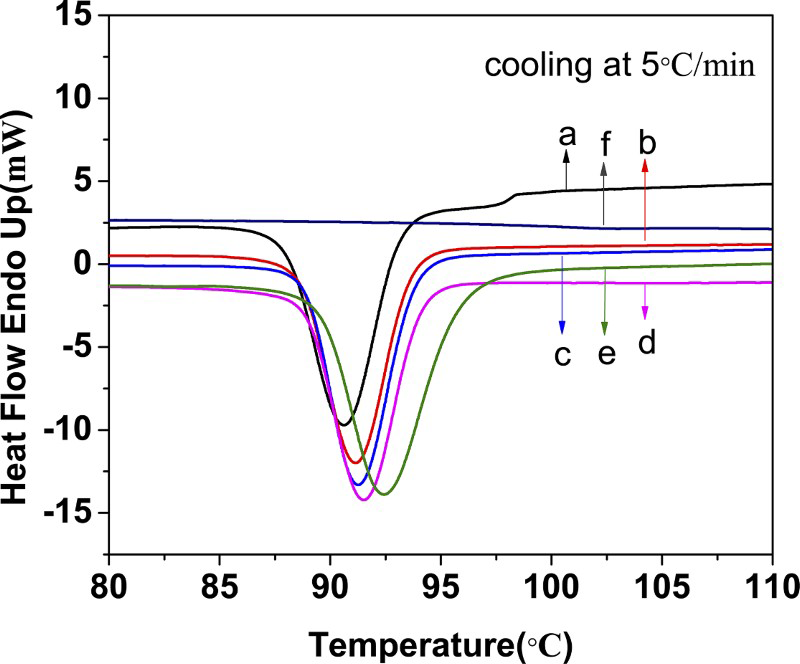
Cooling DSC thermograms at cooling rate 5°c min− 1 for neat polymer and blends after melting at 15°C for 3 min: a TPS/PBS (40/60); b TPS/PBS/rPBS (40/58/2); c TPS/PBS/rPBS (40/55/5); d TPS/PBS/rPBS (40/50/10); e pure PBS; f TPS (25% glycerol)
Melting and crystallisation results of neat polymer and binary blends: a: TPS/PBS (40/60); b: TPS/PBS/rPBS (40/58/2); c: TPS/PBS/rPBS (40/55/5); d: TPS/PBS/rPBS (40/50/10); e: pure PBS; f: TPS (25% glycerol)
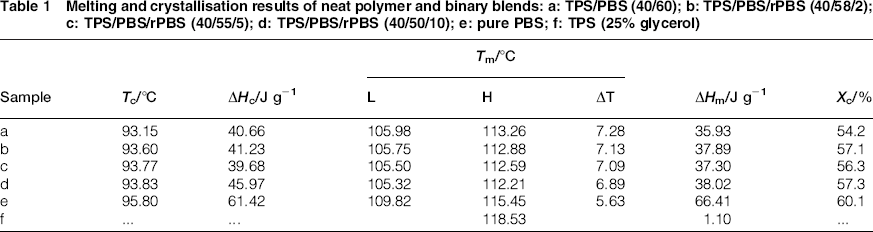
Figure 4 shows that the crystallisation temperature of PBS (Tc) shifted to lower temperature. The result suggests that the crystallisation of PBS was restricted by TPS and rPBS. A major reason for this was that the TPS suppressed the nucleation of PBS in the blends for its high melt viscosity. 19 Distinctly, both crystallisation temperature and crystallinity of PBS decreased with the increase of compatibiliser's content. It can be indicated that rPBS promoted the migration of pure PBS molecular chain segments.
As illustrated in Fig. 5, PBS and its blends show obvious double melting peaks upon crystallised non-isothermally at the given cooling rate. Many authors have explained double melting behaviour by the melt recrystallisation model. 30 The exothermic dip between the double melting peaks was attributed to the recrystallisation. L represented the lower melting temperature of original crystals, H represented the higher melting temperature of recrystallised crystals, and ΔT was the difference between them (Table 1). The shoulder peaks became more and more evident with the addition of TPS. Meanwhile, both L and H temperatures shifted to lower temperature. It was mainly due to the crystallisation of PBS. However, the melting temperature of the blends with rPBS decreased gradually with the increase of compatibiliser contents, 31 which was verified in Fig. 5. The result suggested that the rPBS actually improved the compatibility and the mutual interaction between starch and PBS molecules.
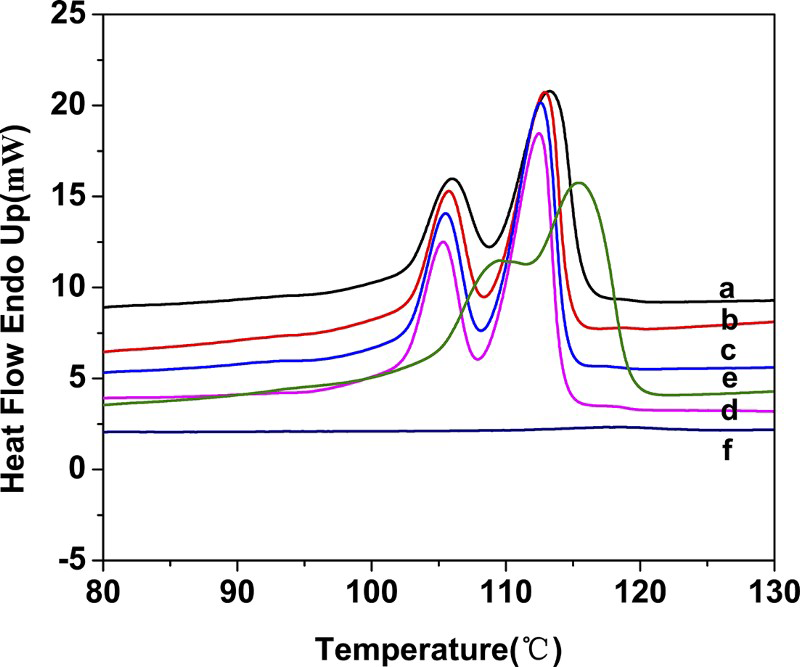
Second heating DSC thermograms for neat polymer and binary blends at 10°c min− 1: a TPS/PBS (40/60); b TPS/PBS/rPBS (40/58/2); c TPS/PBS/rPBS (40/55/5); d TPS/PBS/rPBS (40/50/10); e pure PBS; f TPS (25% glycerol)
Compatibility and phase morphology
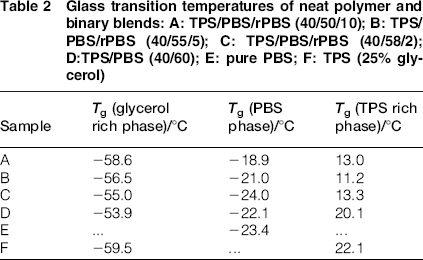
Table 2 shows the data for tan δ of the blends. A single tan δ peak of PBS occurred at − 23.4?, corresponding to its glass transition. Apart from the TPS/PBS/rPBS (40/58/2), a slight shift in the tan δ peak of PBS phase to higher temperature was observed in binary blends. Two distinct tan δ peaks emerged in the DMA data of TPS. As described by Lourdin et al., one α relaxation peak was found at low temperature and closed to the glass transition of glycerol, which was from the glycerol rich phase. 32 The other transition, β relaxation at room temperature, was related to the glass transition of starch rich phase. 33 These studies showed that phase separation occurred in TPS with glycerol as plasticiser. Table 2 reveals that all blends exhibited three distinct glass transition temperatures corresponding to the glycerol rich phase, the PBS phase and the starch rich phase respectively. 5 However, these peaks approached each other with the increment of rPBS content. It was indicated that TPS and PBS were partially compatible, but it had no positive influence on improving mechanical properties. In addition, rPBS enhanced the interfacial compatibilisation. A further reduction in Tg of starch rich phase was found in Table 2 compared to the other two phases. It was attributed to the reaction between anhydride in rPBS and hydroxyl in starch. 18 Moreover, rPBS acted as a plasticiser in TPS/PBS. The two factors above were the main driving forces to enhance the compatibility of TPS/PBS blends. 34
Glass transition temperatures of neat polymer and binary blends: A: TPS/PBS/rPBS (40/50/10); B: TPS/PBS/rPBS (40/55/5); C: TPS/PBS/rPBS (40/58/2); D:TPS/PBS (40/60); E: pure PBS; F: TPS (25% glycerol)
Phase behaviour plays a vital role on mechanical properties of polymer blends. Phase morphology elaborates the relationship between microstructure and the mechanical properties. Figure 6 displays the morphology of TPS/PBS blends. Residual granular structure and uneven block structure were observed on the fracture surface of non-compatibilised blends. Starch granules were detached from PBS matrix, suggesting that phase separation occurred. With the addition of the rPBS, no visible starch granules were detected in Fig. 6b–d. It can be indicated that rPBS weakened the interfacial tension between TPS and PBS and led to the smaller size of phase domain. 35 Starch phase distributed more evenly with the increase of rPBS content. Therefore, when the compatibilised blends were subjected to an external force, deformation of interfacial layer was transferred and the stress was dispersed effectively due to their stronger interfacial adhesion, especially in PBS domains.
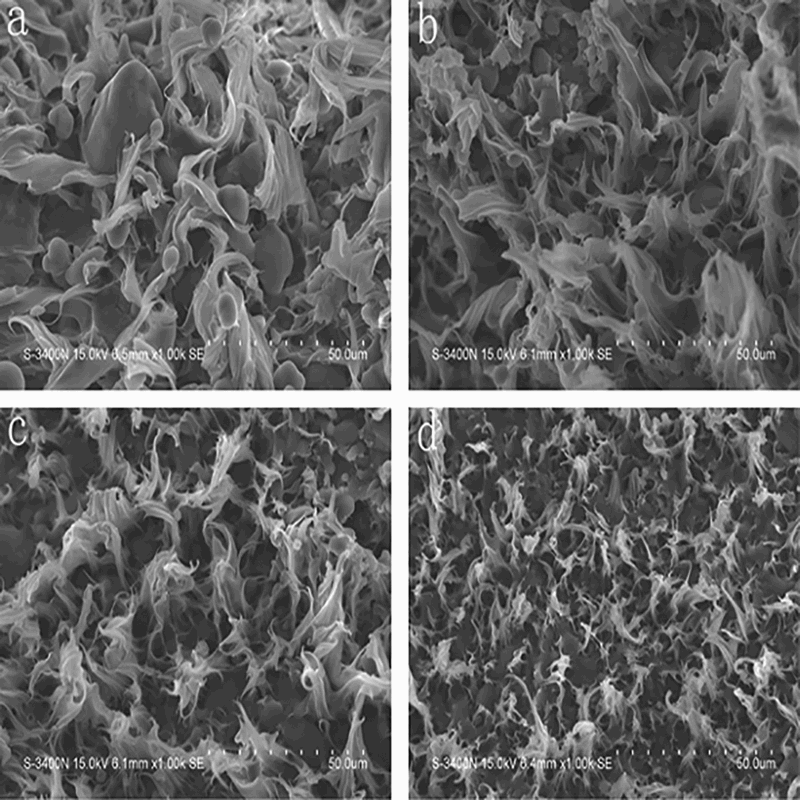
SEM images of fractured surface of TPS/PBS: a TPS/PBS (40/60); b TPS/PBS/rPBS (40/58/2); c TPS/PBS/rPBS (40/55/5); d TPS/PBS/rPBS (40/50/10)
Water absorption
Figure 7 shows the equilibrium water absorption of TPS/PBS blends. The incorporation of hydrophobic PBS dramatically lowered the water absorption of TPS and reduced the water sensitivity of TPS/PBS blends. 27 As illustrated in Fig. 7, the equilibrium water uptake in blends containing rPBS was lower than those blends without rPBS. It is attributed to the good dispersion, homogeneous microstructure of starch and well dispersion of starch particles restricting the diffusion of water molecules in TPS/PBS blends. 36 The result also demonstrated that the content of compatibiliser has no effect on water resistance of TPS/PBS.
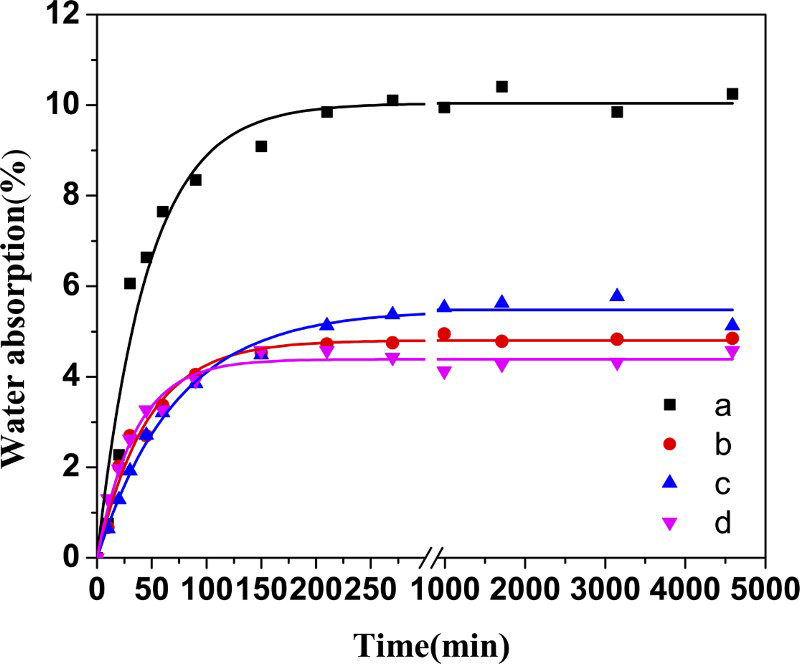
Water absorption of blends contained different contents of rPBS: a TPS/PBS (40/60); b TPS/PBS/rPBS (40/58/2); c TPS/PBS/rPBS (40/55/5); d TPS/PBS/rPBS (40/50/10)
Conclusions
An interfacial compatibiliser rPBS was successfully synthesised by grafting the MAH onto PBS. Fully biodegradable binary blends of TPS and PBS with different contents of rPBS were prepared using a two-step extrusion process. The mechanical properties, morphology and compatibility of blends were investigated. Results showed that rPBS greatly improved the strength and elongation at break of blends, especially for the PBS that occupied the main ingredients. TPS/PBS/rPBS (40/55/5) possessed the highest tensile strength and elongation at break. The rPBS in PBS blends helped to improve interfacial miscibility. Good adhesion of TPS/PBS interface and small evenly dispersed starch particles were observed with higher content of rPBS. rPBS enhanced the water resistance of TPS/PBS/rPBS. The results suggested that compatibilised TPS/PBS blends, with the combination of biodegradability, high strength and water resistance, can be a strong candidate of packing material.
Acknowledgements
This investigation was supported by the National Science & Technology Pillar Program during the Twelfth Five-Years Plan Period (grant no. 2012BAD32B01). The authors gave thanks to Dr Yichen Du in the Guelph Food Research Centre Agriculture and Agri-Food Canada for his help in improving the English of the paper.