







Abstract
Co–W–P films were prepared by a pulse plating method on a copper substrate. Effects of different duty ratios on composition, microstructure and magnetic properties of films were investigated. With the increase in duty ratios, the deposition speed increased gradually during the pulse plating process. It was found that the higher ratio duty could improve contents of cobalt and reduce amounts of phosphorus in the film. Almost all the deposited films were crystalline and formed tetrahedral structures Co3W with preferred crystallographic orientation (200) and (201). Dissimilar surface morphology could be detected under different duty ratios. Atomic force microscopy showed that lower duty ratios could form typical nodular structures and the dense surface. However, the films with rough and agglomerate nodular structures would be detected with higher duty ratios. Vibration sample magnetometer results showed that higher duty ratio induced larger saturation magnetisation and lower coercivity of Co–W–P films.
Introduction
Cobalt alloy films have been considered as promising materials which possess better properties, such as higher rigidity, consistence, acid resistance, magnetic performance, etc.1 Because tungsten and cobalt possess higher melting point, rigidity and great acid proof performance, it was found that Co–W–P films show great physical and magnetic properties. For example, Co–W–P (containing less W) films are well known to show good magnetic properties and can be used in computer disk devices and inductors; Co–W–P (containing less P) films exhibit superior physical and mechanical performances, which can effectively prevent tear and corrosion.2 Many traditional methods could be used to prepare Co–W–P alloy films. Pulse plating has been considered as an effective and efficient method to obtain dense alloy films because of highly selectivity and easy control.3 Recently, lots of researches focused on obtaining alloy films by pulse plating. Smooth and compact alloy films could form by choosing appropriate duty ratio during the pulse plating process. Moreover, films deposited by pulse plating could possess great magnetic performance which is seldom reported. This paper investigated the effects of duty ratios on the composition, microstructure and magnetic properties of Co–W–P films during the pulse plating process.
Experimental
Co–W–P thin film was deposited on a copper substrate by a pulse plating method. The effects of duty ratio on composition, microstructure and magnetic properties were studied. The components of the solution were summarised in Table 1.
Composition of Co–W–P film pulse plating solutions
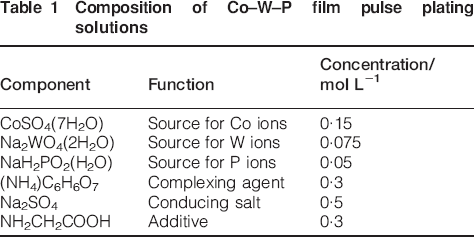
Meanwhile, sulphate hydrous (CoSO4) and sodium tungstate (Na2WO4) were used as the source of Co and W ions respectively. The purpose of adding sodium hypophosphite (NaH2PO4) into the solution is to form Co–W–P films. The content of phosphorus on the Co–W alloy films could affect films’ magnetic performance. Hence, the paper investigated the effects of phosphorus on coercivity of Co–W–P alloy films. Ammonium citrate dibasic [(NH4)C6H6O7] as well as glycine were chosen as complexing agents. Sodium sulphate (Na2SO4) served as conducing salt to improve conductivity of the solution. Working pH value was ∼8·00 while kept the temperature up to 60°C during the experiment process.
Copper was utilised as the cathode, which was cut into 2×3 cm with a diamond saw. Then, the copper was polished by a polish machine (MP-1A). After the copper was polished, an alkaline solution and H2SO4 (10%) were used to get rid of the oils and oxides on the copper surface respectively. Finally, the substrate was immerged into 100 mL electrolyte to perform pulse plating deposition reaction for ∼2000 s. During the pulse plating, the total time t and the pulse period p were kept to 2000 and 200 s respectively; duty ratios were changed to study their influences on microstructures and magnetic properties of Co–W–P films. Figure 1 demonstrates a sketch map of pulse plating process. After the pulse plating deposition, the Co–W–P film was washed with a jet of pure water and dried by a blower. The composition of the films was analysed by energy dispersive spectrum. Microstructure analysis of the deposited Co–W–P films was carried out using X-ray diffraction (XRD, XPert Philips PW 1830), which used a Cu Kα radiation as an incident beam and worked at 40 kV and 150 mA. Surface morphology was examined using scanning electron microscopy (Hitachi S-4700). Magnetic properties were tested by a vibration sample magnetometer (Lakershore VSM7407).
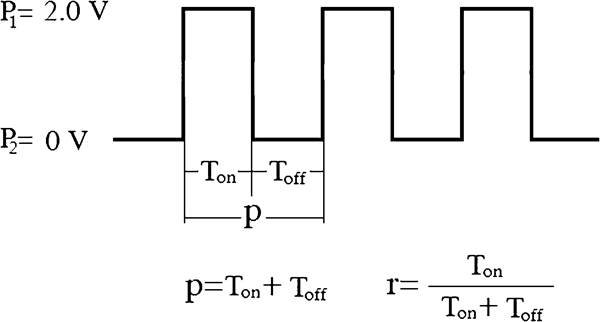
Sketch map of pulse plating process
Results and discussion
Effects of different duty ratios on composition and deposition speed of Co–W–P films
Different duty ratios can effectively affect the deposition speed during the pulse plating process. Figure 2 shows the relationship between the duty ratio and the deposition speed. It is conspicuous that the deposition speed increases gradually with the increase in duty ratio. High duty ratio could accelerate the deposition speed during the pulse plating process. When the high duty ratio reaches 0·9, the deposition speed could get to almost 60 g m−2 h−1. Chemical reaction rates depend on chemical kinetics and mass transfer. Mass transfer played a major role in the deposition speed during Co–W–P alloy film electrodeposition process.4 When the pulse period p keeps to a constant (200 s), the time of Ton would increase along with the increase in duty ratio. Longer Ton time could effectively accelerate mass speed which would improve the deposition speed.
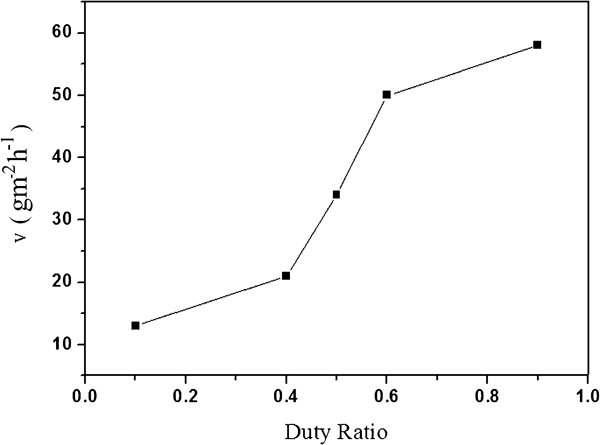
Effects of duty ratio on deposition speed: concentrations of cobalt, tungstate, hypophosphite were 0·15, 0·075 and 0·05 mol L−1 respectively; T = 60°C, t = 2000 s, p = 200 s and pH = 8
In order to study the relationship between the duty ratio and the film composition, Fig. 3 displays the effects of various duty ratios on the film composition. According to Fig. 3, it is very obvious that cobalt and tungsten contents in the film augment simultaneously with the increase in duty ratio. It is because a higher duty ratio could increase time Ton which favours Co2+ transfer and led to the increase in cobalt and tungsten contents in the film. Co–W codeposition phenomenon would happen during Ton time. In the codeposition mechanism proposed so far, hypotheses have been advanced on the basis of the formation of an insoluble intermediate compound of partly reduced tungsten oxide. Following functions give the codeposition mechanism in detail5


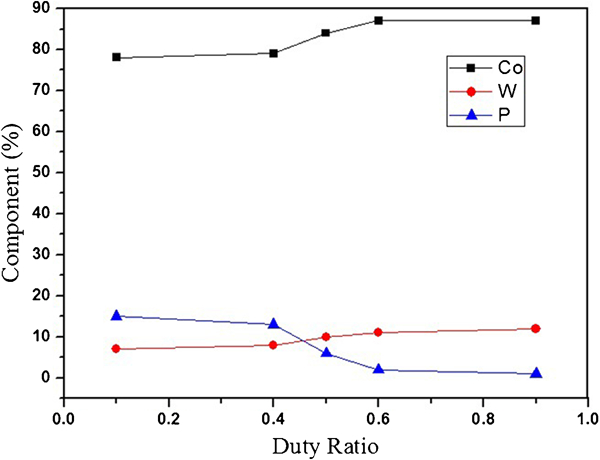
Effects of duty ratio on film composition: concentrations of cobalt, tungstate, hypophosphite were 0·15, 0·075 and 0·05 mol L−1 respectively; T = 60°C, t = 2000 s, p = 200 s and pH = 8
Effects of duty ratios on amount of phosphorus on films
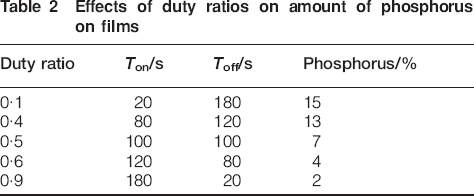
It is impossible to deposit cobalt on Toff time during the pulse plating process. Therefore, Co–W codeposition phenomenon would mainly happen during Ton time. Because hypophosphite (NaH2PO4) was added into the solution, the main reaction occurs during the Toff time period is as follows

Effects of different duty ratios on microstructure of Co–W–P thin films
Figure 4 shows the XRD pattern of pulse plating deposited Co–W–P alloy films. From the XRD spectra, it is very clear that the strong peak appears at 2θ = 43·3°, which corresponds to substrate copper with preferred orientation of (111). Other Cu(200) and Cu(220) peaks appear at 2θ = 50·4 and 74·1° respectively. Moreover, Co3W(200) and Co3W(201) could be observed at 2θ = 40·6 and 46·4° respectively. With the increase in duty ratios, the intensity of Co3W(200) and Co3W(201) peaks raise gradually. Co–W alloys prepared by an electrodeposition method are usually amorphous. However, according to the XRD pattern above, pulse plating deposited Co–W–P alloys are crystalline. Strong intensity of both Co3W(200) and Co3W(201) peaks are shown in the XRD pattern. The structure of Co–W–P alloys was studied by Omi et al.7 in detail. It was suggested that the stoichometric composition of the alloy is Co3W. The alloy consists of distinct basic tetrahedral units and each composed of three cobalt atoms and one tungsten atom.8 Although cobalt and tungsten together would appear Co–W codeposition phenomenon, tungsten does not electrodeposite by itself from an aqueous solution which may result in the structure of tetrahedral arrangement. Based on the Debye–Scherrer equation, it is convenient to calculate the average grain sizes of the crystalline films

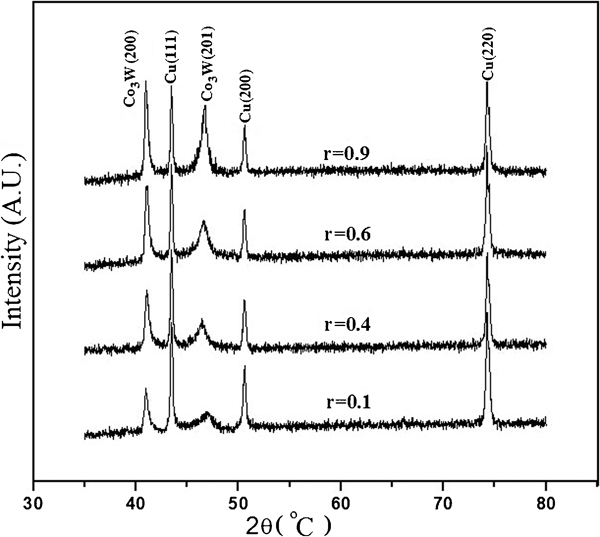
X-ray diffraction pattern of pulse plating deposited Co–W–P films using different duty ratios: concentrations of cobalt, tungstate and hypophosphite were 0·15, 0·075 and 0·05 mol L−1 respectively; T = 60°C, t = 2000 s, p = 200 s and pH = 8
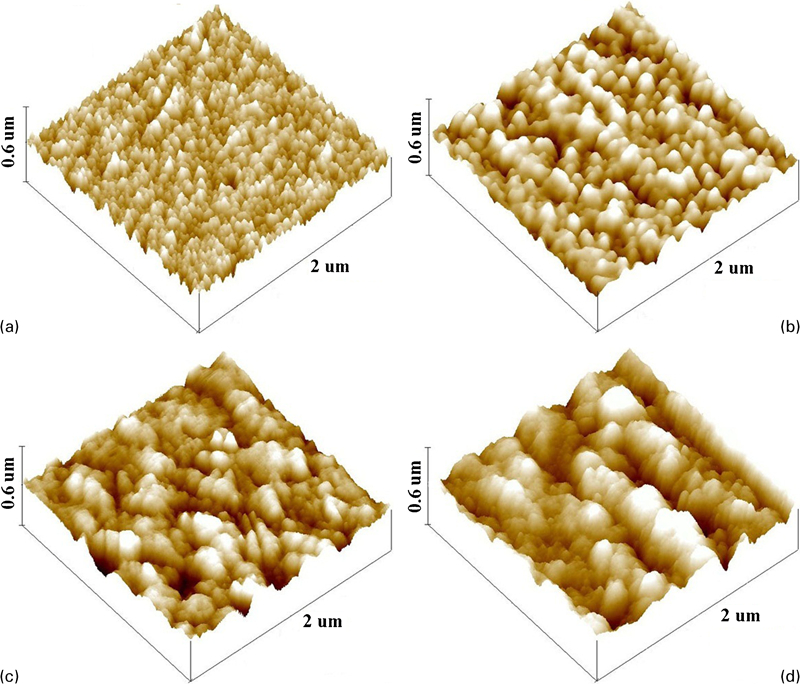
Effects of duty ratio on film surface morphology: concentrations of cobalt, tungstate and hypophosphite were 0·15, 0·075 and 0·05 mol L−1 respectively; T = 60°C, t = 2000 s, p = 200 s and pH = 8
Effects of different duty ratios on films’ magnetic properties
Co–W–P films pulse plating deposited with different duty ratios show various magnetic properties. Figure 6 shows the saturation magnetisation and coercivity of films pulse plating deposited with different duty ratios. It can be seen that a higher duty ratio induced larger saturation magnetisation and lower coercivity of Co–W–P thin films. When duty ratios range from 0·1 to 0·9, the saturation magnetisation increases from 50 to 105 emu g−1. However, the coercivity decreases from 961 to 312 Oe. It is because that high duty ratios lead to a higher cobalt content in Co–W–P films, which contributes directly to the increase in saturation magnetisation.9 Theoretical saturation magnetisation value of cobalt is ∼162·5 emu g−1.10 The maximum saturation magnetisation value of Co–W–P prepared by 0·9 duty ration in the paper is up to 105 emu g−1. The content of phosphorus on the Co–W alloy films could affect films’ coercivity performance. More phosphorus on the films would limit domain wall movement to increase the coercivity performance. Therefore, with the increase in duty ratios, the content of phosphorus on Co–W alloy films decreases, which lead to the decrease in the coercivity performance. Figure 7 illustrates the magnetic hysteresis loop of Co–W–P prepared under different duty ratios. According to the magnetic hysteresis loop, it is obvious to determine the relationship among saturation magnetisation, coercivity and duty ratios.
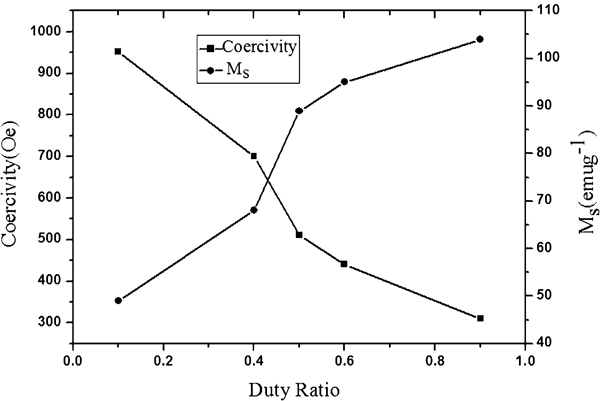
Effects of duty ratio on film magnetic properties: concentrations of cobalt, tungstate and hypophosphite were 0·15, 0·075 and 0·05 mol L−1 respectively; T = 60°C, t = 2000 s, p = 200 s and pH = 8
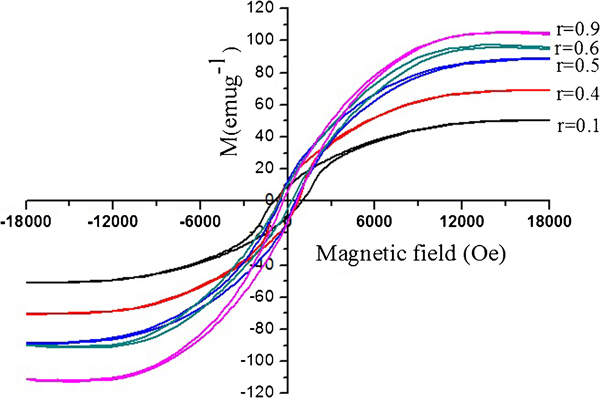
Magnetic hysteresis loops of Co–W–P alloys deposited by pulse plating with different duty ratios: concentrations of cobalt, tungstate and hypophosphite were 0·15, 0·075 and 0·05 mol L−1 respectively; T = 60°C, t = 2000 s, p = 200 s and pH = 8
Conclusions
A typical pulse plating process was used to prepare Co–W–P alloy films on a copper substrate. The paper investigated the effects of different duty ratios on composition, microstructure and magnetic properties of Co–W–P films. It was found that a high duty ratio could effectively accelerate the mass speed which would improve the deposition speed during the pulse plating process. In addition, a higher duty ratio could improve contents of cobalt and reduce amounts of phosphorus in the films. Almost all the deposited films were crystalline and contained tetrahedral structures Co3W with preferred crystallographic orientation (200) and (201). According to the SEM images, lower duty ratios would form typical nodular structures and density surface. However, the films with rougher and agglomerate nodular structures would be formed with the increase in duty ratios. A vibration sample magnetometer showed that a higher duty ratio induced larger saturation magnetisation and lower coercivity of Co–W–P alloys during the pulse plating process.
Footnotes
Acknowledgements
This work is supported financially by the National Natural Science Foundation of China (no. 20971116).