







Abstract
A high speed electroless nickel plating bath has been developed with p-tolyl thiourea and diphenyl thiourea as accelerators for electroless nickel plating process. The acceleration effect of the compounds was determined by weight gain and electrochemical method. Both compounds improved the rate of deposition to considerable extent by adsorbing strongly on the steel surface. The adsorption of the accelerators was found to obey Langmuir adsorption isotherm. The Arrhenius plot and quantum mechanical parameters further justified the impressive performance of accelerators through their effective adsorption on metal surface.
Introduction
It was found on many occasions that the rate of electroless nickel deposition was below 20 μ h−1 and the development of high speed plating process is of great significance in both practice and industry. As pointed out by Han and Fang1 and others,2 – 4 sulphur bearing organic compounds such as cystein, thioglycolic acid and some thiourea derivatives were reported as accelerators for electroless plating process.5 – 8 However, there has been no published report on the acceleration effect of p-tolyl thiourea (p-TLTU) and diphenyl thiourea (DPhTU) on electroless nickel plating. This paper explains the influence of p-TLTU and DPhTU on the rate of electroless nickel plating and energy of activation. The adsorption of the compound on metal is found to obey Langmuir adsorption isotherm. The quantum mechanical parameters such as highest occupied molecular orbital (HOMO), lowest unoccupied molecular orbital (LUMO), ΔE and dipole moment have been studied as a new idea to validate the adsorption of compounds on metal being responsible for acceleration of electroless nickel deposition. Tafel polarisation results indicate that the acceleration of compounds in the electroless nickel plating process follows chemical mechanism.9 – 11
Experimental
The following compounds of analytical reagent grade were used as additives in the present study: DPhTU (Merck, Germany) and p-TLTU (Kochlight Laboratories, UK).
The bath used in the present study had the following composition: nickel sulphate hexahydrate, 0·1M; sodium hypophosphite, 0·2M; glycolic acid, 0·6M.
Experiments were performed with various additives in the concentration ranges from 0·1×10−3 to 10×10−3 mM. Each experiment was repeated for a minimum of three times to get reproducible results. The rate of deposition was calculated using the following formula: rate of deposition (μ h−1) = W×60×104/DAt, where W is weight of the deposit (g), D is the density of the deposit (g cm−3), t is the plating duration (min) and A is the surface area of the specimen (cm2). Mild steel specimens of compositions, Fe–0·08C–0·07P–0Si–0S–0·41Mn, and of size 4×1×0·020 cm were used for weight gain measurements.
The polarisation studies were carried out using 1 cm2 area of electrolessly nickel coated specimens as the working electrodes. The measurement was made with a BAS-100A electrochemical analyser. The auxiliary electrode and the reference electrode used were of platinum plate of 4 cm2 area and saturated calomel electrode respectively. A constant quantity of 200 mL of bath solution was taken in a 250 mL beaker. The bath temperature and pH were maintained at 88±1 and 5·5±0·1°C. No agitation was provided. In order to understand the effectiveness of the mixed potential theory in clearing up the electroless nickel process, Tafel polarisation measurements were carried out in the presence and absence of accelerators in the potential range of ±300 mV from the OCP with all the bath ingredients under the plating condition. Quantum mechanical calculations were carried using MOPAC 2000 program of CS Chemoffice packet program. The energy of HOMO, LUMO and dipole moment μ were calculated with the above given software package.
Results and discussion
Weight gain studies
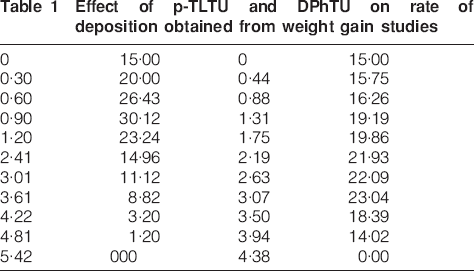
The results of electroless nickel deposition rates obtained in the present study by weight gain method are presented in Table 1. Thiourea derivatives have altered the nickel deposition rate up to certain concentrations beyond which they slow down the plating process. The acceleration effect starts at 0·30×10−3 mM for p-TLTU and reaches a maximum deposition rate of 30·2 μ h−1 at 0·90×10−3 mM. Beyond this concentration, the rate of deposition is on the declining trend and reaches zero rate at 5·41×10−3 mM. In the case of DPhTU, at an optimum concentration of 3·07×10−3 mM, the rate of deposition is found to be 23·04 μ h−1 and at the highest concentration of 4·38×10−3 mM, the deposition of metal virtually stops. This may be due to the fact that beyond optimum concentrations, the additives have poisoned the rate of deposition.
Effect of p-TLTU and DPhTU on rate of deposition obtained from weight gain studies
Tafel polarisation studies
In electroless nickel, the two partial reactions, namely, the reduction of Ni2+ ion and the oxidation of
 , take place concurrently at the same rate on the metal surface at the mixed potential Emp.
The plating rate and Emp are obtained from E versus logi plot through the Tafel extrapolation method. This method suffers from the usual limitations associated with the theory of mixed potentials. For example, extrapolation of the polarisation curves for the decomposition of the reducing agent to the plating potential is not valid if the catalytic properties of the surface change with potential over the range of interest. It is also not suitable if the rate determining step and hence the Tafel slope for any process changes in the potential range through which the polarisation curve is extrapolated. At the mixed potential, idep = im = ired, where idep is the deposition current, im is the current for metal ion reduction and ired is the current for the oxidation of the reducing agent. Using Faraday's law, the nickel deposition current can be converted into equivalent plating rate that is obtainable from the weight gain method [rate (μ h−1) = 1·09idep (mA cm−2)].
The above mentioned bath with or without the presence of different concentrations of the accelerators was used for the polarisation measurements under the same conditions mentioned earlier. The results are presented in Table 2.
Tafel polarisation and weight gain results for rate of electroless nickel plating in presence and absence of p-TLTU and DPhTU
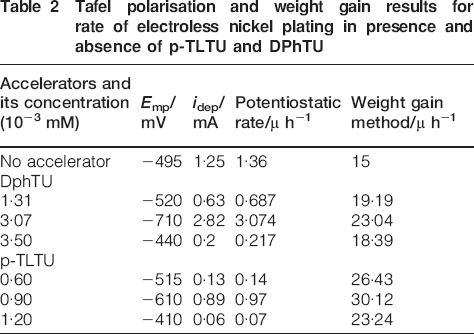
The results of the deposition current idep indicate that the role of accelerators is not at all reflected. Further shift of the mixed potential Emp is also not in a regular way. Therefore, this technique appears not to serve any useful purpose in the evaluation of the accelerators. Similar findings have been put forth by Mital et al.12 in their studies with electroless nickel plating in the presence of sodium hypophosphite as the reducing agent. However, with dimethylamine borane (DMAB) or a mixture of sodium hypophosphite and sodium borohydride as the reducing agent, a good correlation exists between the rate of deposition obtained through this method and weight gain method. The reason cited is that in the case of sodium hypophosphite, the chemical mechanism dominates over the electrochemical mechanism. With the Ni–P–B system, the very powerful reducing action of DMAB over hypophosphite has been quoted as the reason. It is also practically noted that the action of 1 g of DMAB is equivalent to 11 g of sodium hypophosphite. Thus, it is confirmed that the Tafel polarisation technique in electroless nickel plating with sodium hypophosphite as a reducing agent may not be helpful in getting the plating rate as the chemical mechanism predominates.
Application of adsorption isotherms
In the present study, the values of fractional surface coverage θ were obtained using values of rates of deposition in the presence and absence of additives ro from weight gain method. The Langmuir isotherm was tested by plotting 1/rt versus C0 for all the compounds. A straight line relationship was obtained in all the cases, thereby confirming that the adsorption process obeys Langmuir adsorption isotherm. The results are presented in Fig. 1.
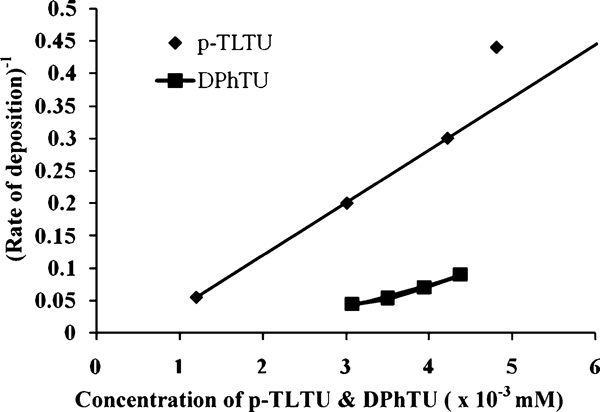
Langmuir isotherm plot for electroless nickel process in presence of different concentrations of p-TLTU and DPhTU
Activation energy
The relationship between the rate of reaction and the temperature on electroless nickel plating can be expressed through the Arrhenius equation


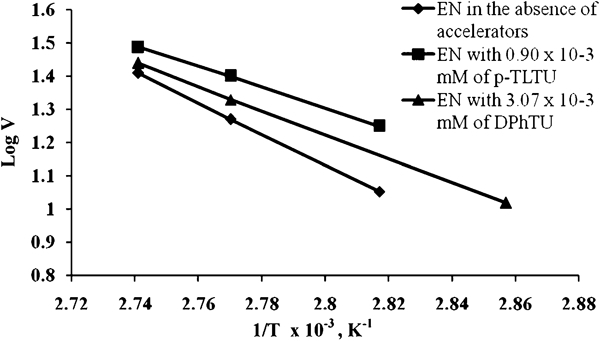
Log v versus 1/T curves of electroless nickel in presence and absence of accelerators
Energy of activation calculated for electroless nickel plating in presence and absence of accelerators
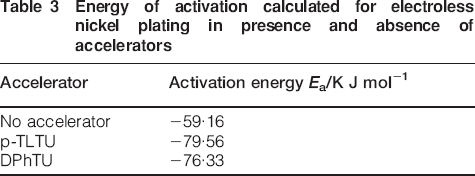
The –M effect of the phenyl ring is moderately offset with the presence of methyl group in the para position in the case of p-TLTU, and this accounts for its improved position compared to DPhTU. The inferior performance of DPhTU is due to the –M effect of the two phenyls, which totally deactivates the sulphur atom in the compound.
Quantum mechanical studies
The computed quantum chemical parameters like energy of HOMO EHOMO, energy of LUMO ELUMO, LUMO–HOMO, energy gap ΔE and dipole moment μ are summarised in Table 4. From Figs. 3–5, it can be observed that HOMO and LUMO energy orbitals were loftily localised on tolyl moiety and almost nil on thiourea, indicating that the tolyl moiety possesses good adsorption centres,13, 14 consolidating the opinion of several researchers that p-electrons and hetero-atoms are responsible for the adsorption process.15, 16 In the case of DPhTU (Figs. 6–8), HOMO and LUMO were effectively localised on one of the phenyl moiety, whereas another phenyl ring is partly confined with HOMO and LUMO. This indicates that DPhTU has not effectively adsorbed on the metal surface and in turn diminished the acceleration of electroless deposition. The gap between HOMO and LUMO energy levels of molecules was another important parameter that needs to be considered. The smaller is the value of ΔE of a compound, the higher is the inhibition of reaction. The higher value of energy gap ΔE for p-TLTU indicates that the compound has not inhibited the deposition process. However, the ΔE value for DPhTU is lower than p-TLTU, demonstrating that the former may not accelerate the electroless deposition of nickel. It has been reported that larger values of dipole moment will favour the adsorption of compounds on metal surface.17 – 20 The dipole moment μ of p-TLTU is higher than that of DPhTU, indicating that p-TLTU adsorbs strongly on metal surface and enhances the plating process to considerable extent as compared with DPhTU.
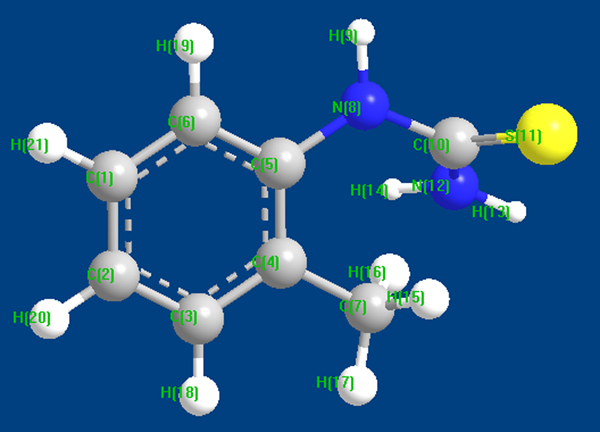
Optimised structure of TLTU
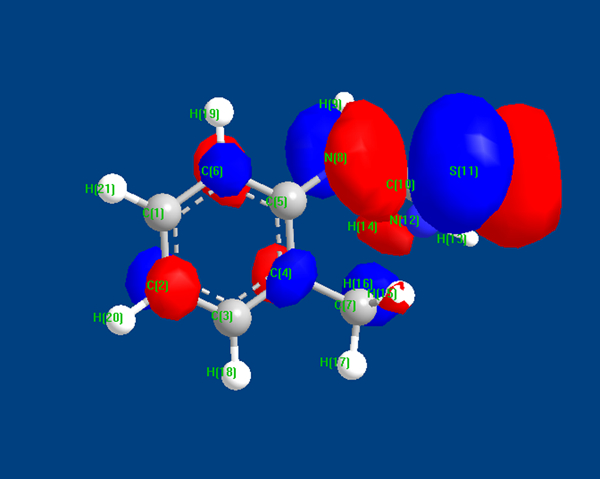
Highly occupied molecular orbital of p-TLTU
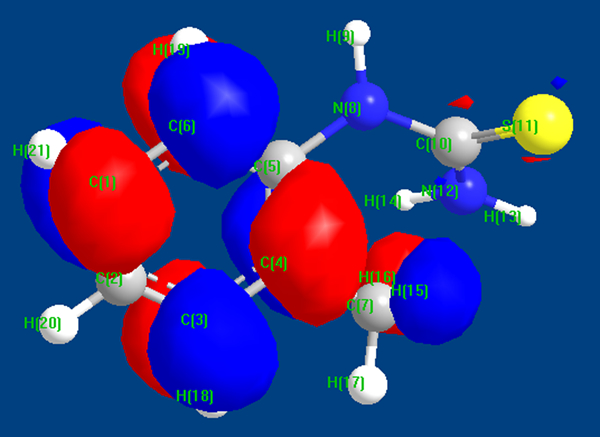
Lowest unoccupied molecular orbital of p-TLTU
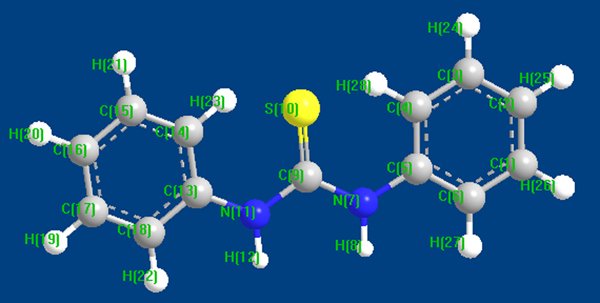
Optimised structure of DPhTU
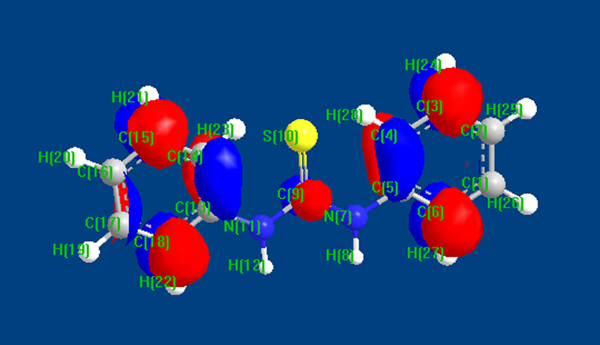
Highly occupied molecular orbital of DPhTU
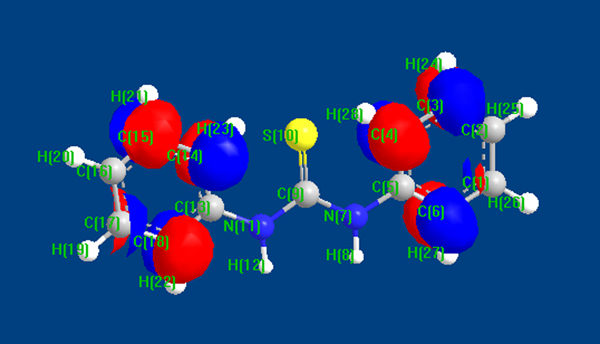
Lowest unoccupied molecular orbital of DPhTU
Quantum mechanical parameters for thiourea derivatives

Conclusion
Thiourea derivatives enhanced the rate of electroless nickel deposition through their effective adsorption on metal surface, and the reduction of nickel with hypophosphite as a reducing agent follows chemical mechanism. The energy activation and quantum mechanical parameters established the mere adsorption of compounds on metal surface.