







Abstract
Electroless undoped and Co, Al co-doped ZnO (Zn1 − x − yCo x Al y O: x = 0.04, 0.03, 0.02; y = 0.01, 0.02, 0.03) nanostructured thin films were deposited on soda lime glass in the present work. Microstructure of the ZnO films was strongly influenced by different doping concentrations of Co and Al into ZnO matrix. X-ray diffraction analysis has confirmed the absence of metallic Co or Al clusters apart from wurtzite type ZnO. The field dependence of magnetisation (M–H) curve of different concentration of Co and Al co-doped ZnO films was measured at room temperature. The ferromagnetism with saturation magnetisation (Ms) and coercive field (Hc) of the order of 3.843–4.813 × 10− 3 (emu) and 400.389–436.769 (Oe) respectively were observed for the doped ZnO thin films. The mechanisms for the ferromagnetism at room temperature in Co and Al co-doped ZnO films are discussed.
Introduction
There has been ever growing interest in growth and characterisation of dilute magnetic semiconductors for their potential technological applications in transparent spintronics devices such as spin solar cells, spin light emitting diodes, optical isolators and ultra fast optical switches. Dilute magnetic semiconductors are produced by introducing small fraction of transition metals into non-magnetic host semiconductors such as III–V and II–VI compounds. 1 From opto and magneto electronics application point of view, ZnO is attractive because of high its exciton binding energy (60 meV) and band gap (3.3 eV).2,3 It is environmental friendly, available in plenty, economical and resistive to high energy radiation. For fabricating dilute magnetic semiconductor materials, these features can be promising for strong ferromagnetic exchange coupling between localised spins due to carrier induced ferromagnetism such as Ruderman–Kittel–Kasuya–Yosida interaction and double exchange interaction. 4 In case of Co+2 and Al+3 ions co-doped ZnO system, extra carriers provided by Al+3 ions interact with Co+2 ions, thereby introducing permanent dipole moments aligned in one direction. Al+3 ions act as donor dopant by providing free electron for conduction in the dilute magnetic semiconductor system. It also provides optical transparent films in the visible region for magneto-optical devices.
Aluminium doped ZnO films have been investigated by many researchers5–7 because they have potential applications in a variety of opto-electronic devices such as solar cells, flat panel displays and transparent heat mirrors. ZnO films doped with magnetic metals, for example, Co, Ni and Fe, have been studied as dilute magnetic semiconductors.8,9 Tominaga et al. 10 reported the sputter deposited Co doped ZnO:Al films. The films were heated in air from room temperature to 673 K. They reported that the conductivity of the films is stable until 573 K. Minami et al. 11 prepared Co doped ZnO:Al films by DC magnetron sputtering with a mixture target of ZnO, Al2O3 and CoO (or CoCl2). They found that the Co doped ZnO:Al films exhibit better chemical stability without a significant alteration of the original electrical and optical properties after HCl and KOH etching. Most of the researchers8,10 reported the development of Co and Al doped ZnO film by RF magnetron sputtering process. The literature is scarce on magnetic metals and Al doped ZnO thin films by electroless process. The deposition of thin films by magnetron sputtering/pulse laser deposition (PLD) is a complex process as it requires high vacuum and costly target materials. In addition, size of the samples is limited.
In the present research work, undoped and Co, Al co-doped ZnO films with different mole fractions were fabricated by electroless deposition process. Electroless deposition process is simple, cheap and easy to handle, and no sophisticated elements or instruments are required.12,13 Good adherence of the films can be obtained by this deposition technique. The dopant additions can be easily controlled by altering composition of inorganic precursors. In addition, there is flexibility in size and shape of the sample for deposition of the film by electroless. The effect of doping on structural, optical and magnetic properties of Co, Al co-doped ZnO (Zn0.95Co0.04Al0.01O1.005, Zn0.95Co0.03Al0.02O1.010, Zn0.95Co0.02Al0.03O1.015) nanostructured electroless thin films was investigated in the present work. The morphological characterisation of the films was made by AFM. The optical and magnetic properties of the nanostructured doped and undoped films were measured by spectrophotometer and superconducting quantum interference device (SQUID) respectively. The mechanism of ferro magnetic behaviour of doped films was substantiated using its microstructural features and X-ray diffraction (XRD) results.
Experimental
Preparation of plating bath
The electroless bath solution was prepared using zinc-acetate-2-hydrate [Zn (O2CCH3)2.2(H2O)] (Sigma-Aldrich, purity 99.99%), cobalt sulphate [CoSO4.7(H2O)] (Sigma-Aldrich, purity 99.99%), aluminium-nitrate-9-hydrate [Al(NO3)3.9(H2O)] (Sigma-Aldrich, purity 99.99%) and diethanolamine (analytical grade). Co, Al co-doped ZnO (Zn1 − x − yCo x Al y O: x = 0.04, 0.03, 0.02; y = 0.01, 0.02, 0.03) nanostructured thin films were prepared in the laboratory using electroless process. Mole fraction Co (x = 0.04, 0.03, 0.02) and Al (y = 0.01, 0.02, 0.03) of the constituent element in the films was controlled by adjusting the Co and Al to Zn weight ratio. The above chemicals were used without any further purification. Initially, appropriate amounts of zinc acetate and diethanolamine were dissolved in distilled water and stirred at 60°C for 2 h. Then, cobalt-sulphate-7-hydrate and aluminium-nitrate-9-hydrate with different mole fractions (x = 0.00–0.04 with step of 0.01 and y = 0.00–0.03 with step of 0.01) were added to it, and the final solution was stirred for additional 2 h, which served as bath solution after cooling to ambient temperature.
Plating, drying and annealing sample
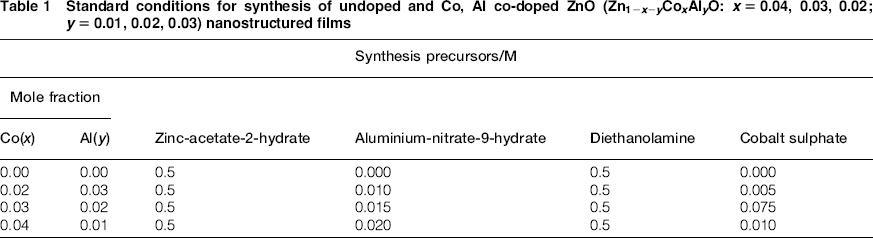
Soda-lime glass substrate (dimension: 25 × 25 × 1.33 mm3) was used, and it was cleaned in acetone and distilled water. Finally, the clean glass substrate was dipped into the electroless bath at 90°C temperature for 2 h. After plating, the wet deposited samples were dried in air at room temperature. The samples were kept in the horizontal position (plating position) to avoid draining and blending of the just deposited wet films, which could lead to irregularities in the layer thickness and to surface inhomogeneties. The deposited films were heat treated in a muffle furnace for 2 h in air at 500°C. A series of samples (Zn0.95Co0.04Al0.01O1.005, Zn0.95Co0.03Al0.02O1.01, Zn0.95Co0.02Al0.03O1.015) were prepared with different mole fractions of Co (x = 0.04, 0.03, 0.02) and Al (y = 0.01, 0.02, 0.03). Standard conditions for synthesising of different samples were shown in Table 1. The structural characteristics of the films were made using XRD Bruker AXS D8 advance diffractometer with Cu Kα target (
 = 1.54052Å) radiation over the range 2θ = 10–80° with a step of 0.01° at room temperature. The photo luminous properties were analysed by spectrophotometer (F-2500) in the spectral range of 300–600 nm. Magnetic measurements of the films were made with superconducting quantum interference device (SQUID, MPMSXL). The surface morphology of the doped and undoped films was characterised using atomic force microscope (NT-MDT, Ntegra).
Standard conditions for synthesis of undoped and Co, Al co-doped ZnO (Zn1 − x − yCo x Al y O: x = 0.04, 0.03, 0.02; y = 0.01, 0.02, 0.03) nanostructured films
Results and discussion
XRD—structural studies
Figure 1a shows the XRD patterns of undoped and Co, Al co-doped ZnO nanostructured films (Zn0.95Co0.04Al0.01O1.005, Zn0.95Co0.03Al0.02O1.010, Zn0.95Co0.02Al0.03O1.015). XRD results indicated that all the samples showed hexagonal wurtzite structures without any characteristic peaks of impurities. The major peaks are identified as (100), (002), (101), (102), (110), (103), (200), (112) and (201) planes of reflections for wurtzite structure of ZnO according to PCPDFWIN CAS number: PDF#800075. The (101) peak shows the highest intensity in all cases, implying that all the samples have a hexagonal crystal structure with a preferred orientation. There were no detectable diffraction peaks of Co and Al metal clusters, Co or Al oxide secondary phases or other impurity phases within the sensitivity of the XRD measurements, implying that Co and Al ions were incorporated into the interstitial site of ZnO lattice sites. In addition, compared to the XRD pattern of undoped ZnO, the peaks of Co and Al co-doped ZnO nanostructured films show a shift in its positions with increase in Co and Al dopant concentrations. The ionic radii of Zn2+, Co+2 and Al3+ are 0.72, 0.58 and 0.57Å respectively as reported in the literature.
14
For a better comparison, Fig. 1b shows the XRD patterns of undoped ZnO and Co, Al co-doped ZnO nanostructured films (Zn0.95Co0.04Al0.01O1.005, Zn0.95Co0.03Al0.02O1.010, Zn0.95Co0.02Al0.03O1.015) only in the detection angle range of the preferred orientations. It can be seen that the peaks are shifted towards lower angles as compared to undoped ZnO, and the intensity of the peaks is also decreasing with increasing dopant concentration. The average crystal size of the samples was determined from the broadening of the diffraction peaks corresponding to (100), (002) and (101) plane using Debye–Scherer's formula,
15
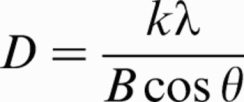
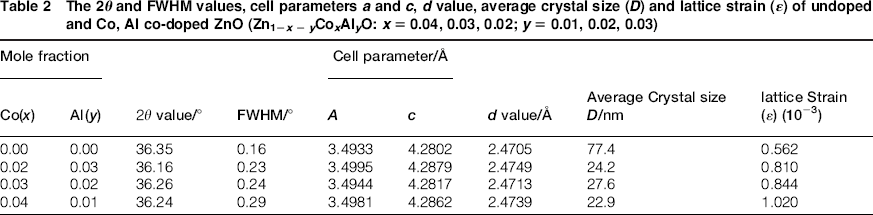
 and full width at half maximum (FWHM) values, cell parameters a and c, d value, and average crystal size (D) and lattice strain for the different Co, Al concentrations, where lattice strain was calculated using the following formula
16
:
and full width at half maximum (FWHM) values, cell parameters a and c, d value, and average crystal size (D) and lattice strain for the different Co, Al concentrations, where lattice strain was calculated using the following formula
16
:

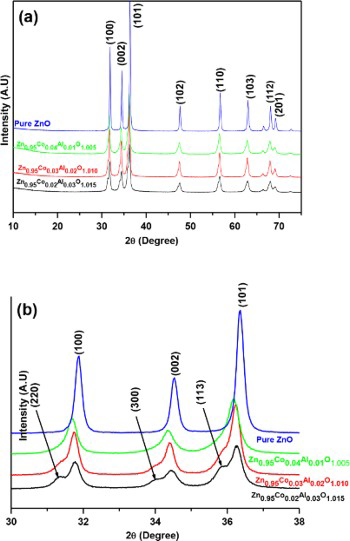
a XRD patterns of undoped ZnO and Co, Al doped ZnO (Zn0.95Co0.04Al0.01O1.005, Zn0.95Co0.03Al0.02O1.010, Zn0.95Co0.02Al0.03O1.015) nanostructured films; b XRD patterns of undoped ZnO and Co, Al doped ZnO (Zn0.95Co0.04Al0.01O1.005, Zn0.95Co0.03Al0.02O1.010, Zn0.95Co0.02Al0.03O1.015) nanostructured films only in detection angle range of preferred orientations for better comparability
The 2θ and FWHM values, cell parameters a and c, d value, average crystal size (D) and lattice strain ( ) of undoped and Co, Al co-doped ZnO (Zn1 − x − yCo x Al y O: x = 0.04, 0.03, 0.02; y = 0.01, 0.02, 0.03)
 value/°
 ) (10− 3)
Microstructure of films
Figure 2a–d shows the AFM surface morphology of undoped and Co, Al co-doped ZnO nanostructured films (Zn0.95Co0.04Al0.01O1.005, Zn0.95Co0.03Al0.02O1.010, Zn0.95Co0.02Al0.03O1.015). Figure 2a represents the micrograph of undoped ZnO film and has large spherical grains. Figure 2b shows the microstructure of Zn0.95Co0.02Al0.03O1.015 nanostructured films. Zn0.95Co0.02Al0.03O1.015 nanostructured films exhibit small spherical shaped grains. The film morphology shows a strong dependence on the doping concentration. In general, the grain shape and size change with the doping concentrations, and it is evident that slightly large spherical shape grains are seen in Zn0.95Co0.03Al0.02O1.015 nanostructured thin films (Fig. 2c). Zn0.95Co0.04Al0.01O1.005 nanostructured thin films (Fig. 2d) show homogeneous and dense surfaces covered by small size grains. From AFM analysis, it was observed that Co and Al ions as dopants into ZnO matrix play a vital role in tuning of microstructure. Co+2 and Al+3 ions occupy the interstitial position into ZnO lattice and retard the grain growth of ZnO films. Owing to this reason, Zn0.95Co0.02Al0.03O1.010 film has small spherical shaped grains as compared to undoped ZnO films (Fig. 2a). When the concentration of Co is increased (x = 0.03) and that of Al is reduced (y = 0.02), large spherical grains are transformed to small spherical grains (Fig. 2c). Further, when the concentration of Co is increased (x = 0.04) and that of Al is reduced (y = 0.01), small spherical grains with dense microstructure are observed (Fig. 2d).
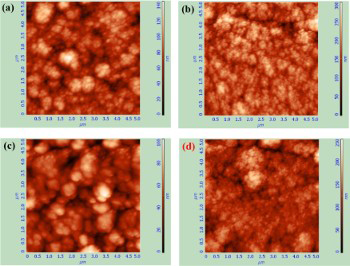
AFM surface morphology of undoped ZnO and Co, Al doped ZnO (Zn0.95Co0.04Al0.01O1.005, Zn0.95Co0.03Al0.02O1.010, Zn0.95Co0.02Al0.03O1.015) nanostructured films: a undoped ZnO film; b Zn0.95Co0.02Al0.03O1.015 film; c Zn0.95Co0.03Al0.02O1.010 film; d Zn0.95Co0.04Al0.01O1.005 film
Photoluminescence studies
The photoluminescence spectra were obtained using Hitachi F-2500 fluorescence spectrophotometer (Hitachi Company, Hong Kong, China) with a xenon lamp as the excitation source. Photoluminous properties of films were determined using the spectrophotometer, and the results are shown in Fig. 3. The photoluminescence emission intensity is related to the recombination of excited electrons and holes, and thus, the lower emission intensity is indicative of decrease in recombination rate.19,20 It is observed that at 400 nm wavelength, the intensities of photoluminescent of Co, Al co-doped ZnO nanostructured films (Zn0.95Co0.04Al0.01O1.005, Zn0.95Co0.03Al0.02O1.010, Zn0.95Co0.02Al0.03O1.015) have lower values as compared to undoped ZnO film. Among them, Zn0.95Co0.04Al0.01O1.005 films have the lowest value of photoluminescence intensity. Figure 3 reveals that the Zn0.95Co0.04Al0.01O1.005 films have minimum recombination of electron hole pairs. The process of recombination of carriers is opposite to that of the generation of carriers. In this process, excited electrons fall back from the conduction band to the valence band, reoccupying an empty energy state (a hole) in the valence band; thus, electron hole pairs get destroyed. The recombination of generated carriers is not desirable on the surface of dilute magnetic semiconductors and should be avoided as much as possible.
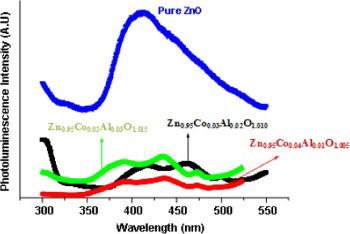
Photoluminescence emission spectra of undoped ZnO film and Co, Al doped ZnO films (Zn0.95Co0.04Al0.01O1.005, Zn0.95Co0.03Al0.02O1.010, Zn0.95Co0.02Al0.03O1.015) for better comparison of intensity of photoluminescence
Magnetic characterisation
The magnetic properties of Zn0.95Co0.04Al0.01O1.005, Zn0.95Co0.03Al0.02O1.010, Zn0.95Co0.02Al0.03O1.015 nanostructured films were investigated at room temperature with superconducting quantum interference device (SQUID, MPMSXL). Distinct ferromagnetic behaviour is observed in the doped samples only, and no trace of ferromagnetism was observed in the undoped ZnO sample, which is tested under similar conditions using the SQUID. Figure 4a shows the magnetic hysteresis (M–H) loop for Zn0.95Co0.03Al0.02O1.010 films. The saturation magnetisation (Ms), coercive field (Hc) and remanent magnetisation (Mr) of the sample are 3.843
 10− 3 (emu), 436.769 (Oe) and 2.799
 10− 3 (emu) respectively. Figure 4b shows the magnetic hysteresis (M–H) loop for Zn0.95Co0.04Al0.01O1.005 film. The saturation magnetisation (Ms), coercive field (Hc) and remanent magnetisation (Mr) of the sample are 4.831
 10− 3 (emu), 400.389 (Oe) and 3.132
 10− 3 (emu) respectively. Figure 4c shows the magnetisation curve for Zn0.95Co0.02Al0.03O1.015 films, which exhibits ferromagnetic behaviour with a small coercive field and remanent magnetisation with low magnetised narrow hysteresis loop. No saturation magnetisation is reached in this sample with applied fields of H = 10000 (Oe). The change in Ms and Hc for different concentrations of Co, Al co-doped ZnO nanostructured films (Zn0.95Co0.04Al0.01O1.005, Zn0.95Co0.03Al0.02O1.010, Zn0.95Co0.02Al0.03O1.015) is compared (Fig. 4a–c). It was found that Ms value is higher for Zn0.95Co0.04Al0.01O1.005 films, and the Ms increases with increasing doping concentration. Higher Ms in Zn0.95Co0.04Al0.01O1.005 films is likely to be caused by enhanced doping and higher ferromagnetic ordering in ZnO. Increased ferromagnetism might be possible with the Co, Al doping in ZnO. Doping of metals (Co and Al) plays a key role to the observed ferromagnetism. High Ms value at room temperature is observed for the Zn0.95Co0.04Al0.01O1.005 films in the present study. It is likely that due to large density of point defects as well as extended defects such as dislocations associated with the strain in the ZnO lattice, magnetic interactions mediated by the interaction of dopants and defects are enhanced in the doped ZnO films. It is expected that samples with higher concentration of strain would show higher magnetisation. XRD analysis has confirmed that Zn0.95Co0.04Al0.01O1.005 film exhibits highest lattice strain.
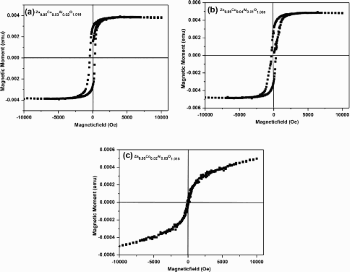
Room temperature field versus magnetisation (M–H) loop showing hysteresis of Co, Al doped ZnO (Zn0.95Co0.04Al0.01O1.005, Zn0.95Co0.03Al0.02O1.010, Zn0.95Co0.02Al0.03O1.015) nanostructured films: a Zn0.95Co0.03Al0.02O1.010film; b Zn0.95Co0.04Al0.01O1.005 film; c Zn0.95Co0.02Al0.03O1.015 film
Conclusion
Nanostructured undoped and Co, Al co-doped ZnO (Zn0.95Co0.04Al0.01O1.005, Zn0.95Co0.03Al0.02O1.010, Zn0.95Co0.02Al0.03O1.015) thin films were synthesised by electroless process. XRD analysis confirmed the hexagonal wurtzite structure without any impurities. Ferromagnetism, at room temperature, in Co, Al doped ZnO (Zn0.95Co0.04Al0.01O1.005, Zn0.95Co0.03Al0.02O1.010, Zn0.95Co0.02Al0.03O1.015) nanostructured films are due to doping of Co+2 ions, Al+3 ions and lattice strain. Zn0.95Co0.04Al0.01O1.005 films show the highest Ms value due to smaller grain size and large amount of lattice strain. It may be highlighted that dense, uniform and small grain size (22.9 nm) of Zn0.95Co0.04Al0.01O1.005 film can be obtained by low cost electroless process and have optimum combination of optical and magnetic properties. It can serve as potential material for the development of semiconductor devices that can retain good ferromagnetic properties at room temperature for the commercial or mobile devices.