







Abstract
In this study, we report the formation and characterisation of a calcium aluminate cement for potential application as a hard tissue replacement. Phase pure monocalcium aluminate powder was synthesised using the Pechini technique, using a relatively low temperature (1000°C) and sintering time (3 h). Characterisation of the hardened material showed a strong relationship between the liquid/powder ratio to which the cement was mixed and the mechanical performance of the hardened materials with little influence on cement microstructure. Interestingly, following immersion in phosphate buffered saline, there was extensive precipitation on the surface of the cement sample. X-ray diffraction showed that the precipitate was hydroxyapatite, which on evaluation using scanning electron microscopy was shown to be of porous structure.
Introduction
Calcium aluminate ceramics have been employed as bone replacement materials since the early 1970s when they were first evaluated for use as root implants.1 Although originally employed in this application as a result of their relatively high mechanical strengths,2 some authors reported the formation of an intimate bond between calcium aluminate ceramics and opposing tissues. Consequently, a range of calcium aluminate ceramics have been evaluated for use as implants. These materials, however, have elicited a range of biological reactions, with some forming intimate bonds with hard and soft tissues and others being surrounded by a fibrous capsule. The formation of a bond between the material and the tissue is thought to occur as a result of surface dissolution of the implant followed by reprecipitation of a layer of poorly crystalline hydroxyapatite at the interface with the tissue. By varying the processing methodology, it is likely that the specific surface area, and hence the rate of dissolution of the material, could be altered. For example if the calcium aluminate is sintered, then it will exhibit a specific surface area of <1 m2g−1, whereas a cement will more likely have a specific surface area of several orders of magnitude higher. This difference in biological reaction could therefore be attributed to the contrasting processing methods used in the manufacture of implants. The higher specific surface area of calcium aluminate cement (CAC) and also their mouldability to irregular defects mean that CACs have been more widely investigated than their ceramic counterparts for bone graft replacement.
Although the application of CACs in regenerative medicine is relatively recent, CAC has been used in civil engineering for ∼100 years.3 Calcium aluminate cement was originally used in civil engineering since it gains strength much faster than Portland cement.2 Depending on the Ca/Al molar ratio, CAC may set to form matrixes composed principally of CaO·6Al2O3, 5CaO·3Al2O3, 4CaO·3Al2O3, or CaO·Al2O3. Of these calcium aluminate salts, monocalcium aluminate (CaAl2O4) is most widely used as a precursor in CAC since it is the most hydraulic calcium aluminate salt. The main phase found in the hardened material is katoite (3CaO·Al2O3·6H2O), which is the only phase in the system CaO–Al2O3–H2O that is thermodynamically stable in ambient conditions.
Calcium aluminate cement was introduced for clinical application in 2000 as a new direct restorative material and sold under the name DoxaDent (Doxa AB, Uppsala, Sweden).4 The material is formed in the most part of calcium aluminate and also contains ZrO2and SiO2 to modify the setting and mechanical properties of the cement. When it is used, the tablet will be contacted with the liquid, which contains water and small amounts of Li+ ions.5 A cytotoxicity study showed that DoxaDent exhibited the lowest cytotoxicity compared to five other currently used restorative materials.6 An in vivo study of calcium aluminate based restorative material showed that a tight bond forms between the material and the tooth, and no gap could be found even at high magnification.7
In this study, we report the synthesis of a CAC system using the Pechini method. The influence of mixing parameters on the mechanical strength and microstructures of the final material was evaluated, and the propensity of the hardened material to form hydroxyapatite across its surface in a phosphate containing solution containing no additional calcium ions was determined.
Materials and methods
The CAC precursor was prepared using the Pechini technique. 8 8,9 Briefly, Ca(NO3)2·4H2O (Sigma-Aldrich, UK) and Al(NO3)2·9H2O (Sigma-Aldrich, UK) were used as cation sources and used combined so the solution had a Al/Ca molar ratio of 2·0. Both salts were dissolved in double distilled water separately, and the two solutions were mixed under stirring using a magnetic stirrer, followed by the addition of citric acid (C6H8O7·H2O; Fisher, UK), at an equimolar ratio to the other cations in the solution. After a clear solution was obtained, ethylene glycol (EG, Sigma-Aldrich, UK) was added (with a molar ratio of EG/citric acid = 2). The mixing solution was stirred continuously at 90°C until the excess water had evaporated. The resulting foam was dried at 110–150°C in an oven overnight. The dried foam was then ground to powder using a pestle and mortar and was calcined at 1000°C for 3 h in a furnace (Carbolite; Derbyshire, UK) at a heating rate of 10°C min−1.
The CA powder was then mixed incrementally with double distilled water using a non-corrodible spatula to make the cement paste, which was cast into a cylindrical polytetrafluoroethylene split mould. A series of liquid (mL)/powder (g) ratio (L/P: 0·6, 0·7, 0·85 and 1·0 mL g−1) was used to determine the influence of L/P on the mechanical properties and microstructure of the hardened cements. The cements were mixed using a wiping motion with a non-corrodible stainless steel spatula to form homogeneous pastes, which were then packed into a polytetrafluoroethylene split mould to form cylindrical samples of 12 mm height and 6 mm diameter. Subsequently, the samples were stored at 37°C in a 100% humidity environment before characterisation.
After hardening for 7 days, the samples were removed from the moulds, and the ends of the cylinders were polished using silicon carbide paper (150, 320, 600 and 1000 grit) and immersed in double distilled water. The cement cylinders were mounted on a universal testing machine (Zwick/Roell Z030; Germany) with their long axes perpendicular to a pair of platens. The samples were then tested in compression at a crosshead speed of 0·5 mm min−1using a 10 kN load cell (n = 10). After testing in compression, the fragments were dried at 37°C until no further mass loss could be detected. The porosity of the cements was calculated from the apparent density of the specimens, as determined from the geometry of the samples before testing, and the true density of the specimens, as determined using a helium pycnometer (Accupyc II 1340; Georgia, USA) (n = 4). The porosity of the samples was determined in accordance with equation (1)

Results
The calcium aluminate powder that was synthesised using the Pechini method was synthesised at a lower temperature than when using other widely reported methods, such as the solid state reaction method.8The material was shown to be crystalline CaAl2O4 with the presence of no crystalline impurity phases (Fig. 1). The L/P to which the cement paste was mixed was shown to have an influence on the phase composition of the hardened cement (Fig. 2). Two forms of calcium aluminate oxide hydrate were formed in all the groups: Ca3Al2O6·xH2O (PDF-02-0083) and Ca3Al2O6·Ca(OH)2·18H2O (PDF-42-0487). Depending on the L/P ratio, however, other phases were also formed within the hardened cement matrix. When the L/P ratio was ⩾0·7, katoite [Ca3Al2(OH)12, PDF-24-0217] was formed, and as the L/P ratio was increased, the intensity of the peaks indicative of katoite increased, suggesting an increase in the katoite content of the hardened material. When the L/P ratio was ⩽0·6, unreacted CaAl2O4 was detected within the hardened cement matrix.
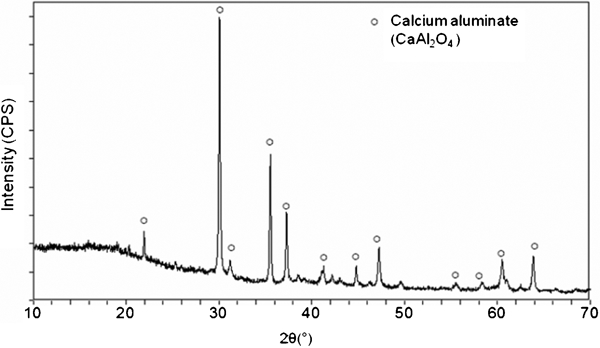
X-ray diffraction pattern of calcium aluminate powder prepared using Pechini technique and sintered at 1000°C for 3 h
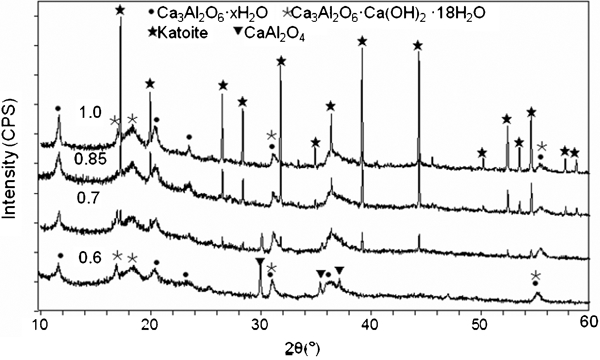
X-ray diffraction patterns of CAC formed using L/P ratios between 0·6 and 1·0
As might have been expected, a reduction in the water content of the cement pastes resulted in a reduction in cement porosity and an associated increase in cement strength (Fig. 3), except between an L/P of 0·6 and 0·7 when there was no notable increase in cement strength. The porosities of the four groups (L/P = 0·6, 0·7, 0·85 and 1·0) were 17, 20, 32 and 40% respectively. When the L/P ratio was 0·7, the CAC samples exhibited the highest compressive strength, i.e. 23·3±2·8 MPa. The lowest compressive strength was 6·9±1·4 MPa when the L/P = 1·0. The compressive strength at an L/P = 0·6 (20·30±3·54 MPa) was lower than that of L/P = 0·7 but higher than that of the other two groups.
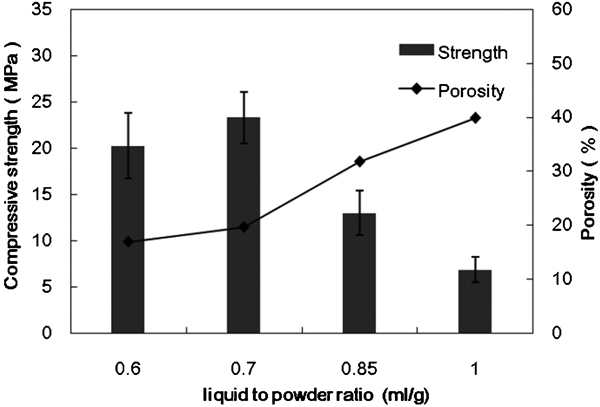
Compressive strength and porosity of CACs formed at different L/P ratios
Scanning electron micrographs of the cement fracture surfaces showed that the hardened cement matrixes were formed of tabular crystals of width approximately 1–10 μm (Fig. 4). The L/P to which the cement was mixed had little influence on the morphology of the crystals from which the cement matrix was formed, but the cement formed at an L/P of <0·7 appeared to be formed of coarser crystals than when formed at the other L/P examined.
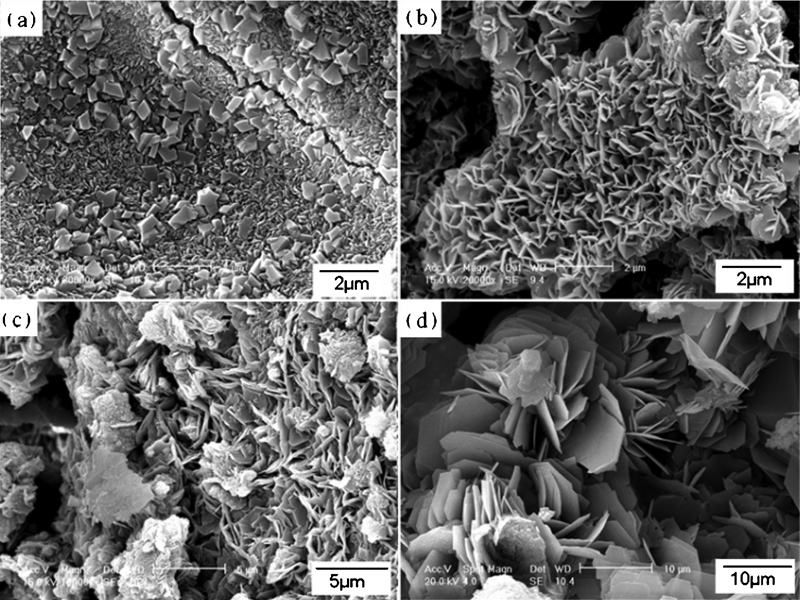
Environmental scanning electron micrographs of fracture surfaces of hardened CAC formed at L/P ratios of a 0·6, b0·7, c 0·85 and d 1·0
The cement cylinders formed at an L/P of 0·7 were immersed in PBS and aged over a period of 40 days. Over this period of time, there was a minimal loss in mass from the cement. However, a large amount of precipitation was noted on the surface of the cement cylinder (Fig. 5a). The precipitate was removed from the surface of the cylinder using a stainless steel razor blade, and the composition was determined using X-ray diffraction. The diffraction patterns collected for the precipitate showed that it consisted of poorly crystalline apatite (Fig. 5b). The morphology of the precipitate was evaluated using environmental scanning electron microscopy and was shown to consist of floret-like agglomerates of submicrometre sized blade-like crystals, typical of the morphology of apatite (Fig. 6).
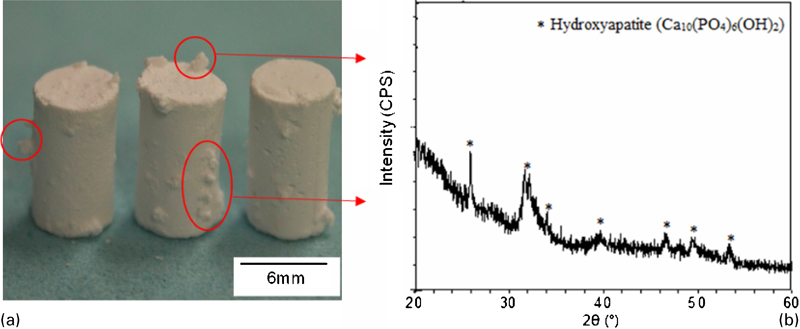
Cement cylinders following immersion of the CAC in daily refreshed PBS over a period of 40 days. a Following ageing there was extensive precipitation on the surface of the cylinders, which b following analysis was shown to be poorly crystalline hydroxyapatite
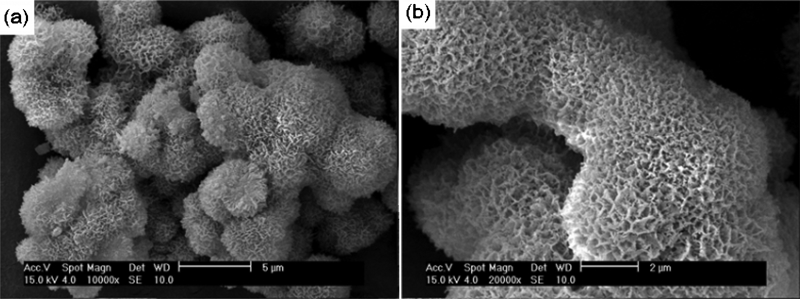
Environmental scanning electron micrographs of precipitate formed on surface of CAC after 40 days of aging in daily refreshed PBS
Discussion
The main hydraulic constituent of CAC is monocalcium aluminate (CaAl2O4, CA). Typically, this compound must be manufactured using a solid state sintering reaction, which requires extended periods of calcination and temperatures that are in excess of 1400°C.8 Using the Pechini technique, however, we were able to synthesise phase pure CA powder at 1000°C with only 3 h of calcination. The use of the Pechini technique for CA ensures intimate mixing of the reactive constituents and maximises heat transfer, thus reducing the overall energy demand of the process.10
When the CA powder is combined with water, several hydrates may be formed:3 CAH10 (CaO·Al2O3·10H2O), C2AH8 (3CaO·Al2O3·8H2O), C3AH6 (3CaO·Al2O3·6H2O) and C4AHx (4CaO·Al2O3·xH2O). C3AH6 (katoite) is the only thermodynamically stable crystalline phase in CAC. All the other phases will transform to C3AH6with time. In the cement formulations evaluated in this study, two calcium aluminate oxide hydrates were formed other than katoite: Ca3Al2O6·xH2O and Ca3Al2O6·Ca(OH)2·18H2O, which have also been reported to form in CAC matrixes in other studies. 11 11,12Changing the water content of the cement had a significant influence on the phase composition of the starting materials. When the L/P ratio is ⩾0·7, katoite was immediately following hardening, and as the L/P ratio was increased, there was an increase in the proportion of katoite present in the cement matrix. When the L/P ratio is 0·6, there was still some calcium aluminate left unreacted within the cement matrix, meaning that the amount of water when L/P = 0·6 is insufficient for complete hydration. With incomplete reaction, the compressive strength of CA mixed to an L/P ratio of 0·6 was lower than CA mixed to an L/P ratio of 0·7, although the material contained less porosity. In the case of the other cement formulations (L/P = 0·7, 0·85 and 1·0), a reduction in porosity was accompanied by an increase in compressive strength.
Many workers have attempted to determine the suitability of a material for use as a hard tissue replacement by evaluating the rate of formation of hydroxyapatite on the surface of an implant in simulated body fluid (SBF). The SBF consists of a selection of ionic constituents of human serum but does not contain any of the biological factors that are known to control mineralisation. As a consequence, some workers have questioned the value of this fluid in predicting how a material will bond with the surrounding tissues when implanted into a complex biological system.13It should also be noted that SBF is supersaturated with respect to hydroxyapatite, and as such, precipitation is likely. In this study, CAC was immersed in PBS to evaluate the extent to which the material degraded over the duration of the study. While there was negligible mass loss from the material over 40 days, there was the formation of a thick layer of hydroxyapatite over the surface of the material. This is surprising given that PBS contains no calcium cations and suggests that as the calcium aluminate hydrates within the cement transform to katoite, they release sufficient calcium to cause nucleation of hydroxyapatite on the surface of the material. The negligible mass loss from the CAC suggests that little dissolution from the bulk material occurred, suggesting that phase transformation to katoite maybe essential to facilitate hydroxyapatite formation. This may to some extent explain the variability of the biological reaction to calcium aluminate ceramics, which may not bond to strongly to surrounding tissues in the composition of the material remaining stable following implantation.
Conclusions
In this paper, it has been shown that CAC precursors may be synthesised using the Pechini technique at lower temperature than when using solid state sintering. The phase compositions of the hardened cement materials were strongly influenced by the water content of the cement pastes, which also had a notable influence on the compressive strengths exhibited by the hardened material. Once immersed in daily refreshed PBS, a thick layer of hydroxyapatite was precipitated on the surface of the cement, and this may be reliant on the release of calcium cations from the cement matrix following transformation of calcium aluminate hydrates to katoite over time.
Footnotes
Acknowledgements
The authors thank the financial support of the China Scholarship Council for Y. Tan's study in UK. In addition, the universal testing machine used was obtained through Birmingham Science City, with support from Advantage West Midlands and part funded by the European Regional Development Fund.
This paper is part of a special issue on Cement and Concrete Research