







Abstract
About 50 million tons of lignin are produced annually in the pulping industry worldwide. A traditional example for lignin research is its use as a resin additive in wood based panels. The aim of this study was to find out why technical lignin has not so far succeeded in substituting for phenolic resins in the wood based panel industry. Interviews were carried out using a multistage expert interview approach adapted from Delphi methods. After the principal factors were identified and verified, quantitative data were taken for the valuation. Technical product properties received the highest ratings by the consulted experts, followed by security of supply, price difference and productivity, which received almost the same overall ratings. Interestingly, researchers rated security of supply much lower than the industry representatives. Depending on fulfilment of criteria identified, the experts expected that between 10 and 30% of phenolic resin can be potentially substituted within the next 10 years.
Introduction
The content of lignin in wood is between 15 and 35%; therefore, lignin is indeed one of the most abundant renewable organic materials on the Earth (Fengel and Wegener 1984). In the chemical pulping process, cellulose is removed from the wood chemicals complex. The spent liquor consists of remaining hemicellulose and lignin. Pulp industries use this spent liquor to extract marketable byproducts for the improvement of material recovery, as well as for their profitability.
Each year approximately 50 million tons of lignin (Kamm et al. 2006) are produced in the pulping industry worldwide. This lignin is mainly burned to produce energy for the pulping process. Based on FAO-Data (FAO 2011), it is estimated, for example, that in Europe an annual amount of 14 million tons of lignin from Kraft pulping would be available. Although the Kraft process is the by far most popular pulping process worldwide, relatively little of its lignin is used industrially. Although various applications for technical lignin exist, a large proportion is just burned (as fuel) for the production of energy. Modern pulp plants using energy efficient processes are able to produce an energy surplus using this process, which can be fed into the power grid. Mead-Westvaco in the USA is the only industrial producer of Kraft lignin and derivatives for chemical use worldwide (Holladay et al. 2007). The production capacity of this company has been previously reported at 35 000 ton/year (dry basis). Approximately 70–75% of their isolated lignin is chemically sulphonated and modified to be used as dye and agrochemical dispersants, while unmodified Kraft lignin is used as asphalt emulsifiers or antioxidants (Holladay et al. 2007).
Hence, most of the current commercial applications available for technical lignin are those utilising lignosulphonates.
The conversion of lignosulphonate to vanillin was the first and most successful process of this kind to the present day. In 1874, Haarmann found that lignin from spruce bark sap can be used to manufacture vanillin (Krammer et al. 2006). Today, lignosulphonate derived from wood during the pulping process is one source for the commercial production of vanillin, which is used as a flavouring agent in food and other industries (Lewis 1989; Priefert et al. 2001). The vanillin manufactured by this process is the same chemical substance, which creates the vanilla aroma of original vanilla beans. The introduction of this process was the prerequisite for introducing vanilla aroma as a bulk ingredient in the food industries (Bütehorn and Pyell 1996). However, in comparison to the amount of lignosulphonate produced by the pulping industry, the market for vanilla flavour is far too small (Hocking 1997).
In contrast to Kraft pulping lignin, lignosulphonate from sulphite pulping processes is mainly utilised in the field of concrete admixture systems, where it acts as an active plasticising agent (Gargulak and Lebo 2000; Plank 2004; Ringena 2006). Gargulak and Lebo (2000) estimate that approximately 50% of all lignosulphonate produced is used in concrete admixtures. Other authors mention higher proportions of up to about 90% (Tejado et al. 2007) or 700 000 t annually (Plank 2004) used in this field of application. Because the plasticising effects of lignosulphonate are limited, so called superplasticisers are increasingly used for concrete with superior fluidity (Plank 2004; Stern and Schwarzbauer 2008).
A traditional example for Kraft lignin research is their incorporation as an organic resin/adhesive or resin additive used, for example, in particle or fibreboard production (Olivares et al. 1995; Calve et al. 1988; Sellers 2001; Lora and Glasser 2002; Sellers et al. 2004; Tejado et al. 2007). Recently, results of technical research projects in this field have delivered promising results (El Mansouri and Salvado 2006; El Mansouri et al. 2007a, b; Lei et al. 2008) so that a practical and economic breakthrough of this technology becomes realistic.
Objectives
The motivation to investigate this topic was raised by the fact that in spite of many technical research results (e.g. Olivares et al. 1995; Calve et al. 1988; Sellers 2001; Lora and Glasser 2002; Sellers et al. 2004; Tejado et al. 2007) and research efforts (Gosselink et al. 2004), the application of technical lignin as a substitute for petroleum based phenolic resins in the wood based panel industry has not yet reached the expected market share (Lei et al. 2008; El Mansouri et al. 2007a).
The aim of this study was to find out why technical lignin did not succeed so far in substituting phenolic resins in the wood based panel industry?
Therefore, the study investigates the factors and conditions influencing the substitution of petroleum based phenolic resins by modified Kraft lignin in the wood based panel industry. So, the barriers that hinder the use, the incentives and future prospects of the substitute product lignin were assessed systematically. To facilitate the analysis, the following research questions were developed for this objective:
Q1: Which are the barriers that obviously hinder the application of technical lignin in the wood based panel industry today?
Q2: What are potential incentives that could help to increase the application of technical lignin in the wood based panel industry?
Q3: Are there any gaps in the valuation of relevant barriers and incentives between research organisations and the different industries involved?
Methodology
In order to investigate the topic, we decided to conduct a survey among experts from relevant industries and research organisations. The interviews were carried out using a multistage expert interview approach adapted from Delphi methods (e.g. Dalkey et al. 1972; Linstone and Turoff 1975). The Delphi method is a survey technique, originally developed as a systematic, interactive forecasting method which relies on a panel of experts. Those experts are repeatedly asked and confronted with the summary of results obtained in previous rounds. This approach of repeated consultation was selected because of the following considerations:
expected difficulties in determining the general barriers and incentives
distil the views of a panel of experts
by iteration/repeated consultation and controlled feedback
to finally draw clear conclusions from diverse expert opinions
fulfil the aim of including future expectations and forward looking opinions properly.
Delphi methods have been applied in similar research contexts such as innovation indicators (Välimäki et al. 2004), future of agro based bioenergy use (Rikkonen and Tapio 2009) or development of the forest energy business (Pätäri 2010).
According to Välimäki and colleagues (2004), the Delphi method allows combining various opinions of innovation experts to find a collective answer. Delphi surveys are mentioned as especially useful when resolving an interdisciplinary research problem that is wide or complex, and where the opinions of the experts are very heterogeneous. Rikkonen and Tapio (2009) refer to Delphi as originally introduced and practiced to deal with technical topics and seek a consensus among homogeneous groups of experts. The so called Policy Delphi, on the other hand, seeks to generate the opposing views on the potential resolutions of a major policy issue (Turoff 1975). In context to this study, another variant of Policy Delphi, the so called Argument Delphi, developed by Kuusi (1999), is the most appropriate. Argument Delphi continues and deepens the discussion with a focused group of experts. While sample size is not decisive in Argument Delphi, the coverage of the expertise in evaluations of future directions is extremely important (Rikkonen and Tapio 2009). According to Kuusi (1999) such expertise can be divided into scientists, decision makers and synthesisers. In the Argument Delphi, consensus seeking is not the main goal because the divergence in an expert panel brings up relevant issues (Rikkonen and Tapio 2009).
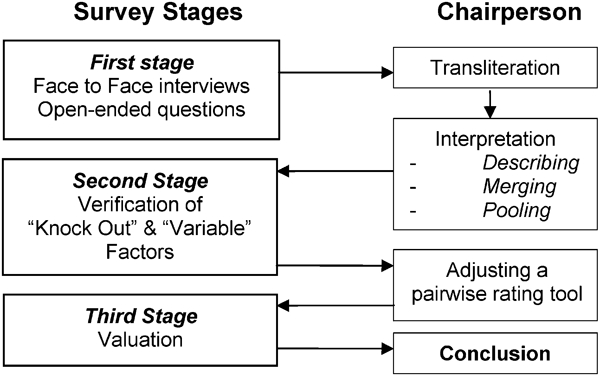
In order to optimise the research design (Fig. 1), according to the topic and the objectives of the study, we decided to deviate from the traditional Delphi methodology. A mixed (qualitative and quantitative) research design was developed.
Research design of study
While traditional Delphi surveys use questionnaires from the beginning to achieve anonymity of the participants, we decided to start the first survey stage with face to face interviews. The reasons leading to this decision were manifold. First of all, this approach followed the idea of starting the investigation as open and broad as possible. By applying qualitative face to face interviews (expert interviews), it was possible to introduce the topic of the study with very general open ended questions, while more specific questions would have increased the risk of biasing the results (e.g. compliance bias: always getting answers to specific questions asked, but nothing or less about other potential factors) or even overlooking important factors. Following such a qualitative approach using a questionnaire was critical as it would demand a very high level of participation from respondents to provide the comprehensive answersneeded. Furthermore, the face to face interviews allowed for clarifying any uncertainties and adding follow-up enquires. This aspect was crucial to speed up the research process by avoiding at least one additional feedback loop. Finally the face to face interviews allowed for personally introducing the study to the participants to ensure their motivation and willingness to contribute.
In this first stage of this survey, the participants had been face to face interviewed by one interviewer (the chairperson) with open ended questions mainly to identify and determine principal factors influencing the potential for phenol resin substitution. The interviews were structured in four sections:
general introduction:
introduction of the person and the company
link to lignin and phenol substitution
barriers:
possible explanations and reasons why lignin is not yet used in a widespread way
incentives:
expected or possible advantages of using lignin as a phenol substitute
future/outlook:
most needed developments or changes to increase phenol substitution by lignins in the next 10 years
percentage of phenolic resin that could be replaced worldwide by 2020
factors that determine this percentage
The personal interviews were audio recorded and thereafter transcribed. Based on these transcripts, principal factors influencing the potential for phenol resin substitution could be identified and determined. The interpretation of the factors by the chairperson (by pooling, merging and describing) was subject to verification and valuation in the subsequent stages of the survey which were performed in written (electronic) form.
In the second stage, a summary and interpretation of the preliminary results was sent to the same panel of experts. This verification process was necessary in order to deviate ‘knockout’ and ‘variable’ factors. ‘Knockout’ factors were defined and confirmed as basic requirements, which have to be fulfilled whenever technical lignin should be used as a substitution product for synthetic phenols in the wood based panels industry. By contrast, the so called ‘variable’ factors were defined as criteria that determine the dimension of the possible technical substitution potential.
Only after this second stage did it become clear which of the principal factors were ‘variable’ and hence could have been considered for valuation.
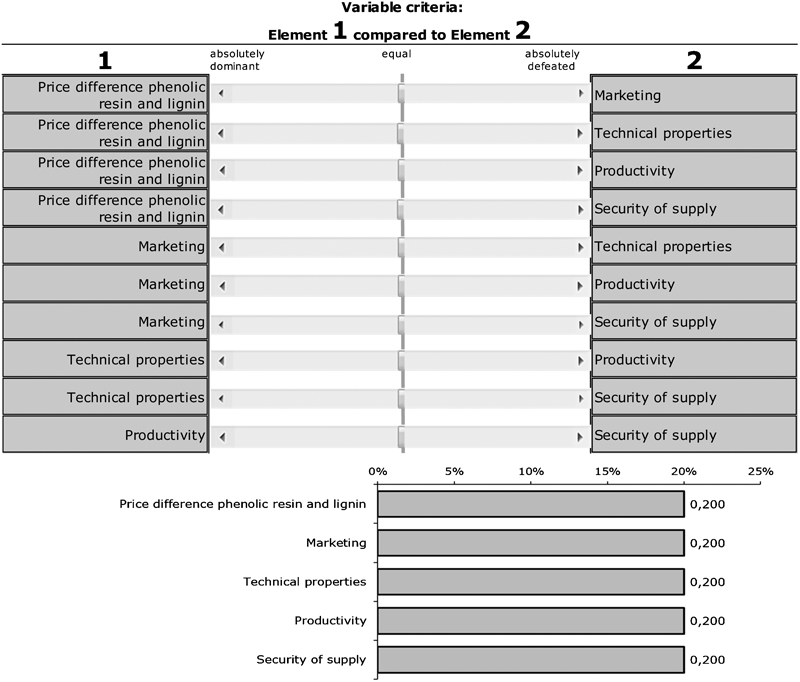
In the subsequent stage, the experts had to rate the importance of some of the factors previously identified by using an electronic tool developed by Meixner (Meixner and Haas 2002; Meixner 2003; Ameseder et al. 2008). This tool based on Microsoft Excel offers an input mask (Fig. 2) that requests a pairwise rating between two relevant factors. The respondents have to state how much one factor is overruling the other. As can been seen from Fig, 2, the respondents had to complete 10 pairwise ratings. While completing the ratings, the respondents could also see how their ratings were converted to factor loadings and a ranking at the end of the sheet. This allowed the respondents to change their previous rating in case they did not agree with the final result. At the same time, the tool was programmed to give a feedback sign in case the given ratings included a degree of inconsistency.
Input mask for rating variable factors in third stage of survey
The selection of experts is a key task in conducting Delphi studies. One major point is to ensure a reasonable variety of views and opinions within the limited number of experts existing and available. Furthermore, the respondents need of course an advanced level of experience and knowledge in the relevant field.
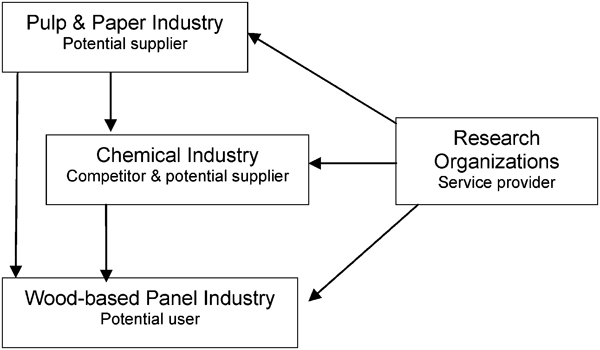
In order to fulfil the aim of covering a variety of views and opinions with a high level of expertise, we decided to expand the survey over three well involved industries plus research institutions with different perspectives regarding the topic (Fig. 3). While the wood based panel industry may use the lignin as a resin substitute and therefore would represent a user perspective in the study, other industries could provide different perspectives. Hence, besides the wood based panel industry the chemical industry was included to represent resin production. This industry may view lignin as a competing product as well as a new raw material source for new resin products. Anyhow, the chemical industry was expected to represent a very high level of relevant knowledge. Another relevant industrial branch in the context of this study is the pulping industry which could deliver the lignin and therefore covers the suppliers’ perspective. Finally, representatives from research organisations that are well known for conducting research in the field of phenolic resin substitution by technical lignin were chosen as another target group.
Role of involved industries and organisation
The survey was restricted to European countries (Austria, Switzerland, Germany and Sweden) to receive a manageable sample in terms of language, available time and performance results. As all companies and organisations were operating internationally, the results are not strictly restricted to this base area but to the limited sample only.
Fifteen experts were identified after a short search based mainly on industrial and research networks, like associations. All industrial experts were experienced representatives in management positions (e.g. Head of Production and Product Manager) from different international companies (Table 1). The representatives from the research organisations all had relevant publication records.
List of experts (anonymous) by branch, position and participation in three stage survey
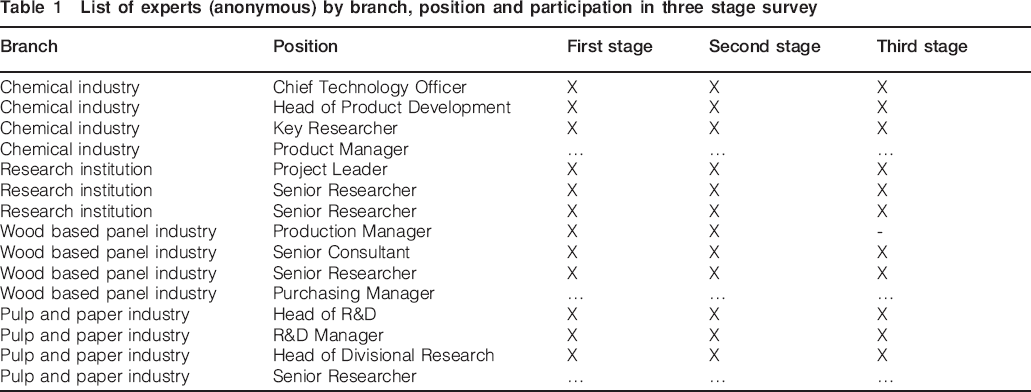
Three experts from each of these four groups (wood based panel, chemical and pulping industry as well as research organisations) agreed to participate in the study.
All interviews were conducted between November 2010 and February 2011.
Results
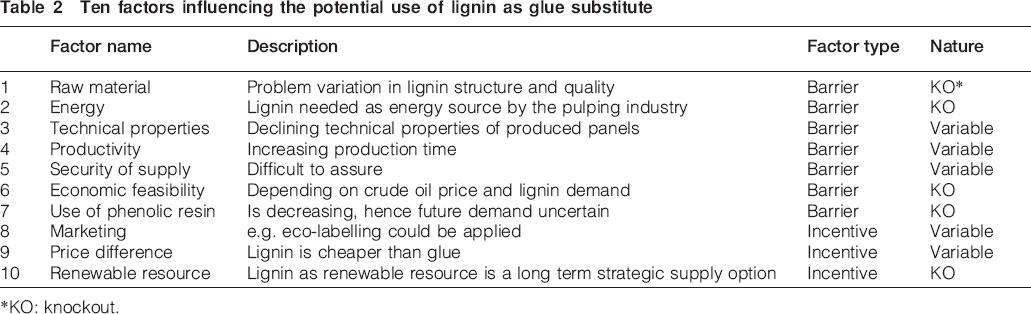
Based on the 12 interviews conducted during the first stage, 10 different factors have been identified as influencing the potential use of lignin as a resin substitute (Table 2).
Ten factors influencing the potential use of lignin as glue substitute
*KO: knockout.
Most commonly, the lignin itself was mentioned as a barrier. The reasons for this statement were that lignin is of a very heterogeneous structure and varying quality which are the reasons for the necessary process of lignin preparation.
Second, it was mentioned that the pulp industry currently needs most of the lignin as a source of energy in their own processes.
In general, the lignin is known to reduce the technical properties of the produced wood based panels. Furthermore, it increases the production time at pressing and hence increases costs. It was also mentioned that security of supply is seen as another barrier. It was expected that several (at least two) suppliers would be needed as a minimum to ensure competition and continued supply in the requested quality. Some of the experts also questioned if the use of lignin could really achieve economic feasibility. Cheap oil on the one hand and possibly increasing price of lignin on the other hand could cause such a barrier. Finally, it was stated that the use of phenolic resins in the wood based panel industry is declining and hence, the demand for lignin as a potential substitute is decreasing too.
The main incentive for considering lignin as a potential substitute for phenolic resins was of course the lower price. Some of the experts also mentioned the possibility of adding some kind of eco-labelling or other marketing incentives that could be established for wood based panels with lignin. In general, the experts mentioned that the substitution of fossil resources by renewable ones is basically an incentive from a longer term strategic perspective.
Altogether these factors were confirmed and differentiated in five ‘knockout’ and five ‘variable criteria’ during the second round.
Knockout criteria
These criteria were defined and confirmed as basic requirements which have to be fulfilled when technical lignin should be used as a substitution product for synthetic phenols. These were:
basic idea: The whole idea of the phenol resin substitution by technical lignin is based on the fundamental goal of replacing fossil oil and the cascading use of wood. Hence, this substitution is the basic incentive. All developments or solutions not aiming at the fulfilment of this fundamental goal are out of scope
Kraft lignin: Currently, technical lignin from the sulphate (Kraft) process is more suitable for further processing than lignin from the sulphite process. This is because they are more available and they have a higher number of reactive phenolic hydroxyl groups. All practical considerations are consequently focused on Kraft lignin only
treatment: The most frequently mentioned barrier was the lignin itself. As a renewable resource there is a high variation in structure and quality, which means that an intensive treatment has to be applied in order to homogenise the lignin before it can be applied
energy from lignin: The pulp industry uses the black liquor containing the lignin to cover their energy needs/needs lignin from the process to cover their energy needs. If lignin is taken out of the process, another resource may be needed for the production of energy. This would entail additional effort and costs. Therefore, increasing energy efficiency in the pulping process is an important prerequisite for utilising lignin
consumption of phenolic resins: In the wood based panel industry, the consumption of phenol formaldehyde resins has been found to decrease in recent years because of price, technical and optical properties. Hence, a potential substitution by technical lignin is limited if there are already plenty of alternatives, which are cheaper on the one hand, and also have better performance in terms of use and appearance on the other hand.
Variable criteria
These criteria were defined to determine the dimension of the possible technical potential.
These criteria were:
technical properties: From a technical perspective, all the experts explained that the use of technical lignin in phenol resins does not improve the properties of the product. With increasing percentage of the substitution product, the properties of the material decrease enormously
security of supply: The problem of supply of the raw material lignin in a consistent quality is also often cited as a barrier. The experts considered that a certain number of suppliers are needed in order to facilitate basic competition among these. This would be necessary to build up a stable low price for lignin
price difference between phenolic resin and lignin: The potentially lower price for the raw material lignin is seen as a major incentive by almost all experts. Thus, the substitution of phenolic resins by technical lignin is enforced if the price difference between these materials reaches a certain level and remains constant
productivity: The use of the substitution product leads to an increasing press time and press temperature. This reduces the productivity and therefore increases the production costs
marketing: The experts generally agreed that they see a potential to increase sales through the introduction of an eco-label for wood based panels using technical lignin.
Rating of variable criteria
After the total ten factors were confirmed as either ‘knock out’ or ‘variable’ factors, the panel of experts was asked to provide a valuation of the ‘variable’ criteria (technical properties, security of supply, price difference, productivity and marketing) using an electronic tool. As a prerequisite for this valuation of the ‘variable’ factors, the ‘knockout’ factors (basic idea, Kraft lignin, treatment, energy from lignin and consumption of phenolic resins) were of course assumed to be fulfilled. The tool (Fig. 2) allowed a pairwise comparison of the five ‘variable’ factors. The experts had to state their view on the relative importance of one factor compared with each other (e.g. technical properties versus security of supply) (see the section on ‘Methodology’).
Overall, all the experts rated technical properties highest. This result is unsurprising when taking into account the focus of research in this field so far. The security of supply, price difference and productivity were estimated very close to each other. As shown in Fig. 4, marketing was rated considerably lower than all the other criteria.
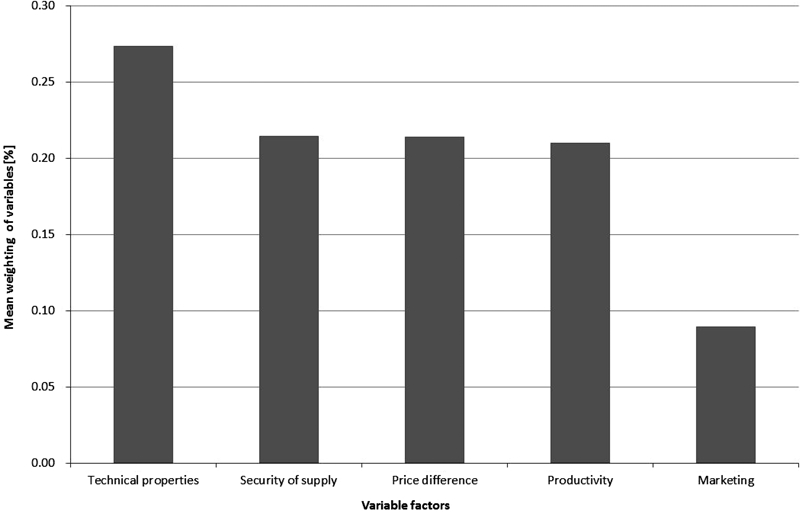
Overall rating in per cent weight of five variable factors (n = 11)
Difference between fields of expertise
The experts of the pulp and paper as well as of the chemical industry agreed that the properties of the final product and the security of supply are more important than price difference and marketing.
In contrast, the experts of technical research somehow had an opposite opinion (Fig. 5). They estimated the influence of marketing and price difference much higher than the experts from industry. This is a result that may be seen as a typical difference between respondents closer to the daily business operations and the more strategic point of view typically expected from research experts.
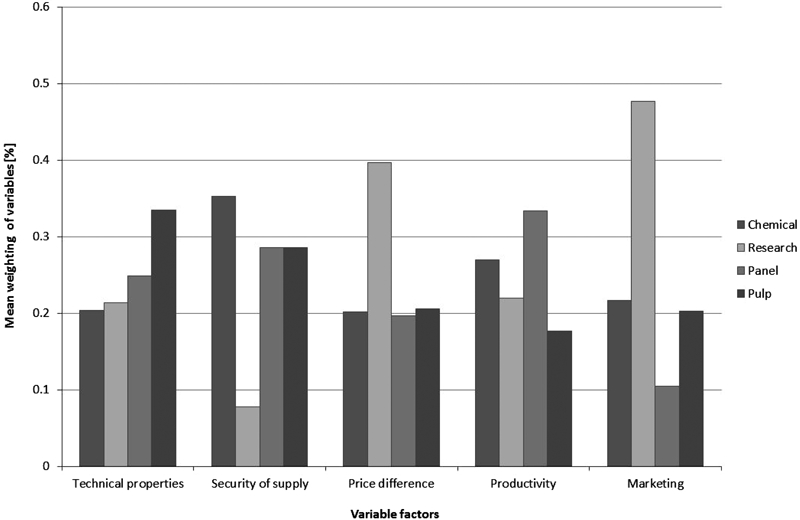
Rating in per cent weight of five variable factors by different groups of experts (n = 11)
In a similar way, the wood based panel industry rated productivity higher than other fields.
The largest differences could be obtained by comparing the rating of the security of supply between the technical research and all industry respondents.
Conclusions
Depending on the fulfilment of the identified criteria, experts expected 10–30% of the phenolic resin to be potentially substituted by technical lignin within the next 10 years. In order to achieve this, both industry and research and development will need increased focus on the security of supply. This is a topic sometimes investigated in the context of biomass and bioenergy supply (Bauen et al. 2010), but not yet in the context of lignin utilisation.
Published research results mainly focus on technical properties (e.g. Olivares et al. 1995; Calve et al. 1988; Sellers 2001; Lora and Glasser 2002, Sellers et al. 2004; El Mansouri and Salvado 2006; Tejado et al. 2007) and also some on productivity (e.g. El Mansouri et al. 2007a; El Mansouri et al. 2007b). This reflects the high importance of these topics. The research and dissemination of results on productivity and technical properties needs to be continued as it seems that the results so far have not reached a completely satisfactory level.
The difficulties in overcoming the identified barriers are various and complex which become extremely clear in the case of oil price relations. As crude oil prices rise, the economic feasibility of using lignin as a phenol substitute in wood based panels (stage of demand) will increase. In the same situation, the feasibility of lignin supply may decrease due to increasing energy costs in the pulp and paper industries which usually use lignin as a major energy source. Further research will be needed on this subject, which is indeed closely related to the matter of security of supply.
Seven out of 10 identified impact factors can be considered to act as barriers to substitution of resins by technical lignin. Hence, it is not surprising that the developed technology is suffering from a lack of general practical introduction. These barriers are what prevent the application of technical lignin in the wood based panel industry today (answer on Q1).
Of course, the study also identified three incentives that would help to foster the implementation of the new technology. Overall, these incentives have been found to not fully compensate for the impact of existing barriers at the moment (answer on Q2). Therefore, it is possible to conclude that the current situation is more a consequence of the existing barriers than of the lack of incentives. Overcoming the dominating barriers by research and development based solutions seems to be possible in some cases. Increasing energy efficiency in the pulp and paper industry for example would be a necessary prerequisite. Productivity, economic efficiency and supply chain management are further topics that may be promising in this context. Although the analysis shows that the different industries involved have quite similar views on the importance of the most variable factors, it seems that security of supply is underestimated by the research organisations (answer on Q3). Representatives from research organisations were focusing a lot on the factors of price difference and marketing. As these factors are representing the major potential incentives for the technology, it seems a good possible explanation why much research has been undertaken on this topic.
However, there are several limitations to be considered in the context of this study. Only a small number of experts participated in the survey which was restricted to European countries only. Although the experts were representing companies and organisations that are internationally operating, the results of this study cannot be generalised. However, the factors identified in this study could be taken for more representative and quantitative studies.
However, the multistage expert interview approach applied in this study turned out to be very suitable for investigating innovation barriers when several various players (different industries and research organisations) are involved. The approach presented should be applied to other cases of deadlocked innovations and further developed, e.g. by integrating additional survey steps towards overcoming innovation barriers.
With new biorefinery projects and processes coming up, it is very likely that upgraded products based on technical lignin will offer better technical properties and higher productivity for this application (e.g. El Mansouri et al. 2007a, b). Crude oil prices are very likely to increase in the long term and are therefore a perspective of feasible price differences between conventional resin and technical lignin prices. Finally, we conclude that the security of supply is a topic which in this context has so far been underestimated. This topic should be addressed in new research and development projects including innovative management approaches. This study made a starting point in investigating the important field of innovation barriers in the field of technology development in the context of wood biorefineries.
Footnotes
Acknowledgements
The authors would like to thank Professor O. Meixner for his assistance with the survey tool. The research leading to these results has received funding from the European Community's Seventh Framework Programme FP7/2007–2013 under grant agreement no. CP-IP 228589-2 AFORE and the Austrian Federal Ministry of Science and Research under grant agreement no. 651·432/0001-II/2/2009.