







Abstract
Wood compositional changes during thermal modification follow a characteristic trajectory when mapped in a van Krevelen diagram. The trajectories of widely different wood species appear to merge into a single master curve, suggesting a common thermal modification chemistry shared by these wood species. The largest effect of thermal modification on the chemical composition can be explained by dehydration reactions, followed by decarboxylation reactions. A carbon valence electron donor–acceptor model is proposed, which relates the observed compositional changes to changes in polarity and redox character, which in turn are related to the characteristic hydrophobic and fungal resistance effects on wood by thermal modification.
Keywords
Introduction
Thermal wood modification (Hill 2006) is the most commercialised as well as the most investigated method for modifying wood composition. Despite of this status, there are many remaining scientific questions concerning the complex thermal modification chemistry. Unexpectedly, CHN(O) elemental analysis on various thermally modified wood species, has revealed an interesting universality in composition, as well as in correlation with a number of characteristic material properties (Chaouch et al. 2010). The latter study was focussed on the use of the elemental analysis method to identify a fungal resistance performance marker for thermally modified wood. It motivated the authors to study a postulated fundamental link between the elemental composition and certain characteristic properties of heat treated wood.
It will be shown in this paper that theoretical relations can be derived, connecting the elemental CHO composition of wood to the equilibrium moisture content and the fungal resistance of thermally modified wood (following the EN113 European test standard). An analysis of thermal wood modification chemistry via the van Krevelen diagram (explained below) will provide some essential insights on the nature of wood compositional changes, which can consecutively be used for modelling of hygroscopic and durability properties of heat treated wood from elemental composition. The derived theoretical models are verified using experimental data from literature.
Methods
van Krevelen diagram
In this work, the empirical chemical formula CHyOx is used to represent oven-dried ash-free wood (y≈2x and x>0·4). Parameters x and y (molar O/C resp. H/C ratios) are used as the coordinates in a compositional state diagram (van Krevelen 1950, Fig. 1). The diagonal line y = 2x (Fig. 1) plays a central role in the present work as a neutral reference representing carbohydrates C(H2O)x. All points above this line (i.e. y>2x) are hydrogen rich (reduced), whereas all points below are oxygen rich (oxidised), with respect to carbohydrates. For later convenience, a new variable Z = 2x−y is introduced. |Z| = |2x−y| is the vertical distance of any point (x, y) to the Z = 0 reference line. Native wood (open circle) is generally slightly reduced – with heat treatment progressively more reduced; lignin is most reduced.
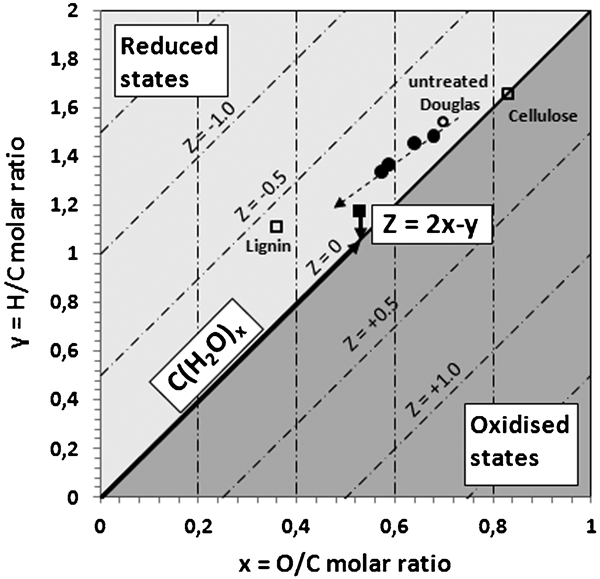
van Krevelen diagram, a molar elemental ratio state diagram to map the composition of CHyOx compounds, using y = H/C and x = O/C as the coordinates. Z = 2x−y is a definition. Carbohydrates C(H2O)x satisfy the Z = 0 reference condition. The dark/light shaded areas (Z>0/Z<0) contain compounds that are relatively oxidised/reduced with respect to carbohydrates. Douglas fir (open circle: untreated, closed circles: heat treated, data from Lam (2011)) follows a characteristic trajectory on heat treatment (broken line with arrow indicating the direction of increased degree of thermal modification)
In the case of changing composition ratios, as occurs during thermal modification, corresponding trajectories can be visualised in the van Krevelen diagram (e.g. the broken line with an arrow pointing the direction of increasing degree of thermal modification Fig. 1). Wood is a composite of polysaccharides and lignin, each having considerably different compositions; still it can be represented by a single point in the van Krevelen diagram, being the molar weighted average of its components. Hence, on polysaccharide removal, wood composition will become more lignin-like. However, the measured composition changes in thermally modified wood are accompanied by mass losses (typ. <15%) that are far too small to explain the observed composition change by a removal of hemicelluloses (needing >50% removed, Willems et al. 2013b). On the other hand, thermal modification composition changes can be explained from a limited number of elimination reactions (see Table 1).
Calculated effect of various known elimination reaction products on elemental composition of wood CHyOx with initial composition: x = 0·72 and y = 1·55. ΔZ = 2(Δx)−Δy and Δx (last two columns) are calculated for typically measured yields (willow 250°C, 30 min, 12·8% dry mass loss, given in middle column: Prins 2005) of each elimination product
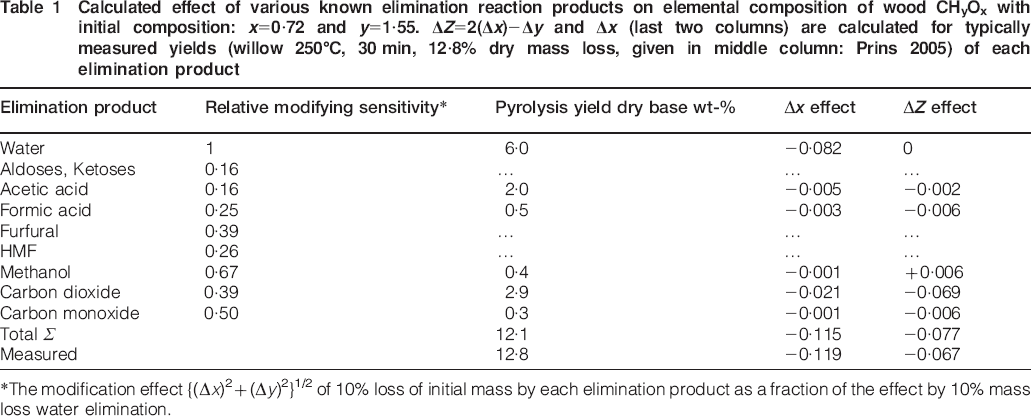
*The modification effect {(Δx)2+(Δy)2}1/2 of 10% loss of initial mass by each elimination product as a fraction of the effect by 10% mass loss water elimination.
The actually measured Δx and ΔZ (Table 1, last row, data Prins (2005)) correspond well within experimental inaccuracy to the calculated effects of the measured pyrolysis products. About 0·7% of the dry mass loss is unaccounted for in the table, containing various organic substances, each less than 0·1% of the dry mass. It follows that water and carbon dioxide elimination are the main composition modifiers. Following the thermal modification trajectory (Fig. 1) it may be noted that it runs roughly parallel to the carbohydrate reference line Z = 0 (due to overall dehydration), but progressively deviates to more reduced states (Z<0, due to decarboxylation).
Theory on relation between composition changes and modified polarity and redox character of wood
Thermal modification has a pronounced effect on the chemical reactivity of carbon atoms in the organic substance, which is reflected in the average oxidation state of carbon and can be shown to be exactly given by Z (Fig. 2).
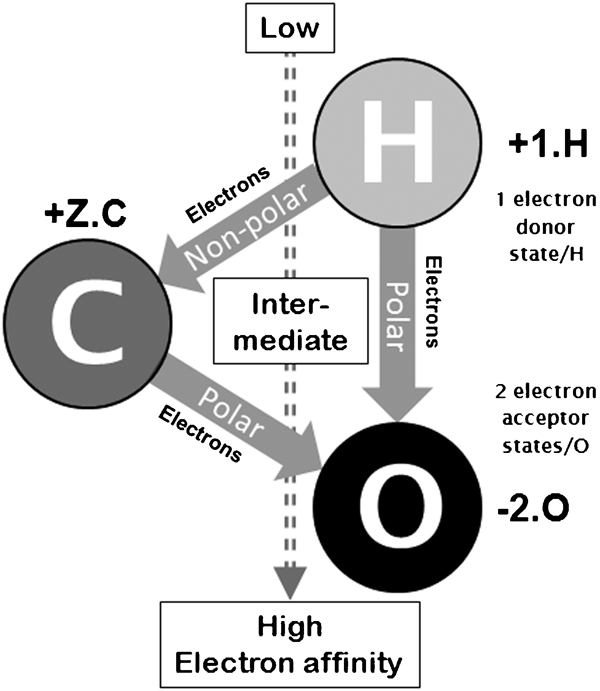
The average oxidation state of carbon. The electron affinity differences in the CHO elements makes electrons shift (1 donation per H atom and 2 acceptances per O atom) causing a formal charge on the carbon atoms, that follows from molecular charge neutrality condition: +ZC+1H–2O = 0, hence Z = 2(O/C)−(H/C), which is equal to the definition of Z = 2x−y in Fig. 1. The polarity of wood is caused by the highly electronegative oxygen atoms
The oxidation of an organic compound involves the transfer of an electron pair from the organic to the oxidising species (Fig. 3), which is most likely molecular oxygen O2 in an aerobic environment. The thermodynamically favoured reaction of O2 for all organic compounds is due to the very large negative Gibbs free energy of the reduction half-reaction ΔGC,red of O2 to H2O. LaRowe and van Cappellen (2011) found that the Gibbs free energy of the oxidation half-reaction of organic substance ΔGC,ox (kJ/mol C) is positive (i.e. must be activated) and correlates (equation (1)) strongly with the average oxidation state of carbon Z


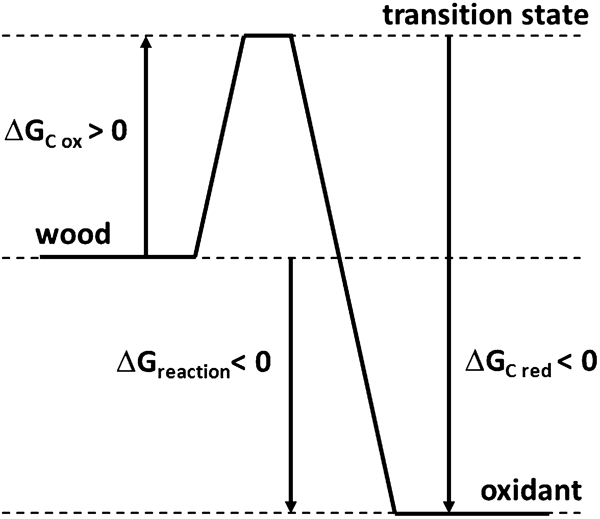
Electron energy state diagram explaining the relation between the Gibbs free energies of the overall reaction ΔGreaction, the oxidation half-reaction ΔGC,ox and the reduction half-reaction ΔGC,red.. Oxidation involves the transfer of an electron pair from wood via the transition state to the oxidant
The correlation equation (1) states that the oxidation stability of wood increases (increase of ΔGC,ox) by chemically reducing wood (ΔZ<0), as occurs during thermal modification of wood. This trend will below be correlated quantitatively using thermally modified wood durability data from literature. First, another property of thermally modified wood will be analysed, the moisture sorption behavior, which is related to the polarity of wood.
Wood polysaccharides are highly polar substances as a result of the high content of electronegative oxygen (Fig. 2). During heat treatment the oxygen content is decreased via an overall dehydration type reaction (Fig. 1), decreasing the polarity of the polysaccharides. From the non-polarity of covalent C-H and C-C bonds, it follows that the (fractional) number of polar sites per carbon atom is given by the O/C ratio.
Interestingly, the chemical formula CHyOx may be formally split into a ‘polar part’ C(H2O)x and a ‘redox part’ CH-Z, where x gives the average number of polar sites per carbon and Z gives the average oxidation state of carbon:

Results
Application of theory to analysis of moisture sorption isotherms
The average number of polar sites per carbon atom, the molar polarity, is directly given by the O/C ratio for wood (Fig. 2). It is convenient to compare this molar polarity to the molar moisture content (moles of adsorbed water per mole carbon) calculated from the wood moisture content, using the molar mass (g/mol C) of CHyOx wood


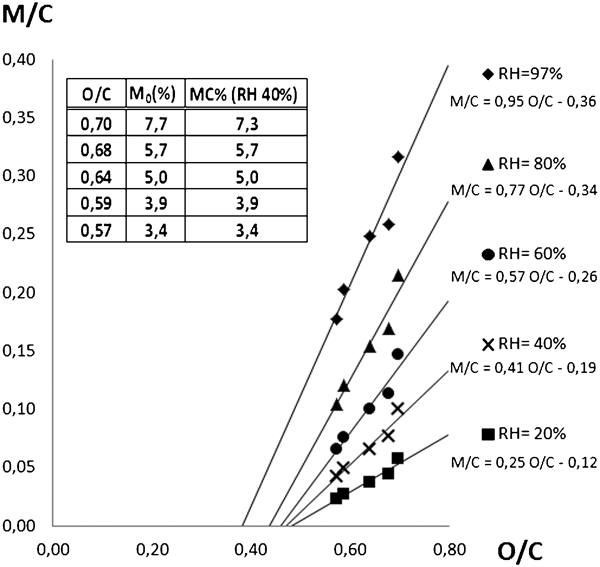
Heat treated Douglas fir (Lam 2011). The molar moisture content M/C (equation (4)) versus O/C trends are linear for all relative humidity (RH) and reach M/C = 0 via extrapolation at O/C = 0·40–0·50, instead of O/C = 0 (no polar sites). The slopes of the linear trend lines are equal to the occupancy of accessible sorption sites. The table inset shows the hydration moisture content M0 from Hailwood–Horrobin moisture sorption analysis (Skaar 1988) as well as the moisture contents at RH = 40% for comparison
Not all polar sites in wood can act as water sorption sites, since there are inaccessible domains in the wood ultrastructure (Fengel and Wegener 1983; Englund et al. 2012). The non-zero (O/C = 0·4–0·5) intercept of the linear trend lines at M/C = 0 confirms that a part of the polar sites are not involved in the moisture sorption process (Fig. 4). These domains appear stable during heat treatment, whereas the relative humidity can reversibly change the inaccessible polar site density. For a full discussion on this effect by humidity the reader is referred to Willems et al. (2013a).
The slopes of the linear trends (Fig. 4) represent the change in molar moisture content (M/C) with the change in polar sites (O/C), which is the occupancy of polar sites. Remarkably, the occupancy is close to 1·0 at RH = 100% instead of RH = 40%. The latter may be expected from the observation that the moisture contents at RH = 40% are close to the monolayer moisture content, determined from Hailwood–Horrobin isotherm analysis (see table inset Fig. 4). Similar discrepancies were noted in other studies comparing the Hailwood–Horrobin isotherm monolayer moisture content with sorption site densities (Englund et al. 2012). On the other hand, sorption studies on a well defined linear hydroxyl polymer, poly vinyl alcohol, studied by differential scanning calorimetry (DCS) and fourier transform infra-red spectroscopy (FTIR), showed that hydroxyl groups act as a single water sorption sites, reaching full occupation at unity water activity (Ping et al. 2001).
Application of theory to model durability of thermally modified wood
The complementary property of wood polarity is the average oxidation state of wood carbon Z, which can be related to the chemical oxidation stability (see theory section)


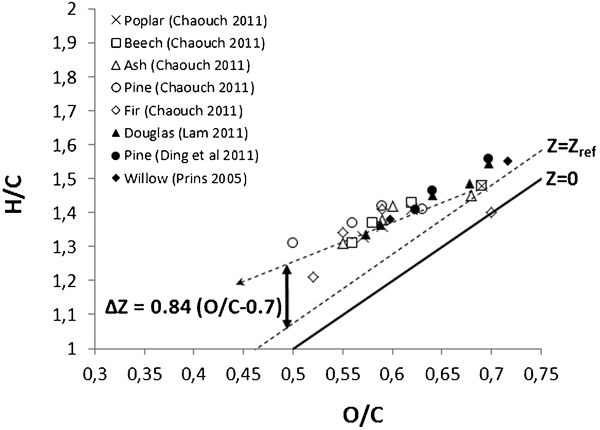
van Krevelen diagram for eight wood species from four different sources, showing universal correlation
In an accelerated wood durability test, such as the European standard test EN113, optimal conditions for growth of the most aggressive types of Basidiomycetes are ensured, to measure the decay of a test specimen in comparison with a non-durable reference, quantified by the so called ‘X-value’, being the ratio of weight loss WL of a test specimen to that of a reference specimen, measured after 16 weeks of fungal exposure. Applying a linear approximation, the ratio of weights losses may be expressed as the ratio of weight loss rates k


Taking the ratio of the oxidation rates for some heat treated wood species under test ktest and kref for the untreated wood species as a reference, it follows that all undetermined constants k0 (equation (8)) and Ea0 (equation (1)) are divided out, giving a result that is only dependent on ΔZ = Ztest–Zref and the factor 28·5 kJ mol−1 (equation (1)) with RT = 2·45 kJ mol−1


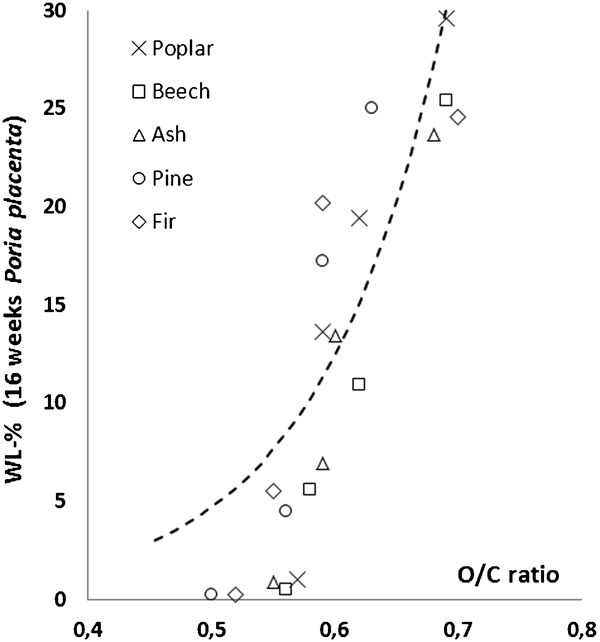
Comparison of EN113 weight losses caused by 16 weeks of Poria placenta exposure on five wood species in relation to O/C ratio (data Chaouch (2011)) and our predicted relation (broken line), based on relative oxidation rates, calculated from equation (10)
Discussion
Heat treatment is a method to modify the chemical composition of wood, whereby many physical and chemical properties are altered, notably the fungal resistance, hygroscopicity, colour and strength. Hemicelluloses are being depolymerised and deacetylated via hydrolysis (Hill 2006), leaving the redox state Z unchanged. Proximate wood analysis data can be successfully correlated with the strength properties of wood and changes therein made by pyrolysis (Rowell 1984). On the other hand, the correlation of durability with proximate analysis data of thermally modified wood is weak compared to correlations with elemental composition (Chaouch et al. 2010).
The thermal mass loss is often referred to as a ‘hemicellulose loss’. The van Krevelen diagram and yield data (Fig. 1, Table 1), however, show that predominantly water and carbon dioxide are being lost. Dehydration reactions are indeed to be expected under the prevailing acid high temperature treatment conditions (Fengel and Wegener 1983). The typical carbon dioxide yield (Prins 2005) is (nearly 10 times) too large to subscribe to the combustion of cell wall components by residual oxygen in the free reactor space and wood pore volume.
It was shown in the van Krevelen diagram and subsequent analysis, that the thermal modification trajectory may be broken-down into dehydration and decarboxylation parts. The former is related to the polarity changes and the latter mainly to the changed redox properties of the wood. The hydration- and redox-state of lignocellulose can be characterised by two independent elemental ratio based parameters: x = (O/C), the molar polarity, and Z = 2(O/C)−(H/C), the average carbon oxidation state, with typical values 0·5<x<1 and |Z|<0·5 for lignocellulose (heat treated or not). It was shown in theoretical models using these state variables that O/C has a direct relation to moisture sorption isotherms and that Z has a direct relation to chemical oxidation rates – tentatively connected to the durability of wood against Basiodiomycetes.
A strong, linear correlation between O/C and H/C in thermally modified wood was noted in this study (Fig. 5), meaning that dehydration and decarboxylation reactions are somehow linked to each other. This may be understood from the formation of new carbonyl groups (Nuopponen et al. 2004) as a result of dehydration which, in case that they become located at the β-position, may destabilise carboxyl groups (McMurry 2008). A correlation between O/C and H/C may also explain how the principally independent (see equation (2)) changes in the sorption behaviour and durability become linked in thermally modified wood (Tjeerdsma et al. 1998).
Experimental data on the molar moisture content M/C show a steep dependence on O/C, reaching M/C = 0 via extrapolation at O/C≈0·45 (Fig. 4) instead of O/C = 0 (no polar sites). Apparently, a significant part of the polar sites cannot be occupied by sorption water, which may be explained by water inaccessible domains in the microfibrils (Englund et al. 2012). The occupancy of the accessible polar sites was determined in this study and revealed that the routine multilayer surface sorption isotherm analysis seems physically incorrect for wood moisture sorption. A full discussion on this result and its interesting consequences is given in another paper (Willems et al. 2013a).
For the first time, a parameter free quantitative model was developed for calculating durability of thermally modified wood. The calculated effect of the change in average carbon oxidation state Z along the thermal modification trajectory, and its sequential effect on the activation energy of oxidation, was found reasonably consistent with the experimentally observed correlation between fungal decay weight loss and the O/C ratio (Chaouch 2011, Fig. 6). Increasing antioxidant behaviour with heat treatment intensity has indeed been independently reported for a number of wood species using electron spin resonance spectroscopy (ESR) and a DPPH assay (Ahajji et al. 2009) and has been successfully correlated with standardised durability test results using ESR and a TEMPOL assay (Willems et al. 2010). A full discussion on the correlation between durability and the O/C ratio with respect to environmental effects, the durability test procedure and possible other reasons for the durability of thermally modified wood are given in another paper (Willems et al. 2013b).
Conclusion
The most important effects of thermal modification on wood, regarding its durability and moisture sorption capacity, may be characterised and understood from the changes in its elemental composition. The van Krevelen diagram appears to be a valuable tool to visualise these compositional changes, helping to identify the most relevant thermochemical reactions and their effect on certain wood properties.
Footnotes