







Abstract
Improving the durability of exterior coatings is essential for the use and development of wood as a building material. In Europe, performances of wood coatings are mainly estimated through visual assessments of panels exposed to weathering. The aim of this work was to investigate the Persoz pendulum as a simple tool to gain information on hardness and mechanical properties of exterior wood coatings. The influence of the substrate and the coating thickness has been studied to figure out the limits of the test method. Through a comparison with tensile tests performed on free films, Persoz pendulum was found to be relevant as a simple tool to estimate mechanical properties of the coating film. Finally, Persoz hardness was assessed on several coatings exposed to 4032 h of artificial weathering. Results have shown that the pendulum hardness test is a useful method to study wood coatings performances for outdoors.
Introduction
When used outdoors, wood is subject to fluctuating conditions between dry and wet periods which lead to its deformation in the three directions (Simpson and TenWolde 1999). That is why in addition to their decorative effects, coatings are recommended to decrease wood moisture content and limit water ingress. Nevertheless coatings may be stressed by dimensional variations of wood even if they have been reduced. These deformations lead to cracks especially if the coating is too hard (Podgorski and Merlin 2001). For clear coatings, mechanisms of failure were recently reviewed (Evans et al. 2014). De Meijer and Nienhuis (2009) studied the interaction between physical paint properties and dimensional change of coated wood to understand cracks formation. They found that the ratio between maximum stress and extensibility was a good predicator of crack formation. On the opposite, a too soft coating may not be suitable to protect wood against mechanical impacts such as hail.
In Europe, performances of exterior wood coatings are evaluated according to the standards of the EN 927 series: several visual parameters (flaking, cracking, blistering, chalking, general appearance and mould growth), adhesion, colour and gloss changes are assessed after 1 year of natural weathering at 45° facing south. Additional information on barrier properties towards liquid water is obtained thanks to the test method described in the standard EN 927-5. For these parameters (except general appearance, gloss, colour and mould growth), limit values have been established and included in the standard EN 927-2. Wood coatings performances strongly depend on physical properties of the film and despite their significant influence on performances, mechanical properties of coatings are not assessed in the European framework.
Sato (1980) showed that hardness test is one of the different methods to evaluate mechanical properties of coatings. Coating hardness is defined as the ability to resist permanent indentation, scratching, cutting and penetration by a hard object (Koleske 2006). The definition of this term is difficult because its meaning is different according to the experiment. In paint industry, hardness is a major parameter used to control products performance. Different experiments may be used to assess hardness like indentation, scratch and damping tests. Indentation tests determine the resistance of the coating film to penetration by an object (Sato 1980). Brinell and Rockwell hardness tests belong to this category. Indentation tests are not often used with coatings because of the low thickness of the film which implies the use of sensitive microhardness meter to reduce the influence of the support hardness. Scratch tests include pencil hardness test and Bierbaum test. This latter uses a prismatic diamond cube as an indenter and is more used for plastics whereas pencil hardness test is widely used in the paint industry. Finally, damping tests refer to an indenter doing a reciprocating rocking movement on a horizontal coating. Choi and Kim (2006) studied the difference of sensitivity of three test methods: microhardness, pencil hardness and pendulum hardness test on UV curable acrylate epoxy coatings. They showed that microhardness was the most sensitive test followed by pendulum hardness. Pencil test was the least sensitive. Pendulum hardness is often chosen in the paint industry for its ease of use. In Japan and the United States, the Sward rocker is often selected whereas in Europe, the König and the Persoz pendulums are used. The Sward Rocker hardness measurement is based on the amplitude of the oscillation of a rocking device. The König and the Persoz pendulums refer to the same type of apparatus but they consider different fraction of amplitude. The amplitude of swing decreases from 6° to 3° for the König pendulum and from 12° to 4° for the Persoz pendulum. Compared to the König pendulum, the Persoz pendulum is particularly useful with relatively soft organic coatings (Koleske 1995). The use of this instrument to study performance of exterior wood coatings exposed to 2016 h of artificial weathering (EN 927-6) and 1 year of natural weathering (EN 927-3) has recently been presented (Malassenet, Podgorski, George and Merlin 2014). The authors showed that a low initial Persoz hardness with little change owing to weathering seemed to be required to ensure good performances.
Pendulum method is often used to follow cross-linking degree of coatings (Valet 1999; Rodriguez, Gracenea, Kudama Suay, 2004; Huang et al. 2014). Mirone, Marton and Vancso (2004) used the tensile modulus to comprehend cross-linking. They explained that elastic modulus (E) is proportional to cross-link density according to the following formula

The aim of this work was to investigate the Persoz pendulum as a simple tool to give first evidence on mechanical properties of exterior wood coatings in addition to tensile tests carried out on free films. In a first part, this paper discusses the advantages and the limits of the test method through the study of the influence of the substrate and the coating thickness. Then, tensile test results on free films are presented in order to compare the physical and mechanical methods to evaluate viscoelastic properties of exterior wood coatings. Finally, performances and Persoz hardness of coatings exposed for up to 4032 h of artificial weathering are analysed.
Materials and methods
Substrates
Scots pine sapwood (Pinus sylvestris) has been selected to fulfil the requirements of the standard EN 927-6 and was free from knots, cracks and resinous streaks. Inclination of the growth rings to the face was 5° to 45°. One set of oak heartwood (Quercus robur) and glass plates of 12 × 12 cm were also used as substrate. All samples were conditioned at 20 ± 2°C and 65 ± 5% of relative humidity for 2 weeks prior coating application.
Coatings application
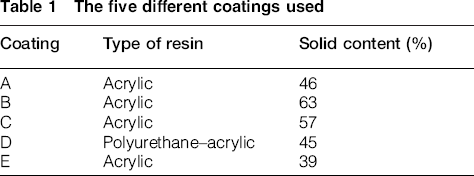
Four white paints (A, B, C and D) and one semi-transparent stain (E) were used. A, B, C and E were based on acrylic resins and D was based on a polyurethane–acrylic binder. All coatings were waterborne. They were applied in three layers according to the recommendations of the manufacturers. After coating application samples were conditioned at 20 ± 2°C and 65 ± 5% of relative humidity to let them dry. Some wood samples were left uncoated to assess the pendulum hardness of both species. Solid content is summed up in Table 1. Because A was available only in small amount, the use of this coating was restricted to the study of the influence of weathering on performance and hardness variation.
The five different coatings used
Persoz pendulum
The surface hardness of both coated and uncoated samples was assessed with the Persoz pendulum. As a deviation with EN ISO 1522, hardness was assessed for coatings applied on wood directly (and not on glass) in order to achieve a realistic film formation and to be able to study coated wood samples that have been exposed to weathering. Samples were positioned on a horizontal panel and the pendulum was placed on them thanks to two tungsten-carbide balls of 8 ± 0.005 mm diameter which were 50 ± 1 mm apart. The time for damping from 12° to 4° displacement was recorded and represented the hardness of the surface tested. The longer the damping time, the harder the coating. The pendulum was calibrated using a glass plate (without any coating) and checking that the damping time was 430 ± 15 s. Twelve measurements were performed for each combination species/coating/weathering time on samples that were conditioned at 20 ± 2°C and 65 ± 5% of relative humidity till constant mass.
Thickness measurement
Coated samples were cut in transversal sections which were refreshed with a blade. The thickness was measured (20 measurements per coating) along the section thanks to a binocular magnifier LEICA MZ8 and using the software LAS v3.7.
Free films
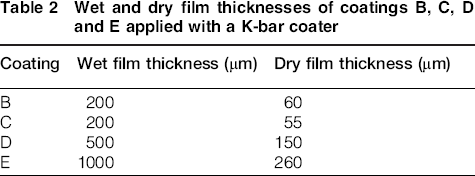
Coatings B, C, D and E were applied on silicon foils using a K-bar coater. Free films of A were not produced as explained above. Coatings were dried for 5 days in a controlled environment at 20 ± 2°C and 65 ± 5% of relative humidity. Then films were carefully detached by hand and cut to size (70 × 20 mm) using a scalpel. Different thicknesses were applied according to the ability of the coating to form a film on such a substrate. Wet and dry film thicknesses are summed up in Table 2.
Wet and dry film thicknesses of coatings B, C, D and E applied with a K-bar coater
Tensile tests
Mechanical properties of the free films were assessed using tensile tests. Samples had an overall length of 70 mm and width of 20 mm. Specimens were oriented longitudinally relative to the direction of film preparation. The specimens were conditioned at 20 ± 2°C and 65 ± 5% of relative humidity for 2 weeks before testing. A universal testing machine equipped with a 100 N load cell was used. Young's modulus was assessed as the parameter measuring the stiffness of the material and was determined in accordance with EN ISO 527-1. Gauge length was 50 mm and the crosshead speed was set to 10 mm min− 1. Five replicates were tested for each coating and average values were calculated.
Artificial weathering test
An artificial weathering test was performed in a QUV weathering device. Samples were exposed to 24 h of condensation at 45 ± 3°C followed by 48 cycles alternating 2.5 h of UV-A 340 nm and 0.5 h of water spray for a total of 1 week according to EN 927-6. Samples were removed for assessments after 12 and 24 weeks of exposure i.e 2016 and 4032 h and were conditioned at 20 ± 2°C and a relative humidity of 65 ± 5% for 2 weeks. Then different properties were assessed: flaking, cracking, chalking, gloss, colour and general appearance. Only cracking is discussed in the paper as a sign of a loss in the mechanical properties of the film. General appearance (as defined in EN 927-6) is also considered as it includes all the visual changes (including cracking). Cracking was evaluated from 0 to 5 according to EN ISO 4628-4, with 0 meaning no cracking and 5 severe cracking. General appearance was evaluated on the same scale (0–5) compared to the unexposed samples: 0 meaning no defect and 5 significant changes. Cracking and change of general appearance are reported as a mean of the four replicates exposed for each coating.
Results
Influence of the substrate on Persoz hardness results
According to EN ISO 1522, Persoz hardness is measured on coatings applied on glass. Nevertheless the formation of coating films may be different on glass and on a porous substrate like wood: for example, the flow of the coating is not the same on both substrates and the impregnation in the substrate is very different. That is why coatings B, C, D and E were applied in three layers on Scots pine, oak and glass in order to study the influence of the substrate on Persoz hardness results.
Persoz hardness results of uncoated Scots pine, oak and glass are presented in Fig. 1 which shows a big difference in glass hardness (430 s) compared to wood hardness (between 80 and 120 s for pine and oak, respectively).
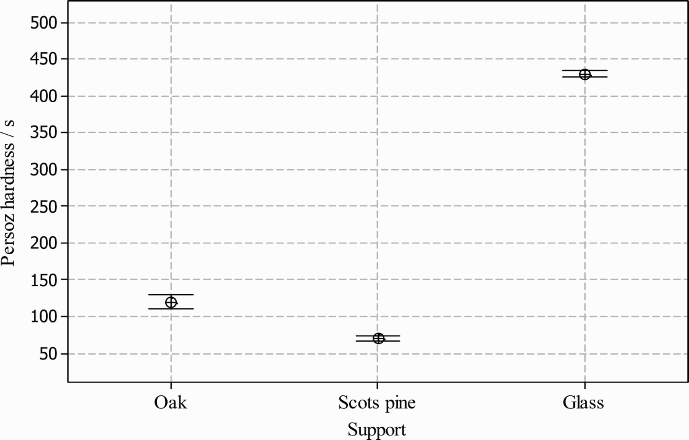
Persoz hardness of uncoated substrate (mean and 95% confidence interval)
Results of Persoz hardness for the four coatings applied on the three substrates are presented in Fig. 2.
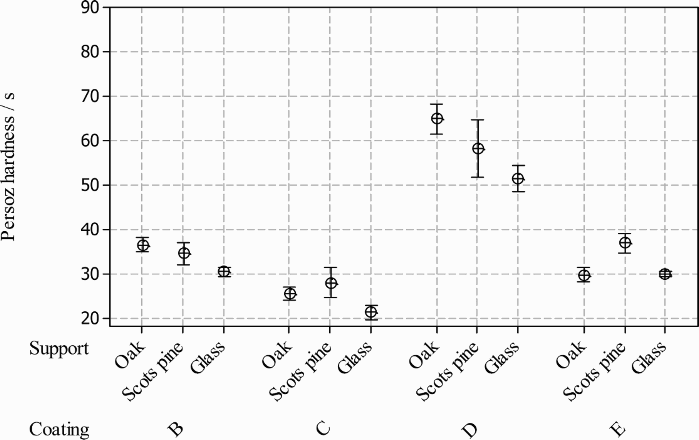
Influence of the substrate on Persoz hardness (mean and 95% confidence interval)
Figure 2 shows that Persoz hardness of coated substrates was lower compared with uncoated supports. Therefore hardness values for the system substrate + coating were mainly attributed to the coating hardness. Taking into account confidence intervals, each coating had very similar Persoz hardness whatever the support. The mean Persoz hardness for B and E varied from 30 to 35 s. The mean Persoz hardness of C was between 20 and 30 s and it varied from 50 to 65 s for D.
In conclusion, the results showed that measuring Persoz hardness on coated wood is pertinent and allows the study of samples that have been weathered in conditions representative of real end-uses. For coating dedicated to wood, it may be more appropriate to measure Persoz hardness on coating applied on wood than on glass because film formation may be influenced by some wood components as shown by Grüll, Forsthuber and Ecker (2014).
Influence of the coating thickness on Persoz hardness results
The influence of the coating thickness on Persoz hardness was studied. Coatings B, C, D and E were applied by brushing in one, two and three layers on Scots pine and Persoz hardness was assessed for all samples. Results are shown in Fig. 3.
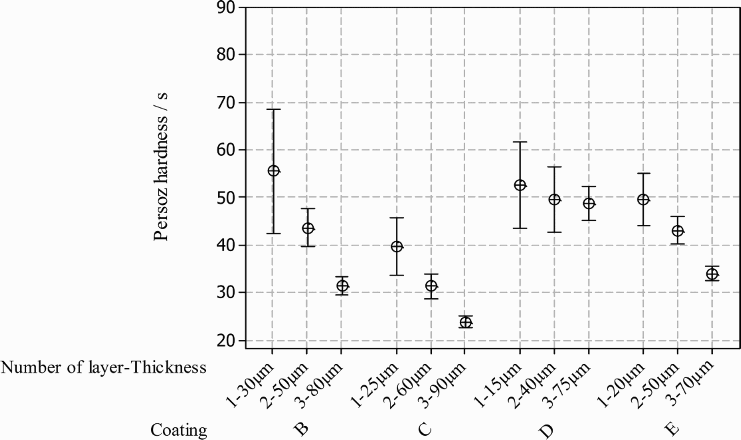
Influence of the coating thickness on Persoz hardness of several coatings applied on Scots pine (mean and 95% confidence interval)
Figure 3 shows that Persoz hardness decreased with the number of layers. This was expected as a sufficient thickness is required to form a regular coating film and reduce the influence of the wood substrate. Moreover, the confidence interval was bigger for one coat than for three coats. Indeed, the difference in wood anatomy and density between earlywood and latewood may have a more pronounced influence on the film regularity when the coating was applied in one coat. Therefore, a sufficient coating thickness is recommended to get reliable Persoz hardness results.
The decrease in Persoz hardness was more or less pronounced depending on the coating. The difference of dry film thickness could be a hypothesis to explain it.
As illustrated in Fig. 3, the decrease in Persoz hardness with the dry film thickness was less pronounced with coating D. This coating had almost the same hardness for a thickness range from 30 to 70 μm, whereas a significant decrease in Persoz hardness between these two thicknesses was observed for the other coatings. For coating D, thickness did not have a major influence on Persoz hardness which was constant. D was the only coating made of a polyurethane–acrylic binder; the presence of polyurethane could have a major influence on hardness and explain this behaviour.
Mechanical significance of Persoz hardness test
For each coating, B, C, D and E, tensile tests were performed on five free films. Persoz hardness was also assessed on these four coatings applied on Scots pine (five measurements for each coating). The same experiments were performed with an extra set of seven formulations made of acrylic resins. In Fig. 4, the mean Persoz hardness of coated wood has been plotted versus the mean Young's modulus of free films for coatings B, C, D and E and the seven acrylic formulations.
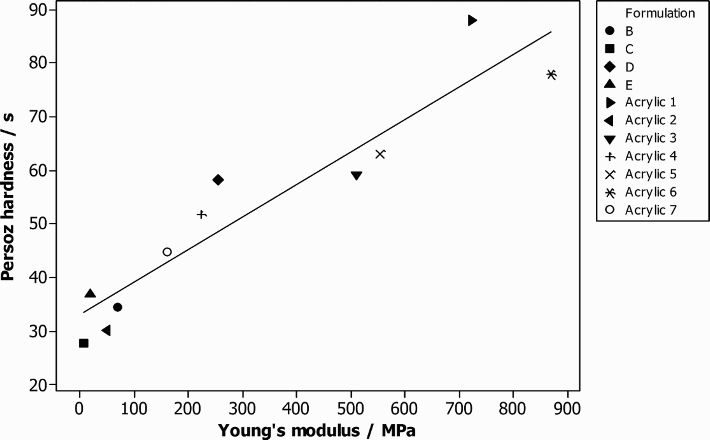
Mean Persoz hardness of coated wood versus mean Young's modulus of coating films
Figure 4 shows that the higher the Persoz hardness, the higher the Young's modulus. A strong link was found between Persoz hardness measured on coated wood and Young's modulus of free films. Despite the substrate was different (free films versus coated wood) and the thicknesses were not the same, this link shows that the use of the Persoz pendulum is an easy technique to give evidence of mechanical properties of exterior wood coatings. It is a simple tool and the test is cheap and non-destructive. Despite these advantages, Persoz hardness is not commonly used as an indicator of mechanical properties of exterior wood coatings
Influence of artificial weathering on Persoz hardness variations.
The influence of artificial weathering was studied through the assessment of Persoz hardness on samples exposed for 24 weeks (4032 h) of artificial exposure. Results are shown in Fig. 5.
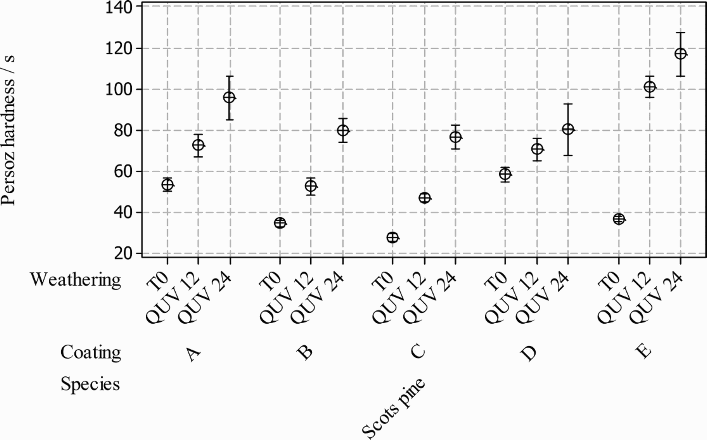
Persoz hardness of coatings on Scots pine before (T0) and after 12 (QUV 12) and 24 weeks (QUV 24) of artificial weathering (mean and 95% confidence interval)
Figure 5 shows that before weathering the five coatings studied displayed different Persoz hardness values lower than the hardness for uncoated Scots pine (80 s). Thus, Persoz hardness tests made possible the discrimination of the five coatings at their initial state (T0). After 12 weeks of artificial weathering, an increase in the surface hardness was observed and the discrimination between coatings was still possible. This increase in hardness was not the same for the different coatings. Before weathering, B, C and E had the lowest Persoz hardness (respectively, 34, 28 and 37 s). After 12 weeks of weathering, only B and C still displayed the lowest hardness (respectively, 52 and 47 s) whereas E had a mean hardness of 101 s after artificial weathering. A and D had the highest Persoz hardness before artificial weathering (respectively, 54 and 58 s) and one of the highest hardness after artificial weathering (72 and 71 s). From 12 to 24 weeks of artificial weathering, there was still an increase in Persoz hardness which was less pronounced for coating D. After 24 weeks of artificial weathering, it became difficult to discriminate coatings B, C and D which had similar Persoz hardness. Coatings A and E appeared as the coating with the highest Persoz hardness after 24 weeks of artificial weathering.
A similar work was done using a set of coated oak samples exposed to artificial weathering for 12 weeks only (Malassenet et al. 2014). For oak, coatings could also be discriminated thanks to Persoz test. Compared with pine presented in this article, exposure to artificial weathering also led to an increase in surface hardness of coated oak samples with the same trends than those made for Scots pine. The influence of the wood species on surface hardness was minor for these 3-coat systems.
Cracking and general appearance (mean of four evaluations) were assessed on samples exposed to artificial weathering for 12 weeks. Results are presented in Table 3 which also includes initial Persoz hardness (before weathering) and its increase owing to weathering.
Visual assessments after 12 weeks of artificial weathering and Persoz hardness values on coated Scots pine samples

Table 3 shows that coatings B and C had no cracking and only few changes in their general appearance and therefore had good performances on Scots pine after 12 weeks of artificial weathering. Coating E displayed few cracks and presented significant changes in its appearance especially owing to pronounced colour and gloss changes. These three coatings with no or few cracks after weathering had the lowest initial Persoz hardness values (less than 40 s). Coating E showed a big change in appearance but also the biggest increase in Persoz hardness after weathering (+64 s). Coatings A and D presented more cracks than B, C and E, and D had a significant change of general appearance. These two coatings A and D showed the highest initial Persoz hardness.
Visual assessments (cracking and general appearance) after 24 weeks of artificial weathering are listed in Table 4 with initial Persoz hardness (before weathering) and Persoz hardness increase owing to weathering.
Visual assessments after 24 weeks of artificial weathering and Persoz hardness values on Scots pine samples

First, it can be observed that visual assessments made after 24 weeks of artificial weathering showed worse results than after 12 weeks of artificial weathering except for cracking of E and general appearance of D. Samples removed from the artificial weathering device after 12 weeks of exposure were not re-exposed. Another set of four samples per coating was used for the exposure to 24 weeks of weathering. This explains why some of the results were found to be worse after 12 weeks than after 24 weeks. High initial Persoz hardness together with large increase of Persoz hardness owing to weathering was still found for coatings with poor performances to weathering. Indeed, after 24 weeks of weathering, A and D which had the highest initial Persoz hardness still displayed the highest cracking score and a big change of general appearance. Similarly, B and C which had a low initial Persoz hardness still showed no cracking and only few changes of general appearance. E which had a low initial Persoz hardness remained the coating with the highest increase of Persoz hardness (+79 s) owing to 24 weeks of artificial weathering and displayed no cracking but the highest change of general appearance.
Discussion
Our results showed that it was possible to distinguish the different coatings thanks to Persoz hardness measurements even if assessments were made directly on wood samples and not on glass. Uysal, Atar and Ozciftci (1999) assessed pendulum hardness of wood coated with different varnishes (acrylic, polyurethane, synthetic and acid catalysed) and concluded that results were more influenced by the type of the coating than by the wood. In our study, it was also possible to discriminate coatings even if they were based on the same family of resins (acrylic). Persoz pendulum appeared as a simple tool to measure surface hardness of coatings directly applied on wood. Sato (1984) insisted on the fact that the validity of the pendulum hardness was restricted to materials with similar viscoelastic properties. He went further assuring that all specimens to be compared should be either in the glassy state or in the rubbery state.
The coating thickness is an important limitation of the use of Persoz pendulum. Indeed, coatings need to be thick enough to ensure the relevance of the measurement. Cho and Hong (2004) and Ma et al. (2013) also found that the pendulum hardness decreased with the increase in the thickness of the coatings but they gave different explanations. Cho and Hong (2004) studied the influence of thickness on pendulum hardness results for UV curable coatings applied on glass. They showed that the decrease in Persoz hardness with the increase in thickness was explained by the fact that the thicker the film the lower its cross-link density. Ma et al. (2013) applied acrylic cross-linkable and uncross-linkable paints on glass with 100 and 200 μm wire bar coater. They observed that the pendulum hardness (König) decreased with the increase in thickness and explained that the sensitivity of pendulum hardness to coating thickness greatly depends on the glass temperature transition (Tg). In other words, the sensitivity of pendulum hardness to the thickness is weaker with the increase in Tg. In our study, the decrease in Persoz hardness with the increase in thickness was mainly because of the fact that the bigger the coating thickness the lower the influence of the substrate. Fink-Jensen (1965) evidenced that the dependence of pendulum hardness on thickness was different when coatings had different viscoelastic properties. Sato (1984) went further in the analysis of pendulum hardness demonstrating that the value measured by the pendulum was the viscoelastic properties of the film and not the hardness number. That is why the author stated that the validity of the pendulum hardness was restricted to material with similar viscoelasticity. Sato (1980) also put in evidence the importance of the thickness in the measurement of Persoz hardness and explained that the penetrating depth of the indenter changed with the rigidity of the film.
An important finding of our study is the link between Young's modulus obtained on free films of exterior wood coatings and Persoz hardness of these coatings applied on coated wood. According to Sato (1980), Inoue also showed that a relation existed between the Young's modulus and the pendulum hardness for cellulose nitrate coating film up to a certain level of the modulus above which the hardness was constant. Other fields such as polycrystalline materials and bulk metallic glasses (Chen, Niu, Li and Li 2011) have also successfully correlated hardness (Vickers) and elasticity.
The Persoz pendulum could be used to a larger extent by wood coating manufacturers to assess coating properties and therefore develop formulations with better performances to weathering. Tensile tests are well known to get mechanical parameters (Young's modulus, tensile strength) but these tests have drawbacks. Indeed, making free films may be difficult with some coatings and it can be impossible to study very thin or brittle samples (Zosel 1980).
The increase in Persoz hardness of exterior wood coatings with weathering was another finding of our work. The increase in surface hardness after artificial weathering was also observed by Baysal, DizmanTomak, Ozbeyc and Altinc (2014) for two types of coatings (an alkyd-based synthetic varnish and a solvent-based two-component polyurethane varnish) applied on Scots pine. In their work, the authors did not use the Persoz pendulum but used the König pendulum and measured the hardness after 500 h of artificial aging in a QUV. However, they did not use the EN 927-6 cycle but exposed samples to a cycle made of 8 h UVA followed by 4 h of condensation. They explained the increase in surface hardness of the alkyd-based varnish by progressive cross-linking of alkyd molecules. Çakicier et al. (2011) studied the influence of artificial weathering on surface hardness of one- and two-component waterborne varnishes applied in two and three coats on Scots pine, iroko and chestnut samples. They exposed samples in a QUV for 416 h using a cycle made of 4 h UVA followed by 4 h of condensation and assessed the hardness using a König pendulum. They observed an increase in the surface hardness of the two-component waterborne varnishes. The authors explained that UV rays might cause polymerisation and cross-linking of the molecule in the coating. This would change molecular cohesion and then increase surface hardness. In our study, Persoz hardness variations were studied for longer exposure time: 2016 and 4032 h. The increase in Persoz hardness is probably explained by variation in the mechanical properties owing to weathering which consequently leads to a loss of coating performance. A possible leaching of some components and/or migration to the top surface of some constituents may contribute to the increase in hardness. Chiantore, Trossarelli and Lazzari (2000) showed that acrylic polymers are subject to photooxidative degradation during weathering which induce molecular and chemical changes such as chain scissions, macroradical recombinations and cross-linking. These changes may explain the increase in coating hardness.
Moreover, our study indicated a possible link between high initial Persoz hardness value and bad performances. This was especially shown with coatings A and D after 12 and 24 weeks of QUV on Scots pine. These two coatings presented cracks and had the highest initial Persoz hardness. Baumstark (2014) also showed that formulations with high hardness had worst durability than soft ones. This author assessed König hardness of exterior wood stains applied on glass (200 μm wet layer thickness) and found that coatings with König hardness lower than 40 s showed good performances to weathering. Likewise Vollmer and Evans (2013) showed that clear coatings performance is dependent on coating flexibility: they studied different coatings (acrylic, alkyd and polyurethane) on modified wood, including an acrylic coating made of a hard binder. They showed that this coating failed earlier during natural weathering possibly because it lacked flexibility. In our work, coating E had a low initial Persoz hardness (37 s) and therefore was expected to have good performances. However coating E presented big changes of general appearance and also the highest increase in hardness owing to weathering. Changes of general appearance, increase in Persoz hardness and change in the mechanical properties are connected. This significant change of appearance might be explained by the fact that E was the coating with the biggest increase in Persoz hardness. This large increase in Persoz hardness indicates changes in the coating which explain a change of appearance of the samples. Our results show that the initial Persoz hardness together with its variation owing to weathering give good indication of mechanical properties and performances of exterior wood coatings. Similar conclusions were drawn after 12 and 24 weeks of artificial weathering for both species confirming that the wood substrate had a minor influence in the Persoz hardness measurement.
Conclusion
This paper studied Persoz hardness of commercial acrylic coatings directly applied on wood and its increase owing to 24 weeks of artificial weathering (EN 927-6). First, it has been shown that the Persoz pendulum is a convenient method to assess hardness of exterior coatings directly applied on wood provided that a sufficient coating thickness is achieved. Indeed, the influence of the substrate was minor on hardness results when coatings were applied with a sufficient thickness. Hence, the wood species can be chosen according to the final application and the coating should be applied with the thickness recommended by the manufacturer. Finally, a strong link between Persoz hardness results on coated wood and Young's modulus of coating films has been established and showed that damping tests are suitable to gain knowledge on mechanical properties of exterior wood coatings. Moreover, an increase in Persoz hardness has been observed after 12 and 24 weeks of artificial weathering. It indicated that mechanical properties were modified by the exposure. Last but not least, this study confirmed that a low initial Persoz hardness together with few variations during weathering is a condition for high performance wood coatings. In this paper coatings with good performance to weathering had their initial Persoz hardness lower than 40 s.