







Abstract
This research investigates how the relationships among pieces of numerical information in a price promotional offer (i.e., regular price, sale price, absolute discount, and relative discount) affect deal processing fluency. Across four studies (including a field study involving purchase data collected from an online group-buying website), the authors show that when the numbers constitute an approximation sequence or are multiples of one another, deal processing fluency is increased, which influences deal liking and ultimately has an impact on consumers’ price promotion predilection. In addition, this article demonstrates that when consumers are not highly motivated to process numerical information, they may choose deals that offer less economic value but feature a combination of numbers that they can more fluently process. This research has important implications for the type of numerical information marketers should include in price promotional offers.
Companies have long used price discounting as a means to attract customers and stimulate sales. Price promotions are a means to convey that a price has been discounted, typically by supplying numerical information in addition to the final sale price (Monroe 2003). The three most widely employed types of price promotions are (1) dollar-off promotions, which present the absolute discount in addition to the sale price; (2) percentage-off promotions, which present the relative discount in addition to the sale price; and (3) comparative price promotions, which present the regular price in addition to the sale price (DelVecchio, Lakshmanan, and Krishnan 2009; Krishna et al. 2002). Many studies have examined the specific circumstances under which consumers might perceive one or more of these discount framing options more favorably (e.g., Chen, Monroe, and Lou 1998; Grewal, Monroe, and Krishnan 1998). To date, however, no study has investigated how the combination of pieces of numerical information included in a price promotion (i.e., regular price, sale price, absolute discount, and relative discount) affects deal processing fluency; such a study is necessary because processing fluency ultimately has an impact on deal liking and purchase intentions.
When determining which pieces of numerical information to provide to consumers, marketers are often guided by the “more is better” concept. Retailers often provide a reference value (i.e., regular price) in addition to the sale price to increase the desirability of the sale price by way of contrast (Kalyanaram and Winer 1995). Believing that desirability will be further enhanced, retailers often also provide the absolute discount. For example, Staples recently offered a desk chair regularly priced at $169.99 for $99.99 and noted that the total savings was $70. Some promotions take the “more is better” concept even further by providing the regular price, absolute discount, and relative discount. As a case in point, the online group-buying site Groupon promotes the sale price, the “value” (i.e., regular price), the “discount” (i.e., relative discount), and the amount “you save” (i.e., absolute discount). Yet is it desirable to present all these pieces of numerical information, effectively performing calculations for the consumer that demonstrate the relationship(s) between regular price and sale price? By removing the need to perform these cognitively taxing calculations, will deal processing fluency be enhanced, leading to higher purchase intentions?
Some evidence suggests that it will not. For example, Thomas and Morwitz (2009) find that people perceive easy-to-compute price differences (e.g., $5.00 - $4.00) to involve greater discounts than difficult-to-compute price differences (e.g., $4.97 - $3.96). The effects were attenuated, however, when the actual price discount amounts were provided (i.e., $1.00 and $1.01, respectively). Conversely, other evidence has suggested that sale price numbers may be more fluently processed—and thus, better “liked”—if information that supports the generation of the sale price number is also activated (for a discussion, see Dehaene 1997). For example, King and Janiszewski (2011) find that priming the addends (e.g., 6 = 3 + 3) or operands (e.g., “3 medium pizzas, up to 8 toppings, for $24”) of a sale price increases the fluency with which people process it.
Given the conflicting evidence, our primary objective is to understand which pieces of numerical information to include in a price promotional offer and when to include them. In so doing, we extend the number fluency/ease-of-processing streams of literature by showing that, for price deals, the whole is greater than the sum of is parts. More specifically, we demonstrate that liking for a series of numbers is a function not only of the consumer's predilection toward its individual components but also of the way those number components are related. We examine number relationships in terms of base-10 “approximation sequences” (Jansen and Pollman 2001) and in terms of non-base-10 multiplicative series (Hecht and Ploger 2012).
Our findings indicate that the relationships between the pieces of numerical information presented in a deal can affect the ease, or fluency, with which those numbers are processed and encoded. Consistent with extant research, processing fluency leads to deal liking and, ultimately, purchase intentions (Boyd 1985; Gunasti and Ross 2010; King and Janiszewski 2011; Pavia and Costa 1993). Importantly, we also demonstrate that under conditions of low processing motivation, the fluency of the deal numbers can overcome superior economic value in driving choice.
Theoretical Development
In addressing number fluency effects in price promotions, we draw on several theoretical perspectives. Previous research has demonstrated that a primary factor that may contribute to the processing fluency of individual numbers (and thus prices) involves the frequency with which numbers are used and appear within languages (Dehaene and Mehler 1992). Greater frequency of use promotes familiarity, which in turn induces liking (Zajonc 1968). Thus, we first examine a factor that contributes to the usage frequency of individual numbers: number “roundness.” We then discuss the manner in which individual number roundness contributes to approximation sequence membership. Next, we investigate how base-10 approximation sequences and number-multiple series are related. Finally, we discuss the moderating effects of processing motivation.
Individual Number Roundness
Numbers such as 10, 25, and 100 are commonly referred to as “round” numbers. Round numbers are expected to be used more frequently than other numbers (and thus to be better liked; King and Janiszewski 2011) because they can express approximate quantities and therefore refer to an entire range of magnitudes (Dehaene 1997; Jansen and Pollmann 2001; Pollmann and Jansen 1996). For example, people might refer to any given number within the range 90–110 (e.g., 93, 99, 102, 106) as “about 100.” However, they are much less likely to refer to the number 100 as “about 93” or “about 106.” As such, people should use the number 100 more frequently and process it more fluently than those other numbers, leading to greater predilection for it (e.g., Dehaene and Mehler 1992).
The question then arises: what makes a number round? According to Sigurd (1988), the roundness of a number is related to the base of the number system used; more specifically, the roundness of a number is determined by whether it is divisible by (1) a base number (e.g., 10), (2) half of a base number (e.g., 5), and/or (3) a quarter of a base number (e.g., 2.5). Along similar lines, Jansen and Pollmann (2001, p. 201) argue that doubling and halving (sometimes followed by halving again) are basic means to manipulate quantities and that there is a “natural propensity” for halving and doubling. Thus, they relate Sigurd's (1988) base number divisibility concept to membership in the sets [10 × (1–9) × 10n], [5 × (1–9) × 10n], [2.5 × (1–9) × 10n], or [2 × (1–9) × 10n] and label it “ten-ness,” “five-ness,” “two-and-a-half-ness,” and “two-ness,” respectively. 1 According to these definitions, a number such as 40 has ten-ness, two-ness, and five-ness, whereas a number such as 8 has two-ness but no five-ness, ten-ness, or two-and-a-half-ness. Jansen and Pollmann (2001) find that these four characteristics accurately predict the roundness of a number. The more of these features a number shares, the rounder it is and the more commonly it is used.
n ≤ 0 in all cases.
Because the pieces of numerical information in a price discount promotion can exhibit different forms of numerical roundness (i.e., ten-ness, five-ness, two-ness, and/or two-and-a-half-ness), the processing fluency associated with the combination of numbers (as a whole) must be determined by their degree of commonality. For example, three of the numbers in the combination 5–10–15 contain five-ness, whereas only two of the numbers in the combination 5–12–15 contain five-ness. As described in the next two sections, we maintain that either (1) membership in a base-10 “approximation sequence” or (2) the formation of a multiplicative relationship can establish commonality.
Approximation Sequences
If two (or more) pieces of promotional price information (e.g., regular price, sale price, relative discount, absolute discount) contain the same type of roundness, they can be classified as being members of a base-10 approximation sequence (Jansen and Pollmann 2001). Thus, the numbers (2, 4, 6, 8, 10 …), (5, 10, 15, 20, 25 …), and (20, 40, 60, 80, 100 …) are all members of approximation sequences because they contain two-ness, five-ness, and ten-ness, respectively.
Importantly, these sequences, which are learned by a process of rote memorization (Dehaene 1992; Dehaene and Cohen 1995), represent fundamental components of mathematical competence (Holmes and McGregor 2007). Children typically learn base-10 sequences in the form of multiplication tables and commit that rote learning to memory for life (Dehaene 1997). As such, people perceive the numbers that make up these sequences to belong together and therefore are expected to process those numbers more easily and quickly than other, less frequently encountered combinations (Holmes and McGregor 2007).
The term “approximation sequence” refers to the finding that pairs of consecutive numbers within that sequence are typically employed in two-number approximation expressions, which, like individual round numbers, can be used to estimate a range of quantities (Pollman and Jansen 1996). For example, 16, 17, 18, or 19 books could all be described as “about 10 or 20 books” (i.e., both numbers contain ten-ness) or as “about 15 or 20 books” (i.e., both numbers contain five-ness). The difference between using an individual round number versus an approximation expression to estimate a quantity is that in the latter instance, a layer of estimation precision is added by “bracketing” the range.
Across multiple languages, Jansen and Pollman (2001) find cross-linguistic regularities in two-number approximation expressions. This regularity “can be described by a sequence rule where a small set of basic means to manipulate quantities plays a central role … [and] … the predictive power of the sequence rule … [can] be attributed to the frequent occurrence of expressions where first number and ratio equal a base number of the decimal system 1 × 10n” (Jansen and Pollman 2001, p. 197). Thus, approximation expressions follow a consistent pattern based on similar types of ten-ness, five-ness, two-ness, or two-and-a-half-ness. People use these approximation expressions (e.g., 15 to 20 books) more frequently than other types of expressions (e.g., 16 to 19 books) to estimate quantities.
Because this research examines price discount promotions consisting of more than two pieces of numerical information, we define number commonality in terms of membership in base-10 approximation sequences rather than two-number approximation expressions. We expect that because approximation sequence members share the same type of roundness (e.g., both 10 and 25 contain five-ness), consumers will be more favorably predisposed toward such combinations than toward combinations of numbers containing either different types of roundness (e.g., 12 and 25) or no roundness characteristics (e.g., 11 and 23). Furthermore, because these approximation sequences are learned in childhood (e.g., Dehaene 1992, 1997) and because the numbers that constitute them are perceived to belong together (Holmes and McGregor 2007), we expect that those numbers should be processed more easily and quickly together. As noted previously, price promotion research has posited this ease of processing to lead to number liking and, ultimately, higher purchase intentions (Gunasti and Ross 2010; King and Janiszewski 2011). Thus, we hypothesize the following:
H1: A price promotional offer (a) is more fluently processed, (b) is better liked, and (c) results in higher purchase intentions if the individual price discount–related numbers that constitute that deal are members of a base-10 approximation sequence.
Number Multiples
If people perceive the nonsequential numbers in approximation sequences to be related because they initially learned them in multiplicative series, it stands to reason that people might also perceive any two (or more) pieces of numerical information (i.e., regardless of whether they contain ten-ness, five-ness, two-ness, or two-and-a-half-ness) as related if they are multiples of one another. Children are often taught to use repeated-addition strategy for small-answer multiplication problems when they have not yet automated the result (Lemaire and Siegler 1995). Such strategies involve creating number multiples; for example, the product of 8 × 5 might be learned as [8 + 8 (= 16),+ 8 (= 24),+ 8 (= 32),+ 8 (= 40)]. Even adults report using such repeated addition strategies (Hecht 1999).
As we noted previously, Jansen and Pollmann (2001) posit four possible base-10 approximation sequences on the basis of the “natural propensity” for halving and doubling of numbers. For any given sequence, if the first number is also the ratio, the second number in the sequence is determined by doubling the first number, the third number is determined by tripling the first number, and so on. Thus, in addition to halving and doubling, one could argue that there is also a natural propensity for the tripling, quadrupling, and quintupling of numbers. If that is the case, deal processing fluency is enhanced to the extent that the regular price, sale price, absolute discount, and relative discount are multiples of one another.
If the first number in an approximation sequence (e.g., 10) is included among the pieces of numerical information in a price promotion (e.g., regular price $50, sale price $40, absolute discount $10, relative discount 20%), number multiples must be present. However, as we have noted, we expect that the relationship between number multiples may be strong enough that they need not be members of a base-10 approximation sequence (i.e., either individually or in combination) to facilitate deal processing fluency and drive deal liking. For example, the four numbers 99, 33, 66, and 66 are not all members of a single base-10 approximation sequence, 2 but they are all multiples. We expect that the way these numbers are related may cause consumers to choose them over other, nonmultiplicative options. Extant research has shown number multiples to be processed more quickly and fluently; therefore, they should be better liked (Gunasti and Ross 2010; King and Janiszewski 2011). In turn, product promotions that comprise these numbers stand a greater likelihood of purchase. We posit the following:
The last two numbers contain two-ness; therefore, both are members of the (2 10n) sequence, where n = 0.
H2: A price promotional offer (a) is more fluently processed, (b) is better liked, and (c) results in higher purchase intentions if the individual price discount–related numbers that constitute that deal are multiples of one another.
Cognitive fluency research has shown that people experience positive feelings when they can process something easily, especially if they are unaware of the source of the processing ease. This feeling of pleasure results in more positive evaluations, which people unintentionally and effortlessly use as an input in judgments (e.g., Menon and Raghubir 2003; Reber, Winkielman, and Schwarz 1998). Consistent with these findings, our first two hypotheses imply mediating relationships; more specifically, we expect that people will more fluently process deals that contain approximation sequences and number multiples, which will subsequently influence deal liking and in turn will ultimately affect purchase intentions. Formally:
H3: Deal processing fluency mediates the effects of number combinations on deal liking, and deal liking mediates the effects of processing fluency on purchase intention.
Fluency versus Economic Value and the Moderating Role of Motivation
We have noted that consumers will more easily process a deal if the numbers/prices representing that deal are members of an approximation sequence (H1a) or are multiples of one another (H2a). However, the combination of prices cannot be altered without altering the economic value of the deal, which is also a driver of purchase intentions. For example, consider a promotional deal consisting of a $100 regular price, $47 sale price, $53 absolute discount, and 53% relative discount. To increase the processing fluency associated with that combination of numbers, the marketer could raise the sale price to $50 (i.e., resulting in a $50 absolute discount and 50% relative discount). The higher margin could be expected to result in lower sales volume (due to a decrease in economic value), but if the increase in deal fluency tempered or even eliminated that loss, the strategy would represent a viable option.
Alternatively, the marketer could increase the processing fluency associated with the original combination of numbers by lowering the stated “regular” price to $94 (i.e., which, along with the $47 sale price and $47 absolute discount, would create a three-number multiple sequence). 3 In this case, the margin is not affected, but perceived economic value is reduced. Therefore, if expected purchase volume is greater for the more fluently processed combination ($94, $47, $47, 50%) than for the greater economic value combination ($100, $47, $53, 53%), the price change makes sense.
We assume that the marketer has the latitude to engage in this option.
The logical question that arises from this discussion is the following: When, or under what circumstances, will consumers choose deals involving more fluently processed number combinations over those involving less fluently processed numbers but greater economic value? Consumers often view deals in isolation, without making the effort to compare offerings. Yet what happens when consumers do actively compare deals? Will fluency effects still trump economic value? The answer to this question is dependent at least in part on the difference in economic value between the two options as well as the typical price elasticity of demand within the applicable product category.
The answer is also likely to be dependent on a consumer's level of motivation to process the numerical information. Previous research has shown that if consumers have a low level of processing motivation, they are more likely to engage in heuristic processing (Suri and Monroe 2003). Conversely, if motivation to process information is high, consumers are more likely to engage in systematic processing (Eagly and Chaiken 1993; Suri and Monroe 2003). Because extant research has posited fluency effects to operate at a nonconscious level (Janiszewski and Meyvis 2001; Lee and Labroo 2004; Shapiro 1999), we hypothesize that in the case of direct choice comparisons, deal-fluency effects will only manifest when processing motivation is low. More specifically, when choosing between two deals involving fundamentally equivalent items, consumers will choose the deal involving the more fluently processed (but lesser in economic value) numbers when processing motivation is low. When motivation is high, we expect that economic value will “trump” processing-fluency effects. Thus, H4: When processing motivation is low, consumers choose deals that contain fluently processed numbers. When processing motivation is high, consumers choose deals that offer greater economic value.
We test these hypotheses in a series of four studies. In Study 1, we test H1–H3 by comparing deals that contain an approximation sequence and number multiples, respectively, with a deal that contains neither of these characteristics (but has greater economic value). Study 2 retests H2 and H3 but also directly addresses the “more is better” issue by examining how the relationship between a fourth piece of numerical deal information and three other pieces of numerical information affects deal processing fluency, liking, and purchase intentions. Study 3 extends the external generalizability of our findings (and again tests H1 and H2) by using real-world data collected from the online group-buying site Groupon. Finally, Study 4 offers a conservative test of H4 by manipulating the level of motivation and having participants choose between deal offers that are superior in terms of either number fluency or economic value.
Study 1
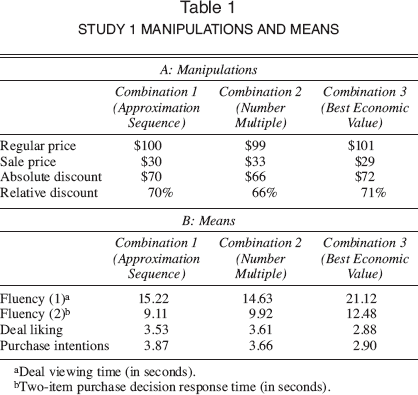
Study 1 compares processing fluency, liking, and purchase intentions across price and discount information that either (1) constitutes an approximation sequence (Combination 1, Table 1, Panel A), (2) displays a number-multiple relationship (Combination 2, Table 1, Panel A), or (3) does not exhibit sequential or number-multiple properties but offers greater economic value (Combination 3, Table 1, Panel A). Because a combination of numerical information such as [regular price $100,sale price $50,absolute discount $50,relative discount 50%] could entail both approximation sequence and number-multiple properties, we chose numbers such that sequential overlap was minimal. 4 In addition, we avoided a fully crossed experimental design because such a design would result in extraneous cells that have neither an economic value nor a processing fluency advantage.
Study 1 Manipulations and Means
Deal viewing time (in seconds).
Two-item purchase decision response time (in seconds).
For example, the last two numbers listed in Combination 2 exhibit two-ness.
Procedures
We conducted a three-level, between-subjects online experiment; participants were 135 students, faculty, and staff from a university in the eastern United States. Participants were exposed to one of three randomly determined promotional offers from the Sun Tavern restaurant (see Table 1, Panel A, and Web Appendix A). Sun Tavern was an actual retail establishment advertised on Groupon; however, participants were not familiar with this establishment (i.e., M = 1.19 on a five-point scale [1 = “not at all,” and 5 = “extremely familiar”]), and there were no significant differences in familiarity across conditions (p > .10). To be consistent with typical online group buying sites, we labeled the sale price, regular price, percentage discount, and absolute discount as “Buy,” “Value,” “Discount,” and “You Save,” respectively.
Participants were exposed to one of the three (randomly determined) deals through a web-based survey. After viewing the stimulus, participants responded to a series of purchase intention and liking questions (see Appendix A). All questions were based on those previously used in the literature (e.g., Suri and Monroe 2003). We also electronically recorded the time spent viewing the stimulus offer as well as the time spent responding to the purchase decision questions. These two measures enabled us both to determine whether there was a difference in processing time (i.e., fluency) as a function of the number combination presented and to test mediating effects. Finally, we also collected manipulation checks involving price recall as well as items assessing familiarity with the target product (see Appendix A).
Analysis and Results
Manipulation checks
Overall, participants were highly accurate in their recall of both prices (M = 93%) and discounts (M = 92%). For all the numerical information measures, there were no significant differences in recall across conditions. Thus, we successfully manipulated sequential and number-multiple price discount information, and differences in our dependent measures across conditions could not be attributed to recall.
Deal processing fluency
In terms of time spent viewing the offer, the analysis of variance (ANOVA) revealed a significant difference across conditions (F(2, 132) = 6.54, p < .01, ηp2 = .09; see Table 1, Panel B). Bonferroni comparisons indicated that participants spent significantly less time viewing (and thus processing) both the approximation sequence offer (M = 15.22, p < .05) and the number-multiple offer (M = 14.63, p < .01) compared with the nonsequential/nonmultiple (but economically superior) offer (M = 21.12). There was no significant difference in processing time across the approximation sequence and number-multiple conditions (p = .63).
Similarly, regarding purchase decision time, the ANOVA (F(2, 132) = 5.44, p < .01, ηp2 = .08) and follow-up Bonferroni comparisons revealed that participants spent less time deciding to purchase when evaluating either the approximation sequence offer (M = 9.11, p < .01) or the number-multiple offer (M = 9.92, p < .05) compared with the nonsequential/nonmultiple (but economically superior) offer (M = 12.48; see Table 1, Panel B). There was no difference in processing time across the former two conditions (p = .88). Thus, we conclude that people more fluently processed both the approximation sequence [$100,$30,$70,70%] and number-multiple [$99,$33,$66,66%] combinations than they did the economically superior offer [$101,$29,$72,71%]. This finding lends support to H1a and H2a.
Deal liking
The two deal-liking items were highly correlated (r = .84), so we averaged them to form a deal-liking scale. There was a significant difference in deal liking across conditions (F(2, 132) = 18.88, p < .001, ηp2 = .217). Consistent with our expectations, participants liked the deal more when the numbers formed an approximation sequence (M = 3.53, p < .001) or were multiples (M = 3.61, p < .001) than when they offered superior economic value (M = 2.88; see Table 1, Panel B). This finding lends support to H1b and H2b.
Purchase intentions
We averaged the two purchase intention items to form our measurement scale (r = .76). As we expected, the ANOVA revealed a significant difference across groups (F(2, 132) = 6.15, p < .01, ηp2 = .085; see Table 1, Panel B). Purchase intentions were higher in the approximation sequence condition (M = 3.87) and the number-multiple condition (M = 3.66) than in the nonsequential/nonmultiple condition (M = 2.90; ps < .01). This result lends support to H1c and H2c. There was no significant difference (p > .10) between the approximation sequence and number-multiple conditions.
Notably, the processing fluency created by approximation sequence membership was sufficient to “overcome” the 3% lower sale price, $2 greater absolute savings, and 1% greater relative discount associated with the nonsequential/nonmultiple condition in driving purchase intentions across groups. Similarly, the processing fluency created by number-multiple relationships was sufficient to overcome the 12% lower sale price, $6 greater absolute savings, and 5% greater relative savings associated with the nonsequential/nonmultiple condition.
Mediation analysis
We tested for mediation using the PROCESS macro for SPSS (Hayes 2012) and employed Model 6, which estimates the conditional indirect effect(s) of a single causal variable (number combination) on an outcome variable (purchase intentions) through two mediator variables (processing fluency and deal liking) linked in series (see Appendix B). We used deal viewing time as our fluency measure.
Analysis revealed that both the total effect (c = .57, t = 4.28, p < .001) and direct effect (c’ = .28, t = 3.15, p < .01) of number combination on purchase intentions are positive and significant. Furthermore, the normal theory tests for indirect effects showed that the indirect effects through processing fluency (a1 × b1 =.07, Sobel Z = 2.38, p < .05), liking (a2 × b2 =.13, Sobel Z = 3.94, p < .01), and fluency/liking in series (a1 × d21 × b2 = .09, Sobel Z = 2.30, p < .05) are also positive and significant. Bootstrap results revealed that the bias-corrected and accelerated 95% confidence intervals excluding zero were, respectively, .02, .12; .04, .45; and .02, .27. Thus, we conclude that both processing fluency and deal liking partially mediate the number combination–purchase intention relationship (see Appendix B), in support of H3.
Discussion
These findings support our contention that consumers more fluently process deals with prices and discount amounts that are members of either an approximation sequence or a number-multiple relationship; in turn, such deals generate greater liking and purchase intentions than deals that are less fluently processed. These effects occurred even when the nonsequential/nonmultiple deal(s) offered greater economic value. However, Study 1 did not directly address the “more is better” concept. Is it better to present all four pieces of numerical information—effectively performing two “calculations” for the consumer—or could the same (or better) results been achieved by only presenting three? We directly investigate this question in the next study.
Study 2
Study 2 examines price discount situations that include three (i.e., regular price, sale price, and either percentage discount or absolute discount) versus four (i.e., regular price, sale price, and both percentage discount and absolute discount) pieces of numerical information. All deals represent the same economic value. By comparing processing fluency, liking, and purchase intentions across three versus four member combinations (in which the fourth piece of numerical information is or is not related [as a number multiple] to the other prices or discount amount), we are able to directly assess the efficacy of providing that additional information.
Method
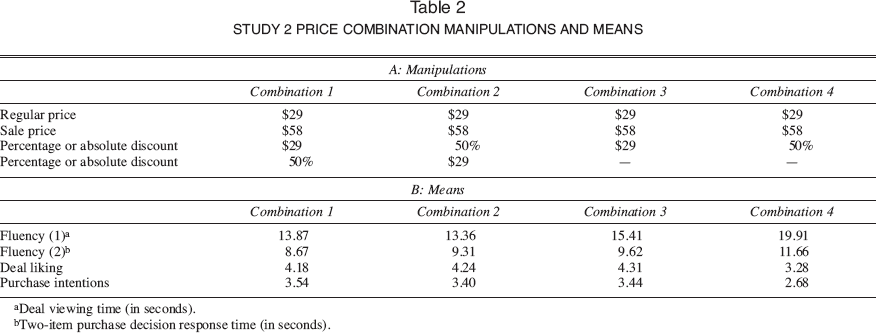
We conducted a four-level between-subjects experiment. Participants, students from a major northeastern U.S. university who were given extra class credit for participation (N = 161), were exposed to one of four randomly determined promotional offers from Tyler English Fitness (for the numerical information included in each offer, see Table 2, Panel A; for the stimulus, see Web Appendix B). Tyler English Fitness was an actual retail establishment advertised on Groupon; however, as in Study 1, participants were not familiar with this establishment (mean level of familiarity = 1.09 on a five-point scale [1 = “not at all familiar,” and 5 = “extremely familiar”]). There were no significant differences in familiarity across conditions (p > .10).
Study 2 Price Combination Manipulations and Means
Deal viewing time (in seconds).
Two-item purchase decision response time (in seconds).
We used the four combinations of numerical information listed in Table 2, Panel A. We labeled the deal information “buy,” “value,” “discount,” and “you save.” In the three-number combination conditions, we removed either the “discount” or “you save” amount. After viewing, participants responded to the series of questions used in Study 1.
Analysis and Results
Manipulation checks
Participants were highly accurate in their recollection of the prices and discount amounts (M = 90% across all pieces of numerical information). For all the numerical information measures, there were no significant differences in recall across conditions (p > .10); thus, we could not attribute differences in our dependent variables to recall.
Deal processing fluency
For both time spent viewing the offer and time spent making the purchase decision, the ANOVAs revealed a significant difference across conditions (F(3, 157) = 3.78, p < .05, ηp2 = .055; F(3, 157) = 4.81, p < .01, ηp2 = .067, respectively; see Table 2, Panel B). Notably, neither the time spent viewing the offer nor the time spent deciding to purchase corresponded to the amount of numerical information. Participants spent significantly more time examining the three-component offer that only contained two number multiples (M$29, $58, 50% = 19.91) than they did the other offers, which each contained three number multiples (M$29, $58, $29, 50% = 13.87, p < .01; M$29, $58, 50%, $29 = 13.36, p < .01; M$29, $58, $29 = 15.41, p < .01). Similarly, they spent more time making their purchase decisions when exposed to the offer that contained two number multiples (M$29, $58, 50% = 11.66) than when exposed to the offers with three number multiples (M$29, $58, $29, 50% = 8.67, p < .01; M$29, $58, 50%, $29 = 9.31, p < .01; M$29, $58, $29 = 9.62, p < .01). These results corroborate H2a and support our contention that the relationship between the numbers is critical to determining ease of processing.
Deal liking
We found a significant difference in deal liking (two-item r = .82) across conditions (F(3, 157) = 4.86, p < .05, ηp2 = .08). In support of H2b, participants liked the deals containing three number multiples (M$29, $58, $29, 50% = 4.18; M$29, $58, 50%, $29 = 4.24; M$29, $58, $29 = 4.31) more than the offer with only two number multiples (M$29, $58, 50% = 3.28; p < .01 for all comparisons).
Purchase intentions
An ANOVA revealed a significant difference in purchase intentions across conditions (two-item r = .85; F(3, 157) = 4.20, p < .01, ηp2 = .07). Participants exposed to the deals with three number multiples (M$29, $58, $29, 50% = 3.54; M$29, $58, 50%, $29 = 3.40; M$29, $58, $29 = 3.44) were more likely to purchase than those exposed to the deal with only two number multiples (M$29, $58, 50% = 2.68; p < .05 across comparisons; see Table 2, Panel B), in support of H2c.
Mediation analysis
Regarding the number combination–purchase intentions relationship, analysis revealed that the total (c = .59, t = 5.26, p < .01), direct (c’ = .25, t = 2.41, p < .05), and indirect effects through fluency (a1 × b1 = .07, Sobel Z = 2.14, p < .05), deal liking (a2 × b2 = .10, Sobel Z = 2.51, p < .05), and fluency/liking in series (a1 × d21 × b2 = .17, Sobel Z = 4.30, p < .01) are all positive and significant. The bootstrap results for indirect effects showed that the bias-corrected and accelerated 95% confidence intervals excluding zero were, respectively, .05, .43; .02, .27; and .08, .65. Therefore, fluency and deal liking partially mediate the number combination–purchase intention relationship (see Appendix B), and H3 is supported.
Discussion
In addition to lending support to H2 and H3, the results of Study 2 have important theoretical implications. Adding a fourth piece of numerical information resulted in more fluent processing when it was a multiple of two of the other three numbers. In comparing Combination 2 ($29, $58, 50%, $29) with Combination 4 ($29, $58, 50%), the addition of the incremental numerical information (i.e., $29 absolute discount) did not adversely affect processing fluency. Instead, it resulted in consumers spending less time processing the numbers. That increase in processing fluency led to greater deal liking and higher purchase intentions.
When the fourth piece of numerical information was not a multiple of any of the other three numbers, it did not increase processing fluency. More specifically, in comparing Combination 1 ($29, $58, $29, 50%) with Combination 3 ($29, $58, $29), the addition of the incremental numerical information (i.e., 50% relative discount) did not decrease the time consumers spent processing the deal. We speculate that addition of a nonround, nonmultiple number (e.g., 51%) might have a deleterious effect (i.e., reduce processing fluency and increase deal processing time).
In this case, however, addition of the 50% discount did not increase deal processing time, perhaps because 50% is a commonly employed and frequently encountered round number. Thus, a worthwhile question arises: Had the other numbers in our series (i.e., $29 and $58) also been members of an approximation sequence rather than (just) number multiples (e.g., $30, $60), would addition of the 50% discount have had a beneficial effect? To shed light on how the relationship between a fourth piece of incremental information and the other price information might affect fluency, we conduct Study 3. Study 3 also enables us to assess the relative importance of the two types of numerical relationships (i.e., approximation sequence vs. number multiple). In addition, we are able to expand the external generalizability of our results by assessing the impact of numerical price discount sequences in a nonlab setting.
Study 3
In Study 3, we examine data from the Groupon group-buying website, which displays not only the final sale price but also (1) reference price, (2) percent discount, and (3) absolute discount. Thus, Groupon represents an optimal context in which to test our hypotheses.
Method
We collected data from the Groupon “deal of the day” in two northeastern U.S. cities over a three-month period in spring 2011. We examined a total of 218 deals; all deals were of the same 24-hour duration. For each reported deal, we recorded the regular price (i.e., “value”), sale price (i.e., “buy”), percentage discount (i.e., “discount”), and absolute discount (i.e., “you save”). In addition, at a specific time (six hours before expiration), we recorded the number of people who bought.
Fluency-Related Measures
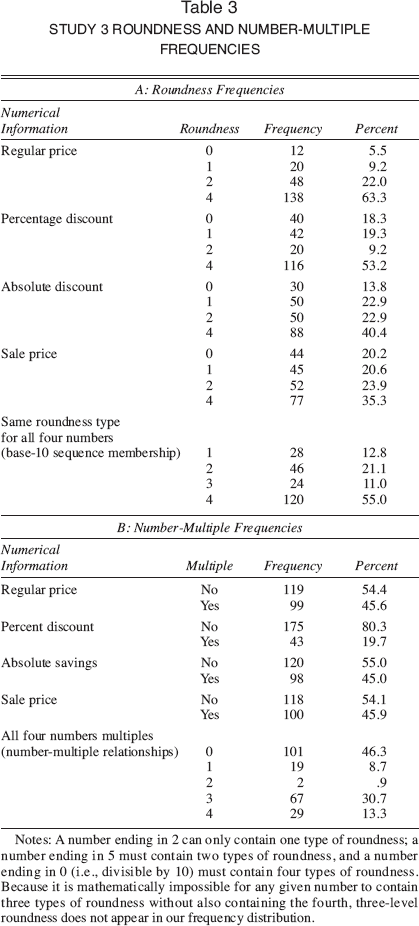
We created two processing fluency–related measures. First, two independent judges unfamiliar with study objectives coded the regular price, sale price, absolute discount, and relative discount for ten-ness, two-ness, five-ness, and two-and-a-half-ness (i.e., in each case, 1 = present, 0 = not present for each type of roundness). Thus, the individual numbers were coded from 0 (no roundness) to 4 (complete roundness; see Table 3, Panel A).
Study 3 Roundness and Number-Multiple Frequencies
Notes: A number ending in 2 can only contain one type of roundness; a number ending in 5 must contain two types of roundness, and a number ending in 0 (i.e., divisible by 10) must contain four types of roundness. Because it is mathematically impossible for any given number to contain three types of roundness without also containing the fourth, three-level roundness does not appear in our frequency distribution.
Next, we assessed how many of the pieces of numerical information exhibited the same type of roundness and thus were contained in the same approximation sequence. If all four of the economic value indicators were members of any one approximation sequence (e.g., $10 sale price, $20 value, $50% discount, and “you save” $10 all contain ten-ness), we coded that series as 4; if three of the indicators were members of any one sequence, we coded that series as 3; and if two of the indicators were members of one sequence, that series was coded as 2. If only one (or none) of the indicators had sequential roundness properties, we coded that series as 1 (see Table 3, Panel A). Thus, our measure captures the benefit of providing additional pieces of related numerical information (i.e., in terms of any given approximation sequence).
For our second processing fluency measure, we assessed the data for number-multiple relationships (see Table 3, Panel B). For each of the four pieces of numerical information, if that number could be evenly divided by any other number in the series, we coded it as 1; otherwise, we coded it as 0. Our measure was formed by summing across the four numerical (i.e., 1/0) items (see Table 3, Panel B). Tables 4 and 5 provide descriptive statistics and item correlations.
Study 3 Descriptive Statistics

Analysis and Results
Separate approximation sequence and number-multiple regression results
Because examination of the item correlation matrix (see Table 5) revealed some overlap between approximation sequence membership and number-multiple relationships, we first examined the approximation sequence and number-multiple measures of processing fluency in separate analyses. More specifically, we regressed buyer number on the absolute savings and relative discount measures of economic value as well as either our approximation sequence or our number-multiple relationship measures. Table 6, Panels A and B, present the results.
Study 3 Correlation Matrix

Notes: All correlations are significant at p < .001 except where indicated by superscript n.s. RPR = regular price roundness, PDR = percentage discount roundness, ADR = absolute savings roundness, SPR = sale price roundness, STR = same type roundness (all numbers; i.e., base-10 sequence membership), RDO = regular price divisible by any other number, PDO = percent discount divisible by any other number, ADO = absolute discount divisible by any other number, SDO = sale price divisible by any other number, TDO = total numbers divisible (i.e., number-multiple relationships), and PUR = purchase number.
Study 3 Regression Results

Regarding the first regression, the overall model was significant (F(3, 217) = 4.22, p < .01), as were both the sequence membership (b = .16, p = .033) and absolute savings (b = .15, p = .040) variables. Somewhat surprisingly, however (though consistent with previous findings; see Dholakia [2010]), the economic value of the percentage discount did not affect the number of people who purchased the deal (p = .68). We attribute this result to the finding that discount amounts across Groupon's offerings typically fall within the 50%–70% range, and therefore discount shoppers are relatively insensitive to percentage changes.
The significance of the sequence variable lends support to the number combination–purchase intention relationship (H1c). The finding that the beta coefficient associated with the sequence membership variable (β = .16) was roughly equivalent to the coefficient associated with the absolute savings variable (β = .15) indicates that deal processing fluency may have been at least as important as the economic value of the deal in driving purchase (Nathans, Oswald, and Nimon 2012).
Regarding the second regression, the overall model was again significant (F(3, 217) = 6.74, p < .001), as was the number-multiple variable (β = .24, p < .001). The absolute savings variable (β = .14, p = .062) was only marginally significant, and as before, the economic value of the percentage discount did not affect the number of people who purchased the deal (p = .94). The significance of the number- multiple variable again lends support to the number combination–purchase intention relationship (H2c).
Combined approximation sequence and number-multiple regression results
To assess the impact of both fluency-related measures simultaneously, we regressed buyer number on absolute savings and relative discount as well as on the approximation sequence and number-multiple relationship measures. The results revealed that the overall regression was significant (F(4, 217) = 5.06, p = .001; see Table 6, Panel C). Unlike the first regression, the approximation sequence variable was nonsignificant. However, the number-multiple variable was again significant (β = .22, p = .014) and in the predicted direction. Note that it is possible for certain combinations of numbers (e.g., $100 regular price, $75 sale price, $25 absolute savings, 25% relative discount) to comprise both approximation sequence and number-multiple relationships simultaneously. Thus, some degree of multi-collinearity was present, and we attribute the nonsignificant approximation sequence variable to this factor.
Importantly, the absolute savings variable was also significant (β = .14, p = .05). Although a Z-test (Paternoster, Mazerolle, and Piquero 1998) revealed that the number-multiple beta coefficient (β = .22) was not significantly greater than the absolute savings beta coefficient (p > .10), the results indicate that fluency was at least as important as economic value in driving purchase (Nathans, Oswald, and Nimon 2012).
Discussion
Our findings from the online data demonstrate that deals with prices and discount amounts that constitute an approximation sequence or are number multiples influence product purchase. Because we employed composite fluency–related measures, Study 3 expands on the results of Study 2 to show that adding round-number, numerical-discount information that is related to either a number-multiple combination or an approximation sequence combination can increase deal processing fluency and thus drive purchase.
Study 4
The results of our previous two studies demonstrate that deals with more fluently processed number combinations are better liked and therefore can result in higher purchase intentions than deals with less fluently processed number combinations, even if the latter offer greater economic value. Of course, whether this difference in intentions translates into actual choice depends at least in part on the difference in economic value between the two options as well as on the typical price elasticity of demand within the applicable product category. Although it might be tempting to conclude from the online Groupon data in Study 3 that fluency can frequently trump economic value, that conclusion must be tempered with the knowledge that Groupon consumers are less likely to compare deals. Rather, consumers typically use Groupon to evaluate a single deal (i.e., in this case, a particular location's “deal of the day”) and decide whether to purchase it.
Thus, as we explained in the “Theoretical Development” section, whether fluency effects will hold when the consumer is making a choice between two deals rather than deciding on a deal in isolation is likely dependent on that consumer's motivation to process the numerical information. When motivation is low (e.g., because of the hedonic nature of the purchase, low involvement, or some other factor), we expect that consumers will choose the deal with the more fluently processed price combination (H4). Conversely, when consumers are more motivated to focus on the numerical information, we expect that they will choose the deal with the best economic value.
To test this hypothesis, we manipulated motivation and had participants compare deals that were presented simultaneously. In addition, to rule out the possibility that the effects were limited to a certain level of discount, we tested discounts at the 20%, 40%, and 60% levels.
Method
We conducted a 3 (discount level: 20%, 40%, 60%) × 3 (number variation: sale price lower, regular price higher, sale price lower and regular price higher) × 2 (motivation: low, high) between-subjects online experiment. Three hundred eighty-six participants were monetarily reimbursed for taking part in our web-based survey. Consistent with prior research (Suri and Monroe 2003), in the low motivation condition, participants were told that the survey was being conducted on a large group of participants and that their opinions would be averaged across all respondents. They were then told that they would be shown offers from two restaurants in Portland, Oregon (a survey question confirmed that no respondents were locals or regular visitors to that city, thus making it a nonlocal city). In the high motivation condition, participants were told that the survey was being conducted on a small group of participants, and as part of that select group their opinions would be highly relevant. They were then told that they would be shown offers from two local restaurants.
Participants were subsequently shown the two restaurant offers simultaneously (see Web Appendix C) and asked to indicate which of these options they would choose to purchase. They then answered a series of questions consistent with measures used in our previous studies. As a proxy measure for deal processing fluency, we also included two items (r = .79) that assessed participants’ evaluations of sale price typicality (see Appendix A). 5 Finally, we included an item that measured participants’ motivation to process the numerical information contained in the deal.
Because participants were exposed to the deals simultaneously, neither time spent viewing the offers nor time spent making the purchase decision was indicative of the fluency of the individual deals.
The two offers were for fictitious Italian restaurants. Although the product descriptions varied slightly, the offers were essentially equivalent. To confirm this equivalence, a pretest (N = 63 graduate students) comparing the offers (i.e., with no price or discount information included) revealed no significant differences in terms of either product liking or purchase intentions (p > .10). To further ensure that there was no confounding impact, we counterbalanced the restaurants’ names and product descriptions across deals.
Participants chose between a more fluent deal and an economically superior deal; the two were presented simultaneously (for deal descriptions, see Table 7, Panels A, B, and C). In the 20% condition, the choice was between Deal 1 and Deal 2, Deal 1 and Deal 3, or Deal 1 and Deal 4. Deal 1 was the most fluent because all numbers contained ten-ness, five-ness, two-ness, and two-and-a-half-ness. However, from an economic value perspective, Deal 1 represented the smallest absolute and relative discount. In the 40% discount condition, the choice was between Deal 5 and Deal 6, Deal 5 and Deal 7, or Deal 5 and Deal 8. Deal 5 was most fluent, whereas Deals 6–8 were economically superior. Finally, in the 60% condition, the choices were between Deal 9 and Deal 10, Deal 9 and Deal 11, or Deal 9 and Deal 12. Deal 9 was the most fluent, and Deals 10–12 were economically superior. To ensure that there were no order effects, we counterbalanced deal order.
Study 4 Numerical Combinations

Analysis and Results
Manipulation checks
There were no significant differences in recall for any of the pieces of numerical information, neither across “fluent” (1, 5, 9) versus “nonfluent” (2–4, 6–8, 10–12) deals (p > .10) nor across our 12 options (p > .10). As in our previous studies, recall accuracy was uniformly high overall (Moverall = 91%).
Regarding the processing fluency measure, across all discount conditions (20% discount: t(115) = 4.91, p < .001; 40% discount: t(131) = 2.94, p = .004; 60% discount: t(129) = 2.87, p = .005), participants found sale prices to be significantly more typical for the fluent (Moverall = 3.92) than for the nonfluent (Moverall = 3.47) options (see Table 8, Panels A and B). As we expected, participants indicated that they were more motivated to process the numerical information in the deals when motivation was high than when it was low (Mhigh = 5.04, Mlow = 4.47; F(1,388) = 11.35, p = .001). Thus, we successfully manipulated both processing fluency and motivation.
Study 4 Motivation Means

Choice
We classified all participants in terms of whether they had chosen to purchase the fluent versus nonfluent option. Logistic regression including our three independent variables revealed a significant overall model (χ2(5) = 21.83, p = .001, Cox and Snell R2 = .05). As we expected, level of processing motivation accurately predicted fluent versus nonfluent purchase choice (Wald(1) = 17.49, p < .001, β = .86), but neither discount level (p = .43) nor number variation within discount level (p = .26) had an impact on choice.
Consistent across all discount levels, when motivation was high, participants were more likely to choose the non-fluent option (20% discount: 37 nonfluent vs. 26 fluent; 40% discount: 39 nonfluent vs. 28 fluent; 60% discount: 41 nonfluent vs. 24 fluent), and when motivation was low, participants were more likely to choose the fluent option (20% discount: 25 nonfluent vs. 39 fluent, χ2(1) = 4.92, p < .05, Cox and Snell R2 = .034; 40% discount: 23 nonfluent vs. 45 fluent, χ2(1) = 8.08, p < .01, Cox and Snell R2 = .064; 60% discount: 32 nonfluent vs. 40 fluent, χ2(1) = 4.76, p < .05, Cox and Snell R2 = .034). Thus, H4 is supported across all discount levels (see Table 8, Panels A and B).
General Discussion
This research examines how the relationships between the various pieces of numerical information in a price discount offer (i.e., regular price, sale price, absolute discount, and relative discount) can affect deal processing fluency, deal liking, and purchase intentions. The processing fluency drivers we focus on are approximation sequence membership and number-multiple relationships. Approximation sequences are formed when two or more pieces of numerical information within a price discount promotion exhibit the same type of roundness. Number multiples are formed when two or more of those pieces of numerical information are multiples of one another. The results from our four studies indicate that when numbers within a deal are related in either of these ways, consumers process that deal more fluently and like it better, which increases their purchase intentions.
In addition, this research demonstrates that when consumers are not highly motivated to process numerical information, they may prefer deals that offer less economic value but feature a more fluently processed combination of numbers. This is especially important for retailers to consider in the context of online group buying websites, in which consumers often do not compare across deals but simply decide whether they want to purchase a particular offer. It may also be particularly important in situations in which purchase is primarily driven by hedonic “liking” of the promotion. An important boundary condition to this finding is that if consumers are faced with a direct choice comparison and are highly motivated to process the numerical information, the effect of fluency trumping economic value disappears.
In our second study, we demonstrate that adding a fourth piece of numerical information to a deal can have a beneficial effect if that information is a multiple of two of the other numbers. Thus, in a manner of holistic perception similar to gestalt (Smith 1988), more related numerical information seems to result in less cognitive effort, which increases overall deal liking. In Study 3, using real-world data collected from the online group-buying site Groupon, we demonstrate that the effect of adding a round nonmultiple number can also be positive, provided that the number exhibits the same type of roundness as the other pieces of numerical information in the price discount (i.e., it is a member of the same approximation sequence). Further research is required to assess the implications of adding nonround numbers.
Theoretical and Managerial Implications
Our work demonstrates the importance of carefully considering all pieces of numerical information in a price discount series when setting the discount level. This finding is in accordance with King and Janiszewski (2011), who reveal that the fluent processing of a number is a consequence of not only the prior generation of that number but also the activation of information that supports the generation of the number. In their study, that “supporting” generation occurred through the arithmetic process of multiplication. For example, King and Janiszewski find that consumers processed a final sale price of $36 (e.g., for three food items) more easily if the numbers (i.e., multipliers) that generated that price (e.g., three items at $12) were provided to them.
If the same “generation of the number” argument can be applied to a price discount situation, King and Janiszewski's (2011) work (i.e., involving single prices) would seem to imply that “priming” of the numbers used to arrive at that final sale price (i.e., regular price and absolute/relative discounts) should increase processing fluency. For example, one could argue that because a final sale price of $36 might be generated by either subtracting $36 from a regular price of $72 or taking 50% off a $72 regular price, it is advantageous to provide all four pieces of numerical information (i.e., $72, $36, $36, 50%).
Yet results of a recent study seem to argue against providing an absolute discount, particularly in the case of fluently processed regular and sale prices (Thomas and Morwitz 2009). They indicate that when actual (regular/sale) price differences are provided, the larger discount amounts that people typically misattribute to easier-to-compute price differences (e.g., consumers perceive [$5 – $4] to involve a greater discount than [$4.97 – $3.96]) can be attenuated. What, then, is the optimal combination of numerical information? From a processing fluency perspective, the determining factor may be whether both regular price and absolute difference are either part of an approximation sequence or multiples of some other number. For example, few would argue that $5 – $4 is more easily computed than $4.97 – $3.96. Yet $5, $4, and the absolute difference of $1 are not members of the same approximation sequence. Conversely, if we consider a regular price of $6 and a sale price of $4, both of these numbers (as well as the difference of $2) are members of an approximation sequence (i.e., all the numbers exhibit two-ness). In addition, both 6 and 4 are multiples of 2. Therefore, in the latter instance, it may be advantageous to provide the difference. Our findings from Study 2 lend further support to this argument. When we added the absolute difference to a three-member series of price discount information, deal processing was facilitated if that difference was a multiple of one (or both) of the other numbers. Increased processing fluency resulted in greater deal liking, which led to higher purchase intentions.
We maintain that the marketer should first determine (i.e., beyond the sale price) the most important piece of economic information (e.g., regular price, absolute discount, relative discount) and provide that information in addition to the sale price regardless of roundness. In the case of our online Groupon data analysis, the most important piece of economic information (other than the sale price) was the absolute savings. However, because nearly all the Groupon deals examined in this study involved double- or triple-digit amounts, it is possible that the relative difference economic variable might have proven significant given a lower range of prices (Chen, Monroe, and Lou 1998).
After marketers have determined the initial indicator of economic value, they might include additional pieces of numerical information to the extent that those numbers contribute to the establishment of an approximation sequence or a number-multiple relationship. Because both absolute and relative discounts are a function of the regular price–sale price combination, the managerial implications of our study are dependent on the marketer's ability to vary the sale price given the regular price or to establish the “regular” price given the desired final sale price. Thus, given a regular price of $30, setting a sale price of $20 would seem preferable to setting a sale price of $19 or $21.
Regarding this example, a plethora of studies in the pricing literature have espoused the benefits of setting prices that end in nine. Because consumers read multidigit numbers from left to right and tend to round those numbers down, research has found setting nine-ending “just-below” prices (e.g., $19.99) to reduce perceptions of numerical magnitude and thus generate greater-than-expected demand at those nine-ending levels (i.e., compared with the slightly higher whole numbers [e.g.,$20.00] that they approximate; Monroe 2003; for a discussion, see also Schindler 1991).
At a glance, these findings may seem to contradict our results. However, in Study 1, we found that the processing fluency effects associated with a combination of numbers containing a higher (round) sale price were able to overcome the more favorable absolute value associated with a nine-ending “just-below” sale price in driving purchase intentions. Research has also shown that nine-ending numbers are less likely to affect the price's magnitude perceptions when people regard the comparison standard to be “far away” (Thomas and Morwitz 2005). One could argue that the comparison standard met that far away criterion in all our conditions. Thus, future studies can examine other combinations of numerical information to determine whether an increase in regular price–sale price proximity might alter our results.
Limitations and Avenues for Further Research
A rival hypothesis is that consumers preferred certain combinations of numbers not because they processed them more fluently but because the numbers constituting those combinations represented “norms” or marketplace “standards” within a particular industry (e.g., Roggeveen and Johar 2004). This hypothesis is particularly relevant for the Groupon data, in which our numbers suggest that 55% of the combinations belonged to a base-10 sequence. Although it might be difficult to argue that normative standards could account for the processing time differences in Studies 1 and 2, we nevertheless recommend further research to tease out the effects of this alternative or possibly complementary mechanism.
Another possible drawback of our research is that we are able to investigate only a limited number of “pure” number-multiple combinations in our experimental analyses. For example, a combination such as $99, $33, $66, 66% includes number multiples but exhibits very limited approximation sequence membership; thus, it is difficult to replicate. More commonly (particularly on group buying websites such as Groupon), deals tend to involve both absolute dollar amounts and relative discounts that are multiples of 10. When all four pieces of numerical information in a combination are multiples and are also members of an approximation sequence (e.g., $100, $50, $50, 50%), it is more difficult to discern the relative importance of each of these factors because each will contribute toward deal liking and purchase intentions.
In addition, a common practice is to offer 50% off the regular price. In such instances, three of the four pieces of numerical information must, by definition, be number multiples, whereas the relative percentage may not be (e.g., $49, $98, $49, 50%). In this case, the divisibility of the first three numbers (i.e., a three-member number-multiple sequence) and the ten-ness, two-ness, five-ness, and two-and-a-half-ness of the relative discount (Jansen and Pollmann 2001) are inexorably linked. Therefore, future researchers might examine additional number combinations.
Footnotes
Survey Questions from Studies 1,2,and 4
Mediation Model
References
Supplementary Material
Please find the following supplemental material available below.
For Open Access articles published under a Creative Commons License, all supplemental material carries the same license as the article it is associated with.
For non-Open Access articles published, all supplemental material carries a non-exclusive license, and permission requests for re-use of supplemental material or any part of supplemental material shall be sent directly to the copyright owner as specified in the copyright notice associated with the article.
