






Abstract
A problem with the neutrosophic sets, as other fuzzy set extensions, is that they require decimal numbers for truthiness, falsity, and indecision degrees of an element from experts, which cannot be easily assigned. This will be more difficult when three or more digits’ membership degrees are required to assign. Instead, proportion-based relations between the elements of a neutrosophic set can make easier to determine the truthiness, falsity, and indecision degrees. We introduce proportional neutrosophic sets in this study, together with associated aggregation operators and arithmetic operations. The proportional judgments between truthiness, falsity, and indeterminacy are enough for proportional neutrosophic sets. With these data more accurately reflecting the opinions of experts, proportional neutrosophic sets facilitate the use of neutrosophic sets. The provided models also incorporate the ambiguous concept of proportionality. According to the application and comparative analyses, proportional neutrosophic sets yield reliable results and are readily applicable to any kind of issue. Multi-criteria decision methodology using proportional neutrosophic sets based analytic hierarchy process and TOPSIS methods has been developed and used in a personnel selection problem. Additionally, we compare the proposed methodology with its classical version. Proportional neutrosophic sets are very successful in determining the degrees and ease neutrosophic multi-criteria decision making process.
Introduction
Many new fuzzy set extensions have appeared in the literature, with the parameters such as indeterminacy and/or refusal degrees added to the ordinary fuzzy set definition in later years. Figure 1 shows the fuzzy set extensions with a historical order. In all these extensions, decimal membership degrees with one or two digits after dot are assigned by experts, which is an appointment process that is generally determined by the expert’s immediate opinion and is not based on systematics. This paper proposes an easy but effective system to determine the values of elements of neutrosophic sets [1].
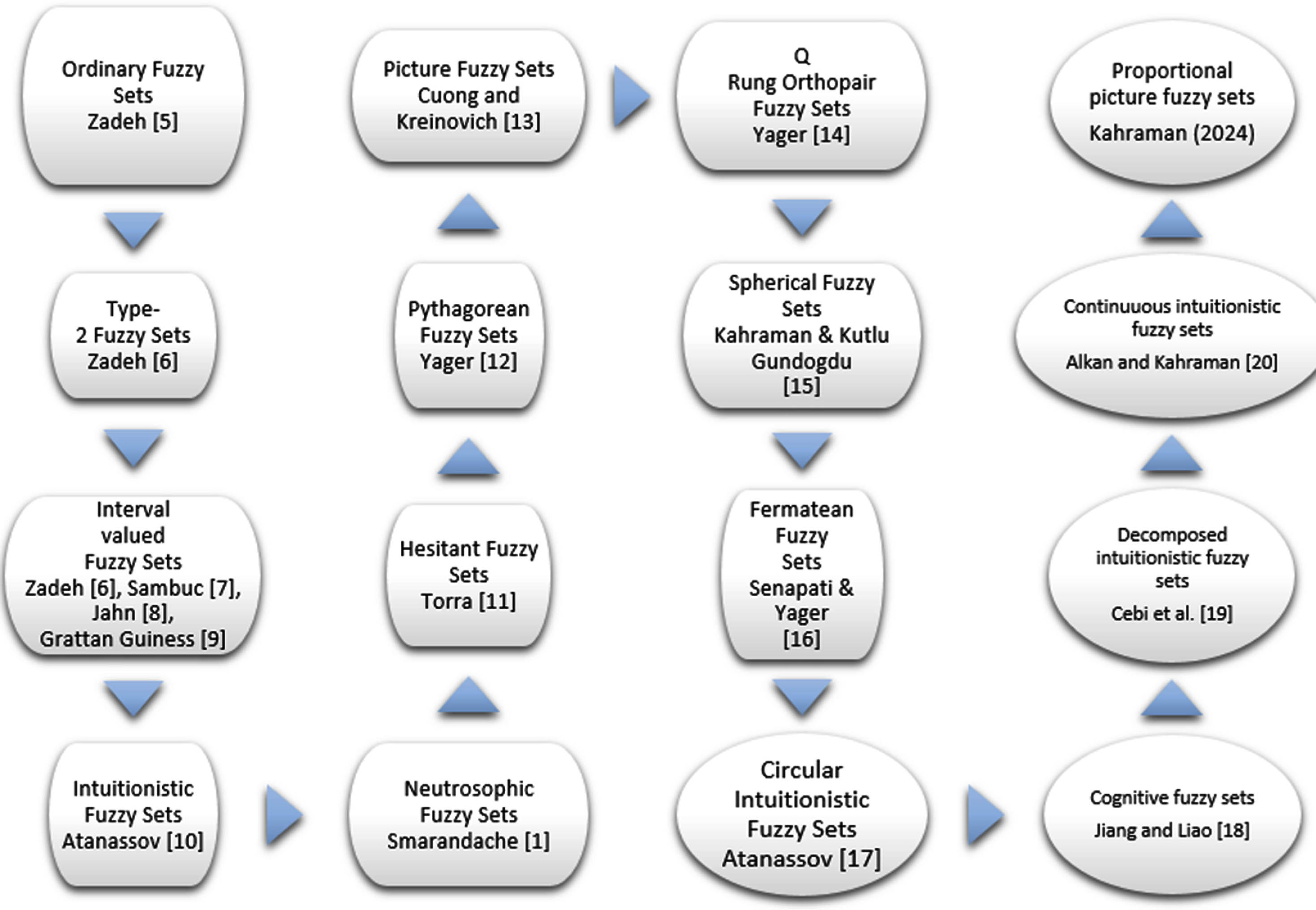
Extensions of ordinary fuzzy sets.
Each of the fuzzy set extensions has been introduced to the literature to complete the missing aspect found in the previous set type. For instance, in addition to the grades being in intuitionistic fuzzy sets, the concepts of hesitancy degree and refusal degree are introduced with picture fuzzy sets. These fuzzy set extensions The motivation for this research is that a methodology on how to assign or determine the degrees in the dozens of fuzzy set extensions introduced to the literature has not been fully developed. This paper introduces an easy but very useful approach for this problem.
The research question is to provide guidance on how to determine degrees in fuzzy sets in general and how to assign these degrees in neutrosophic sets in particular. The goal is to find a technique that will allow obtaining membership degrees from experts with sufficient precision that will not change each time it is asked. This technique should also allow vague degrees of membership defined by experts to be included in the model. Such a simple but effective technique has not yet appeared in the literature. This article proposes a model that will provide all of this.
The use of several elements in neutrosophic sets lessens the likelihood of giving accurate membership values and makes it more difficult to ascertain their values using decimal numbers. Besides, an expert may give distinct decimal membership degrees to the same element of a neutrosophic set at different times within brief intervals. This problem was previously handled by some researchers in different ways ([2, 4]). Our study’s contribution is the development of a system that will significantly lessen this challenge. Rather than attempting to calculate decimal values, the expert can provide his or her insights into the proportions among the variables. As a result, granting degrees will be simpler and more precise.
Consider the cloudy days in Fig. 2. How cloudy is it in (a)? How cloudy is it in (b)? For (a), an expert may assign a neutrosophic number 〈0.85, 0.20, 0.15〉 whereas he/she may assign 〈0.60, 0.30, 0.50〉 for (b). It is not expected that the expert assigns a value having more digits after dot. Instead, the expert can indicate the proportions between truthiness and indeterminacy and between falsity and indeterminacy. For instance, assume that he/she assigns (6, 1) for (a) and (4, 2) for (b). From these proportions, we can obtain the degrees of truthiness, indeterminacy, and falsity with a more sensitive and more correct way such as 〈0.91667, 0.15278, 0.15278〉 for (a) and 〈0.69841, 0.17460, 0.34921〉 for (b).
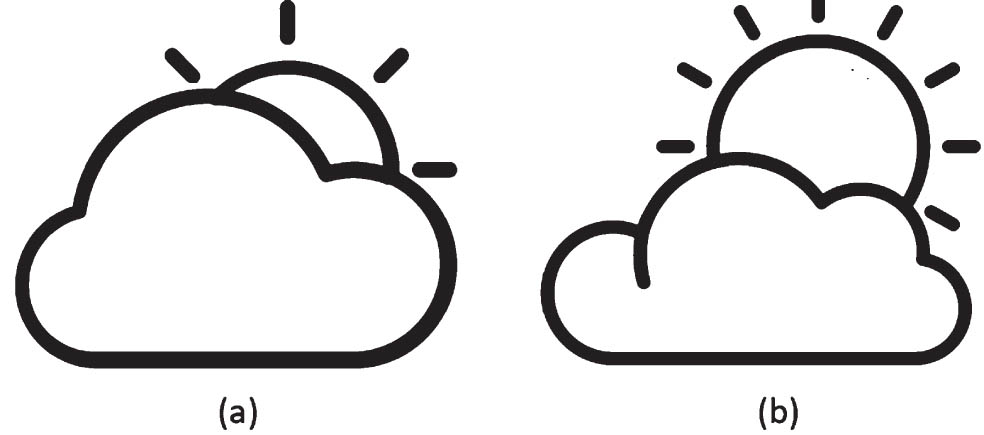
Cloudy days.
In this paper, proportional neutrosophic sets (PNS) are introduced. This new way to determine truthiness, falsity, and indeterminacy degrees is easier and more correct than the direct assignment of a decimal degree. We hypothesize that proportional judgments, as opposed to judgments with decimal membership degrees, are a more effective way for humans to convey their opinions. Let an expert, for example, assign a neutrosophic number 〈x ; T, I, F〉for the proposition “He seems to be around 45 years old”. Let us assume that the expert gives 〈0 . 85, 0 . 10, 0 . 45〉, meaning that there are 0.85 truthiness, 0.10 indeterminacy, and 0.45 falsity degrees. Since accurately assigning these degrees using decimal numbers is a challenging task, it is simpler to make a decision such as a truthiness degree relatively 5 times larger than indeterminacy and a falsity degree relatively 2 times larger than indeterminacy. The foundation of proportional neutrosophic sets is the ease and accuracy with which we can obtain the necessary degrees using relative proportions with more sensitive decimal numbers. Thus, a PN number can be represented by 〈x ; kIT, kIF〉. For proportional neutrosophic sets, the arithmetic operations and aggregation operators of PNS are described. In this paper, imprecise proportions such as “between 2.5 and 3.5” or “around 3” are also handled to show how to model them in arithmetic operations and aggregation operators.
In multiple criteria decision making, the most often used two methods are AHP and TOPSIS. An AHP extension based on PNS is also developed in this paper to obtain the weights of the criteria and then TOPSIS extension based on PNS is developed to determine the best alternative from a given decision matrix. A multi-criteria personnel selection problem is handled to show the practicality of the proposed PNS and proposed methodology.
The rest of the paper is organized as follows. Section 2 introduces the preliminaries of neutrosophic sets. Section 3 develops the proportional neutrosophic set extension. Section 4 includes the incorporation of imprecise proportions to the proposed PNS extensions. Section 5 gives the application of the proposed PNS extensions on MCDM problems. Section 6 concludes the paper.
Determination of membership degrees or functions of fuzzy elements is an important issue in the literature. However, not as many publications have been published on this subject as it deserves. This process is quite interpretive and subjective. This foundation depends on the process of membership assignment. Membership levels can originate from a variety of sources, such as an objectively measured variable, indirect scaling/measurement models, or subjective evaluations made by judges [21]. A membership function’s determination is largely influenced by the problem’s size and context. Excluding the inherent ambiguities in this method becomes difficult when relying on the individual’s experience and personal intuition of the researchers [22].
A decision-maker must express membership degrees as decimal values in the current fuzzy mathematical models. A decision-maker faces a challenging task when determining a value in [0, 1], and the likelihood of making a mistake is very high. To mitigate this dependence on decision-makers, Dalkılıç [3] introduced the notions of relational hypersoft membership degree and inverse relational hypersoft membership degree. An objective determination of these degrees in [0, 1] was attempted, free from the influence of the decision-maker. The ideas of (NOT) bipolar relational non-membership degree and (NOT) bipolar relational membership degree are put out in order to achieve this. Using five distinct data sets, Hasan and Sobhan [23] present a novel and straightforward method for creating fuzzy membership functions. The suggested method makes use of a box plot to identify any outliers in the data set.
The process of accurately determining membership degrees has become more difficult with the emergence of new fuzzy set extensions. Kahraman [4] proposed proportional picture fuzzy sets in order to assign the degrees more accurately and more sensitively. Kahraman [24] proposed proportional intuitionistic fuzzy sets to ease the process of assigning membership and non-membership degrees.
Preliminaries of neutrosophic sets
Neutrosophic sets (NS) were introduced by Smarandache [1]. A NS includes the grades of truthiness, indeterminacy and falsity, which may be independent from each other.
Let a NS is defined as à in the universe X.
The refusal degree in a NS is defined by Equation (2):
Operational rules for simplified neutrosophic sets (SNS) for addition and multiplication of two neutrosophic numbers and multiplication and power operations with a scalar are given by Equations (3–6), respectively.
Assume that
Aggregation of multiple NS is often required in decision-making problems. For calculating neutrosophic weighted arithmetic average, Equation (7) is used:
We will prefer the score function S (x) of Peng et al. [27] for ranking the neutrosophic numbers.
The degrees of truthiness, indecision and falsity in a NS are independent when their sum can be at most equal to 3. In this case, the expert can more easily specify the proportional relations between the degrees of truthiness, indecision and falsity in his/her mind. Here, we present the PNS extension. We first present the basic equations for each PNS extension, then give their operations.
Consider the PNS
Then,
Afterward, each member of the set
Alternatively, a proportional NS
Table 1 presents some reference proportions for neutrosophic sets. For instance for (6, 4), PN number (PNN) is 〈0.666667, 0.111111, 0.444444〉. If the expert assigns a set of (5, 3) between A and AA, the corresponding PN number will be 〈0.679012, 0.135802, 0.407407〉.
Linguistic neutrosophic scale
Operations with PNS are given as in Equations (17–18), respectively.
Let
Equations (19–20) provide the power operation and multiplication by a constant, respectively.
In this section, we show how the imprecise proportion definitions are incorporated into the developed PNS extensions. α-cut approach to handle the imprecise definitions of proportions is used in the following sub-sections. When an expert is largely unsure about the magnitude of the proportion, he/she should assign a smaller value of α. If the expert is largely sure about it, he/she should assign a larger value of α.
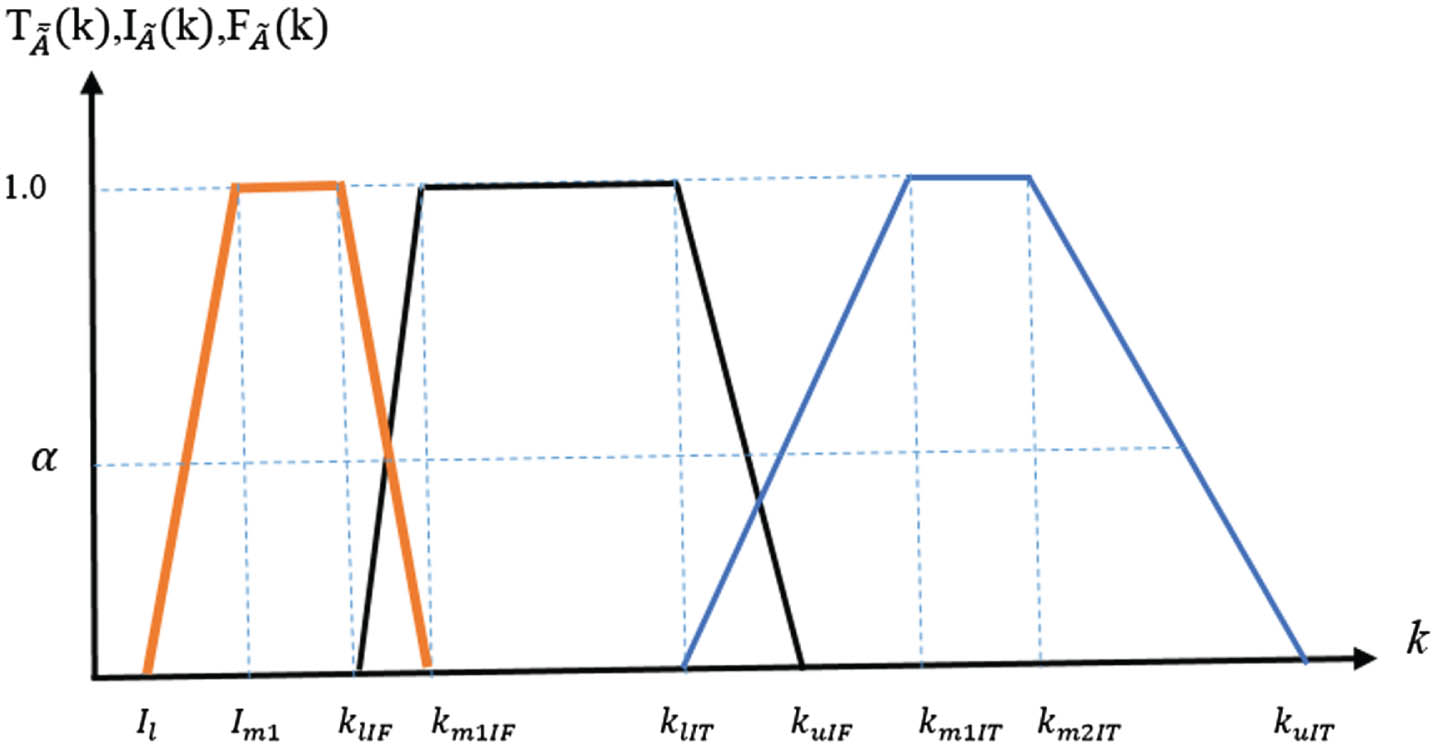
Experts can estimate the mentioned proportions as an imprecise item such that truthiness grade is “around 4 times” larger than the indeterminacy degree; or falsity degree is “between 2 and 2.5 times” bigger than the indeterminacy degree. Figures 2 and 3 illustrate two types of fuzzy estimations of proportions for a neutrosophic set
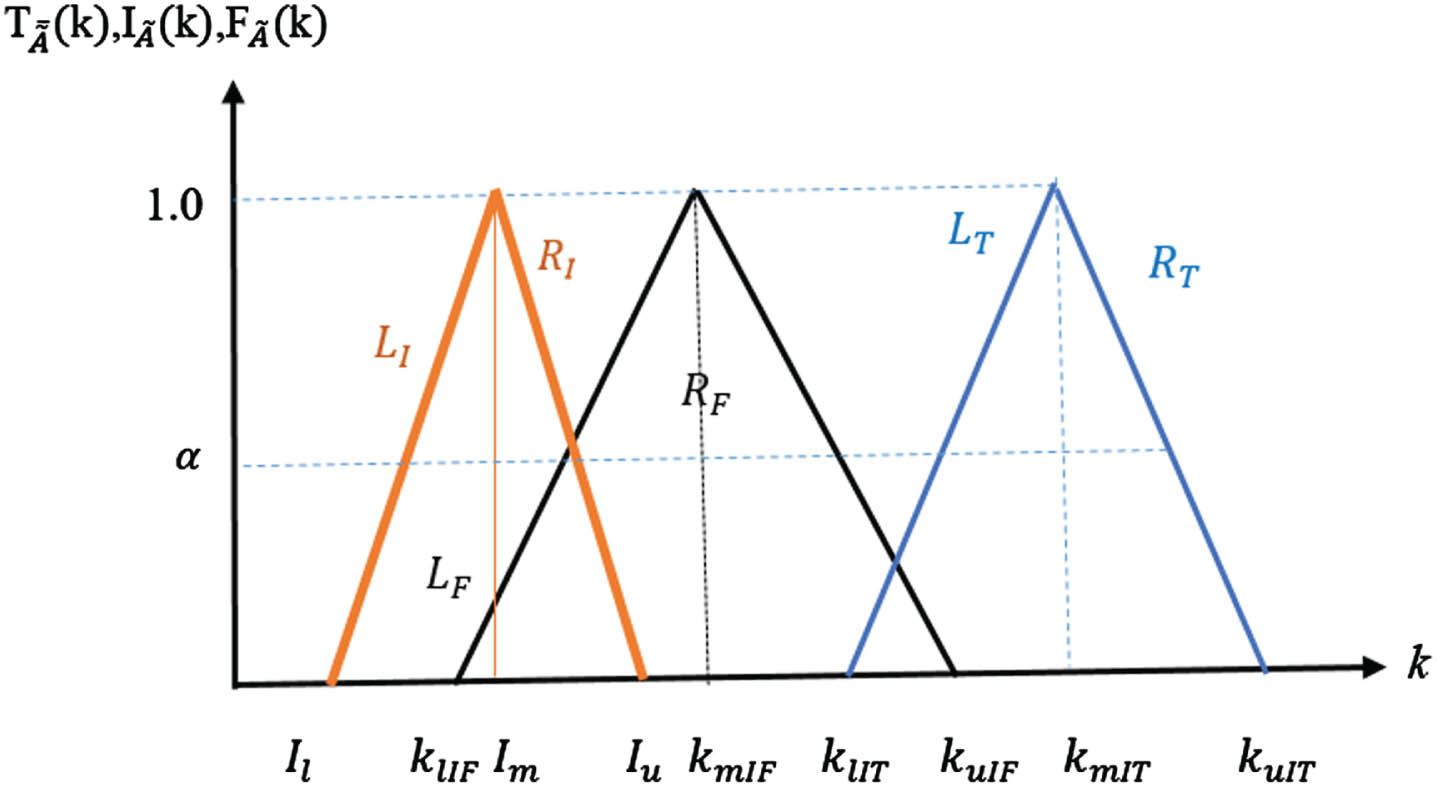
For triangular proportion prediction:
And for trapezoidal proportion prediction between I and T (k
lIT
, km1IT, km2IT, k
uIT
) and for trapezoidal proportion prediction between I and F (k
lIF
, km1IF, km2IF, k
uIF
), the following computations are valid.
Based on triangular α - cut s of k
IT
andk
IF
, Equations (35–37) can be written:
Then, Equations (38–40) are the left and right functions in Fig. 3.
PNS
Then, the definitions of addition and multiplication are found in Equations (42–43), respectively.
Equations (44–45) provide the α-cut multiplication and α-cut power operations by a constant, respectively.
In AHP method, using pairwise comparison matrices, one can break up a big task into smaller ones. The overall solution of the major problem is then obtained by combining the solutions of the smaller problems.
The scale given in Table 1 is proposed to determine the assigned linguistic phrases’ corresponding numerical values. Using the proportion pairs as provided in Equation (46), a pairwise comparison matrix of m criteria can be created.
In Equation (46), reciprocal values are related in such a way that k11n = k1n1, k21n = k2n1. This matrix is transformed to Equation (47) and each element is the normalized (T, I, F) values anymore.
Then, by employing the score function in Equation (48), we convert the normalized neutrosophic matrix to the crisp matrix P in Equation (49).
Consistency of a crisp matrix is calculated by Equation (50) (Saaty [28]) and it should be corrected if the consistency ratio (CI) is larger than 0.10.
In this model we have m alternatives and n criteria, i = 1, 2, … n, j = 1, 2, …, m. Three experts assign the linguistic terms in the decision matrices. Steps of the proportional neutrosophic TOPSIS method are as follows:
Cost Criterion: (T11, I11, F11) → Benefit Criterion: (F11, I11, T11)
For negative ideal solution:
And using the score function:
For positive ideal solution:
And using the score function:
In this section, we give an MCDM application of the developed PNS extensions for both precise and imprecise definitions of proportions.
Three experts (E1, E2, and E3) evaluate four personnel alternatives (P1, P2, P3, and P4) by considering 6 attributes, which are experience (C1), flexible working (C2), responsibility (C3), problem-solving ability (C4), open to innovation (C5), and exam scores (C6). The criteria are evaluated paired as the consensus of experts over the goal and the hesitant degree based pairs, as shown in Table 2. Using Equation (37), this matrix is converted into a crisp pairwise comparison matrix as in Table 3 and then crisp criteria weights are computed. However, each of the experts constructs his/her decision matrix as given in Table 4.
Pairwise comparison matrix of the criteria
Pairwise comparison matrix of the criteria
Crisp pairwise comparison matrix
Proportional neutrosophic decision matrices of the experts
Table 2 converted to a crisp pairwise comparison matrix as in Table 3.
From Table 2, wC1 = 0.425, wC2 = 0.032, wC3 = 0.059, wC4 = 0.112, wC5 = 0.148, and wC6 = 0.224.
Table 4 presents the decision matrices composed of pairs of proportions of three experts.
Giving some values for α, we can aggregate the proportional fuzzy decision matrices. The experts compromise on α = 0.8 since they are not sure about some vague proportions. PNWA operator in Equation (22) gives the aggregated matrix in Table 5.
PNWA aggregation with proportional neutrosophic sets
Table 6 gives the weighted aggregated decision matrix.
Weighted aggregated decision matrix
Table 7 presents the PIS and NIS values based on the score function.
PIS and NIS values
The distances to PIS and NIS and closeness coefficients to the ideal solutions are presented in Table 8.
Distances to PIS and NIS
Based on Table 7, the best alternative is Person-1. The ranking is Person-1 > Person-4 > Person-3 > Person-2.
Comparison with crisp TOPSIS using score function
Using Equation (9), we compute the score values of the aggregated decision matrix as given in Table 9.
Crisp aggregated matrix
Crisp aggregated matrix
Table 10 presents the weighted normalized aggregated decision matrix. The given criteria are benefit type. PIS and NIS are obtained as in Table 11. Table 12 gives the distances of each alternative to PIS and NIS.
Weighted normalized aggregated matrix
PIS and NIS sets
Distances to PIS and NIS
Based on the closeness coefficients given in Table 12, the ranking is obtained as Person-1 > Person-3 > Person-4 > Person-2. The difference in the rankings is the replacement of Alternatives 3 and 4. This is because of the usage of score function, which removes the differences among the PN numbers. The complete neutrosophic solution without the score function is better than the crisp approach causing a loss of information.
In this sub-section, the personnel selection problem is handled as a hierarchical AHP problem and solved by PN AHP alone. Figure 5 gives the hierarchy of the AHP model with one goal, 6 criteria, and 5 alternatives. From the pairwise comparison of 6 criteria, we have already obtained the criteria weights as wC1 = 0.425, wC2 = 0.032, wC3 = 0.059, wC4 = 0.112, wC5 = 0.148, and wC6 = 0.224. The next step is the comparison of alternatives by each criterion. The same experts fill in these matrices parallel to their previous evaluations in PN TOPSIS methodology.
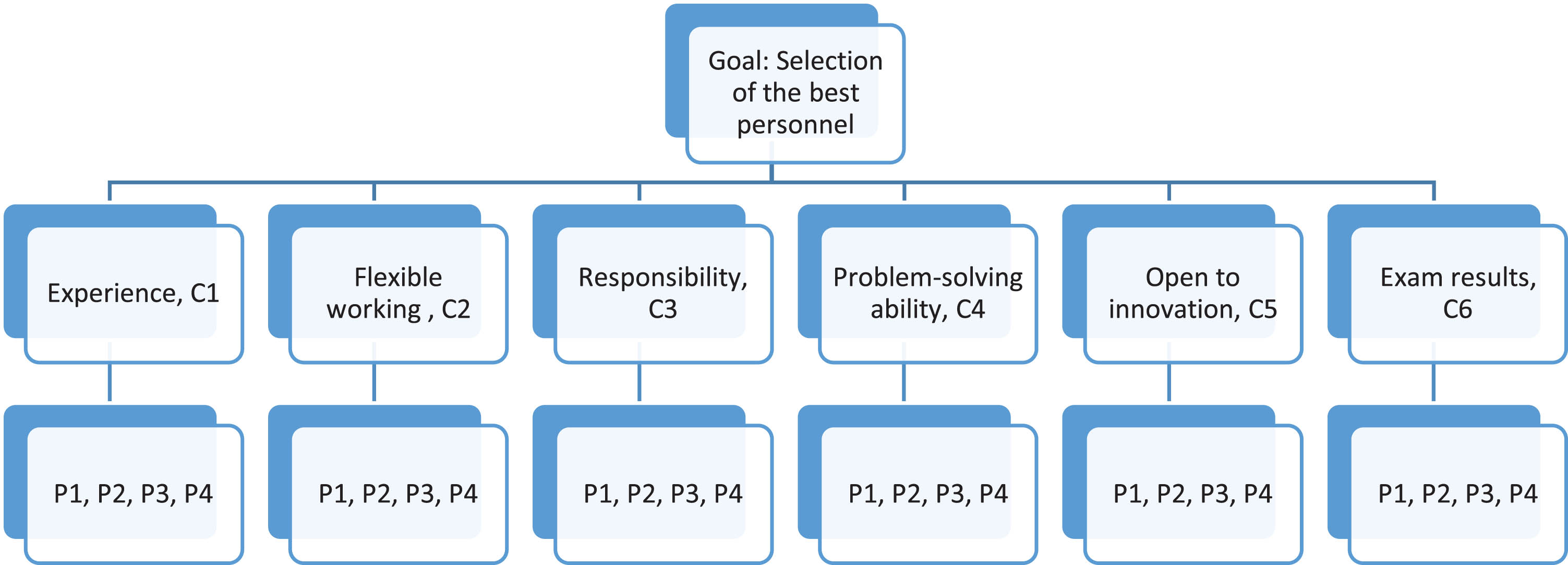
Hierarchy of the problem.
With respect to the criteria C1–C6, the candidates are pairwised-compared by three experts with a full consensus as in Table 13:
Pairwise comparison of alternatives with respect to the criteria
From the given PN pairwise comparison matrices, the sets of scores of the alternatives are computed and the overall score of each alternative is given in Table 14.
Overall scores of the alternatives
Based on the obtained scores, the ranking of the alternatives is P1 > P4 > P3 > P2, which is the same as the PN AHP & TOPSIS methodology. The consistency of the experts is quite important for obtaining the same results. Inconsistent evaluations will certainly produce different ranking results, which can reduce the reliability of the proposed method.
We presented proportional neutrosophic set extensions and their AHP & TOPSIS methodology. The main advantage of these proportional neutrosohic set extensions is their ability to determine the truthiness, falsity, and indecision degrees easily and correctly. We developed the arithmetic operations and aggregation operators of neutrosohic set extension. We also presented α-cut approaches for the cases that experts are unsure to determine the proportions between the degrees. The rule is the more unsure you are, the smaller α you assign or the surer you are, the larger α you assign. Once you determine the proportions, they are substituted into the developed equations. Then, they produce the usual truthiness, falsity, and indecision degrees as in their formaldefinitions.
Experts cannot assign many digits after dot for any membership degree when they directly try to assign it. The proposed proportional approaches could produce membership degrees with several digits after dot. Personnel alternatives in the application section have been prioritized by using PN-AHP & TOPSIS methodology based on proportional neutrosophic sets.
The limitation of the proposed proportional neutrosophic sets is to determine the proportions when the parameters of neutrosophic sets are independent. The proposed proportional neutrosophic sets are mostly appropriate to use when the truthiness, indeterminacy, and falsity degrees are dependent since we propose proportions between these parameters.
For further research, we suggest the developed proportional neutrosphic sets to be employed in the extension of MCDM methods such as ELECTRE, PROMETHEE [29], EDAS, CRITIC, MULTIMOORA, or COPRAS. A proportional neutrosophic AHP & ELECTRE methodology, PN AHP & DEMATEL [30] or PN CRITIC & EDAS methodology can be proposed and its results can be compared by our PN AHP & TOPSIS methodology. The other set extensions such as Fermatean fuzzy sets, q-rung orthopair fuzzy sets, or t-spherical fuzzy sets can be also handled to develop their proportional fuzzy versions and proportional Fermatean fuzzy AHP & TOPSIS methodology or Fermatean fuzzy CRITIC & COPRAS methodology can be proposed in future studies.