







Abstract
Petroleum Waste sludge (PWS) could be used as unusual source for the extraction of barium oxide nanoparticles. A hydrothermal method was adapted to precipitate barium as barium hydroxide that calcined at different calcination temperatures up to 1000 °C to obtain barium oxide nano particles. The mineralogical composition, morphology, particle size and spot analysis of the extracted particles were followed using XRD and SEM+EDAX techniques. These investigations confirmed the purity and nano size of barium oxide particles extracted from PWS at 600 °C.
Introduction
The problem of industrial waste in general, and petroleum waste in particular, represents a major crisis in petroleum industrialized countries especially the Kingdom of Saudi Arabia. Oil factories are spread throughout the Kingdom, which leave behind huge tons of oil treatment processes that cause environmental pollution.
This work concerned with waste management particularly utilization of petroleum waste sludge as a source for extraction of barium oxide nanoparticles, this process is highly economic due to the relatively expensive price of barium oxide nanoparticles (about 200 € for 25 gm).
The huge quantities of petroleum residue sludge left during oil well drilling operations, such as waste petroleum treatment sludge, drilling fluids and bottom tank tailings) represent a major challenge for researchers in this field [1].
Several studies [2–12] aimed to benefit from the huge quantities of PWS through directing them to building materials industries.
N. M. Khlill et al. [13] could produce high quality refractory bricks using PWS as a source of barium and silicon oxides with bauxite raw material as a source of alumina. Other authors [14–19] use PWS with some other additives for conventional ceramic production. Ali Benlamoudi et al [20] was interested with using PWS in the cement industry but as additives to clinker (raw cement) instead of gypsum.
On the other hand, it is no secret that many researchers worldwide have great interest in the field of nanomaterials, especially nano-oxides, which have unique properties that qualify them for use in advanced technological, engineering, chemical and medical fields. One of these materials is nanometric barium oxide, which considered a promising material in these fields, especially in the manufacture of sensors and conductors due to its characteristics with a wide band gap. Therefore, several recent research articles reported different methods to obtain nano particles of BaO from different resources [20–22]. However, most previous trials for BaO extraction use pure chemicals as a source for barium, which is relatively expensive and hence has a low economic impact. According to our previous work [13], PWS contains a relatively high content of BaO, so this work aims at exploitation of this waste (PWS) as a cheap and economic suitable source for extraction of barium oxide nanoparticles.
Materials and experimental
Materials
Petroleum waste sludge (PWS) was collected from Petroleum refining company, Western KSA, then processed through drying, in air for 5 days then at 110 °C for 24 hrs, grinding in an automatic ball mill machine for 3 hrs, sieving through 100-micron standard sieve. Representative sample obtained through quartering technique (in which the powder is divided into four portions considering two opposite portions and excluding the others) has been used as a source of barium. Some general use chemicals i.e. hydrochloric acid (HCl) and potassium hydroxide solution (KOH) were used for the extraction process.
Methods
Hydrothermal method has been used for the extraction of nano barium oxide from PWS. 100 g of the representative PWS sample was treated with diluted HCl (1:1) with gentle heating and stirring for 15 minutes. After filtration through filter paper no. 40, the filtrate was transferred to 500 ml beaker and mechanically stirred with stepwise additions of 0.1 M potassium hydroxide (KOH) solution until pH 10 at which white precipitate was obtained. After washing several times with distilled water, the precipitate was dried in an electrical dryer before subjected to different firing temperature up to 1000 °C. The phase evolution was followed through x-ray diffraction technique analysis using Bruker (Germany) XRD diffractometer; D8 ADVANCE, in which Copper-kα radiation operates at 40 kilovolt and 30 milli ampere. The microstructure, particle size and spot analysis were determined through scanning electron microscope attached with EDAX unit (JEOL-JSM-7600F). The extraction process is summarized in Fig. 1.
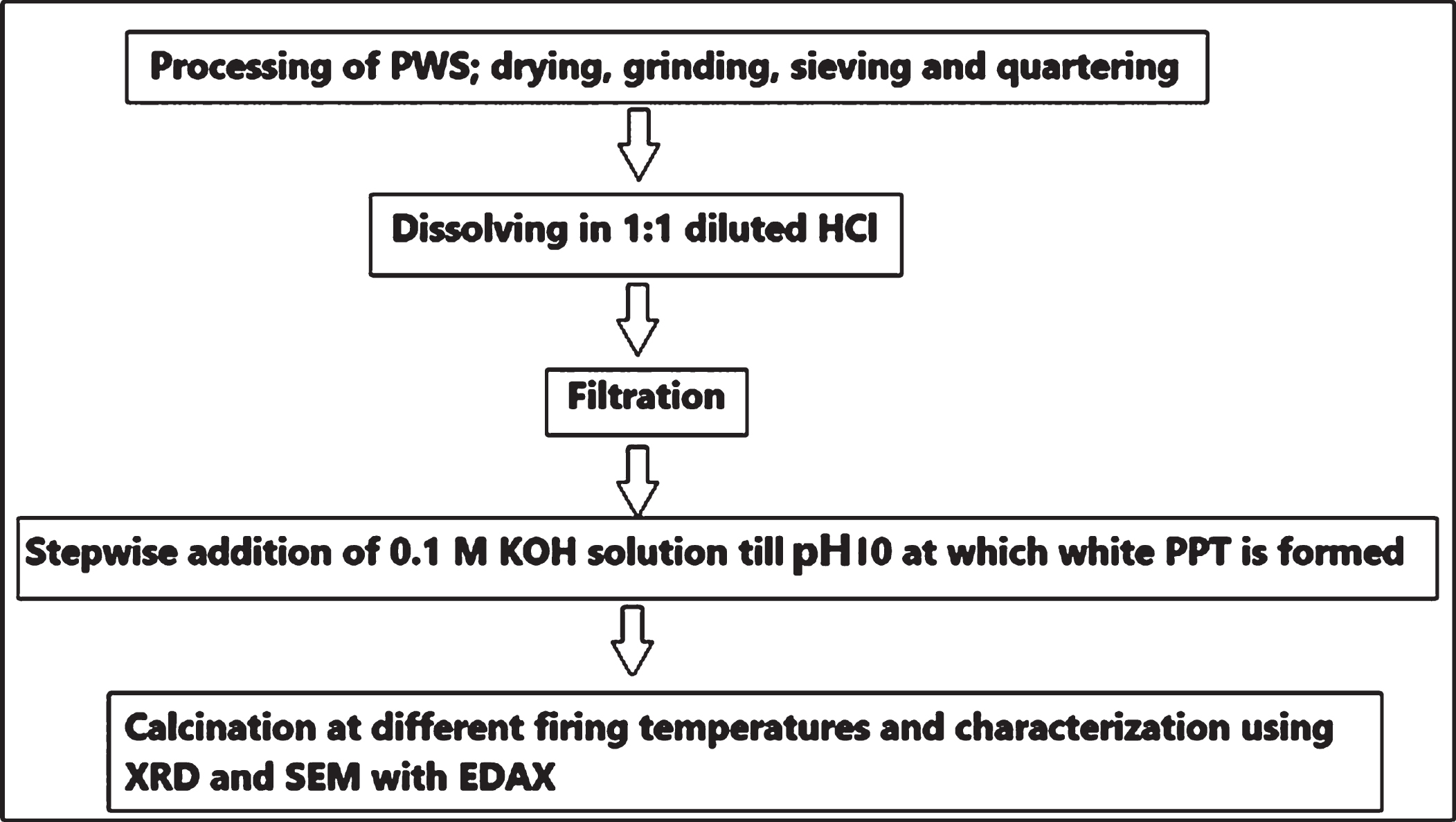
Schematic diagram for the extraction process.
Phase and chemical compositions of PWS
According to a previous study for the authors [13] summarized in Table 1, PWS composed mainly of barite, quartz and kaolinite minerals, it contains a considerable proportions of BaO (39.1 wt. %) which qualify it as a nontraditional source for BaO extraction.
Phase and chemical composition of PWS [13]
Phase and chemical composition of PWS [13]
Figure 2 shows XRD of the extracted particles treated at different temperatures; 110, 250, 600, 800 and 1000 °C. At 110 °C and 250 °C only peaks characterizing barium hydroxide (Ba(OH)2) (JCPDS 78–1831) predominate as a result of hydroxylation of barium solution with diluted ammonia solution. On increasing temperature to 600 °C, all peaks characterizing BaO could be detected (JCPDS 89–4925) with absence of peaks may characterize any other phases because of calcination of barium hydroxide to barium oxide. At 800 °C and 1000 °C no observable change in the phase composition but only increasing in the intensity of BaO peaks as a result of increasing crystallization could be detected which indicates that the calcination of barium hydroxide precipitate to give barium oxide particles was attained completely at 600 °C.
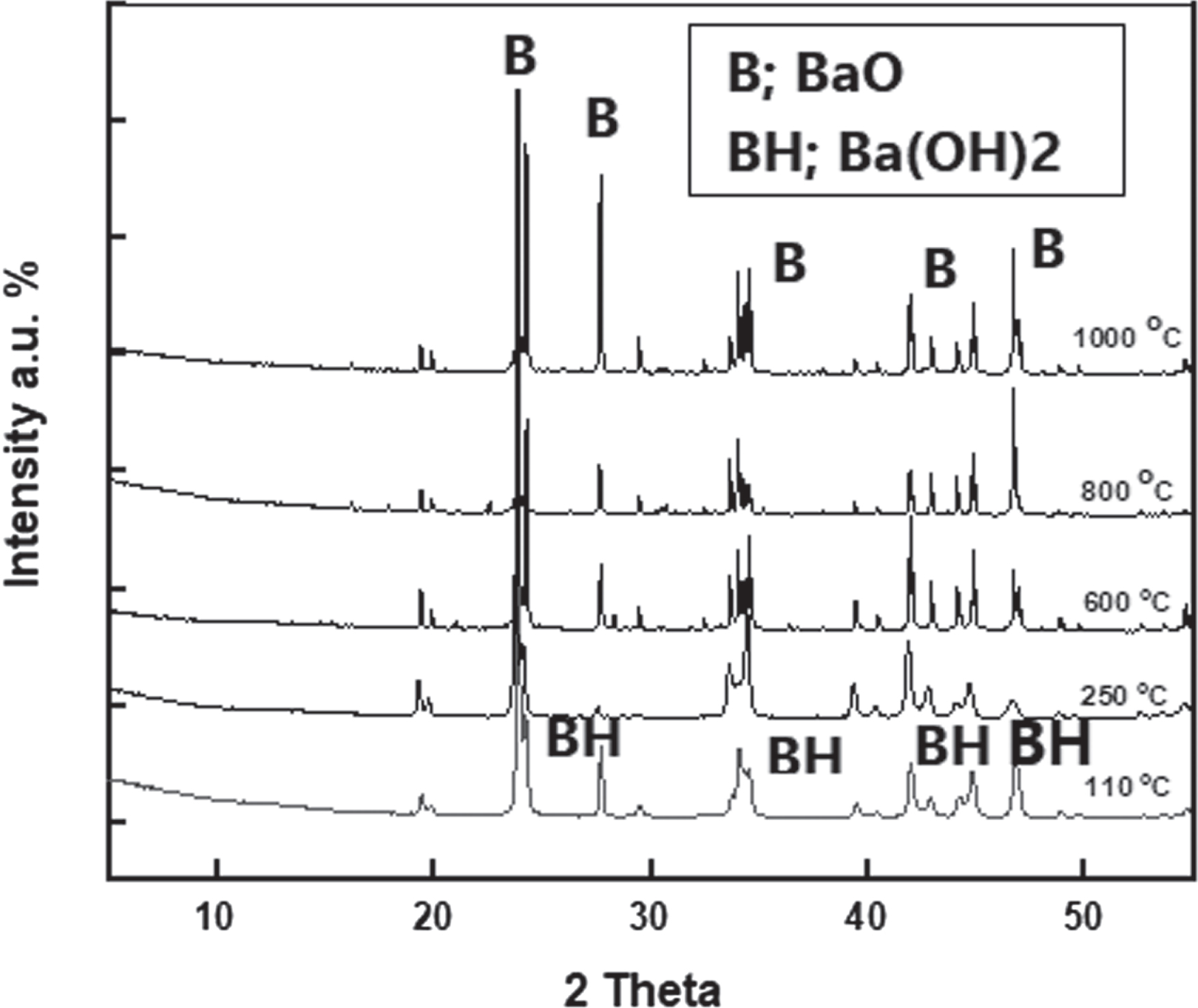
XRD patterns of the extracted particles calcined at different temperatures.
Figure 3 (a, b) shows the microstructure of the extracted particles treated at 600 °C. Figure 3a shows an overview image which indicates homogenous microstructure in which patch rounded crystals spreader everywhere [21, 22], measuring some randomly selected particles in different regions indicate that the particle size is less than 100 nm (average particle size; 71–90 nm) as shown in (Fig. 3b), the hydrothermal technique and the relatively low firing temperature (600 °C) avoid grain growth and hence ensure the relatively low particle size of the extracted barium oxide particles (< 100 nm). EDAX Data shown in Table 2 and Fig. 4 Indicates that only peaks characterizing barium and oxygen are present, no peaks of any other elements could be detected due to carful adjustment of pH which confirm the high purity of the extracted BaO nanoparticles.
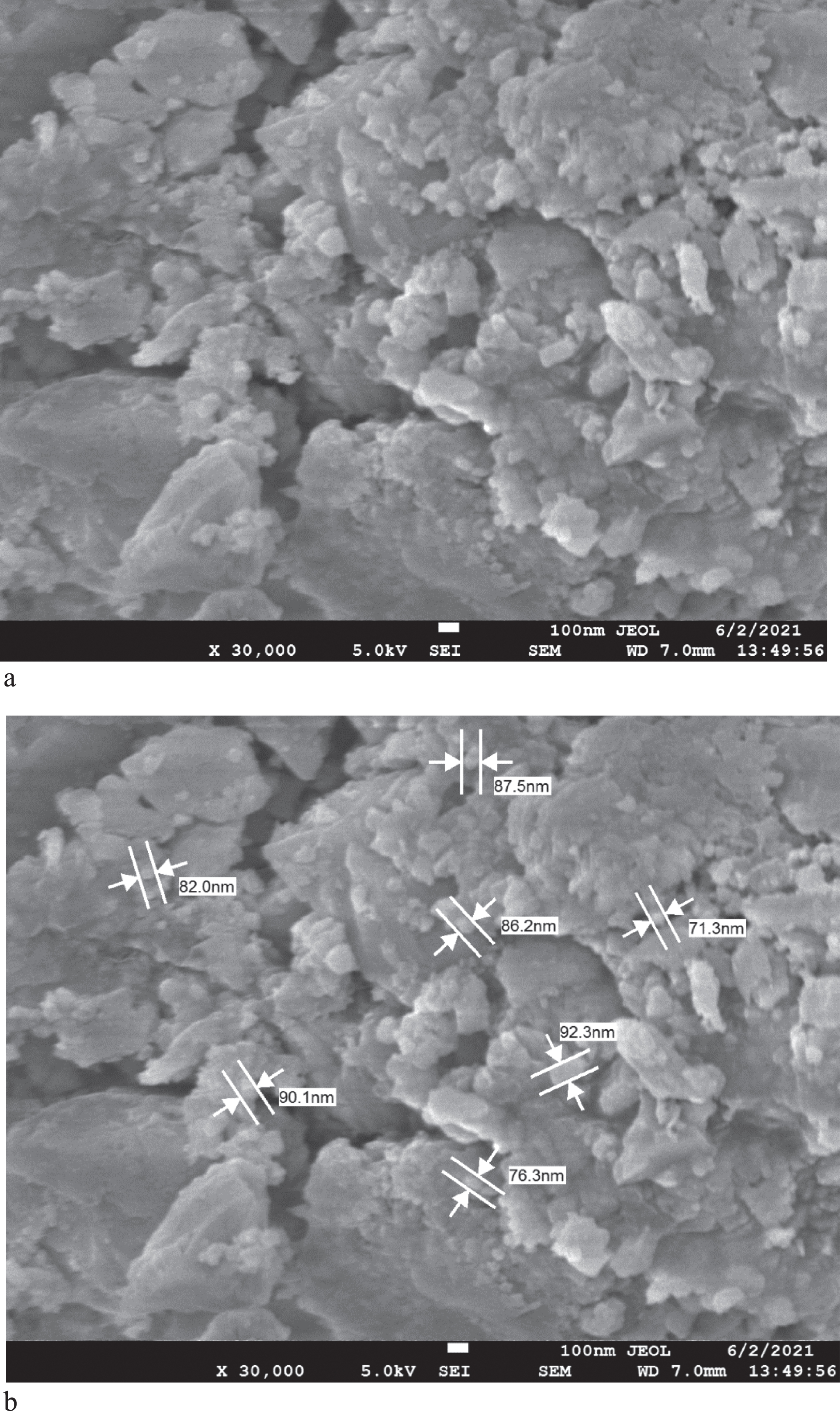
a. SEM photomicrograph; an overview of the extracted particles. b. SEM photomicrograph and particle size of the extracted particles.
EDAX data of the extracted particles
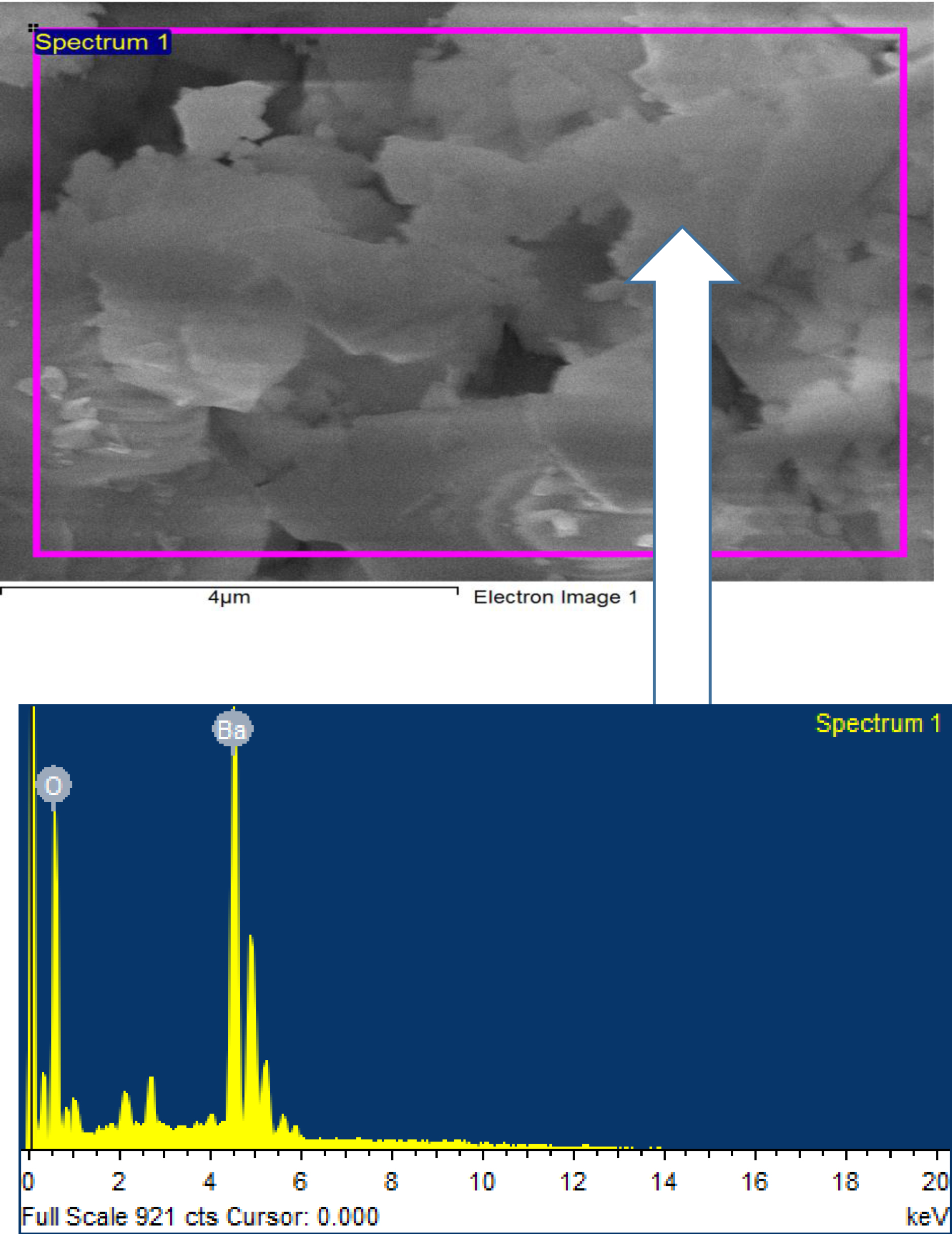
Spot analysis of the extracted particles.
PWS could be exploited as an unusual source for nano BaO extraction. Based on the phase composition and morphology studies, the extracted barium oxide particles are highly pure and fitted with the nanoscale (< 100 nm) which qualifies them for use as a promising material in many engineering, electronic, chemical and medical applications.
Footnotes
Acknowledgments
This article entitled “Extraction of barium oxide nanoparticles from petroleum waste sludge wastes” contains the results and findings of a research project that is funded by Deanship of Research & Post-graduate of University of Jeddah Grant No. (UJ-20-074-DR).