





Abstract
The American Occupational Therapy Association’s Centennial Vision American Occupational Therapy Association (2007) articulates the strategic goals for the profession to be science driven and evidence based in major practice areas. In the practice area of productive aging, a previous review of research published in the American Journal of Occupational Therapy (AJOT Murphy, 2010) found mostly basic research with far fewer effectiveness studies. The current review article is divided into two parts. Part 1 provides an update on the types of research published on productive aging in AJOT in the past 2 yr (2009–2010). Part 2 examines the range and scope of occupational therapy effectiveness research on productive aging published in a similar time frame in other occupational therapy journals and outside of the discipline.
The American Occupational Therapy Association (AOTA; 2007) established the Centennial Vision to optimize occupational therapy’s role in supporting people’s health, well-being, and quality of life. It states that by 2017, occupational therapy should be “a powerful, widely recognized, science-driven, and evidence-based profession with a globally connected and diverse workforce meeting society’s occupational needs” (AOTA, 2007, p. 613). As part of establishing this vision, key practice areas of the profession were identified (productive aging; rehabilitation, disability, and participation; children and youth; work and industry; health and wellness; and mental health), and they provide a framework to track evidence for occupational therapy interventions. The American Journal of Occupational Therapy (AJOT) has been supporting the vision by systematically evaluating literature in these areas. In 2010, I presented a review of the productive aging literature published in AJOT (Murphy, 2010). This article updates the previous review and expands beyond AJOT to examine occupational therapy effectiveness research in productive aging published elsewhere, both within and outside the discipline.
Productive Aging
The U.S. population is aging, and nearly 20% of the population will be ≥65 yr old by 2030 (Day, 2010). With this population growth, the need for rehabilitation services for older adults will increase. This growth also creates opportunities in health promotion because these issues are becoming national priorities for health care (U.S. Department of Health and Human Services, 2000). To provide a framework for occupational therapy’s role in this area, the term productive aging was chosen; however, it has not been defined. To search and examine literature in productive aging, particularly outside occupational therapy, I needed a working definition of this term.
The term productive aging has a long history. It is thought to be the precursor of successful aging (Rowe & Kahn, 1997), although successful aging appears to encompass a larger model involving the interplay among disease status, functioning, and engagement with life. (For an interesting discussion of how successful aging relates to productive aging, see Dillaway & Byrnes, 2009). The concept of productive aging was developed by Robert Butler, the founding director of the National Institute on Aging. Butler and Gleason (1985) stressed that older adults need to be productively engaged in society. Productive aging has been defined narrowly as the ability to serve or support the paid workforce (Caro, Bass, & Chen, 1993) and more broadly to include engagement in a variety of activities, such as volunteering, paid work, assisting in the family, maintaining self-care (Butler, 2002; Herzog, Kahn, Morgan, Jackson, & Antonucci, 1989), and continuing education (O’Reilly & Caro, 1994). This broader conceptualization is better aligned with occupational therapy, highlighting the importance of roles and activity engagement, whether the engagement has a direct societal contribution or whether it is individually meaningful and valuable. I considered articles on productive aging to include those describing activities pertaining to aging issues (e.g., driving, caregiving), an older adult sample (as opposed to samples with a particular condition or disability), and samples with a mean age of ≥60 yr.
Part 1: Types of Productive Aging Research Articles Published in AJOT
Articles on productive aging published in AJOT from 2009 through 2010 were synthesized by type and level of evidence. Types of articles have previously been outlined (Gutman, 2008; Murphy, 2010) and include effectiveness studies, efficiency studies, systematic reviews, basic research, instrument development and testing, and the link between occupational engagement and health. The five levels of evidence (Lieberman & Scheer, 2002) are as follows:
Level I—systematic reviews, meta-analyses, and randomized controlled trials (RCTs)
Level II—two-group, nonrandomized studies (e.g., cohort, case control)
Level III—one-group, nonrandomized studies
Level IV—single-subject designs, descriptive studies, and case series
Level V—case reports and expert opinion.
In 2009–2010, 143 research articles were published in AJOT. Of those, 21 articles (15%) were classified as being on productive aging. Each productive aging article is classified by type in Table 1. Basic research articles and articles on instrument testing and development each made up 28% of the productive aging literature (Figure 1). Efficiency studies—that is, studies pertaining to client factors (e.g., safety, satisfaction), cost, or time efficiency—made up 19% of the articles. The remaining 25% of articles were in the areas of effectiveness (10%), topical area or professional question (10%), and the link between occupational engagement and health (5%).
Research Articles on Productive Aging Published in the American Journal of Occupational Therapy From 2009 to 2010 (N = 21)
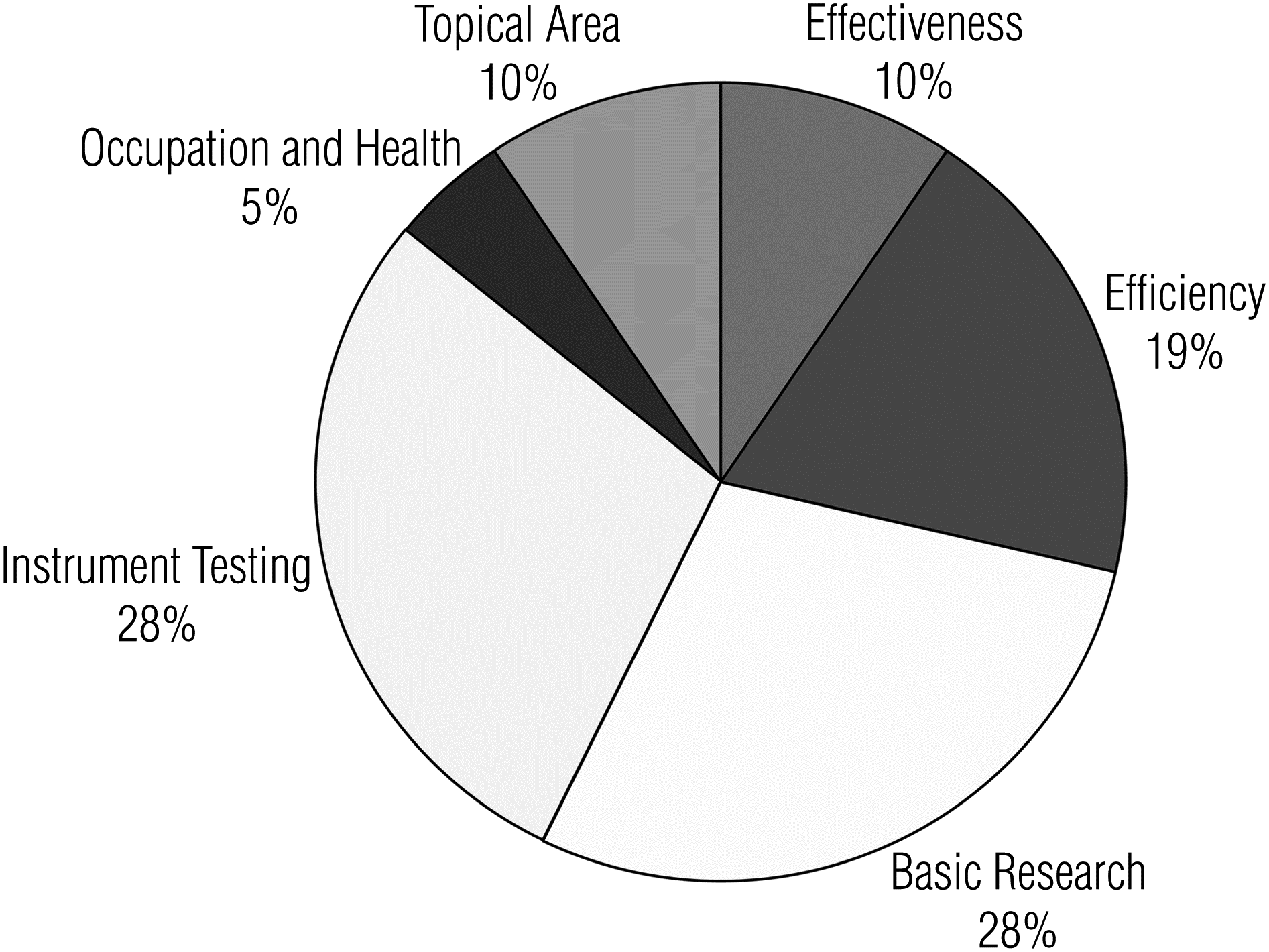
Types of productive aging articles published in the American Journal of Occupational Therapy from 2009 to 2010.
Most of the productive aging literature from 2009 to 2010 pertained to driving (14 of 21 articles, or 67%). Driving articles made up all the efficiency studies and both studies examining a topical area or professional question. Five of the six instrument development studies and half of the basic research articles also pertained to driving. No driving articles were classified as effectiveness studies or as focusing on the link between occupational engagement and health.
Two productive aging studies (10%) were classified as effectiveness studies of an occupational therapy intervention: Murphy, Lyden, Smith, Dong, and Koliba (2010) provided Level I evidence, and Wang, Holliday, and Fernie (2009) provided Level V evidence. One was a pilot RCT that examined two versions of an occupational therapist–led activity pacing program (tailored and general) for symptom management for people with symptomatic knee or hip osteoarthritis. All participants wore a wrist accelerometer during a home period that measured physical activity and allowed for repeated assessment of pain and fatigue severity. Then, depending on group assignment, participants received general activity pacing instruction or tailored instruction on the basis of the relationship between the participant’s own physical activity patterns and symptoms taken from the accelerometer (Murphy et al., 2010). Compared with the general group, the tailored instruction group had lower fatigue levels on the Brief Fatigue Inventory at follow-up.
The other effectiveness article was a case study (Wang et al., 2009) in which the use of a specially equipped, anticollision power wheelchair was tested with a nursing home resident with dementia. Wang et al. (2009) found that the resident’s affect and indicators of social participation increased (e.g., alertness, smiling, engaging others). They also discussed challenges to long-term use of this wheelchair, such as the resident requiring a high degree of support to operate it.
The basic research articles that did not pertain to driving were on disparate topics, although all provided foundation for intervention development and can inform practice (Donovan & Corcoran, 2010; Perlmutter, Bhorade, Gordon, Hollingsworth, & Baum, 2010). For instance, Perlmutter et al. (2010) evaluated common conditions of older adults and participation as measured by the Activity Card Sort and found that decreased levels of vision, depression, and cognition were associated with lower participation. This study provides support for the importance of screening for these conditions and how their presence could guide treatment.
How Well Did AJOT Meet the Centennial Vision in Productive Aging in 2009 and 2010?
To answer this question, I must first review results of the 2010 review of the productive aging literature (Murphy, 2010). That review showed that 14 productive aging articles were published in AJOT in 2008–2009; 50% were basic research articles, 36% were either systematic reviews or effectiveness studies (i.e., Level I evidence), 7% pertained to instrument development and testing, and 7% pertained to the link between occupational engagement and health.
Compared with the literature reviewed in this article, the literature published in 2008–2009 had more articles classified as effectiveness studies. Most evidence came from systematic reviews of articles on driving that used literature both within and outside of occupational therapy. These reviews articulated occupational therapy’s role in driving and identified research gaps in which occupational therapists can be leaders. In the current review, the wealth of driving articles shows the knowledge building in this area. Occupational therapy researchers are examining the efficiency of their driving programs and how conditions such as arthritis and other disabilities affect driving performance (Kay, Bundy, Clemson, 2009). They are developing and evaluating driving instruments. They are also addressing important topic areas such as clinician competence in driving assessment (Korner-Bitensky, Menon, von Zweck, & Van Benthem, 2010) and procedures for administering on-road driver assessments (Stefano, 2009).
In my initial review of the productive aging literature (Murphy, 2010), I concluded that in light of the many basic research studies and few effectiveness studies, occupational therapy is still in the initial stages of supporting practice through evidence. Only one RCT was published in the 2008–2009 time period. For this review, I also found only one RCT. Although I found fewer basic research articles in this review than in the previous review and research in the area of driving is growing, effectiveness articles are still few and therefore limit the ability to use the evidence in practice.
Part 2: Productive Aging Literature Published Outside of AJOT and the Occupational Therapy Field
Given the lack of effectiveness studies related to productive aging published in AJOT from 2009 to 2010, I was asked to examine the occupational therapy effectiveness literature on productive aging that has been published outside AJOT (i.e., in other occupational therapy journals and outside of occupational therapy). This search involved literature published from January 2009 through May 31, 2010.
I used several strategies in the attempt to perform a comprehensive search. In addition to searching several journals for occupational therapy effectiveness literature, I searched by author name to find research performed by specific occupational therapy researchers who conduct productive aging research. In addition, I polled members of AOTA’s Ad Hoc Group on Aging for input on relevant journals and names of occupational therapy researchers.
I first examined occupational therapy journals (see the Appendix). An online search was performed using Medline, CINAHL, and full-text journal resources at my university. If abstracts were not available online, journals were manually searched. Journals outside of occupational therapy included the top 10 gerontology journals by impact factor (“Journals Ranked by Impact: Gerontology,” 2008) and additional journals thought to be relevant taken from resources from the Ad Hoc Group on Aging (see the online Appendix). In this online search, the search term was occupational therapy.
To search for occupational therapy researchers, I included all previous contributors to AJOT on the topic of productive aging, based on the previous geriatric research review article (Murphy, 2010). Second, a list of potential occupational therapy researchers on aging was generated; it included known researchers, chapter authors in occupational therapy publications on aging, and researchers from the American Occupational Therapy Foundation’s Academy of Research. Fifty-two names were generated, and a search was done on those names. Articles were included if they tested an intervention referred to as occupational therapy or if they were conducted by occupational therapists (determined from the author list or by credentials). Exclusion criteria were nonintervention studies; studies that discussed only design or methods of a trial or intervention study, case studies, and effectiveness studies that focused on a particular diagnosis or condition (e.g., stroke, traumatic brain injury, Parkinson’s disease, amputees) typically reflected in another practice area (e.g., rehabilitation, disability, participation). One effectiveness article was excluded because occupational therapy was given to all participants regardless of group assignment and was therefore not the intervention being tested (Gill, McBurney, & Schulz, 2009). Another article was excluded because its main focus was examination of the effect of intersection design on driving performance rather than application of an intervention (Classen, 2009).
Results
The initial search revealed 15 articles on occupational therapy effectiveness in occupational therapy journals other than AJOT and outside the field. On further classification, 3 of the 15 were determined to be efficiency studies (Bendixen, Levy, Olive, Kobb, & Mann, 2009; Gitlin, Winter, et al., 2009; Stefano, 2009), yielding 12 articles on effectiveness. Six articles (50%) were published in occupational therapy journals (Clemson et al., 2010; Greene, Sample, & Fruhauf, 2009; Hasegawa et al., 2010; Klassen, Liu, & Warren, 2009; Petersson, Kottorp, Bergström, & Lilja, 2009; Stark, Landsbaum, Palmer, Somerville, & Morris 2009). Of the 6 articles, 2 were on home modification interventions, 2 were on pain management interventions, and 2 were on fall prevention. Two studies were RCTs (Clemson et al., 2010; Hasegawa et al., 2010). In non–occupational therapy journals, 6 occupational therapy effectiveness articles were published (Gitlin, Hauck, et al., 2009; Lam et al., 2010; Packer, Girdler, Boldy, Dhaliwal, & Crowley, 2009; Svidén, Fürst, von Koch, & Borell, 2009; Wilson, Mitchell, Kemp, Adkins, & Mann, 2009). Three of the studies were RCTs (Gitlin, Hauck, et al., 2009; Lam et al., 2010; Wilson et al., 2009).
Table 2 shows the five RCTs yielded from this search. Two RCTs involved exercise training either to reduce falls (Clemson et al., 2010) or improve pain (Hasegawa et al., 2010). Two RCTs were on home modifications (Gitlin, Hauck, et al., 2009 Wilson et al., 2009). Gitlin, Hauck, and colleagues (2009) conducted an intervention that included behavioral instruction and task performance modifications, and Wilson and colleagues (2009) focused on assistive technology. Lam and colleagues (2010) examined a functional skills training program with people who had mild to moderate dementia.
Occupational Therapy Randomized Controlled Trials in Productive Aging Published in Journals Other Than AJOT, 2009–2010
Note. ABC = Activities-Specific Balance Confidence Scale; ABLE = advancing better living for elders; ADL = activities of daily living; AJOT = American Journal of Occupational Therapy; AMPS = Assessment of Motor and Process Skills; ANOVA = analysis of variance; ANCOVA = analysis of covariance; DAD = Chinese Disability Assessment for Dementia; DSM–IV = Diagnostic and Statistical Manual of Mental Disorders (4th ed.); IADLs = instrumental activities of daily living; LiFE = lifestyle approach to reducing falls through exercise; M age ± SD = mean age ± standard deviation; MESE = Marcus Exercise Self-Efficacy Scale; MFES = Modified Falls Efficacy Scale; OARS = Older Americans Resource and Service Instrument; OT = occupational therapist; PT = physical therapist; SF–36 = Short Form–36.
Although the timespan for the synthesis of the effectiveness literature is relatively narrow (January 2009–May 31, 2010), a few main points are worth mentioning. First, it is apparent that researchers are applying core occupational therapy principles in unique and creative ways in interventions that will likely be important to translate into practice. Most of these RCTs are either done in home environments or consider environmental context for optimal translation. For example, Clemson and colleagues (2010) designed an exercise program built into daily routines to increase compliance and acceptability among older adults. Gitlin, Hauck, and colleagues (2009) have created a strong foundation of occupational therapy using a home-based program to prevent functional decline and mortality in a large RCT (n = 319).
Second, although all of these studies are considered Level I evidence, several were pilot in nature and used small sample sizes. In addition, the lack of detail in the procedure and analysis in some studies made an analysis of the evidence difficult. To build our knowledge base, specific details are necessary. Most studies had a Consolidated Standards of Reporting Trials diagram that depicted the flow of participants through the study. Fewer studies had information about randomization and treatment fidelity procedures, procedures for missing data, intent-to-treat analyses, and exact sample sizes for particular data analyses. In addition, reporting of effect sizes was not commonly done. Detailed reporting of these factors will allow a more rigorous evaluation of evidence and help occupational therapy build its evidence base.
Conclusions
Currently, AJOT’s publication of effectiveness literature on productive aging is lacking. Effectiveness literature was found when searching other occupational therapy journals and journals outside of occupational therapy; however, the review yielded only 12 studies, showing more broadly that evidence for occupational therapy’s effectiveness in productive aging is still lacking. Many studies were in disparate areas and do not provide consensus on which to base practice. In the area of driving, AJOT seems to be a central repository for occupational therapy literature, and occupational therapists appear to be defining their role in this area. Occupational therapist researchers in productive aging are also addressing important issues such as falls, functional difficulties, and pain management. It is possible that occupational therapists are working in multidisciplinary teams and contributing to multicomponent interventions that were not detected in my search because occupational therapy needed to be specifically mentioned in the article or represented in the researchers’ credentials. It will likely be important to clearly define the contribution of occupational therapy in interventions to delineate the unique role in a larger team.
Future Directions
Evidence building in productive aging is ongoing. Evidence in the area of driving has grown and may be a useful model for evidence building because occupational therapists are clearly defining their practice roles and publishing articles in a central place, a pattern that may facilitate advancements in research and provide access to information for clinical practice. The building of evidence may be more challenging in areas such as fall prevention, which often involve multicomponent interventions and investigators from various disciplines. To build and use evidence, it would be helpful if occupational therapists specified their unique contributions in multicomponent interventions. In addition, it will be important to have knowledge of and access to studies involving occupational therapy effectiveness that are published outside of occupational therapy, such as a central source that occupational therapy researchers and clinicians could use to access research. Last, evidence building in productive aging would be advanced by more resources such as funding for postdoctoral and other career development training as well as advanced training for researchers in intervention design, conduct, and dissemination.
Occupational therapy has numerous opportunities to contribute to productive aging. In the future and with adequate knowledge of the current research foundation, it will be possible for disparate research areas to converge and allow the creation of a strong body of evidence in productive aging.
Footnotes
Acknowledgments
I thank the American Occupational Therapy Association’s Ad Hoc Group on Aging for providing insight into and feedback on searching for productive aging literature. I also thank Angela Lyden and Jessica Koliba for assistance in synthesizing the research evidence and Ethan Kolderman for his assistance in gathering information.