





Abstract
T he essence of our profession is the use of occupation as therapy. (1996 Eleanor Clarke Slagle Lecture; Nelson, 1997, p. 22)
The term occupation is used in occupational therapy to capture the richness and breadth of everyday pursuits. Occupational therapy interventions use collaborative client-centered approaches directed at facilitating engagement in meaningful occupations. In focusing on occupations, occupational therapists move past the doing aspects of everyday pursuits to include consideration of the symbolic, temporal, spiritual, and social aspects that reflect their clients’ cultural values. These everyday occupational pursuits play a central role in the formation of self-identity and meaning and must be considered within each client’s specific context (American Occupational Therapy Association [AOTA], 2008). In the practice area of children and youth, occupational therapy practitioners work with the child, parents, caregivers, educators, and other team members to facilitate the child’s participation in occupations.
Occupation-based models describe the process of behavior and performance with a focus on the interlinked relationship of the person, environment, and occupation. In 2001, the World Health Organization (WHO) propelled the profession’s central tenets onto the international and cross-disciplinary stage with ratification of the International Classification of Functioning, Disability and Health (ICF). The ICF is an important framework and language for conceptualizing and communicating the profession’s unique contributions to the understanding and promotion of development, health, and well-being. Occupational therapy’s disciplinary understanding of person, environment, and occupation closely parallels the ICF’s conceptualization of body functions, body structures, and personal factors (person), environmental factors (environment), and activities and participation (occupation). Within the ICF, activity is conceptualized as more limited than participation with a focus on task execution. Participation is conceptualized as broader and more complex, including activities and involvement in life situations (WHO, 2001). Within the ICF, participation is considered the ultimate outcome for occupational therapy clients. As a discipline, occupational therapy’s overarching goal is to improve health and well-being by enabling participation in occupations (Law, 2002). For occupational therapy practitioners, participation in occupations should remain the primary outcome of interest (AOTA, 2008).
In the practice area of children and youth, occupational therapy practitioners work to facilitate participation in meaningful occupations important in family, school, and community contexts. However, the concept of childhood development remains a fundamental dimension of pediatric occupational therapy practice and research (Case-Smith, Law, Missiuna, Pollock, & Stewart, 2010). Developmental perspectives draw heavily on the fields of developmental psychology and human development, which emphasize progression of specified sequences and milestones. Modern ecological developmental perspectives emphasize the environment’s influence while rendering developmental trajectories dependent on characteristics of the child combined with characteristics of the environment (Bronfenbrenner, 1989). The developmental perspective lends itself to an emphasis on assessment and intervention that focuses on the underlying structures, functions, abilities, and performance components inherent to the child. From this perspective, normalizing the underlying processes of the child’s impairments becomes the primary means for developmental advancement, which in turn leads to maturation in the activities and occupations engaged in by the child.
To better conceptualize development in a manner consistent with occupational therapy’s understanding of occupations, it is useful to frame the developmental perspective within the ICF. In the language of the ICF, changes in development reflect intrinsic changes in body functions and body structures that manifest as changes in activity and participation. The holistic focus on occupation guides occupational therapy practitioners to consider childhood development in far broader terms than sequential or hierarchical development; practitioners understand that participation in occupations is more than the outcome of a child’s development. Rather, they understand participation in occupations to be an integral process necessary for advancing the child’s development (Coster, 1998; Hinojosa & Kramer, 1999; Kielhofner, 2008). Occupation-centered pediatric interventions reflect this understanding.
Occupation-centered occupational therapy interventions recognize and capitalize on the interlinked relationships of the person, environment, and occupation. This systematic review focuses on the extent to which pediatric intervention research recently published in the American Journal of Occupational Therapy (AJOT) reflects the holistic occupation-based tenets of the profession. We asked, In what ways and to what extent are occupational therapy interventions in the practice area of children and youth capitalizing on (1) the influencing power of the child’s physical and social environment as a means of intervention and (2) the power of engagement in occupations as a tool within occupational therapy intervention research?
Method
We reviewed 50 intervention research articles in the practice area of children and youth published in AJOT from 2009 through 2013. Evidentiary levels were determined using the levels of evidence for experimental research ascribed to by the AOTA Evidence-Based Practice Literature Review Project (Arbesman, Scheer, & Lieberman, 2008). Level I studies were separated into those reporting on systematic reviews and those reporting on randomized controlled trials (RCTs). Articles reporting on systematic reviews (n = 12) were read and briefly described. Articles reporting on RCTs were combined with the remaining single effectiveness studies, resulting in a sample of 38 single effectiveness intervention studies. These studies were analyzed as to intervention approach, type, level of environmental targeting, level of occupational task and participation practiced (referred to as occupational task–participation practice), and type of measures used.
Coding
Single effectiveness studies were initially coded for intervention approach, intervention procedures, and measures used. Initial coding was conducted by at least two members of the research team. Afterward, codes assigned were compared for agreement and consolidated and refined by senior research team members (Kreider and Bendixen). In addition, we individually read each single effectiveness article, classified interventions as to level of environmental targeting and facilitation of occupational task–participation practice, and then checked them against initially coded descriptions of each intervention. We deliberated coding decisions for levels of environmental targeting and occupational task–participation practice over multiple discussions and data sortings to achieve final classifications and then rechecked them for consistency in application of coding description.
Intervention Approaches
We narrowed categories of intervention approach described in the single effectiveness studies to (1) neuromotor, (2) sensory, (3) acquisition–developmental, (4) biomechanical, (5) cognitive–psychosocial, (6) visual–perceptual, and (7) multiple. We considered the neuromotor approach to include interventions that focus on motor skills through changes in muscle activation. Included in sensory approaches were sensory integration (SI) interventions and interventions using strategies to modify or manipulate sensory input. The acquisition–developmental approach included interventions that targeted mastery of developmentally appropriate behaviors, skills, or tasks. The biomechanical approach encompassed interventions that made use of external devices or supports for improvement in functional performance when the children lacked the ability to attain or sustain the motor control necessary for activity performance. Included in the cognitive–psychosocial approach were interventions that used or supported the ability to analyze, plan, and mindfully act on and regulate behaviors, emotions, and activity performance. The visual–perceptual category included interventions that focused on varying the types and presentations of visual information for gains in visual–perceptual understanding. The multiple category encompassed research articles in which the researchers compared multiple interventions drawn from different approaches.
Level of Environmental Targeting and Occupational Task–Participation Practice
Intervention procedures described in each single effectiveness study were inspected for descriptions of manipulations to the child’s physical and social environment and then classified as to level of environmental targeting. We used three levels of environmental targeting: (1) no mention of environmental manipulations, (2) environmental manipulations incidental to the direct intervention sessions, and (3) explicit targeting of environmental change. We considered an intervention to explicitly target environmental change when the manipulation to the environment was designed to last beyond the direct interventions.
We also inspected intervention procedures for descriptions of the ways in which activities were incorporated into the interventions. We used three levels of occupational practice to classify descriptions of activities used or facilitated during the interventions: (1) minimal to no activities prescribed or facilitated during the intervention, (2) task-oriented activities, and (3) occupational tasks or participation. We considered task-oriented activities to be those that focused on task performance or were primarily used to target component processes. We considered activities to be practice of occupational tasks or participation when they included complex tasks representative of real-world situations or in-context task performance, such as feeding activities conducted in a social or small-group context.
Categorization of Measures Reported
We used the ICF framework to categorize the types of measures used in the studies reviewed (e.g., body function, activity level measurements). We noted measurement instruments and methods used (e.g., frequency counts) and listed them by type of intervention (Table 1).
Single Effectiveness Articles (N = 38) Published in the American Journal of Occupational Therapy From 2009 to 2013 in the Area of Children and Youth, by Intervention Approach
Note. CIMT = constraint-induced movement therapy; SI = sensory integration.
aExplicitly targeted environment for change. bExplicitly used complex/occupational tasks and/or participation level activities. cMeasured participation and/or in-context occupational task performance. dMeasure used for participation and/or in-context occupational task performance. eMeasured aspect of environment. fMeasure used to assess portion of environment.
Measures that assessed performance in (1) social contexts or (2) complex tasks within real-world experiences or representative of real-world experiences were highlighted and classified as measuring at the level of participation. We also noted measures that were used to assess aspects of the environment.
Results
Environmental Targeting and Occupational Task–Participation Practice
Of the 38 single effectiveness studies, 12 (32%) reported procedures incorporating both the highest level of environmental targeting and the facilitation of occupational task–participation practice (Figure 1). Between 2009 and 2013, we observed a steady increase in intervention studies incorporating the highest level of environmental targeting and occupational task–participation practice at a rate of 0 of 3 (0%) in 2009, 0 of 6 (0%) in 2010, 3 of 10 (30%) in 2011, 5 of 11 (45%) in 2012, and 4 of 8 (50%) in 2013. The highest levels of environmental targeting and occupational task–participation practice were observed in 50% of neuromotor, 9% of sensory, 25% of acquisition–developmental, and 86% of intervention studies using a cognitive–psychosocial approach (Figure 2).
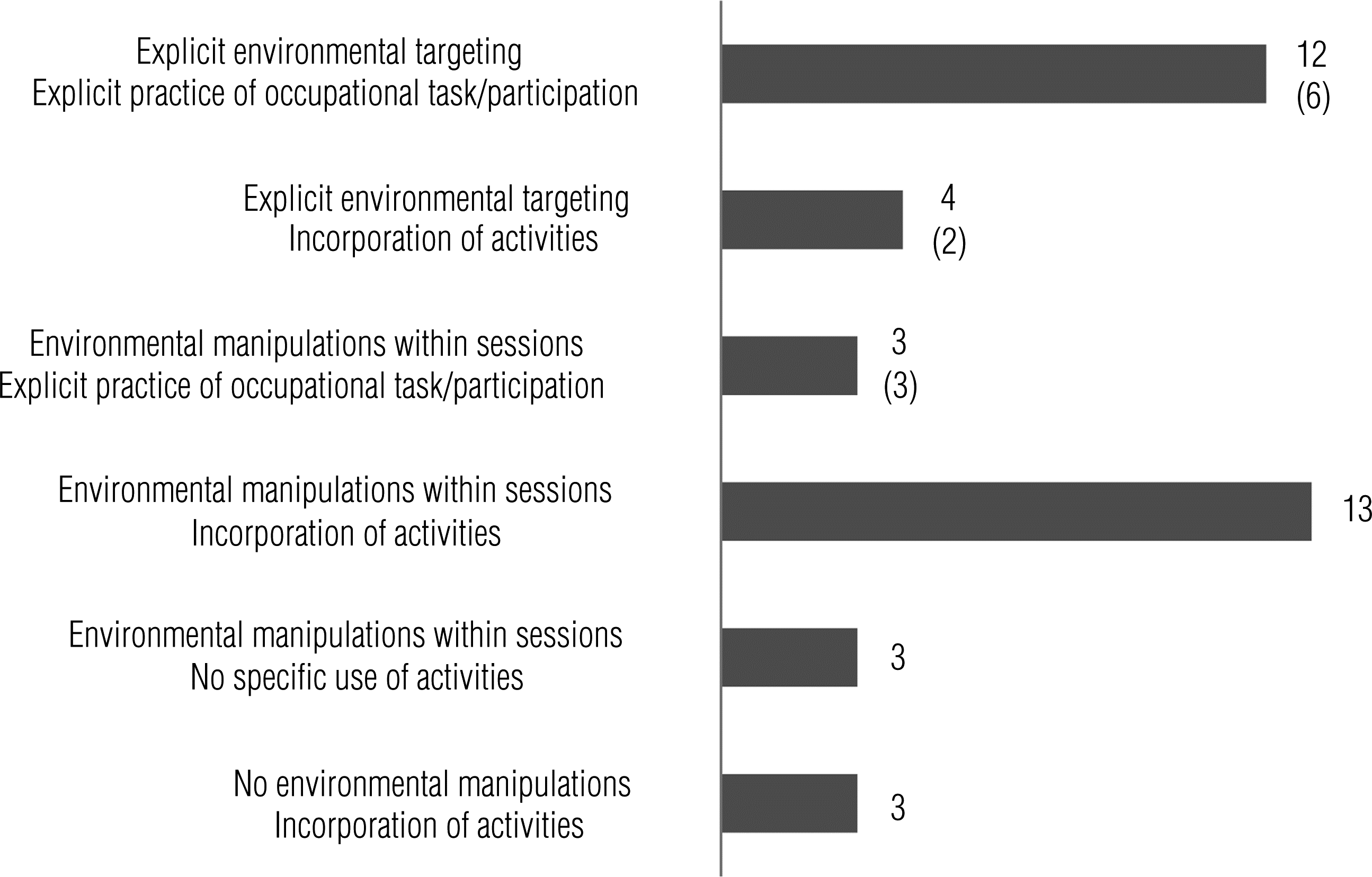
Number of articles per category of environmental targeting and activity level.
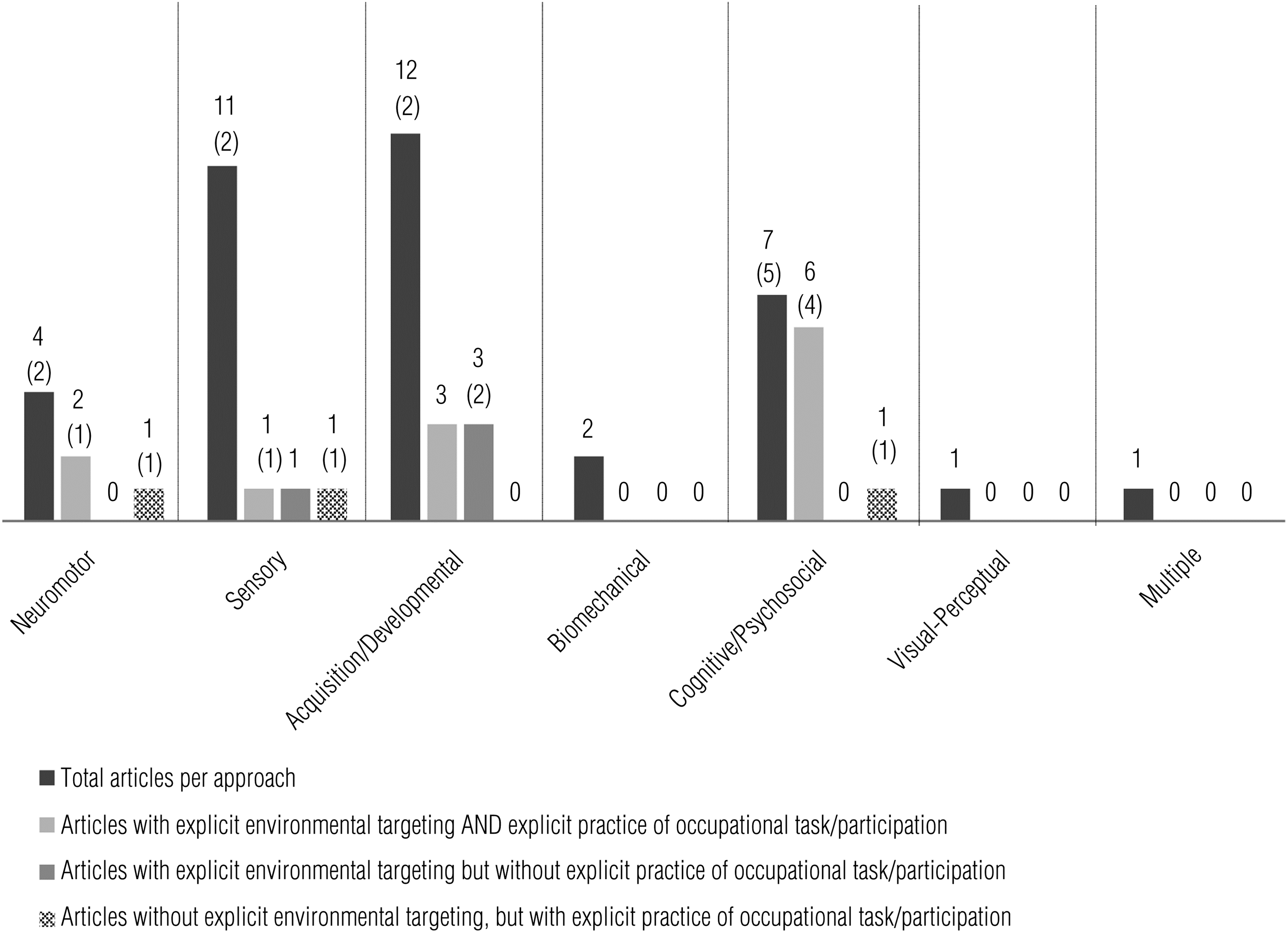
Number of articles per intervention approach.
Of the 38 single effectiveness studies, 16 (42%) described ways in which some aspect of the environment was explicitly targeted within the intervention. Of these 16 studies, 8 also incorporated the highest level of occupational task–participation practice. Measurement of any aspect of the environment occurred in 5 of the 38 studies (13%; Table 1).
Fifteen of the 38 studies (39%) described ways in which occupational task–participation practice was incorporated into the intervention. Of these 15, 12 also incorporated the highest level of environmental targeting. Measurement at the level of participation occurred in 11 of the 38 studies (29%), with 7 of these 11 studies being published in 2012 or 2013; only 2 also measured some aspect of the environment (Table 1). Of the 11 studies measuring at the level of participation, only 1 was a Level I study. Notably, 50% of intervention studies using a neuromotor approach and 71% of studies using a cognitive–psychosocial approach included measurement at the level of participation (Figure 2).
Intervention Approach
Neuromotor.
A total of four studies described interventions that fell within the neuromotor approach. Of these, three studies reported on a constraint-induced movement therapy intervention, and the remaining study described a robot-assisted repetitive motor intervention to facilitate hand function (Table 1). Two studies using a neuromotor approach reported procedures incorporating the highest level of environmental targeting and occupational task–participation practice, with one measuring at the level of participation (Table 1). Environments were targeted by requiring parents to attend sessions so that interventions could be modeled. Parent training and occupational task practice focused on use of bimanual activities during play and activities of daily living in home and community settings.
Sensory.
Eleven studies reported on interventions using a sensory approach. Of these, 3 reported on SI interventions adhering to Ayres tenets and the remaining 8 reported on the use of non-SI sensory-based interventions (Table 1). Of these 8 articles reporting on non-SI interventions, 1 reported on use of sound and light modification, 2 used therapy balls, 1 used therapeutic seat cushions, 1 used weighted vests, and 3 used daily qigong massage. One SI intervention study and 1 non-SI intervention study incorporated measurement at the level of participation (Table 1). In prioritizing fidelity of the SI intervention being tested via RCT, Pfeiffer, Koenig, Kinnealey, Sheppard, and Henderson (2011) focused intervention at the clinic level and purposefully omitted incorporation of both parent education strategies and home-based functional activities.
Of the 11 studies using a sensory approach, only 1 described procedures incorporating the highest level of environmental targeting and occupational task–participation practice (Table 1). Bellefeuille, Schaaf, and Polo (2013) reported on a case in which, in addition to use of in-clinic SI treatment, the interventionist explicitly incorporated in vivo habit training and provided ongoing parent education designed to augment in-clinic work. Frequency counts measuring performance of desired in-context behaviors were used to quantify occupational performance at the participation level.
Acquisition–Developmental.
A total of 12 articles described interventions using an acquisition–developmental approach (Table 1). Of these, 6 reported on handwriting interventions, 2 on a physical activity program, 3 on classroom integrated occupational therapy interventions with a focus on motor and developmental skills, and 1 on the provision of school-based assistive technology team member services. Two handwriting interventions and one classroom integrated occupational therapy intervention incorporated the highest level of environmental targeting and occupational task–participation practice (Table 1). Additionally, 2 studies incorporated occupational task–participation practice without explicitly incorporating environmental targets but did include measurement at the level of participation (Table 1).
In both handwriting intervention studies described by Case-Smith and colleagues (Case-Smith, Holland, & Bishop, 2011; Case-Smith, Holland, Lane, & White, 2012), the occupational therapy interventionists targeted environmental change through regularly scheduled meetings with classroom teachers to plan upcoming handwriting sessions, review progress, and adjust plans. Purposeful peer pairing strategies were also used to capitalize on peer modeling and feedback. In-context occupational task practice was incorporated into the handwriting intervention through use of independent story writing shared with peers. Ohl and colleagues (2013), as part of their classroom integrated occupational therapy interventions, described facilitation of in-context fine motor task practice through incorporation of fine motor centers integrated into the daily classroom routine.
Cognitive–Psychosocial.
Seven studies reported on interventions using a cognitive–psychosocial approach (Table 1). Of these, parents were the primary targets of intervention in 3 studies. An additional 3 described interventions capitalizing on the child’s metacognitive abilities, and 1 provided parallel interventions targeting both the child’s metacognitive abilities and the parent. Notably, 6 of the 7 studies using a cognitive–psychosocial approach incorporated procedures at the highest level of environmental targeting and occupational task–participation practice (Table 1). Participation-level measurement was used in 5 of the 7 studies, with 2 of the 5 also measuring some aspect of the environment (Table 1).
Parent coaching and training interventions targeted environmental change and occupational task practice by facilitating targeted task performance within daily routines and diverse settings (Bendixen et al., 2011; Dunn, Cox, Foster, Mische-Lawson, & Tanquary, 2012; Graham, Rodger, & Ziviani, 2013). Hahn-Markowitz, Manor, and Maeir (2011) and Rowe, Yuen, and Dure (2013) reported on interventions that taught the children to monitor their own behaviors and then taught parents to monitor and assist with shaping desired replacement behaviors at home and in the community. In Wells and colleagues’ (2012) study, the children and parents received simultaneous and parallel training and were then brought together at the end of each session for rehearsal and facilitation of strategy adaptation in real-life settings.
Biomechanical, Visual–Perceptual, and Multiple.
None of the 4 studies using biomechanical, visual–perceptual, or multiple approaches described procedures incorporating the highest level of environmental targeting and occupational task–participation practice. Measures used in these studies were at the body function and activity levels.
Description of Articles Reporting on Systematic Reviews
Twelve articles reported on two sets of 5 systematic reviews conducted as part of AOTA’s Evidence-Based Practice Project. Both sets of systematic reviews used standardized procedures and focused questions to appraise the multidisciplinary scientific literature in the identification of practice-relevant pediatric literature. The first set of systematic reviews was published in 2010 and focused on evidence relevant to children and youth having difficulties with sensory processing and integration. The second set of systematic reviews, published in 2013, focused on evidence relevant to early intervention and early childhood services. A summary of the articles included in these systematic reviews is provided in Table 2.
Summary of Systematic Reviews in the Area of Children and Youth Published in the American Journal of Occupational Therapy, 2009–2013
Note. ADLs = activities of daily living; IADLs = instrumental activities of daily living; OT = occupational therapy; SI = sensory integration.
Discussion
Occupation-Centered Intervention Research
More than half of the 38 single effectiveness studies included in our sample described ways in which researchers explicitly capitalized on the influencing power of the child’s environment, engagement in occupations, or both. We were encouraged by the frequency and creativity with which empirically studied occupational therapy interventions incorporated task practice and facilitation of activity performance within in vivo (e.g., social) or representative contexts. Incorporation of in vivo task practice was most prevalent in interventions using cognitive approaches but sparsely described in interventions using sensory and acquisition–developmental approaches.
Research has been clear that individuals learn activity by engaging in the activity itself, especially when embedded within routines and natural environments (Aarts, Jongerius, Geerdink, van Limbeek, & Geurts, 2010; Law et al., 2011). However, proportionally lower numbers of interventions focusing on development, to include a focus on development of performance components (e.g., sensory and fine motor skills), described mechanisms for facilitating in-context occupational task practice.
For pediatric occupational therapy practitioners, understanding development is foundational knowledge. Importantly, developmental perspectives are widely understood, valued, and used by society and payers. Demonstrating the need for, and gains made in, pediatric occupational therapy services often includes measurement indicating a delay or aberration in developmental sequence and hierarchy. Implying that changes intrinsic to the child are the primary causal factors leading to development of maturing childhood occupations is at odds with occupational therapy’s disciplinary understanding of the interdependent nature of the child, environment, and development of occupations (Humphry, 2002).
Unless practitioners and researchers guard against losing occupational focus while addressing development, they may be missing opportunities to facilitate and document functional changes in real-life situations, the types of changes often most salient in the lives of the clients they serve. Striking a balance between the sequential and hierarchical nature of the developmental perspective and occupational therapy’s holistic focus on participation is a dichotomy clinicians and researchers must reconcile if they are to remain true to occupational therapy’s fundamental beliefs in the value of participation in occupations of childhood.
Measures Used
We were encouraged to observe a steady increase in the frequency and range of ways in which participation in occupations was measured in occupational therapy intervention research. Also notable was the small but burgeoning number of studies that found ways to include measures that captured participants’ subjective experience of in-context activity engagement. Building evidence of occupational therapy’s efficacy in facilitating participation requires occupational therapy researchers and practitioners to push past measuring body function and activity-level capacities and include measures of participation (Bendixen & Kreider, 2011).
For measures of participation to more closely align with measurement of occupational performance, participation measures need to extend beyond focusing on the observable aspects of participation (e.g., what, where, and how often activities occur) to include the subjective experience of it (Law, Dunn, & Baum, 2005). Capturing the holistic experience of participation in occupations requires capturing the client’s subjective experiences, meaning, and self-determination relative to the life experience (occupation) being measured (Hemmingsson & Jonsson, 2005). In many areas of research, measurement has shifted from evaluating only treatment outcomes to including measurement of the subjective experiences of living with the resulting quality of life (Upton, Lawford, & Eiser, 2008). Resultant changes in quality of life and effects on the family are potential outcomes of occupational therapy intervention that can contribute to demonstrating the ways in which occupational therapy meets society’s needs. Although measures exist that include holistic information regarding children’s experiences of participation, their numbers remain relatively few. If occupational therapists are to capture the richness of the experience of participation in occupations that encompass the range of life’s situations, then they must continue to strive to develop and use such measures in both research and practice.
Range and Rigor of Pediatric Occupational Therapy Intervention Research
Although the studies included in this review covered a broad range of interventions, the increased number of studies testing cognitive approaches especially encouraged us. Cognitive approaches were used to target a range of performance areas that included social, behavioral, communication, and areas of performance identified by the participants as important in their lives. These studies provide important contributions for documenting occupational therapy’s unique role and effectiveness in facilitating cognitive functioning for enhancement of occupational performance and participation, self-efficacy, and perceived satisfaction and quality of life.
Not surprisingly, because of the relatively early research state of many cognitively based occupational therapy interventions, the majority of studies using a cognitive approach were at evidence Levels III and IV, with only 1 study at Level I. In our sample, the more rigorous Level I and II designs were applied to more discrete interventions (e.g., massage, adapted ALERT Program®) or interventions with longer histories of being studied (e.g., constraint-induced movement therapy, SI). In general, we were happy to note that in our sample, the ratio of Level I and II studies to studies at Levels III and lower was almost 3:4.
Considerations regarding the rigors of Level I and II study design (e.g., factors affecting internal validity) can impede the ability of occupational therapy researchers to incorporate environmental targets of intervention and home- or school-based occupational task practice (higher external validity) into the occupational therapy interventions being tested. These considerations were clearly illustrated in our analysis regarding levels of environmental targeting and occupational performance. Notably, 1 of the 8 Level I and 1 of the 7 Level II single effectiveness studies in our sample explicitly refrained from incorporating parent education and home-based occupational task practice strategies into the interventions because of design-rigor considerations. Both caregiver and teacher education strategies and augmentative home-based activity programs are strategies commonly used by occupational therapy practitioners. Adherence to the traditional single-hierarchy levels of evidence model for assessing intervention research has been suggested to be limited in its ability to assess rigor for the broad types of evidence needed and used by practitioners during the process of clinical decision making (Tickle-Degnen & Bedell, 2003; Tomlin & Borgetto, 2011). In heeding this warning, occupational therapy researchers must strive to design ways of testing interventions that reflect the broad range of strategies used in the profession for facilitation of occupational performance in life situations.
Occupational therapy researchers must carefully consider research designs to ensure that the holistic occupation-based tenets of the profession are fully reflected in their intervention research. Researchers can do this by striving to make certain that despite the reductionist nature of intervention research, the interventions they investigate reflect the holistic understanding of the interplay among child, environment, and occupations.
Limitations
When coding descriptions of activity incorporation during interventions, we found that descriptions of activities that were clearly task oriented or oriented toward development of performance components or performance processes were easily classified below our highest level of occupational task–participation practice. However, distinguishing task practice as activity practice was far more difficult when it occurred in natural contexts (e.g., the classroom) but was facilitated for the primary purpose of developing performance components or processes. In recognizing that incorporation of occupational task practice within everyday life situations (participation) cannot always be easily incorporated into systematic testing of occupational therapy interventions, we included descriptions of occupational task practice in situations representative of in-context conditions in our highest level of occupational task–participation practice. This placed more complex, representative (but at times contrived) types of occupational facilitation at the same level as in vivo practice. Our decision to equate the ICF definition of participation (involvement in life situations) with our highest categorical level of occupational task–participation practice, thus allowing for inclusion of complex, representative task practice, is a limitation of this study.
Conclusion
The science of occupational therapy published in AJOT in the area of children and youth is making steady gains in reflecting and demonstrating the effectiveness of the profession’s holistic occupation-based tenets. Steady progress is being made in responding to AOTA’s Centennial Vision, which boldly envisions occupational therapy as “a powerful, widely recognized, science-driven, and evidence-based profession … meeting society’s occupational needs” (AOTA, 2007, p. 613). However, it will take continued and concerted efforts by occupational therapy researchers, educators, and practitioners for occupational therapy to fully realize the profession’s vision. In demonstrating the ways in which occupational therapy meets society’s needs, it is imperative that we continue to expand empirical measurement and documentation to include the range of ways in which our clients are able to engage in and experience life situations after our interventions. In doing so, we must also ensure that occupational therapy outcomes extend beyond those related to human development and include outcomes of participation and occupational performance. As a science-based profession, occupational therapy must ensure that its science serves to both inform and reflect practice, whereby the profession’s holistic tenets of client, occupation, and environment are addressed and informed by the evidence.
Footnotes
Acknowledgments
This research was supported by a grant from the Eunice Kennedy Shriver National Institute of Child Health and Human Development (principal investigator, Bendixen; award no. K01HD064778). The content is solely the responsibility of the authors and does not necessarily represent the official views of the Eunice Kennedy Shriver National Institute of Child Health and Human Development or the National Institutes of Health.
*
Indicates studies that were reviewed for this article.