






Abstract
Microstructure and alloy element distribution of dissimilar joint 316L and EH36 in laser welding were researched, especially the influence of misalignment on weld profile and alloy element distribution. Weld zone (WZ) consisted of austensite and ferrite (F), and heat affected zone (HAZ) of EH36 side consisted of martensite, F, pearlite and carbide precipitation. Positive misalignment increased both upper and bottom widths (BWs), while negative misalignment made BW wider and upper width narrower. HAZ in steel EH36 side was clear and was narrowed and homogenised by negative misalignment. Alloy element contents of Cr and Ni in WZ was much more in negative misalignment. The interface transition gradient of alloy element between 316L and WZ was sharpened in the +0.8 mm misalignment, but diminished in the −0.8 mm misalignment. The influence of misalignment on alloy element distributions can be attributed to the effect of gravity on transient flow of weld pool.
Introduction
Formation accuracy and even service performance of the large structures are in direct relation to the material combination quality. Combination of different metals by welding process with dissimilar joint is very important for engineering application, because different base metals with different physical properties can be used to adapt to the rigorous service environments. Dissimilar joint quality and service performance are usually evaluated from view of microstructure, bonding mechanism, defects, mechanical properties and so on. Effect of heat input on mechanical properties (tension, fracture and Vikers hardness) of dissimilar AL-6XN/316L welded joints was researched by Flores et al. [1]. Macrostructure and microstructure of the Al 5083-H321 and 316L stainless steel joint were examined using optical microscope and scanning electron microscope (SEM) [2]. The microstructural variations across a dissimilar weld joint between SS316 and 9Cr-RAFM steel were analysed, and further regulated by the post weld heat treatment [3]. Bonding mechanism and interface characterisation for dissimilar joints (copper with steel [4], aluminium with titanium [5] and high-density polyethylene [6]) were researched by SEM and energy dispersive X-ray spectroscopy. Porosity defect in electron beam welding Fe–Al alloy was observed by 3D transparent porosity model reconstructed using X-ray tomography [7]. Microhardness measurements over the fusion zone have been done to understand the keyhole growth and quenching, solidification sequence and stress distribution over the full area [8]. Fatigue life and damage mechanisms of 10% Chromium (Cr) martensitic steel welded with Ni-based filler metal were researched by using low-cycle fatigue tests and microstructure analysis [9], and that of multiple dissimilar joints of high strength steel were evaluated by Cui et al. [10]. The stress corrosion cracking behaviour of heat affected zone (HAZ) in primary water was analysed for dissimilar joint of 308L and 316L [11]. Electrochemical corrosion test in NaCl aqueous solution was completed to research the anti-corrosion property of dissimilar joints for stainless steel 316L with carbon steel S355JR [12] and duplex stainless steel 2205 [13]. Meanwhile, stress corrosion cracking behaviour of dissimilar joints was analysed in the NaCl aqueous solution [14] and simulated primary water [15].
According to the above all, welding process, joint quality and service performance were continuously focused to improve weldability and performance of the dissimilar joint which was widely used in marine propeller nozzle (MPN), storage system of cryogenic liquefied gas, steam generators and so on. Taking MPN as a detailed example, it was a large and key structure to increase propulsive force and ensure the dynamic positioning accuracy, the base metal of the MPN middle part was austensite (A) stainless steel 316L to inhibit cavitation corrosion while that of the MPN both side parts was marine high strength steel EH36 to reduce cost and ensure strength at the same time.
In this paper, weldability of dissimilar joint between 316L and EH36 was researched from the view of the microstructure and alloy element distributions of Cr and Nickel (Ni). While care is taken in industrial fabrications to achieve good joint alignment, nevertheless misalignment may occur, and it is therefore of interest to examine the consequences of such misalignment. Another important work was to research the influence of seam misalignment on weld profile and alloy element distributions.
Experiment setup
Base metal
Chemical components (wt-%).

Experiment details
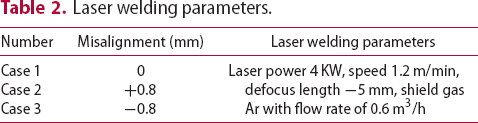
As shown in Figure 1, experiment was completed by fibre laser welding system that consisted of laser head, robot, jig, shielding gas nozzle, subplate and so forth. Base metal 316L and EH36 were welded with butt joint, while assembly misalignment was assumed through an added subplate with thickness of 0.8 mm. The size of base metal was 100 mm × 50 mm × 4 mm.
Laser welding system.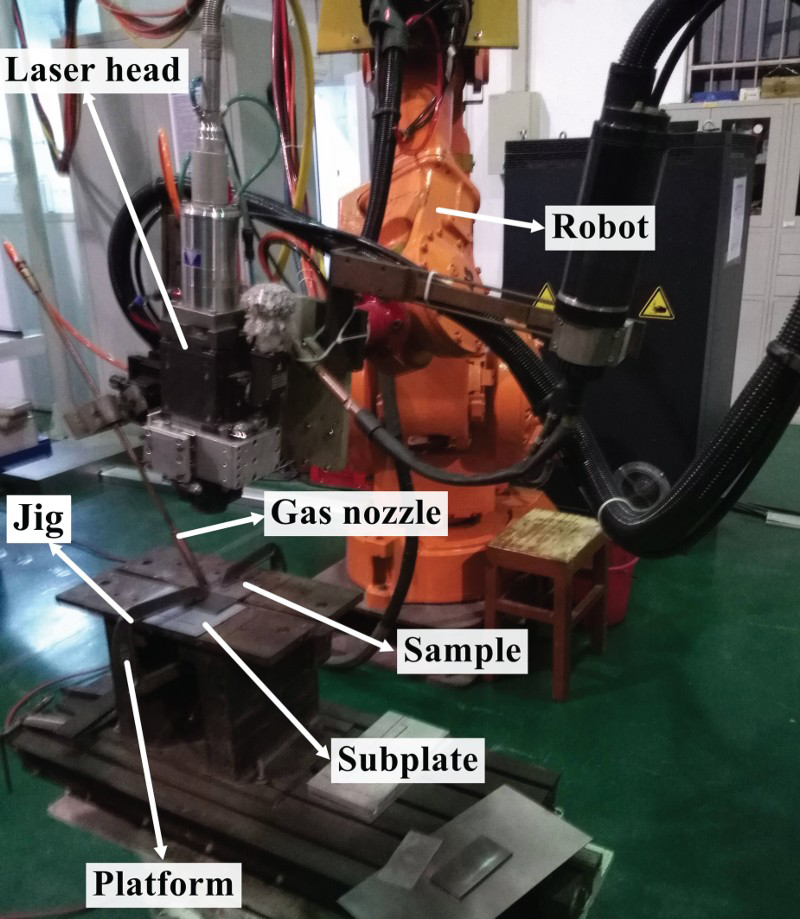
Laser welding parameters.
Measurement methods
Transverse metallographic specimen with size of 15 mm× 10 mm × 4 mm was obtained from the whole weld sample using wire cut electrical discharge machining. The weld profile was extracted and observed by the optical microscope, microstructure was analysed through optical microscope and SEM, alloy element distributions were measured using SEM with the function of energy dispersive spectrometer (EDS).
Results and discussion
Influence of misalignment on the weld profile
Figure 2 showed the weld profile with different misalignment tolerances (0, +0.8 and −0.8 mm). In case 1 without misalignment, upper width (UW) and bottom width (BW) of the weld shape were separately 2.98 and 1.85 mm. Positive misalignment in case 2 increased both UW and BW to 3.13 and 2.13 mm, while negative misalignment in case 3 made BW continuously wider and UW slightly narrower. HAZ in steel EH36 side was clearly visible because of high thermal conductivity. Compared case 1 with case 2, HAZ was similar with each other. HAZ in case 3 was narrower and more homogeneous than that in case 1 and case 2, because most of laser beam energy was distributed at 316L side caused by the influence of gravity on weld pool flow, and less energy was conducted through EH36.
The weld profile of (a) case 1, (b) case 2 and (c) case 3.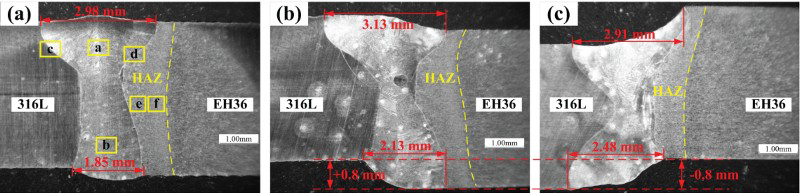
Microstructure analysis
Microstructure of different zone noted in Figure 2(a) was given in Figure 3. As shown in Figure 3(a), direction of solidification and crystallisation was marked in red dotted line, A and ferrite (F) were included in weld zone (WZ), forms of A and F were plane grain and dendrite grain (DG). Compared Figure 3(a) with Figure 3(b) and Figure 3(d), grain size refinement near EH36 side and WZ bottom was ascribed to nuclear driving energy and grain growth time. It was concluded that WZ thermal distribution was heterogeneous in Figure 3(c), because equiaxed grain (EG) and columnar grain (CG) appeared alternately in WZ near 316L side. HAZ width between WZ and 316L was only 20–30 µm. Behaviour of interface diffusion emerged between WZ and HAZ of EH36 in Figure 3(d). As shown in Figure 3(e,f), microstructures near WZ in HAZ of EH36 side consisted of martensite (M), F, pearlite (P) and carbide precipitation.
Microstructures of different zones (a)–(f) noted in Figure 2(a).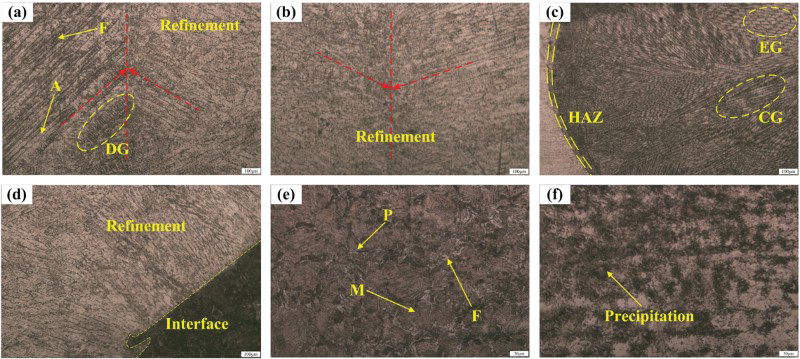
Advanced SEM technology was further used to analyse grain structure. The typical CG in WZ, massive austenite in base metal 316L and HAZ, interface of WZ and EH36, all were clearly observed with magnified 1000 times in Figure 4(a–c). Acicular and anisotropic characteristics of martensite were helpful to improve the weld performance. Microcrack in HAZ of EH36 side was given in Figure 4(d) by magnifying 4000 times. Micro-toughness was decreased by quenching martensite, and thus plastic tensile stress fractured acicular martensite grain.
Microstructures of (a) WZ, (b) interface of WZ with 316L, (c) interface of WZ with EH36 and (d) microcrack zone in EH36 side.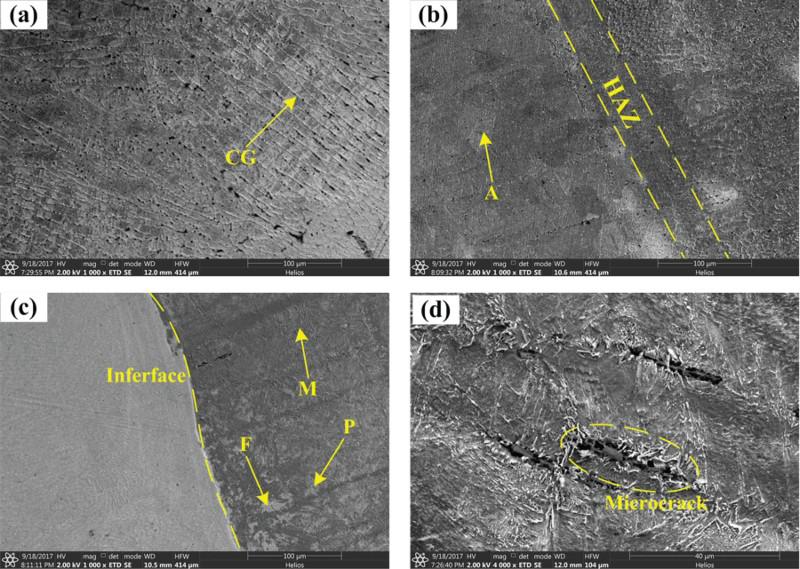
Alloy element distribution analysis of Cr and Ni
According to the alloy components of 316L and EH36 in Table 1, contents of Cr and Ni of 316L were obviously much more than that of EH36. Cr and Ni were selected to research alloy element diffusion in laser welding of dissimilar joint. Distributions of Cr and Ni in WZ were obtained by EDS and shown in Figure 5. Distribution characteristics of Cr and Ni were similar with each other. The left zone presented alloy element distribution state of base metal 316L, the middle zone displayed WZ and the right zone showed the alloy element distribution state of HAZ near EH36 side. At interface position, a clear content gradient existed. It was proved that alloy element distribution state in WZ was decided by mixed alloy components of 316L and EH36 with weld pool heterogeneous flow.
Alloy element distributions of (a) case 1, (b) case 2 and (c) case 3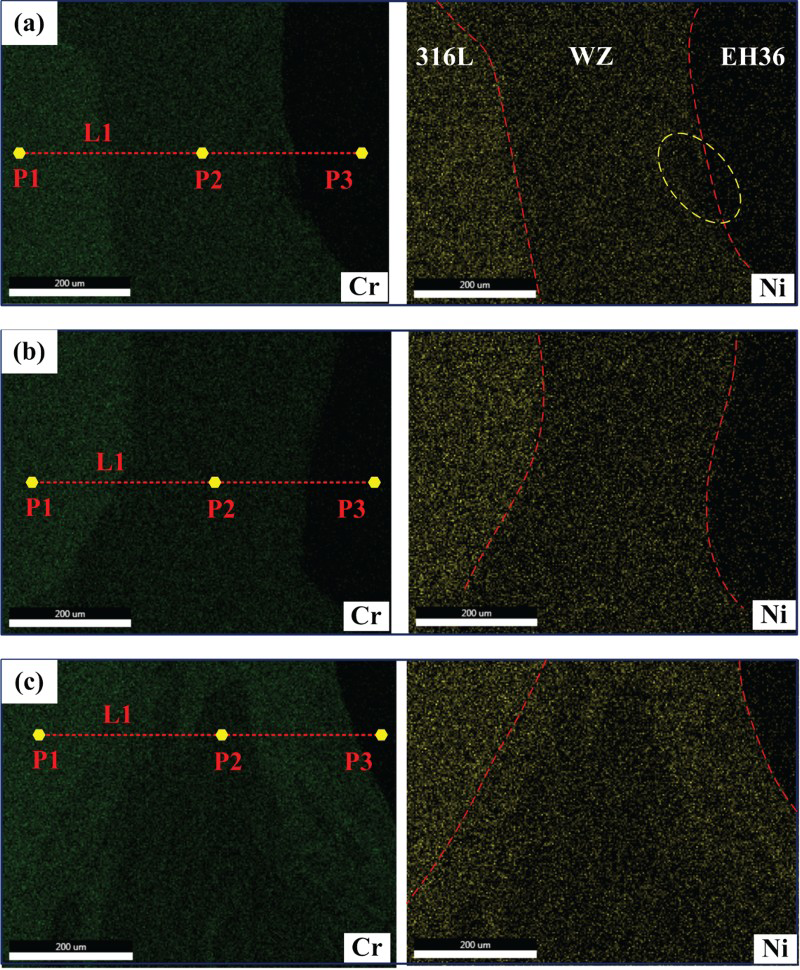
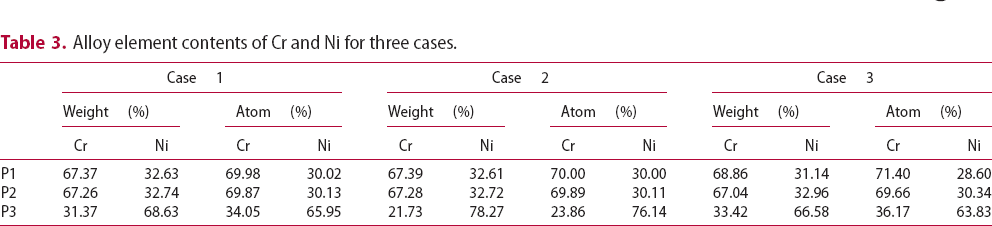
Fluctuation results of alloy elements Cr and Ni by using EDS point scanning were shown in Figure 6 and Table 3, while measurement positions were given in Figure 5. Distribution of Cr and Ni for P1 was similar with that for P2, while this tendency changed dramatically at P3. Taking case 1 as an example, Cr contents of P1, P2 and P3, were reduced from 67.37%, 67.26%, to 31.37%. The variation tendency of other case 2 and case 3 was not repeatedly described.
Quantified analysis of alloy element contents in case 1 for (a) P1, (b) P2 and (c) P3 Alloy element contents of Cr and Ni for three cases.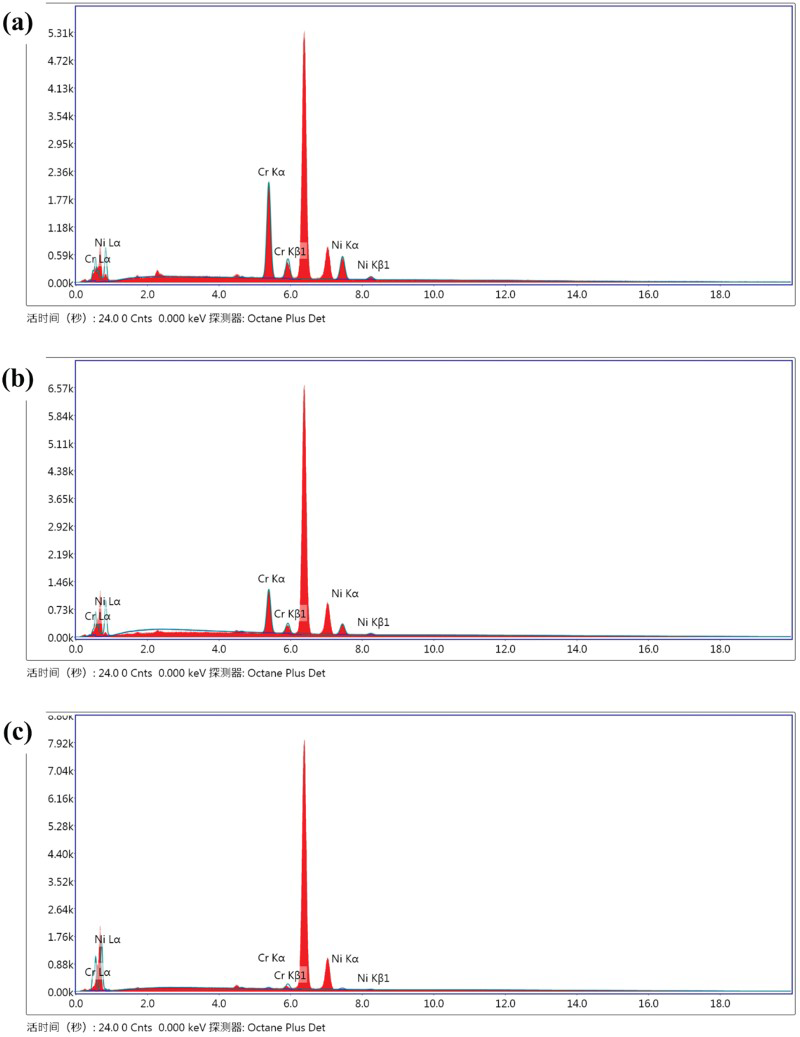
To further research the effect of misalignment on laser dissimilar welding 316L and EH36, EDS line scanning analysis of Cr and Ni through the weld was discussed. As shown in Figure 7, distinct interfaces of WZ with base metal 316L and EH36 were displayed by obvious fluctuation of Cr and Ni in case 1 without misalignment. Alloy element contents of Cr and Ni in WZ was much more in case 3 than that in case 1 and case 2. Fluctuation curves of Cr and Ni for three cases all quickly attenuated from WZ to HAZ in EH36 side. Comparing Figure 7(b) and Figure 7(c) with Figure 7(a), the interface transition gradient of alloy element Cr between 316L and WZ was sharpened in +0.8 mm misalignment experiment at case 2, but reversely diminished in −0.8 mm misalignment experiment at case 3. The influence of misalignment on the alloy element distribution can be attributed to the effect of gravity on transient flow of weld pool in dissimilar joint.
Content fluctuations along L1 for (a) case 1, (b) case 2 and (c) case 3.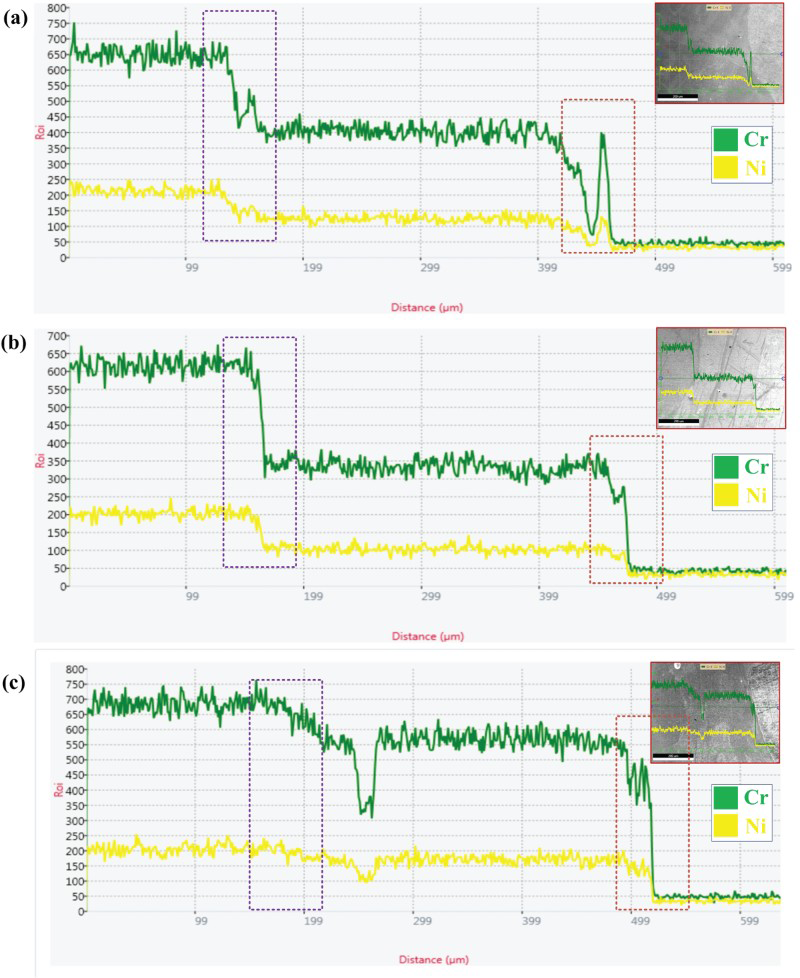
Conclusions
Dissimilar joint of 316L and EH36 in laser welding was researched from the point of microstructure and alloy element distribution, while the effect of misalignment on weld profile and alloy element distribution was analysed to examine its consequences. There were three conclusions that can be drawn as following.
The microstructures showed that WZ was consisted of A and F, and HAZ of EH36 side was consisted of martensite, F, pearlite and carbide precipitation. Forms of A and F were plane grain and DG, grain size near EH36 side and WZ bottom were refinement ascribed to nuclear driving energy and grain growth time. EG and CG both appeared alternately in WZ near 316L side because of heterogeneous thermal distribution, and HAZ width between WZ and 316L was only 20–30 µm. Micro-toughness was decreased by quenching martensite, and thus plastic tensile stress fractured acicular martensite grain. Positive misalignment increased both UW and BW to 3.13 and 2.13 mm, while negative misalignment made BW continuously wider and UW slightly narrower. HAZ in steel EH36 side was clearly visible because of high thermal conductivity, while HAZ in case 3 was narrower and more homogeneous than that in case 1 and case 2, because most of laser beam energy was distributed to 316L side with influence of gravity on weld pool flow, and less energy was conducted through EH36. Distribution of Cr and Ni for P1 was similar with that for P2, while this tendency changed dramatically at P3. Alloy element contents of Cr and Ni in WZ was much more in case 3 than that in case 1 and case 2. The interface transition gradient of alloy element Cr between 316L and WZ was sharpened in +0.8 mm misalignment experiment at case 2, but reversely diminished in −0.8 mm misalignment experiment at case 3. The influence of misalignment on the alloy element distribution can be attributed to the effect of gravity on transient flow of weld pool in dissimilar joint.
Footnotes
Acknowledgements
This research is supported by the National Basic Research Program of China (2014CB046703), the China Postdoctoral Science Foundation (2017M622427), the Major Project of Science and Technology Innovation Special for Hubei Province (2016AAA070), the Fundamental Research Funds for the Central Universities (2016YXMS271) and Huanghe special plan of outstanding talents in Wuhan.
Disclosure statement
No potential conflict of interest was reported by the authors.