






Abstract
In the United States, there has been a recent shift in decision-making models toward shared decision making.1,2 With growing emphasis on patient-centered care, shared decision making can better align medical decisions with the patient’s preferences for care.3–5 Shared decision making might be particularly important to improve outcomes among patients with limited health literacy, which is about 36% of US adults. 6 Research shows that individuals with limited health literacy are more likely to be hospitalized and make medication errors and less likely to obtain preventive care and know how to manage their health problems.7–9
However, research on the relationship between health literacy and decision-making preferences is limited.10–13 Most prior studies have been framed around disease-specific contexts10,12–18; have largely examined white, highly educated, or female populations11–13,16–20; or have not specifically assessed decision-making preferences.17–20 Examination of decision-making preferences among medically underserved groups is particularly warranted as research suggests that shared decision-making interventions may provide greater benefits for disadvantaged groups. 21
Our study examined the relationship between health literacy and decision-making preferences in a medically underserved population. We hypothesized that patients with limited health literacy would be more likely to prefer a physician-directed decision-making role than patients with adequate health literacy. We also explored whether having a regular doctor would modify this association.
Methods
Setting
This study was conducted in the Primary Care Clinic in the Center for Outpatient Health (COH) at Barnes-Jewish Hospital, a large urban hospital. The COH primarily serves a medically underserved population drawn from St. Louis, Missouri, and the surrounding region and is the primary training site for a large internal medicine residency program.
Data Collection
Between July 2013 and April 2014, patients in the waiting rooms of the COH were approached by trained data collectors and asked to complete a self-administered written questionnaire and an assessment of health literacy that was verbally administered by a data collector. To be eligible for the study, participants had to be at least 18 years old, be a patient at the COH, and speak English. The primary reason for incomplete surveys was inadequate time between the start of the survey and when the clinic was ready to begin the patient evaluation. There were no significant differences in gender between individuals with complete surveys and those with incomplete surveys; a higher proportion of those not completing the survey were African Americans (75%) compared with those who completed the survey (63%; P = 0.003). Survey respondents were similar to the underlying COH primary care clinic patient population with respect to gender, age, race, and location of residence. All participants completed a verbal consent process and signed a written consent form before completing the survey. This study was approved by the Human Research Protection Office at Washington University School of Medicine.
Measures
The outcome variable was patient decision-making preferences, measured by asking, “Which statement best describes how you would like decisions about medical treatments to be made?” Response options were on a 5-point scale, adapted from the Control Preferences Scale 22 : I prefer to leave the decision to my doctor (1), I prefer that my doctor makes the decision but seriously considers my opinion (2), I prefer that my doctor and I share responsibility for deciding (3), I prefer to make my own decision after seriously considering my doctor’s opinion (4), and I prefer to make my own decision regardless of my doctor’s opinion (5). 16 For analysis, responses were categorized as physician-directed (1–2) or patient-involved (3–5) decision-making preference,13,23 with the latter including any level of patient involvement from shared to patient-directed decision making.
The primary predictor was patient health literacy, measured by the Rapid Estimate of Adult Literacy in Medicine–Revised (REALM-R), a validated word recognition measure where individuals are asked to read 8 common medical words aloud. 24 Patients who pronounced 7 to 8 words correctly were categorized as having adequate health literacy and those with 0 to 6 correct responses as limited health literacy. Additional covariates included age (measured continuously), whether they had a regular doctor or health professional (yes/no), race/ethnicity, and sex. Race/ethnicity was categorized as non-Hispanic white (reference group), non-Hispanic black, and other. Sex was categorized as male or female (reference group).
Analysis
An analytic sample of 576 patients who had completed measures of health literacy and decision-making preferences was used for this analysis (Figure 1). Patients were categorized into patient-involved or physician-directed decision-making preferences, and bivariate analysis was used to examine patient characteristics that significantly differed between these 2 groups. Multivariable logistic regression analysis was used to examine the independent association of health literacy and decision-making preferences, controlling for sociodemographic characteristics. To investigate whether having a regular doctor moderated this relationship, we tested the interaction of health literacy and having a regular doctor on decision-making preferences in a multivariable model. All statistical analyses were conducted using SPSS for Windows, version 20 (SPSS, Inc., an IBM Company, Armonk, NY). Statistical significance was assessed as P < 0.05.
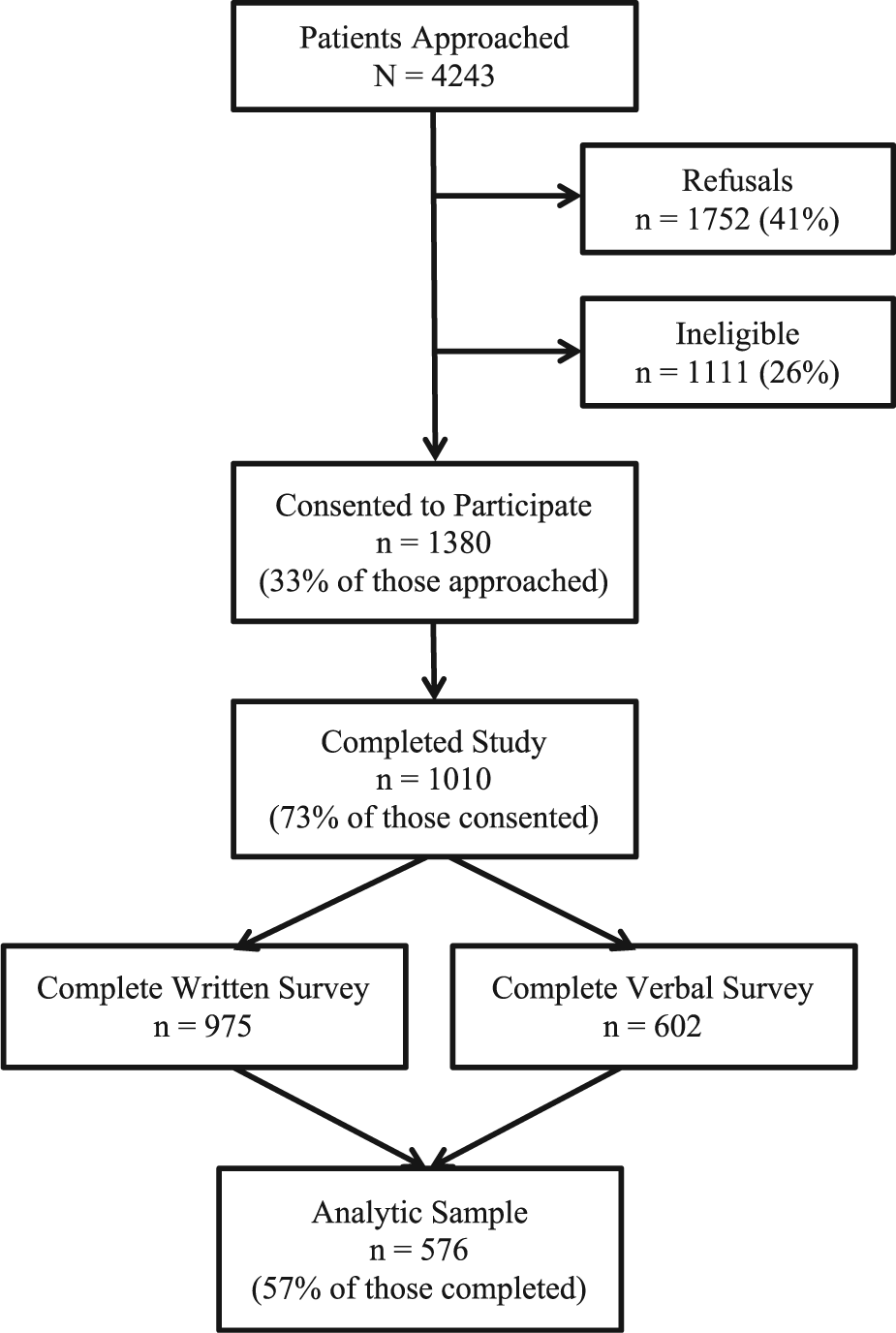
Recruitment flow diagram.
Results
Demographic characteristics are shown in Table 1. The mean age of patients was 51 years (range, 20–93); 66% were female, and 60% identified as non-Hispanic black. Most patients (54%) had no more than a high school diploma/GED; 47% had a yearly household income less than $10,000. About half (45%) had limited health literacy; 58% preferred patient-involved decision making. Most patients (67%) reported having a regular doctor.
Patient Characteristics
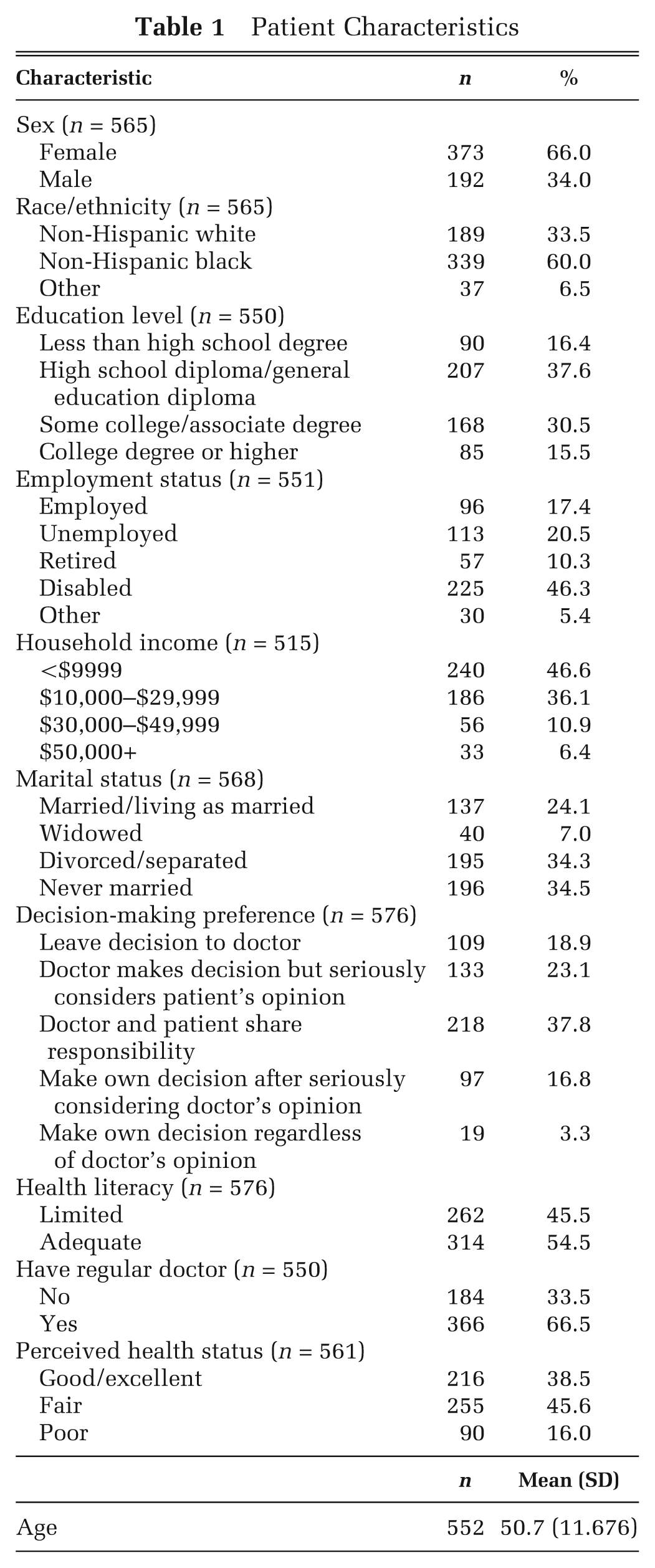
In bivariate analysis (Table 2), health literacy was significantly associated with decision-making preferences (P < 0.001), with patient-involved decision making more preferred among those with adequate health literacy (65%) compared to those with limited health literacy (50%). Decision-making preferences were also significantly associated with sex, race/ethnicity, and education level (P < 0.05).
Bivariate Associations between Decision-Making Preferences and Patient Characteristics
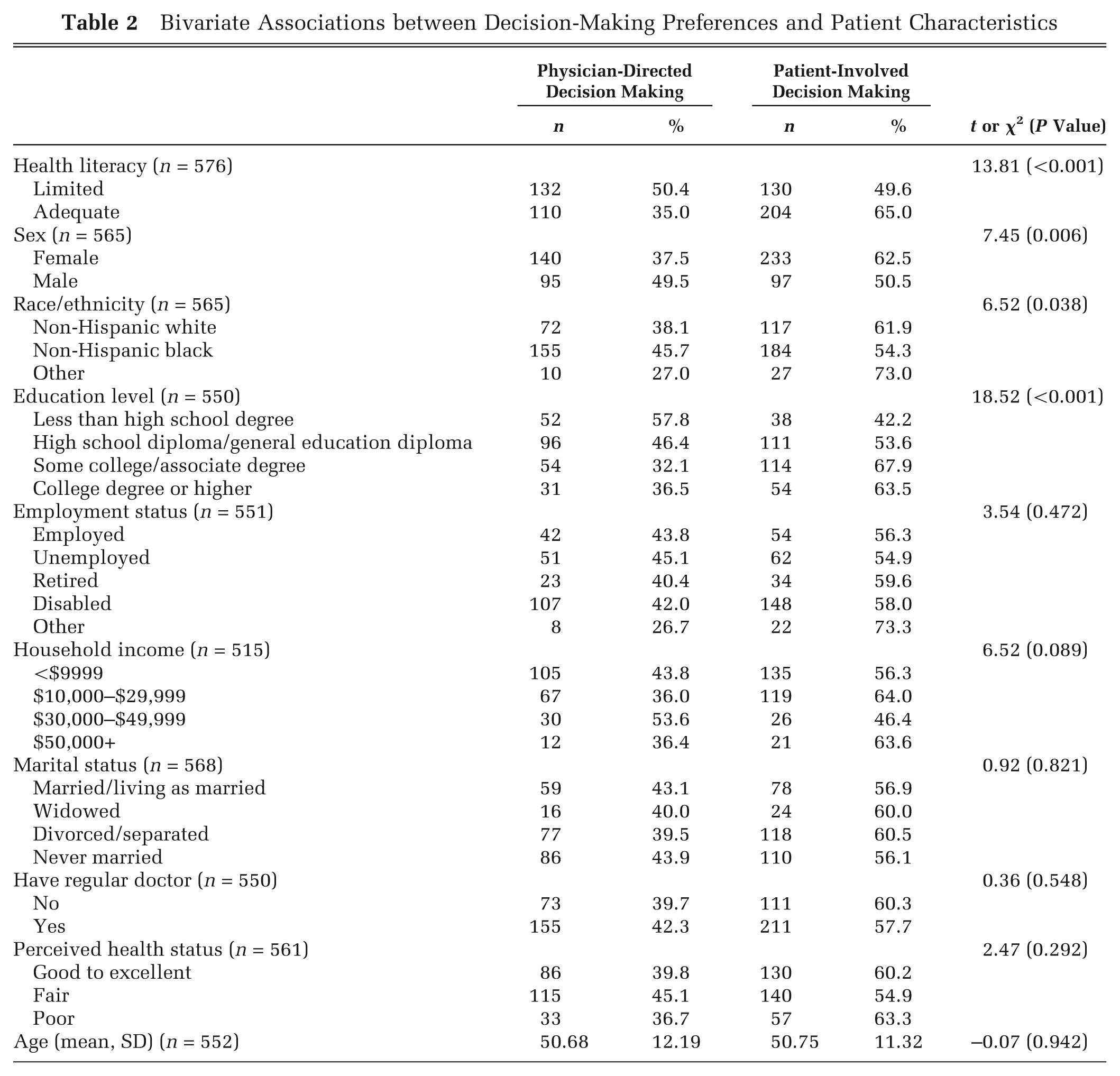
In an unadjusted model, adequate health literacy was significantly associated with preferring patient-involved decision making (OR = 1.88; P < 0.001; 95% confidence interval [CI], 1.35–2.63). This association was also significant in an adjusted model controlling for age, sex, and race/ethnicity (OR = 1.66; P = 0.009; 95% CI, 1.14–2.42). Sex was significantly associated with decision-making preferences in this model, with males less likely to prefer patient-involved decision making (OR = 0.65; P = 0.024; 95% CI, 0.45–0.94). When we added having a regular doctor to the multivariable model, this variable was not a significant predictor of decision-making preferences (P = 0.958), and the interaction between having a regular doctor and health literacy on decision-making preferences was not significant (P = 0.560).
Discussion
To our knowledge, this study is novel in its examination of health literacy and decision-making preferences specifically among medically underserved patients. In our study, patients with adequate health literacy were almost 2 times more likely than those with limited health literacy to prefer patient-involved decision making. This finding is consistent with previous work10,12 and highlights the impact of health literacy on the decision-making process. Patients with limited health literacy may have difficulty understanding medical information and lack the self-efficacy to be actively involved in their care.12,18 Due to the stigma of low health literacy, some patients may also experience feelings of shame, thereby not admitting their difficulties or seeking assistance when needed.25,26 Future research should examine the influence of factors such as patient knowledge, self-efficacy, and perceptions of stigma on decision-making preferences among those with limited health literacy.
Furthermore, patients with limited health literacy may be unaware of their options to participate in decision making, instead assuming physicians know the best course of action. Particularly in cases where no clear solution exists, however, the engagement of patients and consideration of their values are important. 27 Physicians should clearly provide contextual information and available options, as improved communication can facilitate patients’ informed decision-making preferences. While some patients may ultimately prefer to leave decisions to their physicians, they may want to be engaged in the process. 27 This suggests that a broader definition of shared decision making should be considered and that physicians should recognize patients’ expressed preferences regarding their decision-making role.
In addition, sex was a significant predictor of decision-making preferences in our study, consistent with other research indicating that females prefer a patient-involved decision-making role.28–30 We did not find other sociodemographic characteristics, such as race/ethnicity and age, to be associated with decision-making preferences, which differs from prior studies.15,18,28–32 There may be other factors affecting decision-making preferences among this medically underserved population, further highlighting the importance of examining diverse patient populations.
Our hypothesis that having a regular doctor would modify the relationship between health literacy and decision-making preferences was not supported. Contrary to our findings, some prior research shows that having a well-established relationship with a health care provider may facilitate patient-involved decision making for patients.33–35 One explanation for our differing results is our variable of having a regular doctor did not take into account relational factors important for decision making, such as trust and continuity. Due to the resident clinic structure of our setting, patients may be assigned a new regular provider every 3 years and do not necessarily see the same physician for every visit. More research is needed on how patient-provider relationships might affect decision-making preferences among patients with varying health literacy levels and who are seen in different health care contexts.
These findings should be interpreted given study limitations. The outcome was measured by a single question, and general decision-making preferences were assessed rather than decision-making preferences for a specific decision. In addition, while health literacy was measured using a validated instrument, existing measures do not capture all domains of health literacy. 36 Second, convenience sampling was used to recruit patients, limiting the generalizability of results. As patients in this study were a difficult-to-reach, underserved population in a busy primary care clinic, the response and survey completion rates were low; as such, the survey participants may not be representative of the whole patient population. To generalize these findings, more work is needed with other medically underserved populations. Finally, this study assessed patients at a single point, but health literacy and decision-making preferences may change over time. Furthermore, individuals preferring a patient-involved role may engage in behaviors to improve their health literacy; examining the causal direction of this association is an area for future research.
Conclusion
This study addresses an important research gap in its examination of health literacy and decision-making preferences among medically underserved patients. Multiple factors may contribute to patients’ decision-making preferences, notably health literacy. Results suggest that interventions to promote shared decision making may be particularly important for patients with limited health literacy. Since health literacy is a dynamic between the individual’s capabilities and the demands of a health care system,37,38 interventions are likely needed both to assist patients with limited health literacy to participate in decision making, as well as to support physicians in engaging with patients.13,27 Future research should examine other factors associated with decision-making preferences to identify additional points of intervention.
Footnotes
Acknowledgements
The authors thank the patients who participated in this study, data collection and data entry team, Center for Outpatient Health Primary Care Clinic staff, administrators, and residents for their contributions to our work, as well as Sarah Lyons for her valuable assistance in preparation for data analysis.
Financial support for the Survey of Center for Outpatient Health Patients and the project team was provided by the Barnes-Jewish Hospital Foundation, Siteman Cancer Center (grant P30 CA91842), Washington University School of Medicine (WUSM), and WUSM Faculty Diversity Scholars Program. The funding agreement ensured the authors’ independence in designing the study, interpreting the data, writing, and publishing the report. MSG, MP, and MB are employed by WUSM. JS, MSG, MB, and KK declare no conflicts of interest. MP currently has an investigator-initiated grant funded by Merck (2014–2015). The funding agency had no role in study design; collection, analysis, and interpretation of data; writing of the report; or decision to submit the report for publication.