






Abstract
Background:
Racial disparities in breastfeeding persist, with Black mothers experiencing significantly lower exclusive breastfeeding rates compared with White mothers. Limited research has examined how institutional bias and discrimination within birthing centers affect breastfeeding decisions, creating a gap in understanding the role of these environments in perpetuating lactation inequities.
Methods:
A basic qualitative study guided by the social ecological model explored how perceived racism and discrimination in birthing centers shape exclusive breastfeeding initiation and duration among Black mothers. Ten participants were recruited through purposive sampling and completed semistructured virtual interviews. Data were coded inductively using ATLAS.ti 9 and verified through analyst triangulation and Krippendorff’s α to ensure reliability.
Results:
Four interconnected themes emerged: (1) individual level—birth trauma and pain dismissal reduced confidence in breastfeeding; (2) interpersonal level—racialized communication barriers and lack of lactation support undermined trust; (3) community level—formula-first norms and underrepresentation of Black lactation professionals limited culturally relevant care; and (4) institutional level—rigid policies and privacy violations reinforced inequitable treatment.
Conclusion:
Perceived racism and discrimination in birthing centers negatively influence Black mothers’ breastfeeding experiences and outcomes. Equity-driven organizational reforms, anti-racist training, and diversification of the lactation workforce are essential to promote breastfeeding equity and improve maternal-infant health.
Keywords
Background
Racial disparities in breastfeeding remain a significant public health concern in the United States (Green et al., 2021). Black mothers continue to experience lower rates of breastfeeding initiation and duration compared with White mothers, with disparities shaped by historical and contemporary structural racism, discriminatory clinical practices, and inequitable access to culturally responsive lactation support (Asiodu et al., 2021; Centers for Disease Control and Prevention [CDC], 2019; World Health Organization, 2019). Historical and structural inequities rooted in slavery, segregation, and systemic racism have shaped enduring stereotypes about Black motherhood and infant feeding. Although prior research has consistently documented racial disparities in breastfeeding initiation and duration among Black mothers, these disparities are increasingly understood as the product of structural racism, discriminatory clinical practices (Bartick et al., 2017; Davis et al., 2021), and inequitable access to culturally responsive lactation support (Asiodu et al., 2021; Davis et al., 2021; Green et al., 2021; Thomas, 2018). Less qualitative research has centered Black mothers’ perspectives on how institutional birth setting environments—often framed as holistic or affirming—shape exclusive breastfeeding decisions in the context of perceived racism and discrimination. This study addresses that gap by examining how mothers’ perceptions of racism and discrimination within institutional birth settings intersect with breastfeeding intentions and behaviors.
This study is guided by the social ecological model (SEM), which conceptualizes health behavior as the result of interacting influences across multiple levels—individual, interpersonal, community, and institutional/environmental. The SEM provides an organizing structure for understanding how mothers’ beliefs and capacities, their relationships with providers, peers, and family, the norms and resources in their communities, and the policies and practices embedded in institutional birth settings jointly shape exclusive breastfeeding (Attanasio & Kozhimannil, 2015). Consistent with this framework, findings are organized by SEM levels to illustrate multilevel mechanisms that enable or constrain breastfeeding (a conceptual diagram of the applied SEM appears as Figure 1).

Social Ecological Model (SEM) of Breastfeeding Influences.
Significance to human lactation: By centering the lived experiences of Black mothers within institutional birth settings, this study contributes practice-relevant evidence for improving clinical lactation care and organizational equity. Insights from participants identify specific policy, training, and workflow opportunities—such as privacy safeguards, respectful communication, timely and skilled lactation support, and workforce diversification—that can strengthen mothers’ autonomy and confidence in meeting exclusive breastfeeding goals. These findings inform clinicians, IBCLCs, and administrators seeking to operationalize anti-racist, culturally responsive lactation care.
Study Aims
This basic qualitative study explored how perceived racism and discrimination in institutional birth settings shape exclusive breastfeeding initiation and duration among Black mothers.
Methods
This study employed a basic qualitative design guided by the social ecological model (SEM) to examine how multiple-level factors within birthing environments influence Black mothers’ exclusive breastfeeding experiences. The SEM was used a priori to inform the development of the research question, sub–research questions, and interview guide, enabling systematic exploration of individual, interpersonal, community, and institutional influences. The primary research question examined how Black mothers’ experiences in institutional birth settings and perceptions of racism and discrimination affected breastfeeding initiation and duration. Sub–research questions were aligned with SEM levels to explore individual beliefs and embodied experiences, interpersonal relationships with health-care providers, community and social influences, and institutional policies and practices perceived as discriminatory. When used in conjunction with multifaceted SEM, the basic qualitative design aims to understand the meanings participants assign to their lived experiences and how perceived racism and discrimination operate across multiple levels of the birthing environment to influence breastfeeding outcomes and engagement with lactation services. Findings are organized according to SEM-aligned analytic domains derived from the sub–research questions.
Plain-Language Summary Points
Black mothers continue to face lower breastfeeding rates due to discrimination and a lack of culturally responsive care in birthing centers.
This qualitative study found that mothers often felt their pain and feeding goals were ignored because of racial bias in care practices.
Mothers described being pressured to use formula and rarely saw lactation staff who looked like them or understood their experiences.
This research highlights how racism within health-care settings limits breastfeeding success and calls for institutional accountability and culturally inclusive lactation support.
Setting and Relevant Context
Data were collected through virtual, semistructured interviews with Black mothers residing in urban and suburban communities across multiple regions of the United States. Specific geographic locations are not identified to preserve participant confidentiality; however, the study context reflects regions with well-documented racial disparities in maternal and infant health outcomes, including breastfeeding initiation and duration. National surveillance data demonstrate that these disparities persist across geographic regions, insurance types, income levels, and educational attainment, underscoring racism as a structural determinant rather than a proxy for socioeconomic status. Participants represented diverse socioeconomic backgrounds, including Medicaid and privately insured individuals. For analytic purposes, the term institutional birth settings is used as an inclusive descriptor encompassing institutional clinical birth settings other than home birth, including hospital-based labor and delivery units, hospital-affiliated institutional birth settings, and freestanding clinical birthing facilities. This terminology centers shared organizational practices, policies, and care environments that shape labor, delivery, and lactation support across institutional contexts.
Sample
The target population self-identified Black/African American mothers aged ≥18 years with a full-term, uncomplicated birth within the previous 24 months and prenatal intent to exclusively breastfeed. Inclusion criteria: Black/African American identity, age ≥18, intent to exclusively breastfeed, and birth in an institutional clinical setting (hospital-based labor and delivery units or institutional birth settings). Exclusion criteria: limited to medical contraindications to exclusive breastfeeding, preterm birth (<37 weeks), or inability to complete an interview in English. Participants were recruited through purposive sampling via digital flyers in breastfeeding support groups and professional networks. Ten mothers met the eligibility criteria, consented, and participated. Sample size sufficiency was determined by using information power principles appropriate for qualitative inquiry. No financial compensation was provided.
Data Collection
Data were collected between May and September 2021 via semistructured one-on-one virtual interviews, conducted by the principal investigator (an international board-certified lactation consultant and health equity researcher) via secure teleconference platforms, audio-recorded with participant consent, and averaged approximately 60 minutes in length. The semistructured interview guide was developed a priori and aligned with the study’s research question and sub–research questions informed by the SEM. An expert panel validated the interview guide for clarity, validity, and alignment with research objectives. Interview questions explored participants’ birthing experiences, interactions with health-care providers and lactation staff, perceptions of racism or discrimination, breastfeeding support, and institutional policies and practices within birthing environments. All participants provided informed e-consent before participation. Institutional approval was obtained from the Walden University Institutional Review Board (approval number: 12-09-20-0963796, approved in December 2020). All study procedures adhered to ethical principles for human subjects’ research, including voluntary participation, informed consent, and participant confidentiality.
Data Analysis
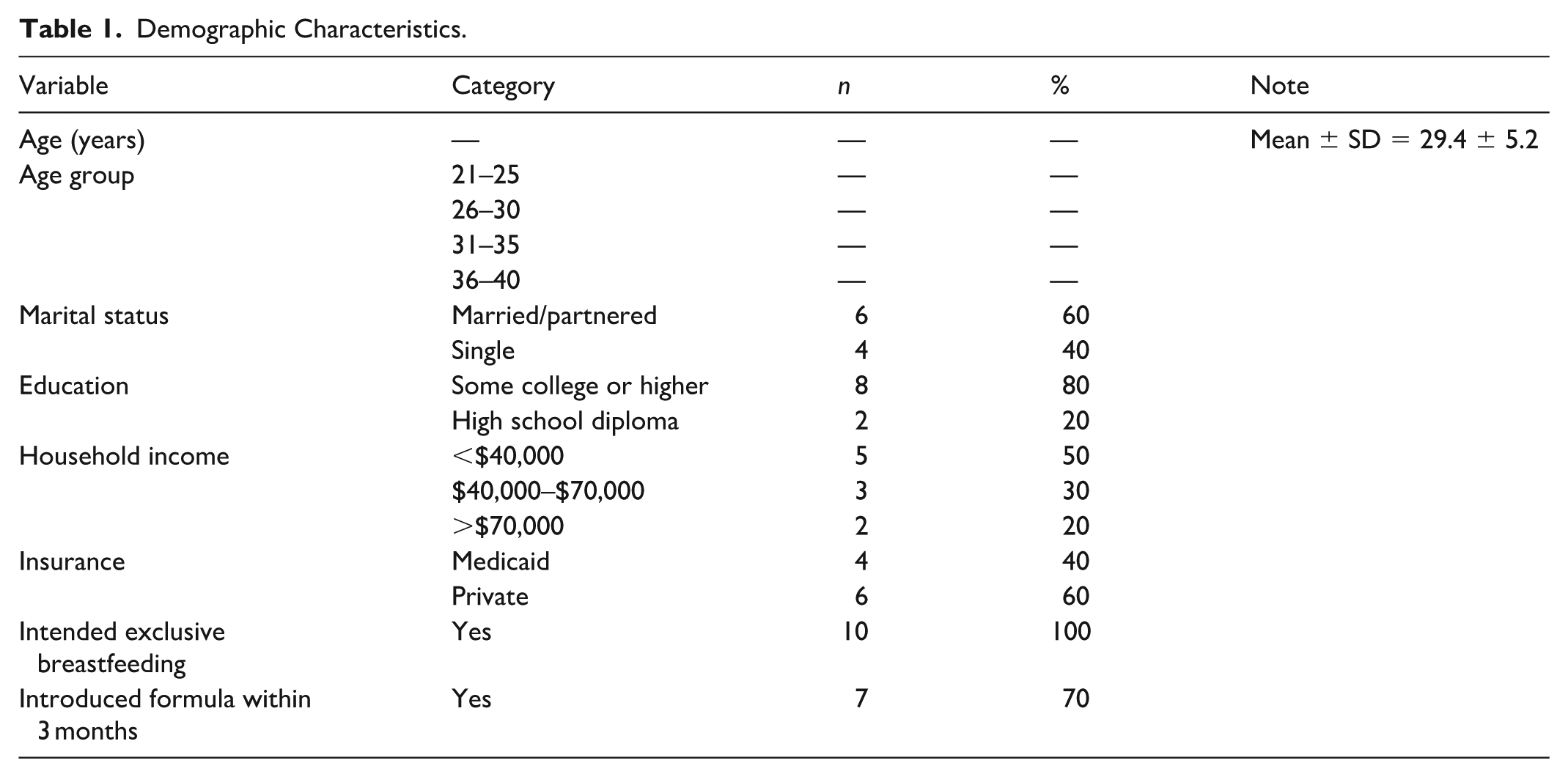
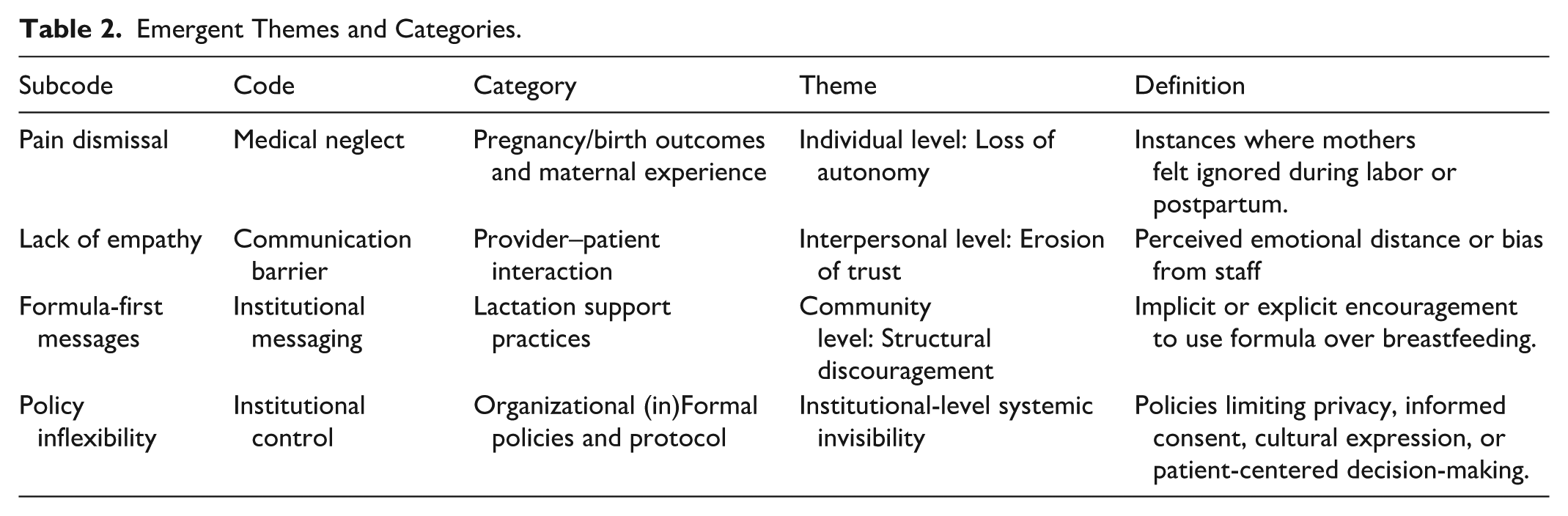
Demographic characteristics were summarized descriptively (see Table 1). Qualitative data were analyzed inductively using thematic analysis in ATLAS.ti 9, with subsequent organization of themes aligned to SEM levels. Analyst triangulation-enhanced analytic rigor and intercoder reliability was assessed using Krippendorff’s alpha (α range = 0.76–0.93). A data analysis structure table (see Table 2) outlines the coding framework, including code definition, categories, and themes. Trustworthiness was established through analyst triangulation, member checking, and maintenance of an audit trail. Following inductive coding, themes were organized according to SEM levels to illustrate how perceptions of racism and bias emerged across individual, interpersonal, community, and institutional contexts.
Demographic Characteristics.
Emergent Themes and Categories.
Results
Ten Black mothers participated in the study. Table 1 presents the demographic characteristics of the sample, including age, marital status, education, income, and type of insurance. Participants ranged in age from 21 to 40 years (M = 29.4). Most held at least some college education and identified as working class or middle income. Six mothers were married or partnered, and four were single. Four participants reported Medicaid coverage, and six had private insurance. All reported a prenatal intention to breastfeed exclusively and met eligibility criteria, excluding medical contraindications to breastfeeding. Despite this intention, seven introduced formula supplementations within the first 3 months postpartum.
Themes Organized by SEM-Aligned Analytic Domains
Findings are presented across SEM-aligned analytic domains reflecting the study’s sub–research questions at the individual, interpersonal, community, and institutional levels. Experiences of perceived racism and discrimination were reported consistently across participants regardless of insurance type, income, education, or relationship status.
Individual-Level Factors
At the individual level, Black mothers described how pregnancy and birth experiences shaped breastfeeding intentions and early feeding outcomes. Mothers reported birth trauma, pain dismissal, emergent procedures, and diminished autonomy that disrupted bonding and early breastfeeding efforts.
Every time I moved, it felt like someone was stabbing me, but they didn’t believe me. (Participant UN9F)
Participants also recounted how stress, a lack of agency during labor, self-advocacy demands, and prior breastfeeding knowledge influenced their ability to persist with exclusive breastfeeding during recovery.
Interpersonal-Level Factors
The interpersonal-level participants emphasized patient–provider communication and the quality of lactation support. Black mothers described dismissive interactions, delayed or inadequate assistance with latch or pumping, and encounters interpreted as biased or invalidating.
They were nice-nasty — not outright rude but dismissive. (Participant 81BI)
Limited time, low empathy, and inconsistent clinical guidance contributed to reduced trust, early supplementation, and reinforced perceived marginalization; several mothers reported that staff prioritized discharge or convenience over feeding assistance.
Community-Level Factors
At the community level, participants described a broader social environment in which social norms and informal messaging shaped exclusive breastfeeding practices. Several described “formula-first” messages circulating in hospitals, family networks, and social media, sometimes framed as safer or more realistic than exclusive breastfeeding.
They made me feel like formula was safer, like I was being unrealistic to want to breastfeed. (Participant H2FF)
Mothers emphasized the lack of visible Black lactation professionals and the limited availability of culturally relevant breastfeeding education.
Policy-Level Factors
At the institutional level, Black mothers described policies and routines perceived as constrained autonomy and reinforcing inequity. They referenced routine separation of infants, policy inflexibility, privacy concerns, and practices that undermined and disregarded cultural or spiritual traditions.
I told them for religious reasons I wanted to keep my placenta. They just said its policy — no. (Participant IXWG)
Black mothers emphasized that these experiences reflected broader organizational norms rather than isolated provider behaviors.
Summary of Findings
Across all four levels of the social ecological model, the central theme emerging from participants’ narratives was the persistent invisibility of Black mothers within institutional birth settings—a feeling of being unseen, unheard, and undervalued—which shaped both emotional experiences and subsequent care-seeking behaviors (see Figure 1). Participants linked repeated dismissal, invalidation, and perceived racial bias during childbirth and postpartum care to reduced trust in clinicians and institutions. This invisibility was associated with lower engagement in follow-up lactation support, earlier-than-intended discontinuation of exclusive breastfeeding, and greater reliance on informal community networks for breastfeeding guidance.
Importantly, participants described underutilization of postpartum and lactation services as a protective strategy to avoid anticipated bias or neglect rather than a lack of knowledge or motivation. These findings suggest breastfeeding inequities are produced not only by individual-level factors but also by structural and relational conditions that diminish Black mothers’ safety and voice within perinatal systems. Health-care practice and policy efforts should prioritize institutional accountability, timely access to skilled lactation support, and culturally responsive care environments—including equitable representation and referral pathways—where Black mothers are consistently affirmed and heard.
Discussion
This study contributes to qualitative literature examining how interpersonal and structural dynamics within institutional birth settings shape Black mothers’ breastfeeding experiences. Findings suggest that underutilization of lactation support reflects not diminished motivation or knowledge but a patterned response to experiences of dismissal, mistrust, and perceived invisibility within perinatal care systems (see Figure 2). Framed through the SEM, these findings underscore how racism operates across individual, interpersonal, organizational, and environmental levels to influence breastfeeding initiation and duration.

Pathway From Invisibility to Underutilization.
Consistent with prior research, participants described encounters characterized by invalidation of pain, limited access to lactation expertise, and differential treatment that eroded trust in health-care providers. Importantly, these narratives were reported across participants with varied educational attainment, insurance status, and income, reinforcing that breastfeeding disparities cannot be attributed solely to socioeconomic factors. Maternal intentions to breastfeed were strong across the sample, yet experiences within institutional birth settings frequently disrupted these intentions during the immediate postpartum period.
Alternative explanations warrant consideration. Participants’ interpretations of discriminatory treatment may reflect cumulative experiences with bias across health-care settings, potentially shaping perceptions of subsequent encounters. Likewise, mothers with negative experiences may have been more inclined to participate in this study, introducing possible selection bias. Despite these considerations, the convergence of narratives across participants and alignment with existing literature support the credibility and transferability of the findings.
These findings have implications for clinical practice and health systems. Interventions that rebuild trust—such as racially concordant lactation care, continuity of support, and accountability for respectful communication—may mitigate disengagement from postpartum services (Attanasio & Kozhimannil, 2015; Bleich et al., 2019). Future research should examine institutional practices, provider training models, and policy-level interventions that address structural contributors to inequitable lactation care. Mixed-methods studies may further clarify how perceptions of discrimination correlate with measurable service underutilization and breastfeeding outcomes.
Strengths of this study include its SEM theory-driven design, rigorous analytic procedures, which allowed for a multilevel interpretation of breastfeeding outcomes centered on Black mothers’ lived experiences. By situating Black mothers’ experiences and breastfeeding behavior within systems of care, this study advances understanding of how structural conditions—not individual deficits—shape inequities in lactation support and outcomes.
Limitations
Several limitations warrant consideration. As a qualitative study, this work prioritizes depth of understanding rather than generalizability. The small, purposive sample—while appropriate for the study aims, may not represent the full diversity of Black mothers’ experiences across rural, international, or non-U.S. health-care contexts. Participants’ accounts were self-reported and may be subject to recall bias, particularly given the 24-month postpartum inclusion window. However, this timeframe allowed for reflection on both immediate and sustained breastfeeding experiences. Virtual interviews increased accessibility but limited observation of nonverbal communication.
The researcher’s positionality—specifically, the shared racial and professional identity with participants—may have enhanced trust and disclosure while also requiring reflexivity during analysis; this was addressed through analyst triangulation and audit trail maintenance.
Finally, findings are situated within the sociopolitical climate of the early 2020s, a period marked by heightened awareness of racial inequities in health care, which may influence transferability.
Conclusion and Implications for Practice
Perceived racism and discrimination within institutional birth settings contribute to mistrust, emotional withdrawal, and underutilization of lactation and postpartum care services among Black mothers. These experiences reflect structural conditions—not individual deficits—that shape breastfeeding initiation and duration. For lactation professionals and birthing systems, these findings underscore the need to move beyond awareness-based approaches toward structural accountability. Equity-centered lactation practice requires consistent access to culturally responsive IBCLCs, transparent communication, respect for maternal autonomy, and organizational policies that actively counter bias. Clinical implications include integrating bias-responsive training into lactation education, increasing racial and cultural representation among lactation staff, and conducting routine organizational climate assessments to identify practices that undermine trust. Addressing disparities in breastfeeding outcomes requires not only supporting individual mothers but also transforming the systems in which lactation care is delivered.
Supplemental Material
sj-jpeg-1-jhl-10.1177_08903344261430461 – Supplemental material for Perceptions of Racism and Discrimination in Birthing Centers: Implications for Exclusive Breastfeeding Practices Among Black Mothers
Supplemental material, sj-jpeg-1-jhl-10.1177_08903344261430461 for Perceptions of Racism and Discrimination in Birthing Centers: Implications for Exclusive Breastfeeding Practices Among Black Mothers by Natashia Le’Nee Conner, Cheri N. Langley and Yitza Arcelay Rojas in Journal of Human Lactation
Supplemental Material
sj-jpeg-2-jhl-10.1177_08903344261430461 – Supplemental material for Perceptions of Racism and Discrimination in Birthing Centers: Implications for Exclusive Breastfeeding Practices Among Black Mothers
Supplemental material, sj-jpeg-2-jhl-10.1177_08903344261430461 for Perceptions of Racism and Discrimination in Birthing Centers: Implications for Exclusive Breastfeeding Practices Among Black Mothers by Natashia Le’Nee Conner, Cheri N. Langley and Yitza Arcelay Rojas in Journal of Human Lactation
Footnotes
Acknowledgements
The authors extend their deepest gratitude to the Black mothers who shared their experiences and to the community partners and birthing centers who supported this work through The BLACK Collaborative Inc.
Author Note
Dr. Langley and Dr. Rojas served as faculty advisors to Dr. Conner at Walden University.
Ethical Considerations
This study was reviewed and approved by the Walden University Institutional Review Board (IRB # 12-09-20-0963796). All participants provided informed consent. Confidentiality and anonymity were maintained throughout data collection and analysis.
Author Contributions
Funding
The authors disclosed receipt of the following financial support for the research, authorship, and/or publication of this article: This research received no external funding. The BLACK Collaborative Inc. provided in-kind institutional support.
Declaration of Conflicting Interests
The authors declared no potential conflicts of interest with respect to the research, authorship, and/or publication of this article.
Study Registration
Not applicable (qualitative study).
Supplemental Material
Supplementary Material may be found in the “Supplemental material” tab in the online version of this article.
References
Supplementary Material
Please find the following supplemental material available below.
For Open Access articles published under a Creative Commons License, all supplemental material carries the same license as the article it is associated with.
For non-Open Access articles published, all supplemental material carries a non-exclusive license, and permission requests for re-use of supplemental material or any part of supplemental material shall be sent directly to the copyright owner as specified in the copyright notice associated with the article.


