






Abstract
Background:
Elite American football athletes are at high risk for Jones fractures. Fixation is recommended to minimize nonunion and allow early return to play. The purpose of this investigation was to evaluate the prevalence of Jones fracture repair in athletes invited to the National Football League (NFL) Combine and the impact of fracture repair on short-term NFL participation compared to athletes with no history of repair.
Methods:
A total of 1311 athletes participating in the Combine from 2012 to 2015 were evaluated. Athletes with history of Jones fracture repair were identified. Athlete demographic information was collected while physical examination findings were recorded. Radiographs were evaluated to determine fixation type and the presence of nonunion. Future participation in the NFL was evaluated based on draft status, games played, and games started in the athlete’s first season following the Combine.
Results:
Fixation was performed for 41 Jones fractures in 40 athletes (3.1%). The highest prevalence was in defensive linemen (n = 10 athletes), with the greatest rate in tight ends (5.1%, n = 4 of 79 athletes). Intramedullary screw fixation was used for all fractures. Incomplete bony union was present in 3 (8%) fractures. Athletes with a history of repair were not at significant risk for going undrafted (P = .61), playing (P = .23), or starting (P = .76) fewer NFL games compared to athletes with no history of repair during athletes’ first NFL season.
Conclusion:
Athletes with a history of Jones fracture repair were not at significant risk of going undrafted or for diminished participation during their first season in the NFL.
Level of Evidence:
Level IV, case series.
Metatarsal fractures are common, with the highest incidence of fractures occurring in the fifth metatarsal.8,18 Fractures sustained at the base of the fifth metatarsal are subdivided into 3 zones based on their location and mechanism of injury (Figure 1).2,3,13 Those located at the metaphyseal-diaphyseal junction of the fifth metatarsal, the Jones fracture, present a challenge to treating physicians as these fractures occur within the fragile blood supply watershed area, leaving these fractures prone to delayed union and repeat injury.21,22
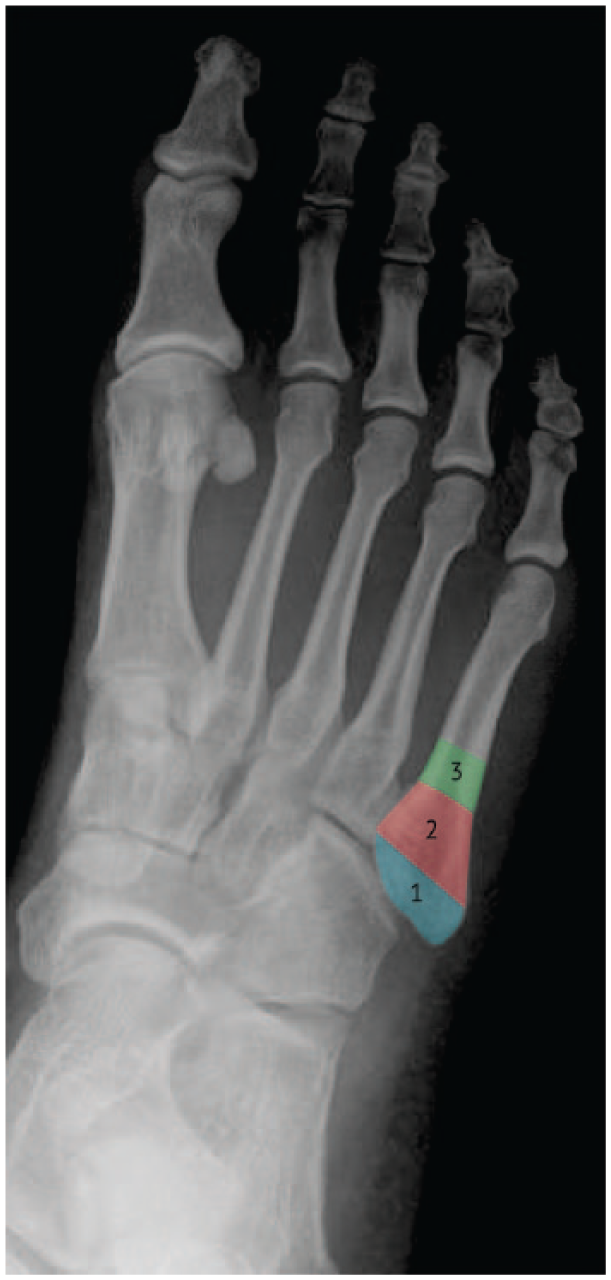
Oblique radiograph of the foot demonstrating classification of fractures to the proximal fifth metatarsal based on injury location. Avulsion fractures (zone 1) occur proximal to the tubercle, Jones fractures (zone 2) involve the metaphyseal-diaphyseal junction, and stress fractures occur distally in the diaphysis (zone 3).
The forces placed across the foot sustained during cutting and running in American football compromise the strong ligamentous and capsular attachments between the fifth metatarsal and the fourth metatarsal and cuboid, making football athletes susceptible to fracture. Based on data from the National Football League (NFL) surveillance program, Jones fractures comprise 17.8% of all foot fractures, 9 significantly higher than the 0.7% to 1.9% incidence of all foot fractures reported in the general population. 7 While numerous treatment options have been reported, nonoperative treatment in the elite athlete is generally avoided due to high rates of nonunion and delayed return to sport.4,9,20 However, even with operative fixation, multiple studies have reported complications, including delayed union, nonunion, and repeat fracture.5,6,9,12 For this reason, outcomes following Jones fracture fixation are of interest to physicians caring for elite athletes to better understand the impact of fracture management on prospective participation.
The purpose of this investigation was to evaluate (1) the prevalence of Jones fracture fixation in American football athletes invited to the NFL Scouting Combine from 2012 to 2015, (2) athlete-specific factors associated with a history of fracture repair, and (3) the impact of Jones fracture repair on athlete participation during their first season in NFL season compared to athletes with no history of Jones fracture repair. We hypothesized a low prevalence of fractures among athletes with no significant impact on short-term NFL participation.
Methods
The study protocol was approved by the authors’ institutional review board and the NFL Research Committee. Evaluations of 1311 athletes participating in the NFL Scouting Combine from 2012 to 2015 were retrospectively reviewed using the NFL Combine database. Information collected from the database consisted of athlete position, Combine year, ethnicity, time from surgery to the Combine, and physical examination results. Prospective data regarding future NFL participation based on draft status, games played, and games started during the athlete’s first season in the NFL following the Combine were collected using the Internet database at NFL.com.
Inclusion criteria consisted of athletes with a history of fixation for Jones fractures with physical examination results and radiographic imaging performed at the NFL Combine. Athletes were excluded if they had no history of fracture fixation or a history of operative fixation for fifth metatarsal fractures not consistent with Jones fractures. All radiographs were independently evaluated by the 2 senior authors to ensure fractures were properly classified as Jones fractures, defined as a fracture to the metaphyseal-diaphyseal junction without extension beyond the fourth to fifth intermetatarsal articulation.2,3,13 Radiographs were also evaluated to determine the type of fixation used and the presence of any bony nonunion across the fracture site. If any discrepancies were present between the senior authors regarding fracture classification or the presence of nonunion, an independent musculoskeletal radiologist was consulted to review the imaging to reconcile any disagreements.
Prospective data were analyzed by comparing athletes with a history of Jones fracture repair to all other athletes invited to the Combine based on draft status, games played, and games started during athletes’ first season in the NFL, along with athletes’ roster status following the conclusion of their first season. Continuous variables were compared using the Student t test and categorical variables compared using the χ2 test. Fisher’s exact test was performed in cases in which a variable had an expected frequency of 5 or less. A P value of less than .05 was used to determine statistical significance. All statistical analysis was performed using SPSS (version 23; SPSS, Inc, an IBM Company, Chicago, IL) software.
Results
Review of the NFL Combine database identified 3.1% (n = 40 of 1311 athletes) of athletes with a total of 41 Jones fracture repairs participating in the NFL Combine from 2012 to 2015 (Table 1). Athletes consisted of 30 African American and 10 white athletes. The average time from surgery to the Combine was 27 ± 22.3 months. The highest prevalence of fracture repair based on position was in defensive linemen (n = 10 athletes, 25%), with the highest rate in tight ends (n = 4 of 79 athletes, 5.1%). The right foot was treated in 66% (n = 27 of 41) of cases. One athlete underwent bilateral Jones fracture repair 19 months apart. One athlete required revision surgery for repeat fracture with evidence of bent hardware and symptomatic nonunion. A total of 1264 athletes with no history of Jones fracture repair were excluded from further analysis. In addition, athletes with a history of fixation for diaphyseal stress fractures of the fifth metatarsal (n = 6 athletes) or avulsion fractures off the fifth metatarsal base (n = 1 athlete) were similarly excluded.
Overview of National Football League Combine Participants Based on Position From 2012-2015.
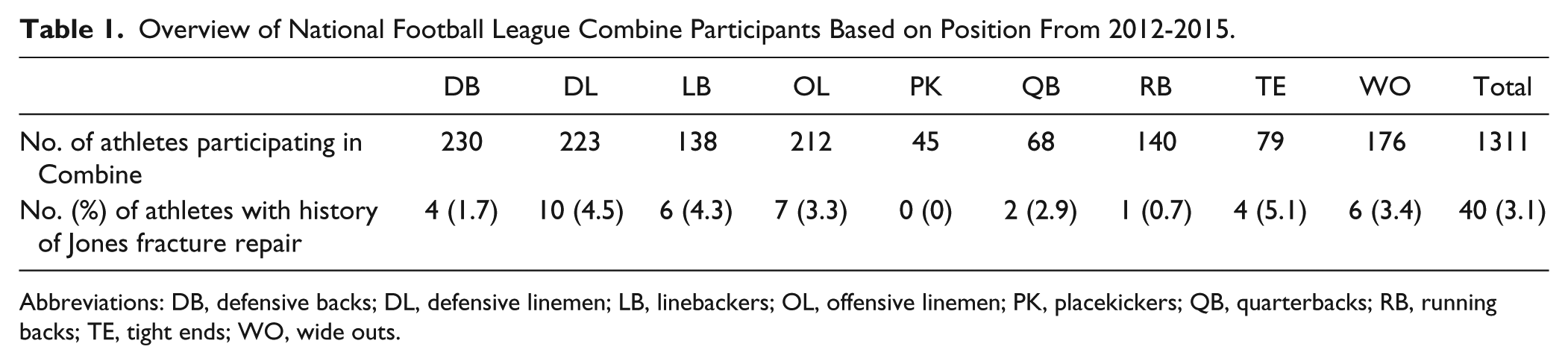
Abbreviations: DB, defensive backs; DL, defensive linemen; LB, linebackers; OL, offensive linemen; PK, placekickers; QB, quarterbacks; RB, running backs; TE, tight ends; WO, wide outs.
All athletes had radiographs of the operative foot obtained at the Combine. Fractures were treated with intramedullary screw fixation in 100% (n = 41 fractures) of cases. Evaluation of repair status on radiographs was consensual among the senior authors, with 92% (n = 38 fracture) of repairs demonstrating complete radiographic union across the fracture site. Incomplete bony union with visualized fracture line was appreciated in 8% (n = 3 fractures) of fractures, including 2 defensive backs and defensive lineman. On physical examination, no athlete, including those with incomplete union, reported any limitations in strength or range of motion of the operative foot compared to the nonoperative foot.
Prospectively, 70% (n = 28 of 40) of athletes with a history of Jones fracture repair were successfully drafted into the NFL, including all 3 athletes with evidence of incomplete bony union (Table 2). During the athletes’ first season in the NFL, 75% (n = 30 of 40 athletes) played in a regular season game while 38% (n = 15 of 40 athletes) started a regular season game. Following the conclusion of each athlete’s first season in the NFL, 65% (n = 26 of 40 athletes) were on an active NFL roster, while the remaining athletes were free agents (13%, n = 5), on a practice squad (8%, n = 3), or on injured reserve (15%, n = 6) due to issues unrelated to their operative foot. Statistical analysis showed that athletes with a history of Jones fracture repair were not at decreased risk of going undrafted (P = .61), playing (P = .23) or starting (P = .76) fewer NFL games compared to athletes with no history of Jones fracture repair during their first season in the NFL.
Prospective Participation During NFL Rookie Season in Athletes.
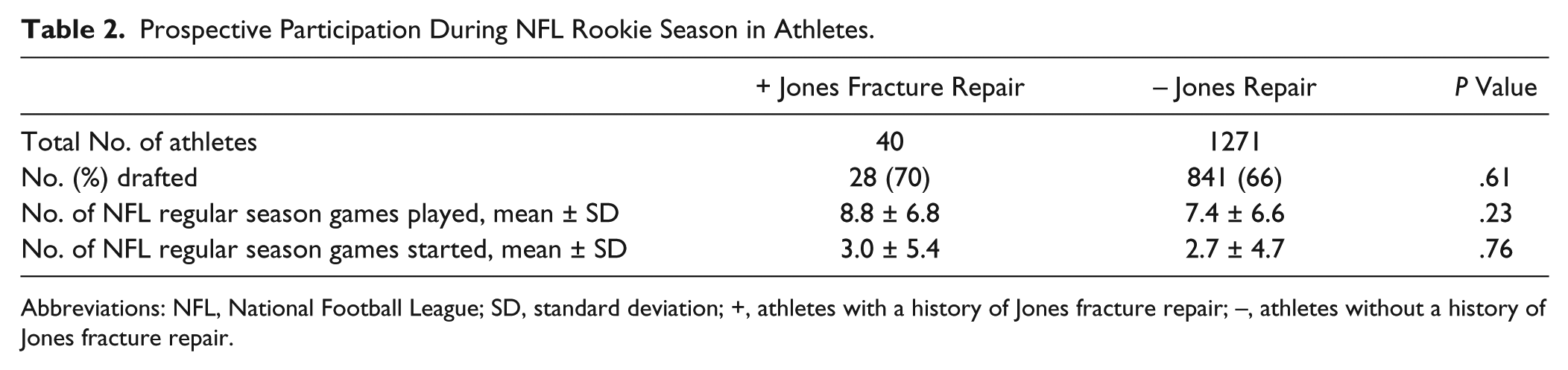
Abbreviations: NFL, National Football League; SD, standard deviation; +, athletes with a history of Jones fracture repair; –, athletes without a history of Jones fracture repair.
Discussion
The principle findings from this study were a 3.1% prevalence of Jones fracture fixation in the 1311 athletes invited to the NFL Combine between 2012 and 2015. Defensive linemen possessed the highest prevalence, while the highest rate was seen in tight ends. Intramedullary screw fixation was used in 100% of athletes, while 8% of fractures demonstrated radiographic evidence of nonunion. Athletes with a history of Jones fracture repair were not at significant risk of going undrafted or for diminished participation during their first season in the NFL.
The 3.1% prevalence rate appreciated in this study is higher than that previously reported by Low et al, 14 who found a prevalence rate of 1.8% in athletes invited to the NFL Combine between 1988 and 2002. Low et al also reported that only 53% of these fractures were treated surgically. Meanwhile, Carreira et al 1 similarly found that Jones fractures in athletes invited to the Combine between 2004 and 2009 were treated with operative fixation in 74% of athletes, but the authors included both Jones fractures and diaphyseal stress fractures in their analysis. In comparison to these studies, we appreciated a trend toward increased fixation with 100% of athletes with Jones fractures undergoing operative repair. This reflects the current consensus among treating physicians recommending fixation of Jones fractures in elite athletes, which has been associated with increased union rates and earlier return to play compared to nonoperative management.4,9
All fractures in this series were treated with intramedullary screw fixation. As a means of expediting return to play following fixation, multiple studies have reported that use of intramedullary screw fixation, with or without bone grafting, results in significantly shorter bone-healing times and lower complication rates compared to conservative management.15,19 The 92% union rate reported in our study is similar to that previously reported in the literature, ranging between 90% and 100%.9,18,21 However, complications following fracture repair using intramedullary screw fixation, including delayed union, nonunion, and repeat fracture, have been reported to occur in 4% to 12% of athletes.14,16,20 In our study, fracture nonunion was present in 8% of fractures in 3 athletes, including 1 athlete with a history of revision surgery for nonunion. However, athletes with evidence of nonunion denied any pain or limitations in range of motion, and all were successfully drafted into the NFL.
When analyzing factors behind failed operative management of Jones fractures in athletes, increased rates of delayed union and refracture following intramedullary fixation using small diameter screws have been reported. 22 A recent radiographic study using computed tomographic (CT) scans reported that the coronal diameter at the isthmus of the fifth metatarsal was greater than 4.5 mm in 81% of males and 74% of females. 17 As such, multiple authors have recommended use of larger (4.5 mm, 5.5 mm, 6.5 mm) diameter screws to decrease fatigue failure and complications.11,12,20 Furthermore, Kelly et al 10 found that the fifth metatarsal can successfully accommodate a 6.5-mm screw as these larger screws possessed significantly greater pullout strength without increasing fracture stiffness. When comparing types of screws used, Pietropaoli et al 19 found no biomechanical differences in load to failure via 3-point bending between a 4.5-mm malleolar screw compared to a 4.5-mm cannulated screw in a cadaveric model. In addition, proper screw length is critical when ensuring proper intramedullary screw fixation in the treatment of Jones fractures. The fifth metatarsal bows laterally such that a screw that is too long abuts the medial cortex and results in distraction and varus angulation at the fracture site. Therefore, the shortest length screw with all threads distal to the fracture site would be ideal. Ochenjele et al 17 found that the straight segment length was 68% of the fifth metatarsal length and averaged 52 mm.
Complete fracture healing is essential to enable athletes to return to play as complications such as refracture have been attributed to athletes returning to play prior to complete healing. Larson et al 12 found that return to full activity before complete radiographic union was the factor most predictive of failure following Jones fracture fixation. However, Wright et al 23 reported 3 cases of refracture in professional football athletes on the day of return to full activity (average, 8.5 weeks) despite 100% clinical and radiographic healing, Similarly, Lareau et al 11 found that while 100% of NFL players in their series were able to return to play after 9 weeks, a total of 12% sustained repeat fractures. Within our study, athletes with radiographic nonunion reported no limitations in strength or range of motion of the foot. This suggests that clinical examination is as important as radiographic union in determining timing of return to play.
To our knowledge, this is the first study to prospectively look at athlete participation in the NFL. Our study found that athletes with a history of Jones fracture repair were not at decreased risk of going undrafted, playing, or starting fewer NFL games compared to athletes with no history of Jones fracture repair. This is consistent with the findings of Lareau et al, 11 who evaluated 25 NFL players following fixation by a single surgeon, reporting that all players were successfully able to return to play at an average of 9 weeks. As such, with proper recognition and management, short-term NFL participation is not compromised in athletes undergoing Jones fracture fixation.
This study is not without limitations. The collection of data was retrospective in nature and history taken from athletes at a single point in time at the NFL Scouting Combine. Specific details regarding injury mechanisms and the date of injury were infrequently reported and thus not included in the analysis. The authors did not have access to operative reports, limiting information regarding operative approach, type and size of screw used, and incidence of any perioperative or postoperative complications. Assessment for the presence of cavus alignment on radiographs or on physical examination of the foot was not performed. Due to the small sample size of athletes with a history of repair, no meaningful statistical analysis examining for position or injury-specific predictors for future participation in NFL such as the presence of screw breakage or nonunion could be evaluated. Only athletes with successful fracture repair, enabling a return to elite-level football and invited to the NFL Combine, were included within the study. Athletes with failed repairs or persistent symptoms limiting optimal performance were likely not invited to the NFL Combine, leading to a selection bias within our results and preventing an evaluation of the true success rate of Jones fracture repair in this population of elite athletes. Last, due to a lack of publicly available information, the authors were unable to prospectively examine athlete data following the Combine with regard to recurrent fractures or revision surgeries.
In conclusion, appropriate treatment of a Jones fracture in elite American football athletes did not diminish NFL participation in the year following the Combine compared to athletes with no history of Jones fracture repair. Future prospective studies analyzing long-term outcomes with regard to fixation failure and impact on NFL performance and professional career length are warranted.
Footnotes
Declaration of Conflicting Interests
The author(s) declared no potential conflicts of interest with respect to the research, authorship, and/or publication of this article. ICMJE forms for all authors are available online.
Funding
The author(s) received no financial support for the research, authorship, and/or publication of this article.
References
Supplementary Material
Please find the following supplemental material available below.
For Open Access articles published under a Creative Commons License, all supplemental material carries the same license as the article it is associated with.
For non-Open Access articles published, all supplemental material carries a non-exclusive license, and permission requests for re-use of supplemental material or any part of supplemental material shall be sent directly to the copyright owner as specified in the copyright notice associated with the article.
