






Abstract
The purpose of this study was to investigate core self-evaluations (CSE) as a moderator of the effect of exhaustion on in-role performance and job satisfaction. This study also examined the effect of exhaustion on the aforementioned job outcomes. Full-time frontline employees, such as front desk agents, reservations agents, guest relations representatives, and food servers in several four- and five-star hotels of Kish Island and Tehran in Iran served as the study setting. The study relationships were tested using LISREL 8.30 via path analysis. The results indicated that exhaustion influenced in-role performance and job satisfaction deleteriously. However, CSE reduced these detrimental effects. Implications of the findings are discussed, and directions for future research are offered.
Introduction
Employees in frontline service jobs of the hotel industry have intense face-to-face or voice-to-voice interactions with customers and are the main actors in the delivery of service quality. However, frontline employees are prone to elevated levels of stressful and demanding situations (Deery and Jago, 2009; Karatepe et al., 2009). Exhaustion, which is widespread among employees in frontline service jobs (Kim et al., 2007; Ledgerwood et al., 1998), refers to “a consequence of intensive physical, affective, and cognitive strain, for example as a long-term consequence of prolonged exposure to certain demands” (Demerouti et al., 2001, p. 500). Exhaustion leads to substantial costs both in tangible and intangible terms. For example, costs arising from work stress and exhaustion/burnout exceed $300 billion annually in the US (Chapman, 2005). The replacement of a highly exhausted employee with an inexperienced new hire, disrupted service, ineffective job performance, low morale, and turnover are also among the costs associated with exhaustion (Babakus et al., 1999; Bakker et al., 2004; Karatepe et al., 2009; Karatepe and Uludag, 2007).
Given that frontline employees are prone to suffer from exhaustion and exhaustion results in substantial costs for hotel organizations, it is of paramount importance to understand how to mitigate the detrimental effect of exhaustion in frontline service jobs. As a dispositional variable, core self-evaluations (CSE) can be a potential remedy. CSE are the fundamental assessments that people make about their worthiness, competence, and capabilities and are the aggregation of self-esteem, generalized self-efficacy, locus of control, and emotional stability (Judge et al., 2005). These personality traits have been used as personal resources in the relevant literature (Grandey and Cropanzano, 1999; Ito and Brotheridge, 2003; Xanthopoulou et al., 2007). As a result, CSE can function as a buffer against exhaustion.
Against this background, the purpose of this study is to examine CSE as a moderator of the effect of exhaustion on in-role performance and job satisfaction. In-role performance refers to “those officially required outcomes and behaviors that directly serve the goals of the organization” (Bakker et al., 2004, p. 85), while job satisfaction refers to an affective state resulting from one’s evaluation of his or her job (Hartline and Ferrell, 1996). This study also investigates the relationship between exhaustion and the aforementioned job outcomes. These relationships are assessed via data gathered from a sample of full-time frontline hotel employees in Iran.
This study contributes to the hospitality management and marketing literature in the following ways. First, CSE is a broad personality construct and has been regarded as a predictor of stressors, strains, and important organizational outcomes, such as job performance and job satisfaction (Bono and Judge, 2003; Karatepe et al., 2010a, b; Stumpp et al., 2009). However, CSE is an under-researched topic in the hospitality management and marketing literature (cf. Crawford et al., 2010; Karatepe et al., 2010a, b). More importantly, there is a dearth of empirical research concerning CSE as a moderator in the stress-outcome/strain-outcome relationship (Harris et al., 2009).
Second, burnout is a psychological response to stressors on the job and is an organizational reality for frontline employees in the hotel industry. Empirical studies have examined the relationship between emotional exhaustion/exhaustion as a component of burnout and job performance (Advani et al., 2005; Bakker et al., 2004; Wright and Bonett, 1997). However, as discussed by Halbesleben and Bowler (2007), there are inconsistent findings regarding this relationship across the empirical studies in the relevant literature. As a matter of fact, there are also mixed findings in the hospitality management and marketing literature (Karatepe et al., 2009; Karatepe and Uludag, 2008). Therefore, more research is needed to test the relationship between exhaustion and in-role performance. Finally, the findings of this study may prove useful from a managerial perspective. That is, understanding how to alleviate the detrimental effect of exhaustion is crucial for hotel managers, especially in the developing countries, which are devoid of contemporary human resource management practices.
The next section of the article presents the relevant literature leading to the study hypotheses. Then, discussions of the method and results of the empirical study are presented. The article concludes with implications of the results and future research directions.
Theoretical framework and hypotheses
Conservation of resources theory
Conservation of resources (COR) theory provides viable guidelines for developing the relationships among CSE, exhaustion, in-role performance, and job satisfaction. Specifically, COR theory posits that there are four fundamental resource categories, which are objects, personal characteristics, conditions or energies (Hobfoll, 1989). Individuals can gain or lose resources from these fundamental resource categories. Stress occurs in the workplace when (i) individuals are confronted with the threat of loss of resources, (ii) individuals lose their resources, and (iii) individuals invest resources and do not harvest what they have predicted in return (Hobfoll, 2001). Exhaustion occurs when individuals find that they no longer have sufficient resources to cope with stressors confronting them (Wright and Cropanzano, 1998). Such individuals have negative job outcomes (e.g., erosion of job satisfaction and poor job performance) as a result of resource loss and exhaustion (Lee and Ashforth, 1996).
According to COR theory, “… people must invest resources in order to protect against resource loss, recover from losses, and gain resources” (Hobfoll, 2001, p. 349). COR theory contends that individual differences can be considered as resources (Grandey and Cropanzano, 1999). CSE is an important personal resource and can be used as a coping mechanism against the detrimental effect of exhaustion on job outcomes. As Judge et al. (2004) state, “Individuals with positive core self-evaluations appraise themselves in a consistently positive manner across situations; such individuals see themselves as capable, worthy, and in control of their lives” (pp. 328–329). Individuals with higher CSE can cope with exhaustion better than those with lower CSE. Consequently, the negative effect of exhaustion on in-role performance and job satisfaction is weaker among employees with higher CSE than those with lower CSE.
Most of the personality traits in the CSE construct appear to be influenced by situational variables (Yagil et al., 2008). Therefore, having a work environment that fosters training and empowerment enhances frontline employees’ abilities. Trained and empowered employees have elevated levels of self-efficacy beliefs and perform better in the workplace (Eden and Aviram, 1993; Hartline and Ferrell, 1996; Krishnan et al., 2002; Stajkovic and Luthans, 1998). Consequently, it appears that employees with lower CSE can be trained and empowered to be among the pool of employees with higher CSE over time.
As COR theory posits, tenure (organizational or job) is one of the condition resources that can be used for coping with the detrimental effect of strain (Hobfoll, 1989). However, there are inconsistent findings regarding tenure as a resource. On one hand, studies indicatethat tenure does not significantly influence employees’ emotional exhaustion (Grandey et al., 2007; Halbesleben and Buckley, 2006; Maslach and Leiter, 2008). On the other hand, studies show that tenure reduces employees’ exhaustion/emotional exhaustion (Boyas and Wind, 2010; Karatepe and Uludag, 2007) and appears to mitigate the positive effect of emotional exhaustion on turnover intentions (Karatepe and Karatepe, 2010). That is, long-tenure employees seem to handle difficulties associated with exhaustion and thus have lower turnover intentions.
There are personality traits, such as self-monitoring and positive affectivity that can also be linked to employee outcomes and/or act as moderators. Specifically, self-monitoring is the degree to which individuals adapt their behavior through situational cues to social appropriateness (Snyder, 1974). According to Abraham (1998), the negative effect of emotional dissonance on job satisfaction is weaker among individuals high in self-monitoring. As a personality variable, self-monitoring has been demonstrated to be a determinant of effective performance of salespeople (Verbeke, 1994) and reduce the positive impact of turnover intentions on turnover (Allen et al., 2005). In Allen et al.’s study (2005), locus of control has also been reported as a moderator of the relationship between turnover intentions and turnover. Positive affectivity, which “reflects the extent to which a person feels enthusiastic, active, and alert” (Watson et al., 1988, p. 1063), is reported to be one of the antecedents of employee outcomes and/or has a moderating role. Specifically, empirical studies demonstrate that positive affectivity mitigates stress and strain/emotional exhaustion and increases job satisfaction (Fogarty et al., 1999; Iverson et al., 1998). In addition, positive affectivity has been shown to reduce the negative effects of perceptions of organizational politics on job satisfaction (Hochwarter and Treadway, 2003).
As stated earlier, this study focuses upon CSE, because empirical research pertaining to CSE in the hospitality management and marketing literature is scarce, and little is known about CSE as a moderator in the stress-outcome/strain outcome relationship.
Hypotheses
Employees who are faced with elevated levels of exhaustion display poor performance in the workplace. This is consistent with COR theory. However, there are limited and mixed findings regarding the relationship between exhaustion and job performance/service recovery performance. For example, in a study of frontline hotel employees in Northern Cyprus, Karatepe et al. (2009) reported that emotional exhaustion reduced service recovery performance. The results of a study conducted with frontline hotel employees in Nigeria demonstrated no significant relationship between emotional exhaustion and job performance (Karatepe and Aleshinloye, 2009). Surprisingly, Karatepe and Uludag (2008) found a positive relationship between these two constructs among frontline hotel employees in Northern Cyprus. These findings require further empirical investigation in the hospitality management and marketing literature.
Therefore, the following hypothesis is proposed:
Hypothesis 1a: Exhaustion is negatively related to frontline employees’ in-role performance
There is much empirical research demonstrating that exhaustion results in job dissatisfaction (Karatepe et al., 2009; Karatepe and Uludag, 2007; Lee and Ashforth, 1996; Mulki et al., 2006). As COR theory proposes, employees are exhausted due to the lack of adequate resources to handle stressors confronting them. Under these circumstances, they are dissatisfied with the job.
Therefore, the following hypothesis is proposed:
Hypothesis 1b: Exhaustion is negatively related to frontline employees’ job satisfaction
As COR theory states, employees can use their personal resources to cope with problems associated with exhaustion and thus display low levels of negative job outcomes. Specifically, CSE moderates the negative effect of exhaustion on in-role performance and job satisfaction. There is empirical research about the components of CSE as moderators. For example, past research found self-esteem as a moderator in the relationships between poor organizational climate and emotional exhaustion and mental distress among male employees (Mäkikangas and Kinnunen, 2003). Prior research indicated that emotional stability buffered the positive impact of work-family conflict on job exhaustion (Kinnunen et al., 2003). According to the findings of another study, generalized self-efficacy was shown to be a moderator in several relationships between stressors and work well-being (Siu et al., 2005). In addition, Noor (2002) demonstrated that locus of control mitigated the negative effect of work-family conflict on job satisfaction.
On the other hand, there is little empirical research concerning the moderating role of CSE as an aggregate construct. Specifically, Tsaousis et al. (2007) found that CSE acted as a moderator in the relationship between subjective well-being and physical health functioning. Harris et al. (2009) demonstrated that the negative effects of social stressors on job satisfaction and the positive effects of social stressors on turnover intentions were weaker among employees with higher CSE. However, in a recent meta-analytic inquiry, it was reported that CSE did not moderate the relationshipbetween problem-solving coping and strain (Kammeyer-Mueller et al., 2009).
In light of COR theory and limited empirical evidence, the following hypotheses are proposed:
Hypothesis 2a: CSE moderates the negative effect of exhaustion on in-role performance such that the detrimental impact of exhaustion is weaker among frontline employees with higher CSE. Hypothesis 2b: CSE moderates the negative effect of exhaustion on job satisfaction such that the detrimental impact of exhaustion is weaker among frontline employees with higher CSE.
Method
Sample and procedure
Data were collected from a sample of full-time frontline employees in the four- and five-star hotels of Kish Island and Tehran in Iran. Frontline employees in these hotels, such as front desk agents, reservations agents, guest relations representatives, and food servershad intense face-to-face or voice-to-voice interactions with customers. Iran (officially known as the Islamic Republic of Iran) is a developing Middle East country (Sari and Soytas, 2007) and covers the land area of more than 1,648,000 km2 (Zamani-Farahani and Musa, 2008). Kish Island is one of the most important tourism destinations of the country, while Tehran is the capital city. There are a number of problems that impede international tourism demand in Iran. Among others, such problems are associated with the lack of quality accommodation facilities and technological infrastructure, bottlenecks in internal transportation, poor marketing efforts, the negative image of the country worldwide, regional political concerns, and the national social and cultural matters, such as the hijab requirement for women and the ban for alcohol (cf. Karatepe et al., 2010a, b). In addition, service standards, especially in the major state and quasi-state hospitality businesses, are very poor (O’Gorman et al., 2007). Customers’ complaints and unmet customers’ expectations resulting from poor service standards appear to create more stressful situations for frontline employees.
The work environment in the hospitality industry of Iran is largely different from that of the Western countries. Specifically, Iran is a collectivist and male-dominated society (Karimi, 2008). The percentage of employed men is greater than that of employed women in the service industries (Trading Economics, 2007). However, the participation of women in the workforce has increased due to the high cost of living and the growing number of educated women in Iran (Karimi, 2009). The dual-earner family structure appears to replace the traditional family structure slowly. Despite such a change, most of the Iranian women are still responsible for all aspects of running a home (Karimi, 2008; O’Shea, 2003). Karimi et al. (2010) discuss that most of the Iranian employees pay utmost attention to the relationship with their supervisor, because supervisors directly control the job characteristics (e.g., job autonomy). Therefore, such employees regard support provided by their supervisor as a guarantee for the access to the promotional opportunities. In the work environment of Iran, kinship relations are also important and influence managers’ decisions in the workplace (Karimi, 2008). Under these circumstances, nepotism and favoritism appear to be rampant in Iran (Karatepe et al., 2010a, b; O’Shea, 2003).
In this study four- and five-star hotels were considered, because smaller hotels would have few paid full-time frontline employees. According to the information obtained from Iran’s Cultural Heritage, Handicraft and Tourism Organization at the time of this study, there were 7 four-star and 4 five-star hotels in Kish Island, while there were 11 four-star and 5 five-star hotels in Tehran. Managements of these hotels were contacted before data collection. Permission was given by 6 four-star and 4 five-star hotels. However, the managers did not allow the researcher to directly contact their frontline employees. Therefore, 270 questionnaires were submitted to these managers. Specifically, 140 questionnaires were submitted to the managers in the four-star hotels and 130 to those in the five-star hotels. The self-administered questionnaires consisted of information about the assurance of confidentiality. The managers were requested to distribute the questionnaires to a broad range of frontline employees, such as front desk agents, reservations agents, guest relations representatives, and food servers. By the cut-off date for data collection, 69 questionnaires were returned from the four-star hotels, while 72 questionnaires were returned from the five-star hotels. In short, 141 questionnaires were retrieved, yielding a response rate of 52.2 per cent.
The sample skewed relatively young. That is, 40 per cent of the respondents were between the ages of 18 and 27, 40 per cent between the ages of 28 and 37 and the rest were older than 37. Sixty-two per cent of the respondents were male. Forty per cent of the respondents had 2-year college degrees, while 22 percent had 4-year college degrees. Nine per cent of the respondents had primary school education and 27 per cent secondary and high school education. The rest had graduate degrees. Fifty-six per cent of the respondents had tenures of 5 years or less. Twenty-six per cent of the respondents had tenures between 6 and 10 years and the rest had more than 10 years. The organizational tenure structure skewed relatively toward employees with less tenure in the workplace. Sixty-two per cent of the respondents were married, while the rest were single or divorced. While 55 per cent of the respondents had no children, 28 had children between one and two and the rest more than two.
Measurement
The primary variables of interest in this study were CSE, exhaustion, in-role performance, and job satisfaction. Moreover, consistent with the other empirical studies (Harris et al., 2009; Karatepe and Aleshinloye, 2009; Karatepe et al., 2010a, b), age and education werecontrolled to avoid statistical confounds. All items were originally prepared in English and then translated into Persian via the back-translation method (Parameswaran and Yaprak, 1987). A pilot sample of five frontline hotel employees was used for the understandability of the items in the questionnaire. The results showed that no changes in the wording of the questions were deemed necessary.
Twelve items from Judge et al. (2003) were used to measure CSE. Sample items are ‘I am confident I get the success I deserve in life’ and ‘Sometimes, I do not feel in control of my work.’ Exhaustion was operationalized using eight items from Demerouti et al.’s (2003) Oldenburg Burnout Inventory. Sample items are ‘I can tolerate the pressure of my work very well’, and ‘When I work, I usually feel energized.’ Six items from Williams and Anderson (1991) were used to measure frontline employees’ in-role performance. Sample items include ‘I adequately complete assigned duties’, and ‘I fail to perform essential duties.’ Job satisfaction was measured using six items from Brayfield and Rothe (1951). Sample items are ‘I find real enjoyment in my job’ and ‘Most days I am enthusiastic about my job.’
Each of the items in CSE, in-role performance, and job satisfaction had a five-point response scale ranging from 5 (strongly agree) to 1 (strongly disagree). Responses to the items in exhaustion were elicited on a four-point scale ranging from 4 (strongly agree) to 1 (strongly disagree). Higher scores demonstrated higher job satisfaction. After the negatively worded items had been reverse scored, higher scores demonstrated higher CSE and in-role performance. Higher scores indicated higher exhaustion after reversing the positively worded scale items. In addition, age was measured using a four-point scale. Education was measured via a five-point scale. Higher scores demonstrated older age and more educated.
Data analysis
All measures were subjected to a series of confirmatory factor analyses to address the issues of convergent and discriminant validity (Anderson and Gerbing, 1988; Joreskog and Sorbom, 1996). The ratio of the χ2 to the degrees of freedom (df), goodness-of-fit index (GFI), comparative fit index (CFI), root mean square error of approximation (RMSEA), and root mean square residual (RMR) were used to assess the goodness of the model. The χ2/df value between 2 and 5 indicates a reasonable fit (Marsh and Hocevar, 1985). Generally, fit indices with values equal to or greater than 0.90 indicate a good fit (Bentler and Bonett, 1980). RMSEA with values smaller than or equal to 0.08 indicates a good fit (Browne and Cudeck, 1993). RMR with values smaller than 0.10 is indicative of a good fit (Sumer et al., 2000). Reliability estimates were evaluated using the commonly accepted threshold of 0.70.
All proposed direct, mediating, and moderating effects were estimated using LISREL 8.30 through path analysis (Joreskog and Sorbom, 1996). Tests of the moderating effects require the creation of interaction variables. Therefore, the product variable was created by multiplying exhaustion with CSE. Prior to multiplication, exhaustion and CSE were centered in order to reduce multicollinearity (Cohen et al., 2003).
Results
Measurement results
According to the initial results of the confirmatory factor analysis, five items from the CSE measure, four items from the exhaustion measure, and one item from the job satisfaction measure were dropped due to non-significant t-values and correlation measurement errors. Such an item-deletion procedure has been suggested as a method for respecifying indicators that have not worked out as planned (Anderson and Gerbing, 1988). This procedure can also be found in a number of empirical studies (Hartline and Ferrell, 1996; Karatepe and Aleshinloye, 2009). The final results of the confirmatory factor analysis for a four-factor model yielded the following fit statistics:
The test of discriminant validity based on a series of χ2 difference tests using measures of each pair of constructs provided evidence of such validity. A two-dimensional model for each pair of constructs was first fit, and then items representing each construct were forced into a single-factor solution. The χ2 difference test produced a significant result for each pair of measures. Thus, imposing a single-factor solution onthe two sets of items representing different constructsdemonstrated a significant deterioration of the model fit, providing evidence of discriminant validity (Anderson and Gerbing, 1988).
Common method bias was checked using Harman’s single-factor test through confirmatory factor analysis. The results for the single-factor model were as follows:(χ2 = 508.55 df = 209; GFI = 0.75; CFI = 0.61; RMSEA = 0.101; RMR = 0.099). The single-factor model accounted for only 20 per cent of the total variance, which was less than the 50 per cent benchmark used in Harman’s single-factor test to see if common-method bias was present (McFarlin and Sweeney, 1992). According to the results of the chi-square test, the four-factor model was superior to the single-factor model (Δχ2 = 208.18, Δdf = 6, p < 0.001). Overall, common method bias was not a critical threat to the magnitudes of the relationships among the study constructs.
Means, standard deviations, correlations of study variables, and Cronbach’s alpha
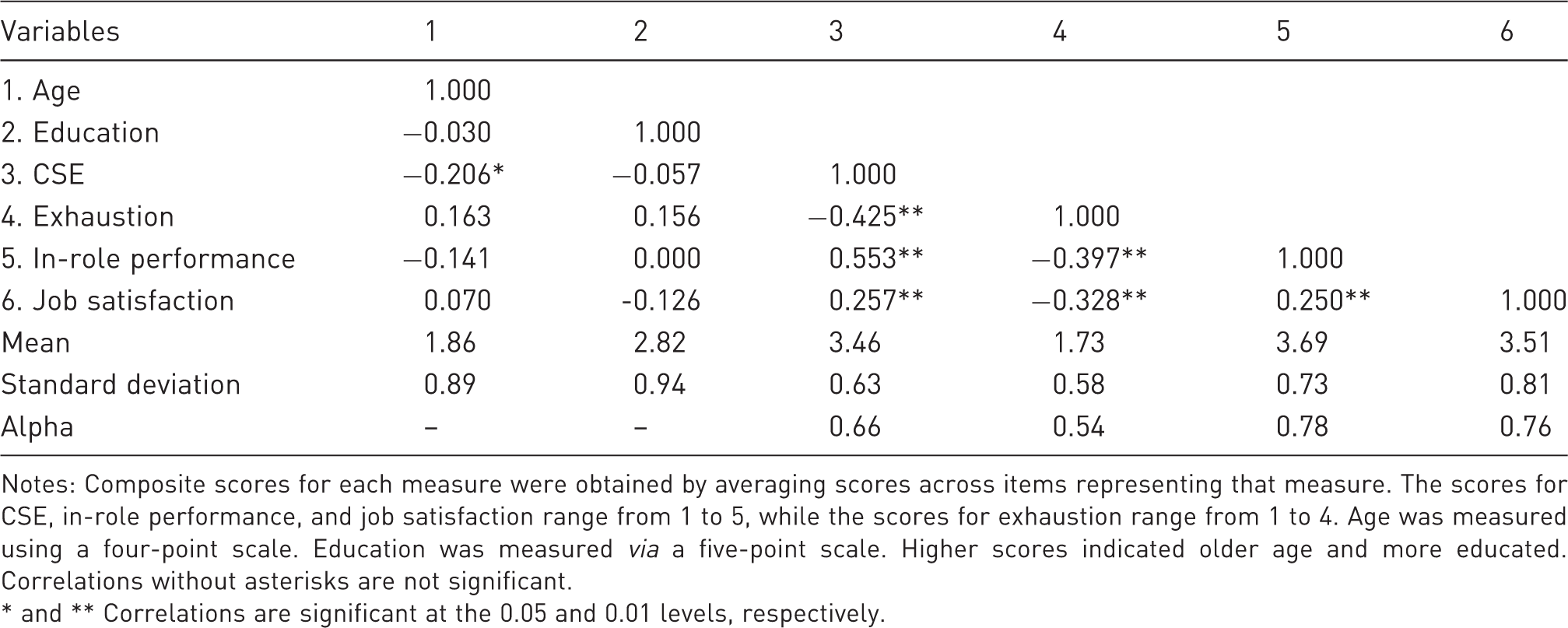
Notes: Composite scores for each measure were obtained by averaging scores across items representing that measure. The scores for CSE, in-role performance, and job satisfaction range from 1 to 5, while the scores for exhaustion range from 1 to 4. Age was measured using a four-point scale. Education was measured via a five-point scale. Higher scores indicated older age and more educated. Correlations without asterisks are not significant.
and ** Correlations are significant at the 0.05 and 0.01 levels, respectively.
Model test results
Model test results
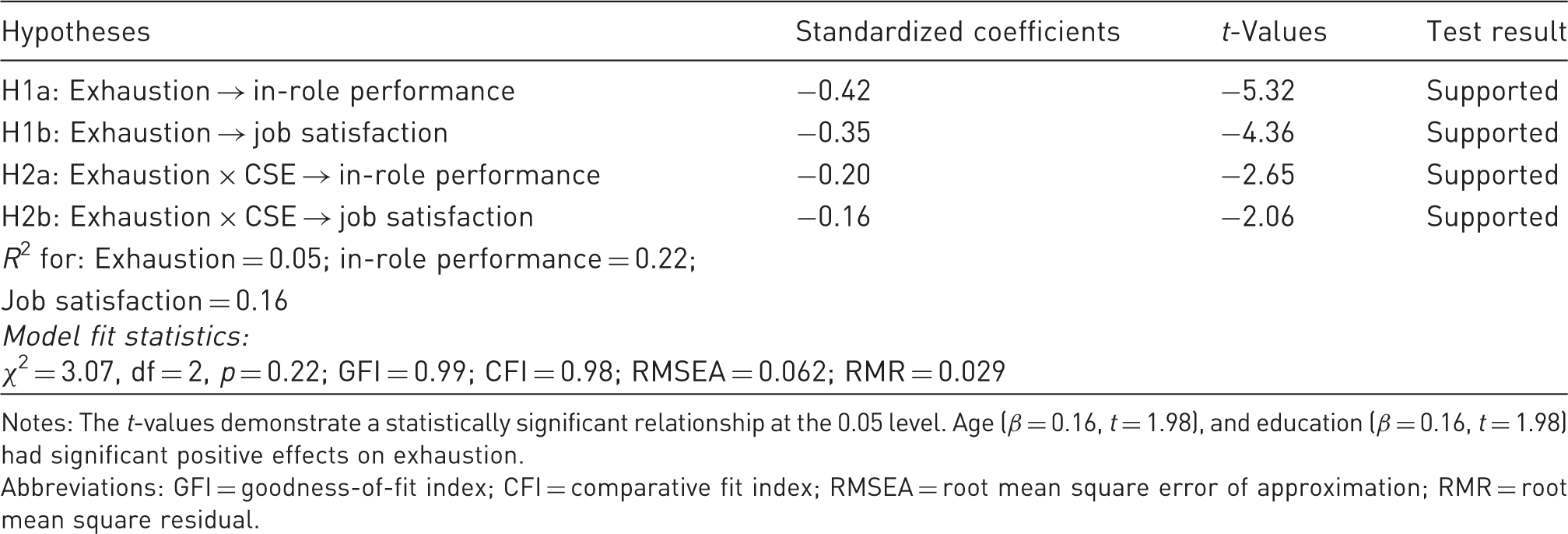
Notes: The t-values demonstrate a statistically significant relationship at the 0.05 level. Age (β = 0.16, t = 1.98), and education (β = 0.16, t = 1.98) had significant positive effects on exhaustion.
Abbreviations: GFI = goodness-of-fit index; CFI = comparative fit index; RMSEA = root mean square error of approximation; RMR = root mean square residual.
The results in Table 2 demonstrate that exhaustion has a significant negative effect on in-role performance (β = −0.42, t = −5.32). Therefore, hypothesis 1a is supported. There is also empirical support for hypothesis 1b, because exhaustion significantly and negatively influences job satisfaction (β = −0.35, t = −4.36).
The results regarding the moderating effects are also shown in Table 2. The results reveal that the interaction of exhaustion and CSE exerts a significant negative impact on in-role performance (β = −0.20, t = −2.65). That is, CSE mitigates the negative relationship between exhaustion and in-role performance. Therefore, hypothesis 2a is supported. The results also indicate that the same interactive variable has a significant negative impact on job satisfaction (β = −0.16, t = −2.06). Specifically, CSE reduces the negative effect of exhaustion on job satisfaction. Therefore, hypothesis 2b is supported.
Discussion
Assessment of findings
Based on data obtained from a sample of full-time frontline hotel employees in Iran, this study investigated CSE as a moderator of the impact of exhaustion on in-role performance and job satisfaction. Also investigated in this study was the effect of exhaustion on in-role performance and job satisfaction. All hypotheses were supported, and several useful findings emerged from this empirical investigation.
First, the results suggest that CSE mitigates the detrimental effect of exhaustion on frontline employees’ in-role performance and job satisfaction. CSE seems to be a viable resource against exhaustion in frontline service jobs. Employees with higher CSE in frontline service jobs see themselves as capable, worthy, and in control of their lives. Therefore, the negative effect of exhaustion on in-role performance is weaker for frontline employees with higher CSE compared to those with lower CSE. This is also valid for the moderating role of CSE on the relationship between exhaustion and job satisfaction. Such results are congruent with the precepts of COR theory (Hobfoll, 2001).
Second, the results suggest that exhaustion influences frontline employees’ in-role performance deleteriously. This finding is important, because there are mixed results across the empirical studies in the hospitality management and marketing literature (Karatepe and Aleshinloye, 2009; Karatepe and Uludag, 2008). The result that exhaustion significantly and negatively influences job satisfaction is consistent with past and recent empirical studies (Karatepe et al., 2009; Lee and Ashforth, 1996). Consonant with COR theory, the results suggest that frontline employees have negative job outcomes (i.e., poor in-role performance and job dissatisfaction), as a result of resource loss and exhaustion.
Management implications
On a practical front, this study provides several useful implications for managers in the hotel industry. First, this study tested the effect of exhaustion on in-role performance and job satisfaction. However, exhaustion can also result in negative outcomes, such as absenteeism, tardiness, and depression. With this realization, hiring employees with higher CSE appears to be important for hotel managers, because acquiring and retaining a pool of employees with CSE helps to reduce the detrimental effects of exhaustion in frontline service jobs. It should be noted that managers should make an objective selection of employees without considering kinship relations in the workplace. This is important for the work environment in Iran, because kinship relations in this country influence management decision processes. In addition, managers should focus on fostering employees’ positive CSE to make sure that their employees can adapt to various challenging work situations (Karatepe et al., 2010a, b).
Second, frontline employees should be trained to learn how to cope with exhaustion. This is significant, because effective and continuous training programs are not widespread in the hotel industry (Karatepe and Aleshinloye, 2009). This is also valid for the hotel industry in Iran (O’Gorman et al., 2007). In training programs, employees can freely provide suggestions regarding the management of exhaustion and undesirable outcomes in frontline service jobs. Trying to obtain feedback from employees may make them valued and less stressed (cf. Netemeyer et al., 2005). On a closing note, mentors provide three categories of functions that are related to vocational support, psychosocial support, and role modeling (Lankau et al., 2006). Accordingly, having mentors in the organization could help employees to deal with problems arising from exhaustion.
Limitations and avenues for future research
As with any empirical research, this study has its limitations. First, the relationships were tested based on cross-sectional data. Using such data does not permit causal inferences. Therefore, in future research, it would be useful for testing the study relationships via longitudinal data. Second, this study also used self-report data to assess the relationships among the study constructs. This practice is prone to common method bias. In this study, common method bias was controlled via Harman’s single-factor test using confirmatory factor analysis. That is, the results showed that common method bias was not a critical threat to the magnitudes of the relationships. Nevertheless, future studies should obtain data from multiple sources to minimize problems emerging from common method bias (Podsakoff et al., 2003).
Third, CSE and exhaustion showed reliabilities below 0.70. In future studies using larger sample sizes would be a potential remedy for improving the internal consistency reliabilities of these measures. Fourth, managements of the hotels did not permit the researcher to collect data directly from frontline employees. If managers had not distributed the questionnaires to employees based on the instructions, it might have created a potential selection bias (Blair and Zinkhan, 2006). With this realization, gathering data directly from frontline employees in future studies would be useful for avoiding such a problem. Fifth, frontline employees in the four- and five-star hotels might be more exhausted than the ones in the other star rated hotels. Therefore, obtaining data from frontline employees of the one-, two-, and three-star hotels would be useful for making a comparison regarding employees’ exhaustion levels among different types of hotels. On a closing note, replication studies with larger samples of frontline hotel employees in Iran and the other similar countries in the Middle East would be fruitful.