






Abstract
This study investigates the effects of rewards and proactive personality on meaning of work and turnover intention. It is theoretically based on Vroom’s Expectancy Theory, which focuses on three components: valence, expectancy and instrumentality. The theory argues that employees are motivated when the following conditions are met. Employees should first see that there is a positive relation between effort and performance, and performance and reward (expectancy). Then, they should accept that the reward is valuable for them (valence). Finally, they should believe that first-level rewards have instrumental effects on second-level rewards (instrumentality). Data were collected through a survey of 224 hotel employees in Turkey. Confirmatory factor analysis was conducted to assess the convergent and construct validity of the measurement model, while multiple regression analysis was used to test the research hypotheses. The results indicate that both non-financial and financial rewards have negative effects on turnover intention, while financial rewards and proactive personality have positive effects on meaning of work. The theoretical and managerial implications are discussed.
Introduction
When employees leave their jobs, their organisation incurs extra costs of recruiting, selecting and training new employees, as well as problems in service delivery while new employees are found, which reduces customer satisfaction (Nazir et al., 2016). Since qualified staff leaving causes many problems (Jun-Cheng et al., 2015), it is essential to retain them (Wei, 2015) so researchers and practitioners are developing various managerial practices to reduce labour turnover (Thomas et al., 2017). According to organisational equilibrium theory, the decision to remain in a job or leave is determined by factors affecting satisfaction in the working environment (Joo et al., 2015), including job security, promotion and training opportunities (Pang et al., 2015), financial incentives, promotional opportunities and external rewards like organisational prestige (Gkorezis and Petridou, 2012).
Proactive people influence their environment (Bateman and Crant, 1993; Horng et al., 2016) and choose work environments that closely match their values and interests (Greguras and Diefendorff, 2010). The interactivity component of the personality trait enables individuals to change their environments rather than be controlled and shaped by it (Liguori et al., 2013). Thus, whereas proactive personalities are more active in identifying and solving problems, less proactive personalities are more passive and adapt to their surroundings rather than change them (Hsieh and Huang, 2014; Zacher, 2013). To develop proactive behaviours in the workplace, organisations must first employ staff with proactive personalities and then provide them with the essential resources to be successful together (Liguori et al., 2013).
Meaning of work is a fundamental human requirement to satisfy individuals’ intrinsic needs, such as reputation or independence (Yeoman, 2014). Thus, attributing great importance to a person’s work leads to comprehensive and effective results (Bassi et al., 2013). However, employees not only develop meaning in their work from their own experiences but also use work meaning in their interactions with social structures and organisations (Ingusci et al., 2016). Some indicators of work meaning (social norms of working rights and obligations, and work centricity) are key determinants of employees’ job searching behaviour (Ingusci et al., 2016).
When a person is choosing a target among various options, rewards generally have a positive effect by increasing the target’s value (Hendijani et al., 2016). Whereas traditionally the financial components of reward were very important for employees, more recently the importance of non-financial components, such as training and development, have been increasing (Schlechter et al., 2015). Organisations use such rewards to increase intended consequences, such as high performance and organisational commitment, and to reduce unintended consequences, such as retirement and poor performance.
Despite the growing literature on meaning of work (Jung and Yoon, 2016; Lips-Wiersma and Wright, 2012), empirical studies on the relationship between this and rewards (Gkorezis and Petridou, 2012), and between meaning and proactive personality remains limited. Likewise, less attention has been paid to the effects of proactive personality on turnover intentions (Allen et al., 2005; Joo et al., 2015; Yang et al., 2011) and the impact of rewards on turnover intentions (Gieter and Hofmans, 2015; Nazir et al., 2016). However, no study has been conducted on hotel businesses to investigate the relationship between the four variables and the mediating role of meaning of work. Therefore, the purpose of this study is to fill this gap in the literature by revealing the effects of financial and non-financial rewards on turnover intentions and meaning of work, and to examine the effects of proactive personality on turnover intentions. The authors believe that the determination of this relationship will contribute to the literature. In addition, it is foreseen that the study will assist hotel managers and provide valuable data for human resources planning.
Theoretical background
Turnover intentions
Employees leave an organisation for two types of reasons: first, voluntarily by their own choice; second, due to the choices of the organisation, such as to reduce staff numbers, which is known as reluctant leaving (Sharma, 2016). Intention to leave an organisation refers to the employee’s emotions regarding the organisation and work before actually leaving. Intention to leave reduces the organisation’s success by decreasing employees’ desired attitudes and behaviours, such as job satisfaction and organisational commitment (Biron and Boon, 2013; Ramalho Luz et al., 2018). Therefore, it is an essential responsibility of an organisation to reduce voluntary leaving and recruit new employees effectively to positions vacated by voluntary leavers. Placing a new employee into these vacated positions imposes financial and non-financial losses, such as demoralisation of remaining employees and disruption of production (Yousaf et al., 2015), and recruitment and training of employees (Nazir et al., 2016). Therefore, essential precautions should be taken to protect the organisation’s human capital during the intention phase before employees leave voluntarily to avoid damaging the organisation’s productivity and competitiveness (Sharma, 2016).
Many factors make employees dissatisfied in organisations. This dissatisfaction causes intention to leave the job (Huang et al., 2017), and employees leave their job at the end of this process. To theorise how employees depart, Mobley’s (1977) seminal model posits that dissatisfaction → thought of quitting → subjective expected utility analysis of the benefits and costs of seeking alternative jobs → search intentions → evaluation of alternative job offers → comparison of job offers with the present job → intention to quit (after choosing a job offer) → actual quitting (Lee et al., 2017).
The most important cost for hotel organisations is their employees because they employ more employees than industrial organisations to provide a wide range of services (rooms, housekeeping, food and beverage, entertainment, etc.) to their customers. However, due to the structural characteristics of hotels (long working hours, low wage levels, limited career opportunities, high job stress, etc.), the turnover rate is very high. Various managerial practices are being implemented in hotels to reduce the high turnover rate, which can be considered as a problem. In particular, it is important to reduce the voluntary quitting by qualified employees.
Research into the antecedents of voluntary turnover intention has determined that it is associated with many factors, including demographic factors like age, marital status and education level (Weng and McElroy, 2012; Yousaf et al., 2015), employees’ understanding of their own competence and emotional commitment (Takase et al., 2014), quality of exchange relationships (Afsar et al., 2018) and career development, career advancement and organisational rewards, which are the three dimensions of career advancement, organisational commitment (Nazir et al., 2016; Weng and McElroy, 2012), distributive justice, procedural fairness and simultaneous justice (Gieter et al., 2012).
Proactive personality traits
Proactive people do not limit themselves to situational constraints but affect environmental change. Individuals who have a proactive personality are more active and comply with environments better those who have some other personality traits. Proactive people take advantage of opportunities, take the initiative and persist until change is achieved. Proactive people identify opportunities and attempt to make them happen, and endure until the change happen. Less proactive individuals become passive and reactive, preferring to adapt to conditions rather than change them (Crant, 2000). Moreover, a proactive personality is a person who, regardless of situational constraints, makes a positive change in his/her environment (Seibert et al., 2001). Woo and Allen (2014) showed that proactive individuals take responsibility to actively seek jobs and take more steps to advance their career while also being more likely to engage in career management and self-improvement activities in their work environments (Shea-Van Fossen and Vredenburgh, 2014). Kammeyer-Mueller and Wanberg (2003) determined that newcomers who reported being proactive tend to have more positive outcomes, are more organised in their tasks and show more group integration. People with proactive personality show more work engagement (Li et al., 2014) and their behaviours advance their careers (Seibert et al., 2001). They are also more creative than other employees (Sears et al., 2018). Therefore, organisations are striving to attract employee candidates with highly proactive personality traits to encourage their other employees to behave more proactively (Liguori et al., 2013). Employees with proactive personality features make significant contributions to organisational efficiency through their proactive behaviours.
According to Parker and Collins (2010), proactive behaviour can be examined in three different ways: the organisation’s internal environment (proactive working behaviour), its external environment (proactive strategic behaviour) and the employees’ adaptation to its environment (proactive person–environment compliance behaviour). While the proactive personality focuses on creating environmental change, their adaptation behaviour focuses on taking control to make this change. In other words, the behaviour does not focus on changing the person’s environment but on self-change.
Individuals with proactive personality traits focus on improving themselves by increasing their job skills and knowledge (Bergeron et al., 2014), and by adopting technological innovations to achieve their vision (Major et al., 2012). Such individuals perceive their role in the organisation more broadly than others (Bergeron et al., 2014). In addition, the interactive element of a proactive personality enables such individuals to transform their environment rather than being influenced by it (Liguori et al., 2013). In the long term, proactive behaviours can be encouraged by appropriate coaching and support in jobs that are redesigned to enable employees to be more autonomous (Parker and Sprigg, 1999). Employees with proactive traits are also more talented than passive employees (Parker and Sprigg, 1999) and do everything they need to perform their functions (Bergeron et al., 2014).
The proactive personality is positively correlated with employees’ current salaries, the number of promotions they receive, career satisfaction (Bajaba et al., 2018; Seibert et al., 1999), work engagement (Kong and Li, 2018; Young et al., 2018), organisational citizenship behaviours (Buil et al., 2019) and job satisfaction (Chung-Yan and Butler, 2011) but negatively correlated with turnover intention (Chung-Yan and Butler, 2011). It has been determined that proactive personalities are positively related to social capital, which reduces voluntary turnover intention (Yang et al., 2011).
Meaning of work
Meaning of work refers to the harmony between an employee’s beliefs, values and behaviours (Manojlovich and Laschinger, 2002), which occurs when the job’s targets correspond to the employee’s own values or standards (Seibert et al., 2004). When meaning of work is low, role conflict and role stress due to overload occurs, which damages employees’ belief in their personal competence (Conger and Kanungo, 1988).
Fourie and Deacon (2015) determined that job purpose and importance are important factors for perceiving meaning of work. There are four fundamental characteristics of work meaning: positive emotional experiences in the workplace, work itself, work meaning and working as part of life (Lee, 2015). High levels of job meaning enable employees to gain positive experiences from work, enhance job performance and work engagement (Wingerden and Stoep, 2018), and increase their contribution to the organisation (Lee, 2015; Spreitzer et al., 1997; Zhang et al., 2018).
Financial and non-financial rewards
Rewards, which are considered part of an organisation’s culture, are used to motivate employees to achieve organisational goals (Aksakal and Dağdeviren, 2014; Foss et al., 2015). Rewards can be classified in various ways, such as financial versus non-financial (Bustamam et al., 2014), or internal social rewards versus external organisational rewards (Mottaz, 1985).
Non-financial rewards are intangible and do not impose monetary costs on organisations or benefit employees financially. Although determining non-financial rewards is harder than identifying financial rewards, they increase the sense of responsibility to the organisation and employee performance, job satisfaction, productivity, organisational effectiveness (Naon, 2010) and creativity (Sears et al., 2018). In the tourism sector, specifically, non-financial rewards have become the primary form used by such organisations to motivate employees due to the increased importance of cost controls (Chiang and Birtch, 2008). An effective reward management system is used as a tool to increase employee motivation and thereby increase service quality. Studies show that there is a relationship between service quality and reward management (Chiang and Birtch, 2008). Using an efficient reward management system to motivate employees encourages them to show preferred behaviours. Non-financial rewards are used to promote the positive attitudes of employees in the workplace and increase job satisfaction (Haider et al., 2015). Financial awards are among the economic factors that provide motivation for employees. Wage increase, wage premium, profit participation of employees is among the important motivational tools that drive employees to more level performance (Dobre et al., 2017; Örücü and Kanbur, 2008). Besides solving economic problems, employees tend towards professions that provide them with more income owing to motivational tools. In other words, there is a positive and significant relationship between financial rewards and turnover intention (Gieter and Hofmans, 2015; Olawale and Olanrewaju, 2016).
Establishing an effective reward management system, and basing it on reciprocity policy and supporting information sharing in the organisation, increases employee satisfaction (Lai, 2009). Regarding reward management systems, financial rewards affect external motivation whereas non-financial awards increase internal motivation (Güngör, 2011). In addition to employee satisfaction based on financial rewards, attitudes and behaviours in the workplace are also affected by non-financial rewards (Gieter and Hofmans, 2015; Halilbegovic et al., 2018). Employees in organisations with high organisational support and high career development opportunities, are happier, have greater work commitment (Wang and Yang, 2016) and higher productivity (Whitaker, 2009), thereby increasing organisational flexibility and success (Aksakal and Dağdeviren, 2014).
Research reveals that reward perceptions vary depending on demographic characteristics, such as age, education level, work experience, marital status and household size (Naon, 2010). For example, older employees (50–59 years) prefer non-financial rewards, such as recognition by their managers, task diversity, job security and more flexible working hours, more than younger ones (20–29 years) (Bonsdorff, 2011). Additionally, non-financial rewards, such as approval, autonomy and job security motivate lower-level employees more (Harunavamwe and Kanengoni, 2013). Finally, non-financial rewards motivate women workers more than men (Schlechter et al., 2015).
Hypothesis development
The possibility of losing existing financial and non-financial gains motivates employees (Akgunduz and Sanli, 2017). It is possible to explain the effect of rewards on turnover intention through Vroom’s Expectation Theory, which is a process theory. According to this theory, the effort that the employee makes depends on valence, expectation and instrumentality. Valence is the degree of desire of an employee to gain a reward from the effort. A particular reward may be desired in different ways by different employees. That is, while different employees strive for a particular reward, some others reduce their effort by judging that it is not worth making the effort for this reward. The second important element of the theory, expectancy, is the employees’ perception that they will be rewarded for a certain effort. If they believe that they will be rewarded, they will show effort. Regarding instrumentality, the result of the employee’s performance is the first step result while the result that an employee obtains from the first step result is called the second step result. Depending on the increase in performance, an employee’s promotion or salary increase is evaluated as the first degree whereas a rise in status as a result of this promotion and salary increase is the secondary result. If employees have a strong sense of valence, expectation and instrumentality then their motivation to work will increase.
According to Vroom’s Expectation Theory, employees’ tendency to show a certain behaviour depends on the attractiveness of the outcome of that behaviour and the perceived likelihood of gaining that outcome. If the importance of rewards for employees increases then desired behaviours (job satisfaction, organisational citizenship behaviour, etc.) will become more likely, whereas undesired behaviour (turnover, presenteeism, absenteism, etc.) will become less likely. Given that wages paid in most sectors and organisations are insufficient to meet employees’ minimum living standards, they become more dependent on rewards that enable them to satisfy their individual and social needs. Various studies have demonstrated that rewards reduce an employee’s intention to leave their job (Ahmad, 2018; Bhatnagar, 2014; Mendis, 2017; Salminen et al., 2016). That is, voluntary turnover intention should decrease as employees pay more importance to the rewards offered by the organisation. This leads to the following specific hypotheses for this study:
H1. Rewards reduce hotel employees’ turnover intentions. H1a. Financial rewards reduce hotel employees’ turnover intentions. H1b. Non-financial rewards reduce hotel employees’ turnover intentions.
Individuals with proactive personalities are open to innovation, resistant to stress, have high self-efficacy perceptions and experience less work-related anxiety about their work than individuals with different personality traits (Han et al., 2014). Such individuals also demonstrate risk-taking and novelty-seeking behaviour in their working life. When employees work in a job for a long time, when their current tasks become boring, or when they have an opportunity to find a better job, they may voluntarily leave by accepting the risk of searching for novelty. Thus, employees with proactive personality traits are more likely to show intention to leave their job, as in the following hypothesis:
H2. Proactive personality traits increase employees’ turnover intentions.
According to Vroom’s Expectation Theory, an employee’s success is generally a function of rewarded behaviour, so employees should desire this reward and believe that their efforts will help to achieve the expected success (Eren, 2013). Therefore, both internal and external factors should be used to motivate employees and reinforce positive behaviours. Internal factors include allocating responsibility to employees, supporting personal development, allocating work according to competencies and being appreciated by supervisors, whereas external factors include job security, salary, rewards, working conditions, company policies, safety and working conditions (Eren, 2013; Lundberg et al., 2009).
Vroom’s Expectation Theory focuses on three relationships: effort-performance, performance-reward and reward-personal goals. Regarding the relationship between rewards and personal goals, it is possible to explain the effect of the rewards on job meaning. Meaning of work increases as the power of rewards to meet the employee needs or attract employees increases (Robins and Judge, 2011). This theory assumes that employees work more and show better performance when they are motivated. While high performance increases rewards, rewards also satisfy esteem needs (Nimri et al., 2015). Studies show that the rewards increase the level of work meaning (Lips-Wiersma and Wright, 2012). Thus, according to Expectancy Theory, if organisations offer both financial and non-financial rewards that employees find valuable then meaning of work should increase, as in the following hypotheses:
H3. Rewards increase employees’ meaning of work perceptions. H3a. Financial rewards increase employees’ meaning of work perceptions. H3b. Non-financial rewards increase employees’ meaning of work perceptions.
Employees with a proactive personality make an active effort to reorganise their work life (Campbell, 2000) because they do not give up in the face of challenges and can take the initiative (Liguori et al., 2013). Such employees try to take jobs and position themselves in organisations where they can carry out tasks with a high meaning of work.
These individuals also take risks, if necessary, to find new jobs aligned with their personality traits (Bergeron et al., 2014). Therefore, in accordance with the explanations given above, hotel employees with proactive personalities will give greater value to the meaning of work, as in the following hypothesis:
H4. Proactive personality traits increase the meaning of work.
Methodology
Sample and procedures
The research was conducted in five-star hotel businesses in İzmir City Centre. According to information provided by the Directorate of Culture and Tourism, there were six five-star hotels in İzmir City Centre in 2016, with a total of 1612 rooms and 3240 beds. Firstly, information about the purpose and scope of the research was given to the human resources departments of each hotel. Three hotels refused to participate because the survey included questions about financial and non-financial rewards, while two hotel managements agreed to participate. There were 621 rooms and 1250 beds in these two hotels, which did not want to give information about their staff numbers. One was a business hotel, while the other was a resort hotel. Based on Turkish standards of 0.80 employees per room per bed (Çakıcı and Yılmaz, 2012), the average number of personnel, namely the universe, was estimated as 497 employees.
The researchers visited the hotels and conducted field research on the days and hours allowed by the hotel management. As every employee who was reached in this process wanted to be included in the survey, non-probabilistic convenience sampling was preferred, with 234 questionnaires administered face to face at the two hotels that volunteered to participate. Ten responses were deleted due to disqualification (n = 6) or incompletion (n = 4), leaving 224 completed questionnaires for coding and analysis.
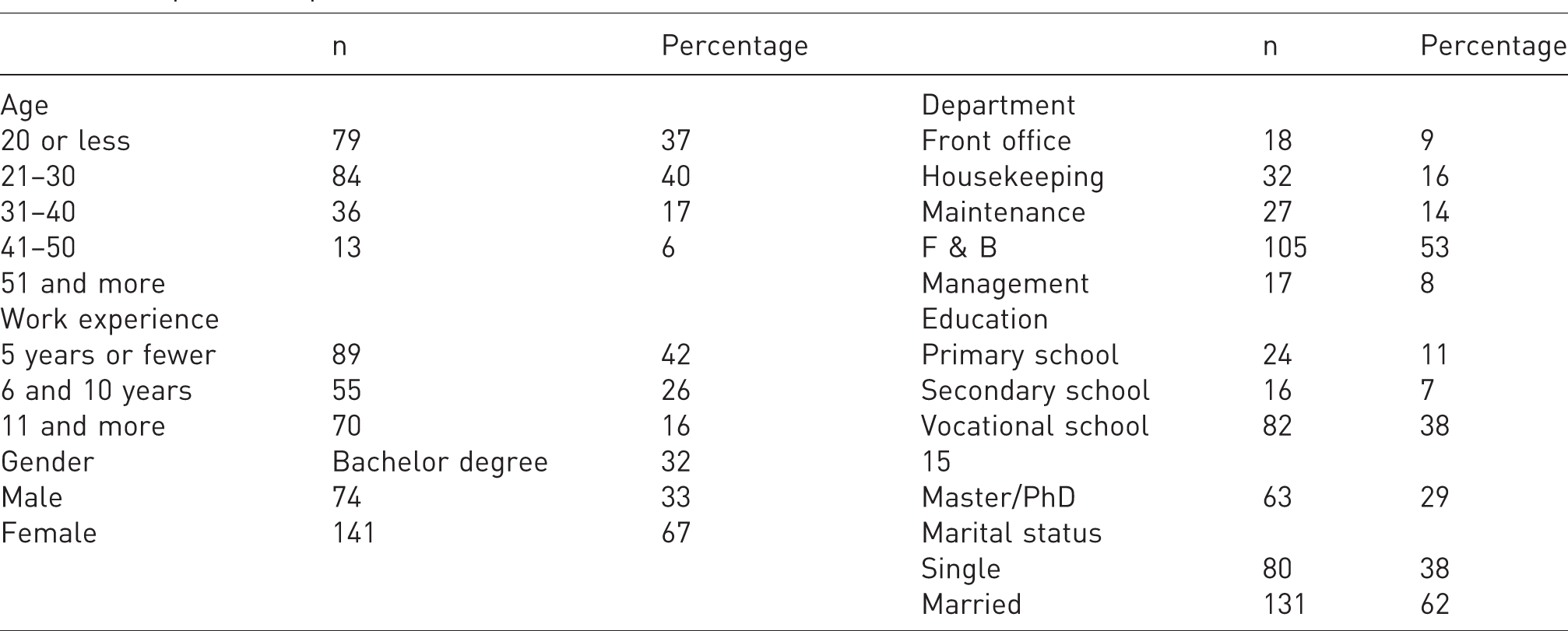
A majority of participants, of whom 53% worked in F & B, were women (67%) and married (62%), while 40% of the participants’ ages ranged between 26 and 35, 42% had less than five years of professional experience and 38% had vocational school education (Table 1).
Respondents’ profile.
Measures
The questionnaire had four parts, except demographic questions. The first part used the 18-item Financial and Non-Financial Rewards Scale, developed by Bustamam et al. (2014). The second part was the 10-item Proactive Personality Scale of Bateman and Crant (1993). The third part used the 3-item Turnover Intention Scale, developed by Wayne et al. (1997). The fourth part was the 3-item Meaning of Work Subscale from the Psychological Empowerment Scale, developed by Spreitzer (1995). All questionnaire scale constructs were measured using a five-point Likert scale, ranging from ‘strongly disagree’ to ‘strongly agree’. Questionnaire items are shown in Table 2. The first part collected demographic information (age, gender, marital status, education and department).
Confirmatory factor analysis.
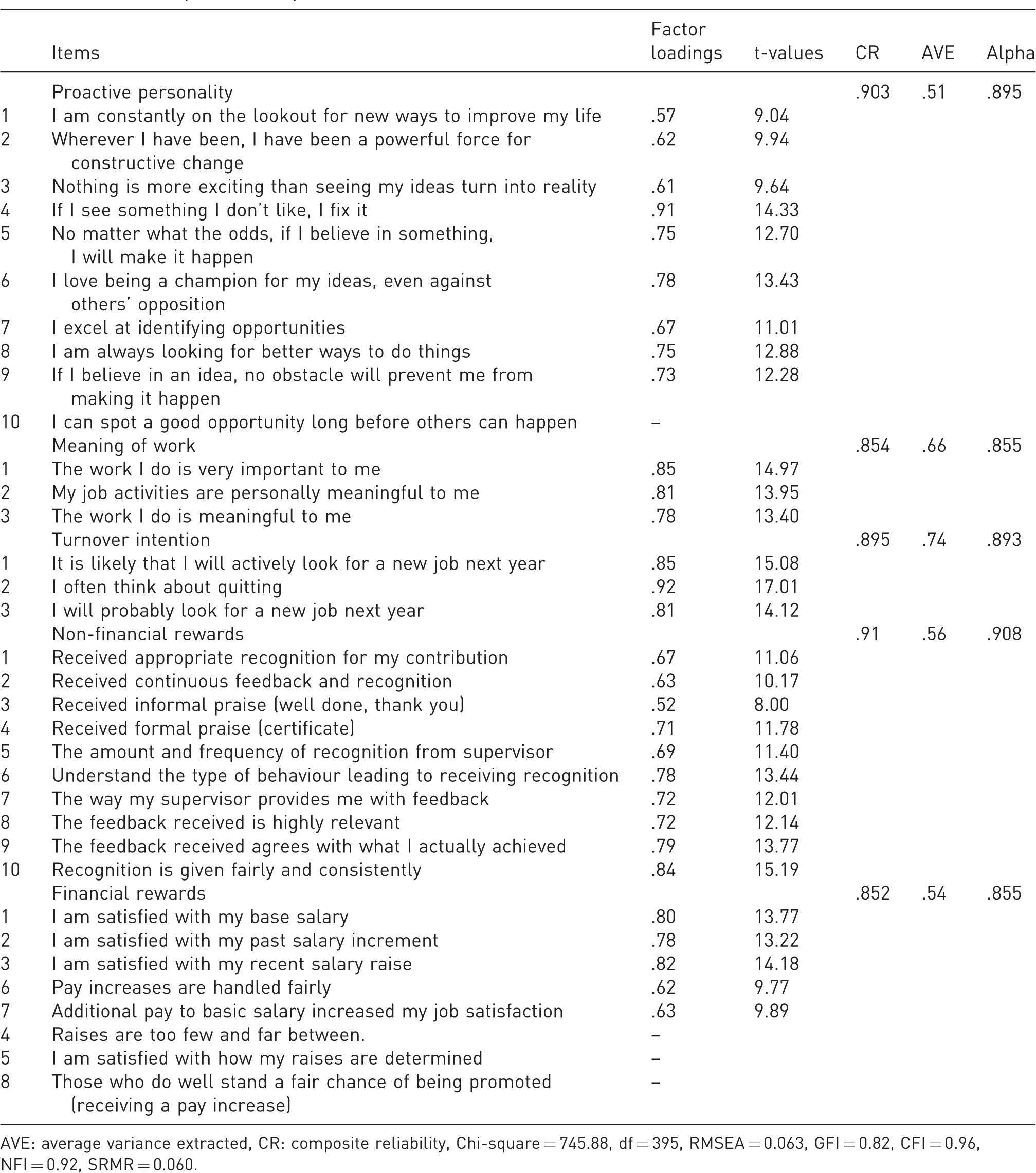
AVE: average variance extracted, CR: composite reliability, Chi-square = 745.88, df = 395, RMSEA = 0.063, GFI = 0.82, CFI = 0.96, NFI = 0.92, SRMR = 0.060.
The questionnaire was first written in English before translation into Turkish in collaboration with two native English speakers working in the tourism industry. Back-translation was conducted to reduce the possibility of translation bias, as suggested by Van de Vijver and Hambleton (1996).
Data analysis
Confirmatory factor analysis (CFA) was used to test validity and reliability, while multiple regression analysis was performed to test the proposed hypotheses. Firstly, CFA was conducted to assess the convergent and construct validity of the measurement model. The initial CFA was performed with a five-factor measurement model (meaning of work, turnover intentions, proactive personality, non-financial rewards and financial rewards). From this analysis, one item for proactive personality and three items for financial rewards were deleted because the loadings were less than 0.40 (Hair et al., 2010). Statistics for the final measurement model, namely goodness of fit index (0.82), normed fit index (0.92), comparative fit index (0.96), standardized root-mean square residual index (0.060), and X2/df (1.89), indicated that the model met the suggested goodness-of-fit criteria. Table 2 shows factor loadings, t-values, CR, Cronbach’s alpha, and average variance extracted (AVE) values, while Table 3 presents means, standard deviations and correlations.
Discriminant validity – means, correlation analysis.
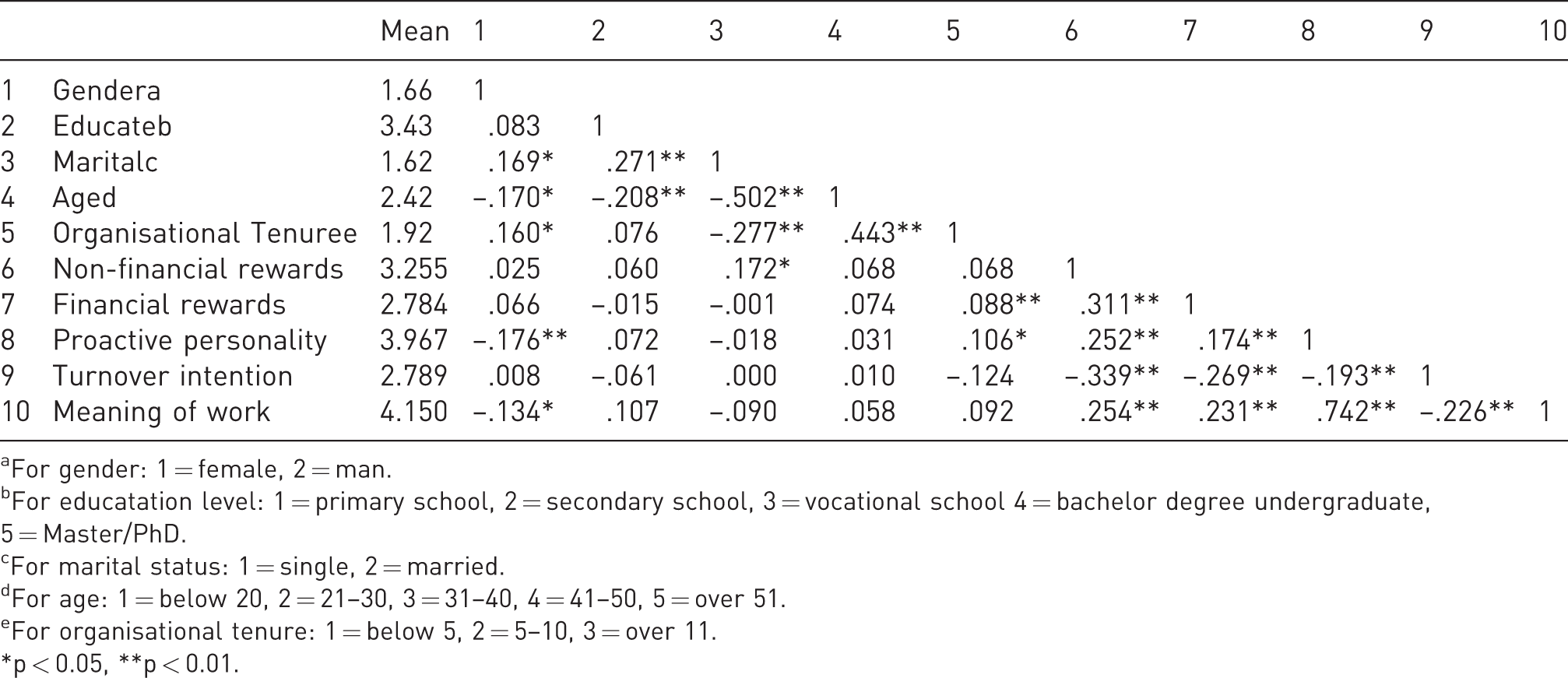
For gender: 1 = female, 2 = man.
For educatation level: 1 = primary school, 2 = secondary school, 3 = vocational school 4 = bachelor degree undergraduate, 5 = Master/PhD.
For marital status: 1 = single, 2 = married.
For age: 1 = below 20, 2 = 21–30, 3 = 31–40, 4 = 41–50, 5 = over 51.
For organisational tenure: 1 = below 5, 2 = 5–10, 3 = over 11.
*p < 0.05, **p < 0.01.
As Table 2 shows, all constructs in the research model were statistically acceptable. Composite construct reliabilities were greater than 0.70. AVE was above recommended values (AVE > 0.50). Cronbach’s alpha ranged from 0.852 to 0.910, implying a high internal consistency among the variables within each factor (Nunnally, 1978). The standardised factor loadings of the five constructs varied between 0.52 and 0.92, and t-values were 8.00 and 17.01 (Table 2).
Fornell and Lacker (1981) argue that, for discriminant validity, the square root of AVE should be higher than the inter-structure correlation value. As Table 3 shows, the square roots of AVE for the structures were greater than the correlation values between the structures, except for proactive personality. Thus, it is reasonable to conclude that both convergent and discriminant validity were obtained in the current study.
Examination of the correlations in Table 3 demonstrates that non-financial rewards were significantly correlated with financial rewards (r=.311), proactive personality (r = 0.252), turnover intention (r = −0.339) and meaning of work (r = 0.254). Financial rewards were significantly correlated with proactive personality (r = 0.174), turnover intention (r = −0.269) and meaning of work (r = 0.231). Proactive personality was significantly correlated with turnover intention (r = −0.193) and meaning of work (r = 0.742). Turnover intention was significantly correlated with meaning of work (r = −0.226).
Hypothesis tests
The effects of the independent variables (financial rewards, non-financial rewards and proactive personality) on the first dependent variable, turnover intention, were determined by multiple regression analysis (Table 4). The results show that non-financial rewards (β = −0.404, p < 0.001) and financial rewards (β = −0.218, p < 0.01) had significant negative effects on the turnover intentions of hotel employees, whereas proactive personality had no significant effect. The equation for this relationship can be written (with a constant of 5.252) as
Multiple regression analysis of determinants of turnover intention.
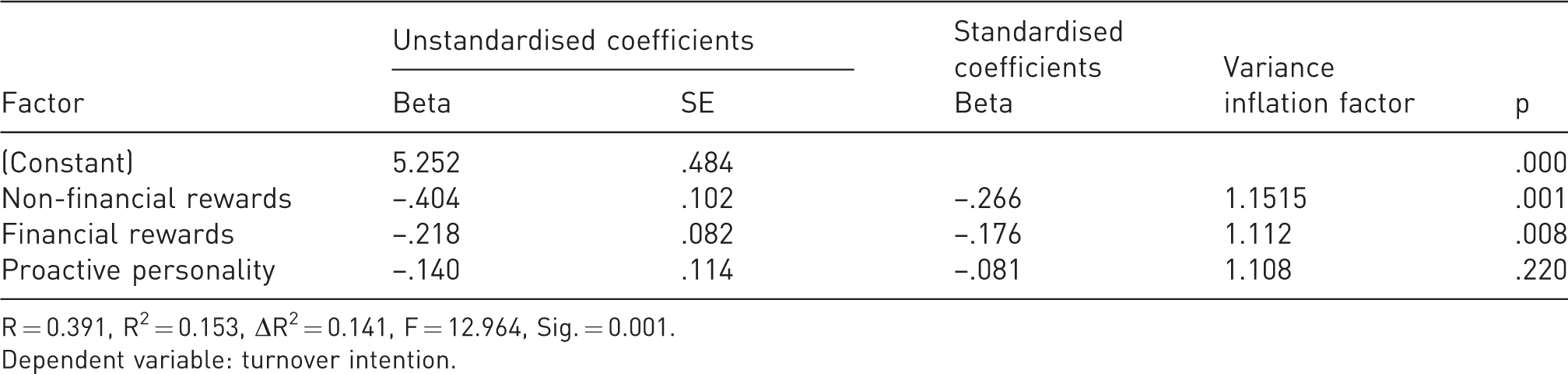
R = 0.391, R² = 0.153, ΔR² = 0.141, F = 12.964, Sig. = 0.001. Dependent variable: turnover intention.
Together, the three independent variables (non-financial rewards, financial reward and proactive personality) explained 14% of the variance in the dependent variable (turnover intentions).
The effects of the same three independent variables on the second dependent variable, meaning of work, was also determined by multiple regression analysis (Table 5). The results show that financial reward (β = 0.076, p < 0.05) and proactive personality (β = 0.808, p < 0.001) had significant positive effects on meaning of work, whereas non-financial rewards had no significant effect. The equation for this relationship can be written (with a constant of 0.607) as
Multiple regression analysis of determinants of meaning of work.
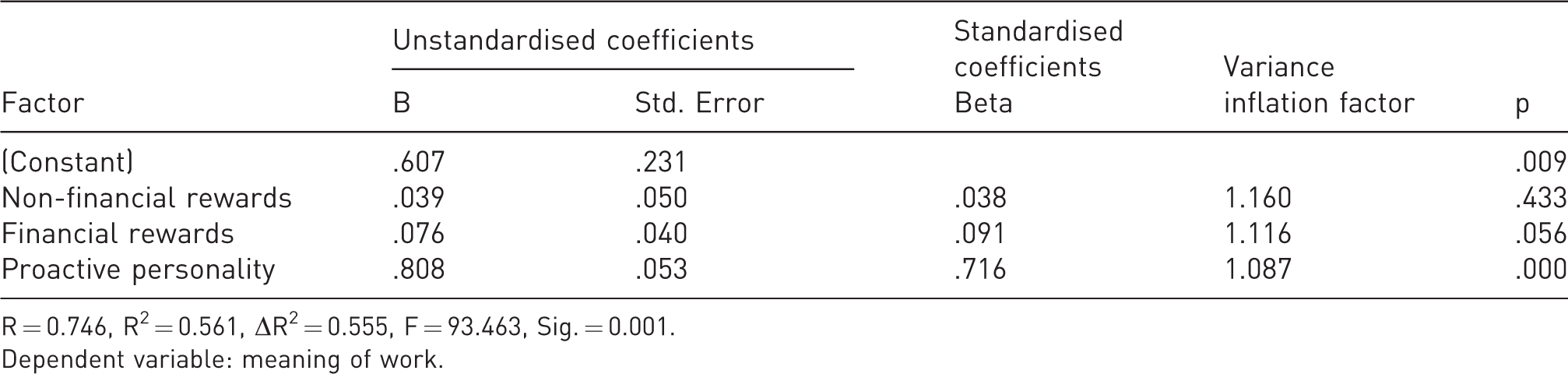
R = 0.746, R² = 0.561, ΔR² = 0.555, F = 93.463, Sig. = 0.001.Dependent variable: meaning of work.
Together, the three independent variables explained 56.1% of the variance in the dependent variable (meaning of work).
Discussion
This study, theoretically based on Vroom’s Expectancy Theory, investigated whether financial and non-financial rewards, and proactive personality traits affect hotel employees’ turnover intentions and meaning of work. The first prediction, that both financial and non-financial rewards reduce turnover intention, was supported. That is, if employees believe that they can obtain financial and non-financial rewards within their current organisation then they are less likely to intend to leave. The second prediction, that proactive personality traits increase turnover intention, was not supported.
The third prediction, that both financial and non-financial rewards increase the perceived meaning of work, was only partially confirmed. Whereas financial rewards increased meaning of work, non-financial rewards had no effect. Fourth, the prediction that a proactive personality increases the meaning of work was supported. In other words, if employees are proactive then they find their work more meaningful.
Theoretical contribution
This study has demonstrated that both financial and non-financial rewards decrease employees’ turnover intentions, which supports previous findings from Gieter and Hofmans (2015) and Cao et al. (2013), who claimed that if employees acquire financial and non-financial rewards that they regard as valuable, they are less likely to intend to leave. The present study also proves that organisations should offer both financial and non-financial rewards to encourage valuable employees to continue to work there. Contrary to expectations, however, this study found no evidence that proactive personality traits significantly influence employees’ turnover intentions. This implies that intentions to leave a job cannot be predicted from the proactive personality traits of employees. This contradicts the findings of both Ariyabuddhiphongs and Marican (2015) and Osman et al. (2016), who reported that personality traits have a significant effect on employees’ intention to leave.
The present study showed that proactive personality traits increase meaning of work, which confirms the findings of Kanten and Er Ulker (2012). It also supports previous arguments (Karatepe, 2009; Tian et al., 2014) that employees with proactive personality traits are open to different work experiences until they find a meaningful job, and that they prefer to work in jobs that are valuable to them.
This study also revealed that meaning of work increases if employees can gain financial rewards, which confirms earlier findings by Saleem (2011) and Nujjoo and Meyer (2012), who determined that financial gains increase employees’ positive attitudes and behaviours towards their organisation. This finding also shows that financial rewards are important for employees, and these rewards are primary reason for employees to be the part of their organisation. The last finding is that, contrary to our predictions, non-financial rewards have no statistically significant effect on work meaning. This indicates that organisations cannot reduce their employees’ turnover intentions by applying non-financial rewards.
Practical implications
The success of organisations in the hotel businesses is directly related to customer satisfaction, which in turn requires the recruitment and retention of qualified employees. To encourage qualified employees to stay, managers should implement various strategies. As this study has demonstrated, both financial and non-financial rewards can increase employees’ intentions to remain in their jobs. Financial rewards may include determining a fair salary level, offering performance-related bonus payments, and increasing employees’ beliefs that they will receive the wages they are entitled to, both today and in the future. Non-financial rewards to reduce intention to leave can include letting employees know which behaviours are appreciated by their managers, official appreciations like appreciation and valuation, and unofficial appreciations like thanking and giving feedback about their performance. The critical point is that managers should only appreciate employees if they really deserve it. Otherwise, others may conclude that the employee was praised because they are favoured by managers rather than for their performance.
The present study suggests that financial rewards increase employees’ meaning of work perceptions. For managers, this implies that if employees are satisfied with their financial rewards then their work will increase in importance. Employees who perform a meaningful job will increase their performance to continue doing this meaningful work for a long time and will work harder to contribute to organisational productivity. Managers should therefore provide salaries on time and distribute any bonus payments fairly. By doing this, managers can increase the perceived meaningfulness of the work, which in turn can decrease employees’ intentions to leave the organisation.
According to recently announced official statistics, Turkey’s unemployment rate is over 11.6% for October 2018 (tuik.gov.tr), and unemployment is probably higher in the tourism sector, especially in hotel businesses, which are a seasonal activity. These employees may want to work in organisations where equitable wages are paid on time rather than in organisations to gain increased income. If wages in the hotel businesses are below the level needed for employees to make a living lower than middle and lower level then employees are likely to change their jobs, even their profession, if they find an alternative job opportunity. Non-financial rewards often relate to secondary needs, such as love and respect. Therefore, it is necessary firstly to improve the financial rewards so that employees in the hotel businesses can meet their primary needs.
Entrepreneurs and managers who want to survive and increase the profitability of hotel businesses tend to suppress their employee costs. However, it is nearly impossible for employees who do not earn enough to meet even their basic needs to satisfy their customers. Although profits may increase when employees’ salaries are kept low, this leads the employees to contribute less to customer satisfaction, which will eventually cause profits to decrease. Hotel managers should therefore satisfy their employees by paying at least the average industry salary to maintain their organisation’s profitability. Qualified and valuable employees will provide more customer satisfaction if they remain in the organisation voluntarily. The findings of this study show that employees who have proactive personality characteristics consider their work meaningful. Nowadays, hotel managers almost always conduct personality tests to determine the suitability of job candidates to meet job requirements. Personality traits often provide clues about how candidates behave in general, their work attitudes, emotional inconsistencies, desire for socialisation and tendency to cooperate. This study shows that when hotel managers recruit employees with proactive personalities, they gain workers who are sincere, seek change, wish to follow their dreams and believe in the value of their work. Because such individuals are trying independently to find meaningful and valuable tasks and work, they may even leave the organisation to avoid meaningless or worthless tasks. Therefore, the organisation can benefit if hotel managers give responsibility to employees for meaningful work to increase their willingness to stay and improve their performance.
Limitations and future studies
There are several limitations to this study. First, it is difficult to generalise the findings since data collection was limited to five-star hotels in Izmir. Further studies can explore other types of hotels, such as resorts and boutique hotels, in different cities (Antalya, Istanbul or Ankara). Such findings would allow more generalisation and comparisons between different regions and hotel types. Lastly, this study only examined rewards, proactive personality traits, turnover intention and meaning of work from the perspective of employees. However, rewards and meaning of work could also be studied from the perspective of managers.
Footnotes
Declaration of Conflicting Interests
The author(s) declared no potential conflicts of interest with respect to the research, authorship, and/or publication of this article.
Funding
The author(s) received no financial support for the research, authorship, and/or publication of this article.