






Abstract
Lexical research is a fundamental part of studying the Khitan scripts and their underlying language. This article examines selected lexical items from the Epitaph of Yelü Yugulin Taishi through comparative philology and textual analysis. Building on established decipherments, it clarifies the meanings of targeted terms and explores their etymological origins. The study aims to interpret obscure expressions in the epitaph, provide lexical references for its in-depth comprehension, and contribute to research on the genetic affiliation between Khitan and related languages.
Introduction
Since the discovery of Khitan-script epitaphs in the 20th century, significant progress has been made in the study of the graphology, phonetics, semantics and grammar of texts written in the Khitan Large and Small Scripts. Nevertheless, due to the complexity of these writing systems and the fragmentary nature of extant materials, numerous lexical items remain unclear, and etymological research remains underdeveloped.
Dated to 1051 AD, as the earliest known inscription in the Khitan Small Script, the Epitaph of Yelü Yugulin Taishi (hereafter Lin) has an exceptional historical and philological importance. It complements the accounts of the History of Liao (Liao shi) and preserves a treasury of Khitan vocabulary that illuminates the language's semantic structure and its genetic connections with Altaic languages. Despite its significance, systematic lexical and etymological studies of the Lin remain scarce. Aisin Gioro and Yoshimoto (2012) reconstructed its genealogy and summarized its content; however, rubbings and the complete Khitan text have not yet been published.
Against this background, this article examines selected lexical items in the Lin using comparative philology. Building on previous decipherments, it cross-references Khitan inscriptions with contemporary Chinese historical sources to interpret obscure terms and trace their etymologies. It aims to clarify the meanings and origins of selected words, fill gaps in the lexical analysis of the Lin, and lay groundwork for a more comprehensive interpretation.
The second line of the Lin records the expression  <ci-i-is t-ém-ci-er>1 in reference to the compiler. The first word
  <ci-i-is > has been interpreted in previous studies as xie 血 ‘blood’ or qinshu 亲属 ‘kin’. The second word
  <t-ém-ci-er > appears for the first time in Lin. By examining morphologically related forms sharing the same root, the usage of
  2 <d-ém-ci-er>,
  <t-ém-ci-ñ>, and
  <t-ém-ci-én > is illustrated in the following examples:
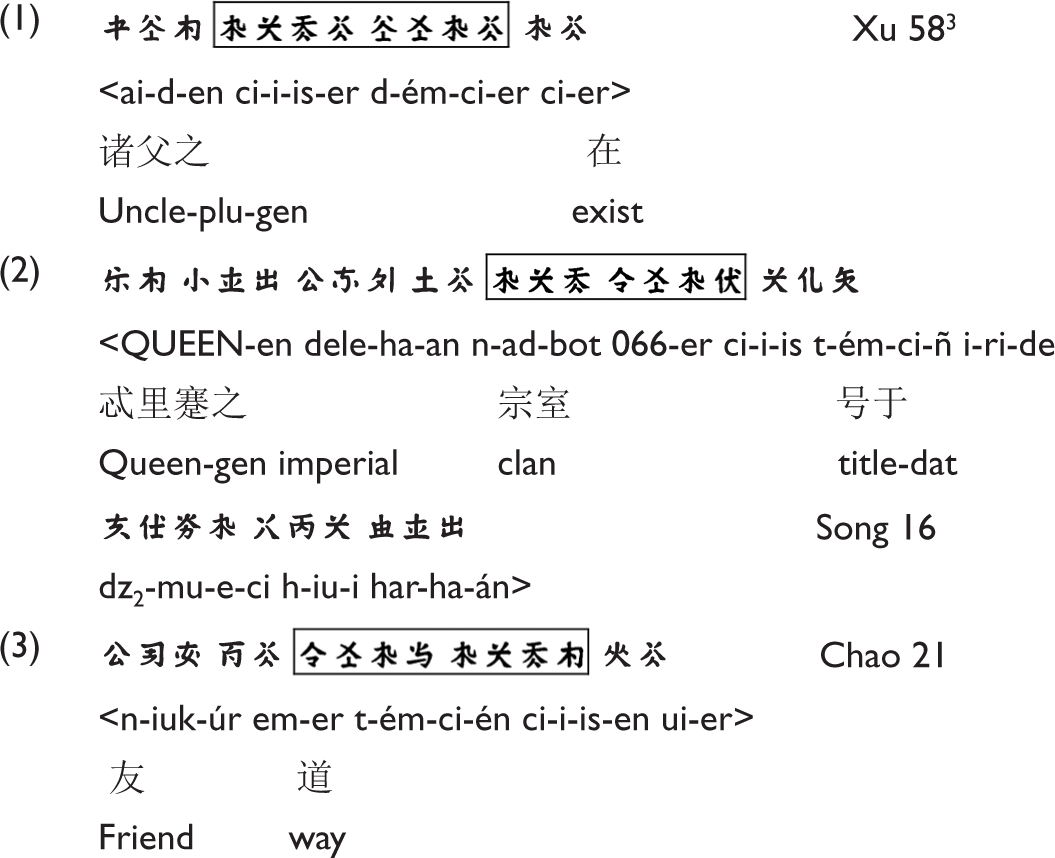
Contextual evidence reveals that all forms derived from the same root, such as  <d-ém-ci-er>,
  <t-ém-ci-ñ>, and
  <t-ém-ci-én>, occur together with
  <ci-i-is> ‘blood’ or ‘kin’. These collocations point to a meaning related to ‘lineal or blood transmission’, comparable to the Mongolian term ᠳᠠᠮᠵᠢᠬᠣ dɑmǰixu, and thus suggest a possible cognate relationship.
Another related term,  <t-ém-ra-ú>, first appears in line 4 of the Lin, describing the son of Xinian Nieli, the ninth–generation ancestor of the owner of Lin:

In my previous work (Bai, 2024, 2025), I interpreted this passage as: ‘Transmitted to the descendants’ generation, there are five attested Changwen’. The phrase
 <p-on-en n-on t-ém-ra-ú> means ‘transmitted to the descendant's generation’, comparable to the Mongolian ᠦᠶᠡ ᠳᠠᠮᠵᠢᠬᠤ üy-e dɑmǰixu. Notably,
  <t-ém-ra-ú> and
  <t-ém-ci-er>, derive from the common lexical base
  <t-ém>.
Line 1 of Lin contains  <p-a-ar p-in tau jau>, meaning ‘a fief of five hundred households’, a reading established in earlier scholarship. While some epitaphs specify the exact number of households granted, Lin records only nominal feudal allotments rather than actual fiefs conferred on the epitaph's owner.
The collocation  <p-a-ar p-in> typically denotes shiyi 食邑 ‘fief’ or ‘household’, although its etymology remains uncertain. In early Chinese usage, shiyi 食邑 (also caiyi 采邑, caidi 采地, fengdi 封地) refers to landed estates granted by rulers to ministers and nobles.
The independent meaning of  <p-a-ar> is hitherto unknown.4 In related Mongolic languages, the root *bari- signifies ‘to take’ or ‘to grasp’. In Mongolian, cognates such as ᠪᠠᠷᠢᠴᠠ bariča or ᠪᠠᠷᠢᠴᠠᠭᠠ baričaɣ-a denote ‘pledged property, tribute property or horses’, and the phrase ᠪᠠᠷᠢᠴᠠᠭᠠ ᠪᠠᠷᠢᠬᠣ baričaɣ-a barixu ‘to offer tribute’ is semantically close to ‘fief’. Chinggeltei (2010) classifies the glyph
  <ar> as a verbal adjective. I suggest that
  <p-a-ar>, which ends in
  <ar>, may also function as a verbal adjective, parallel to Mongolian ᠪᠠᠷᠢᠭᠰᠠᠨ bariɣsan ‘that which has been seized’.
Regarding the second word Jue buxi huozhi, di zhi qipin, ci gonghu shi.玦不喜貨殖, 帝知其貧, 賜宮戶十。[Jue disdained commerce and trade; aware of his destitution, the Emperor bestowed upon him ten palace households.] <p-in>, Wu (2012) identifies it as gonghu 宫户 ‘palace household’, supported by a parallel in the History of Liao (Vol. 91, Biography of Yelü Jue):
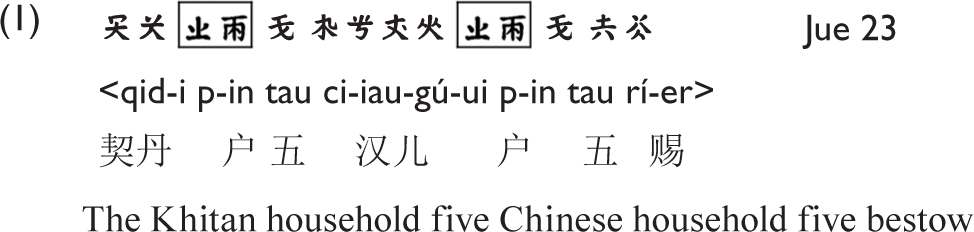
Beyond gonghu 宫户 ‘palace household’,  <p-in> can also signify yi 邑, ‘district’ or fang 房 ‘household’. For example:

Etymologically, no Mongolic term closely matches  <p-in> in the sense of ‘palace household’ or ‘district’. However, the Turkic noun *ǟv ‘house, dwelling’ resembles
  <p-in> in sound and meaning. Clauson (1972) records the Old Turkic ǟv as: ‘basically “dwelling place”, with the particular connotation of a separate dwelling place; the exact meaning: “tent, house”, etc’. This aligns with ‘palace household’ or ‘city/district’ in Khitan usage.
In conclusion,
 <p-a-ar> in
  <p-a-ar p-in> functions as a participle, semantically close to Mongolian ᠪᠠᠷᠢᠭᠰᠠᠨ bariɣsan ‘seized’, and should be regarded as a Mongolic cognate. Although the Turkic genitive form ävin (from ǟv) resembles
  <p-in> phonosemantically,
  <p-in> is best treated as a native Khitan lexeme.
Line 6 of the Lin records the name of Empress Zhaolie, consort of Suzu, as  <n-ra-qo ci-ô-SMALL-ñ>. The second word
  <ci-ô-SMALL-ñ>, corresponds phonetically to the name Zhuozhen 卓真 recorded in historical sources. Previous research confirms the first glyph
  as
as  , the second glyph
  as ʊ, and the last glyph
  as n. The pronunciation of the third glyph
  remains a matter of scholarly debate. Wang (1986) reconstructed
  as əbug; Ji Shi (1994) believed that the
  corresponds to xiao 小 or shao 少 ‘young, junior’, as in xiao wengzhang 小翁帐 or shao fuzhang 少父帐 ‘of the lineage of the junior’, and he reconstructed
  as [ɔtʻ], based on the Mongolian word [ɔtʻkɔn] meaning ‘youngest’. Synthesizing these views, Chinggeltei (2002) suggested that
  represents ‘small’, assumed its pronunciation as baɣ (bag), and proposed the glyph
  as ba.
The first two glyphs  ʧʻ∼ʧ-ʊ clearly correspond to zhuo 卓. The last two glyphs must correspond to zhen 真. According to Pulleyblank (1991), Middle Chinese zhēn 真 is reconstructed as:

When transcribing the Chinese character zhen 真, the final glyph  stands for the consonant n. Therefore, the glyph
  must contain the sound ʧʻ∼ʧ. It is important to observe that in Khitan terms meaning ‘order, repair’ (starting with
  ), the glyph
  and glyph
  <ji> are interchangeable:
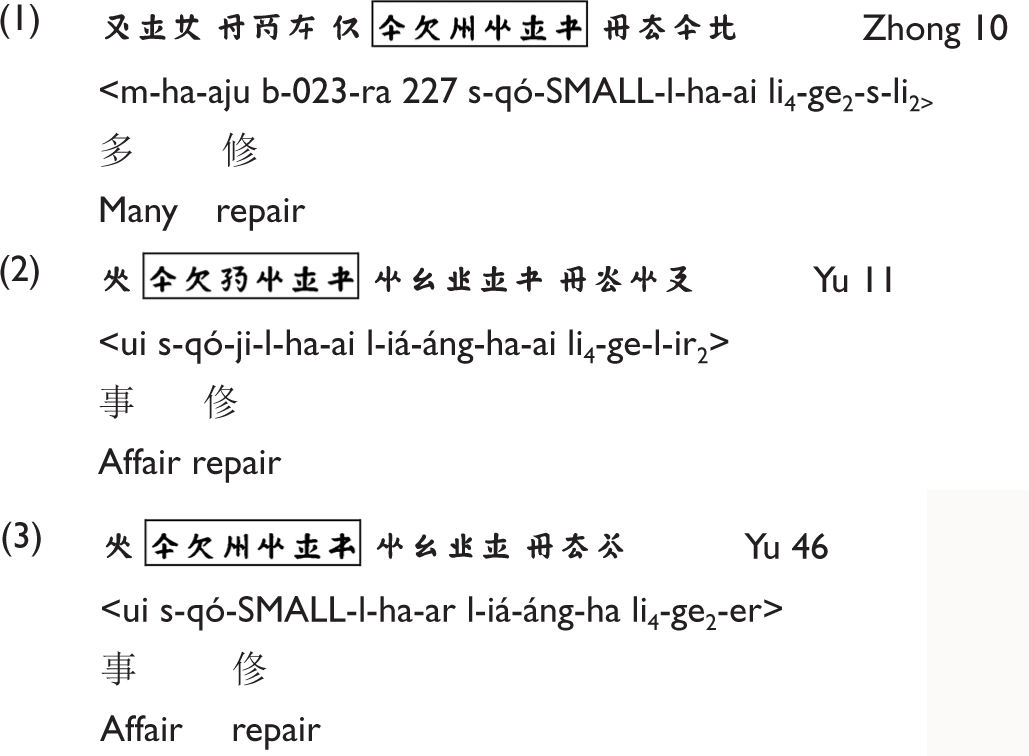
In sentences (1) and (2),  and
and  express the same grammatical meaning. In sentences (2) and (3),
  and
and  have the same lexical meaning. In the forms
  , the root is
  or
or  , the
, the  functions as a causative suffix, the
  as a converb suffix, and
  indicates the past tense. It is thus clear that the third glyph
  and
and  are in alternation.
Another set of Khitan terms,  , shows the same pattern, with the final glyphs used interchangeably. Chinggeltei et al. (2017) proposed that the glyphs
  are variants of each other, and reconstructed their pronunciation as uʧ∼uʤ. This further supports the view that the glyph
  contains the sound ʧʻ∼ʧ.
Scholars have identified
 <SMALL-qó> and
  <SMALL-qu> as meaning ‘small, young’ (e.g. xiao wengzhang 小翁帐 or shao fufang 少父房). With
  reconstructed as ʧʻ∼ʧ now and the final glyph as g∼gu, the term is likely pronounced as /ʧegu/ or /ʧugu/. This closely approximates Mongolian ᠵᠢᠭᠠ ǰiɣɑ or ᠵᠢᠭᠠᠯ ǰiɣɑl, meaning ‘small’ or ‘young’, indicating a cognate relationship.
Upon completion, a commemorative notation was carved on the left side of the stele. The upper section bears the date of the epitaph's inscription in a row of larger-sized Khitan Small Script. Below, two smaller rows of Khitan Small Script are aligned horizontally to the left and right, listing participants in funeral rites:
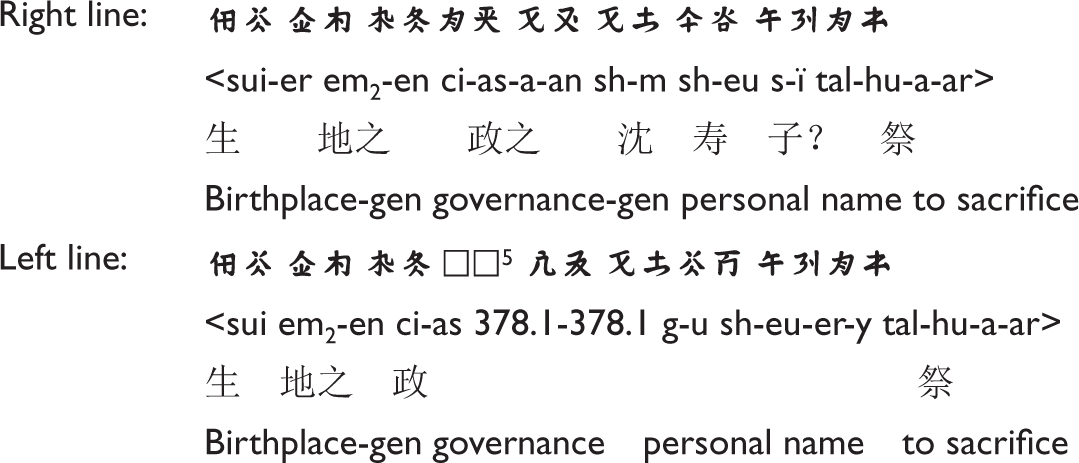
The opening phrase,  <sui-er em2-en ci-as-a-an> of the right line can be interpreted as ‘the governance of the birthplace’. The following sequence,
  <sh-m sh-eu s-ï> is tentatively identified as the personal name Shen Shouzi 沈寿子 by Aisin Gioro and Yoshimoto (2012). The final term
  <tal-hu-a-ar> was previously read as gong 供, but we argue that it means ji 祭 ‘to sacrifice’, supported by the following evidence:
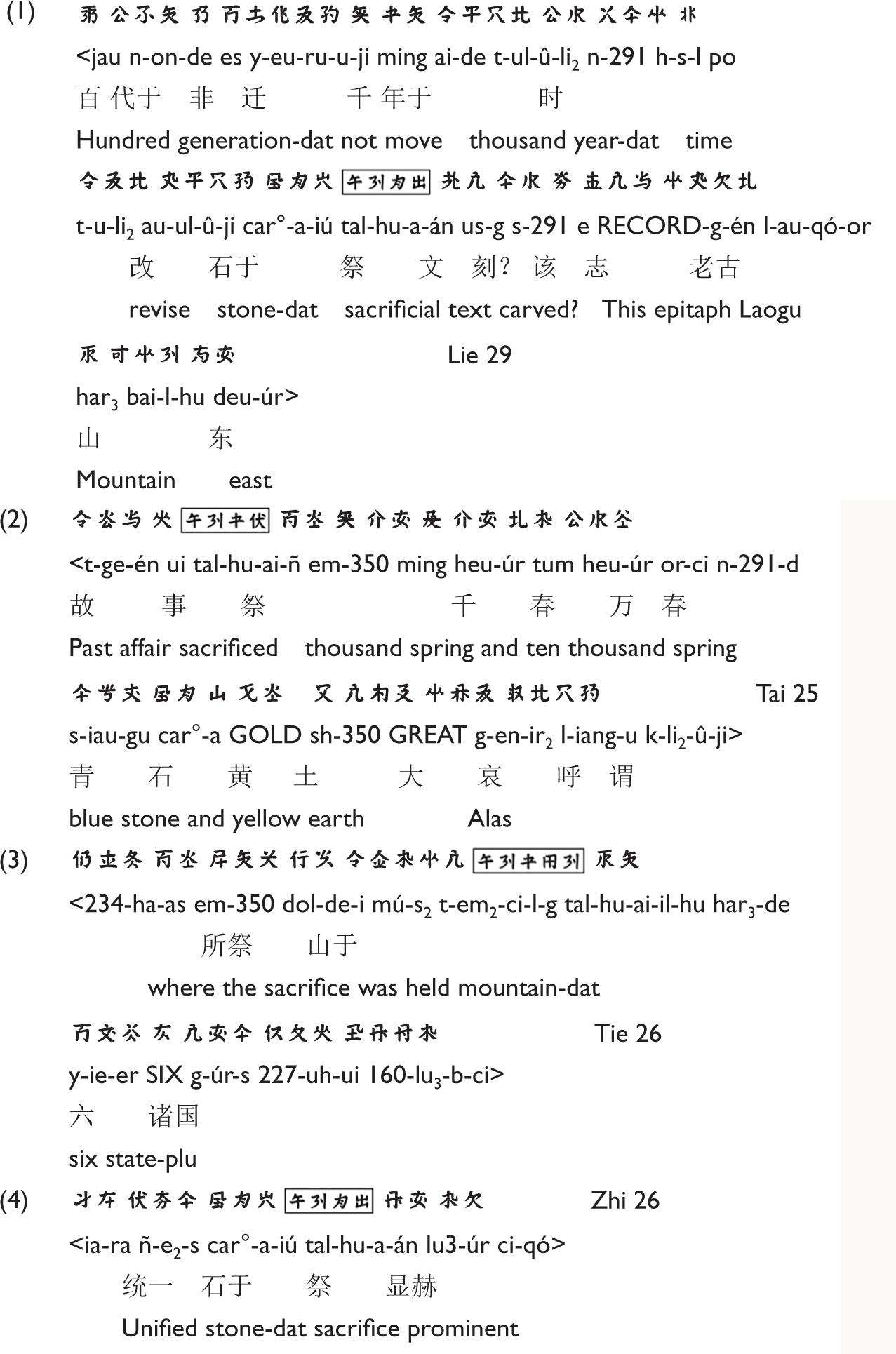
The root form
 <tal-hu->, appearing in the forms
  <tal-hu-a-ar>,
  <tal-hu-a-án>, and
  <tal-hu-ai-ñ>, all denote ‘to sacrifice’. The root
  comprising <tal-hu->, namely tal and ɣ, has been deciphered by scholars. The initial root can thus be reconstructed as *talɣ-, phonetically similar to the Mongolian word ᠲᠠᠬᠢᠬᠣ tɑkixu, meaning ‘to sacrifice, to hold a memorial ceremony’.
Line 6 of the Lin describes Niaoguzhi 褭古直, the fourth son of Emperor Yizu and Empress Zhuangjing:
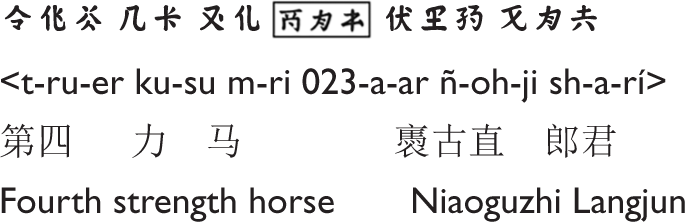
While ‘fourth’, ‘strength’, and ‘horse’ are clear, Yizu sizi: Zhuangjing huanghou xiaoshi sheng, Xuanzu disan. Shula, diyi. Tiela, zi Hende, di’er. Niaoguzhi, zi Yanmugen, disi.懿祖四子:莊敬皇后蕭氏生,玄祖第三。叔剌,第一。帖剌,字痕得,第二。 remains undeciphered. In my view,
  serves as an attributive phrase describing Niaoguzhi, interpretable via the History of Liao records:
History of Liao (2016) further records: Niaoguzhi, Yanmugen. Sheli. Shanqishe. Nianjiguan, duoma zu.褭古直,巖母根。舍利。善射。年幾冠, Commendatory sense: The phrase Biographical sense: The phrase may reference his death in a fall from a horse, semantically linked to zhi 踬 ‘to stumble or fall’ in parallel Liao histories, meaning ‘thrown by a powerful horse’. Dielite, zi Hailin. You lüli,shan chishe, mazhi bupu.迭里特,字海邻。有膂力,善驰射,马 .
.
 may denote exceptional strength, similar to accounts of Emperor Yizu Salade's feat shiguanshuzha 矢贯数札 ‘an arrow pierced through several layers of armor’.
  <ku-su > denotes ‘strength’,
  <m-ri > denotes ‘horse.’ Qidalatu (2022) proposed the phonetic reconstruction of the first glyph
  in
in  to be *-t or *-tat. Thus,
  could be reconstructed as *taːr or *tataːr, resembling Mongolian ᠲᠠᠲᠠᠬᠣ tɑtɑxu ‘to pull, drag, or haul’. The suffix
  <ar> forms an adjectival form parallel to ᠲᠠᠲᠠᠭᠰᠠᠨ tɑtɑɣsɑn, ‘having pulled, dragged’. Accordingly,
  denotes ‘having the power to drag a horse’.
Conclusion
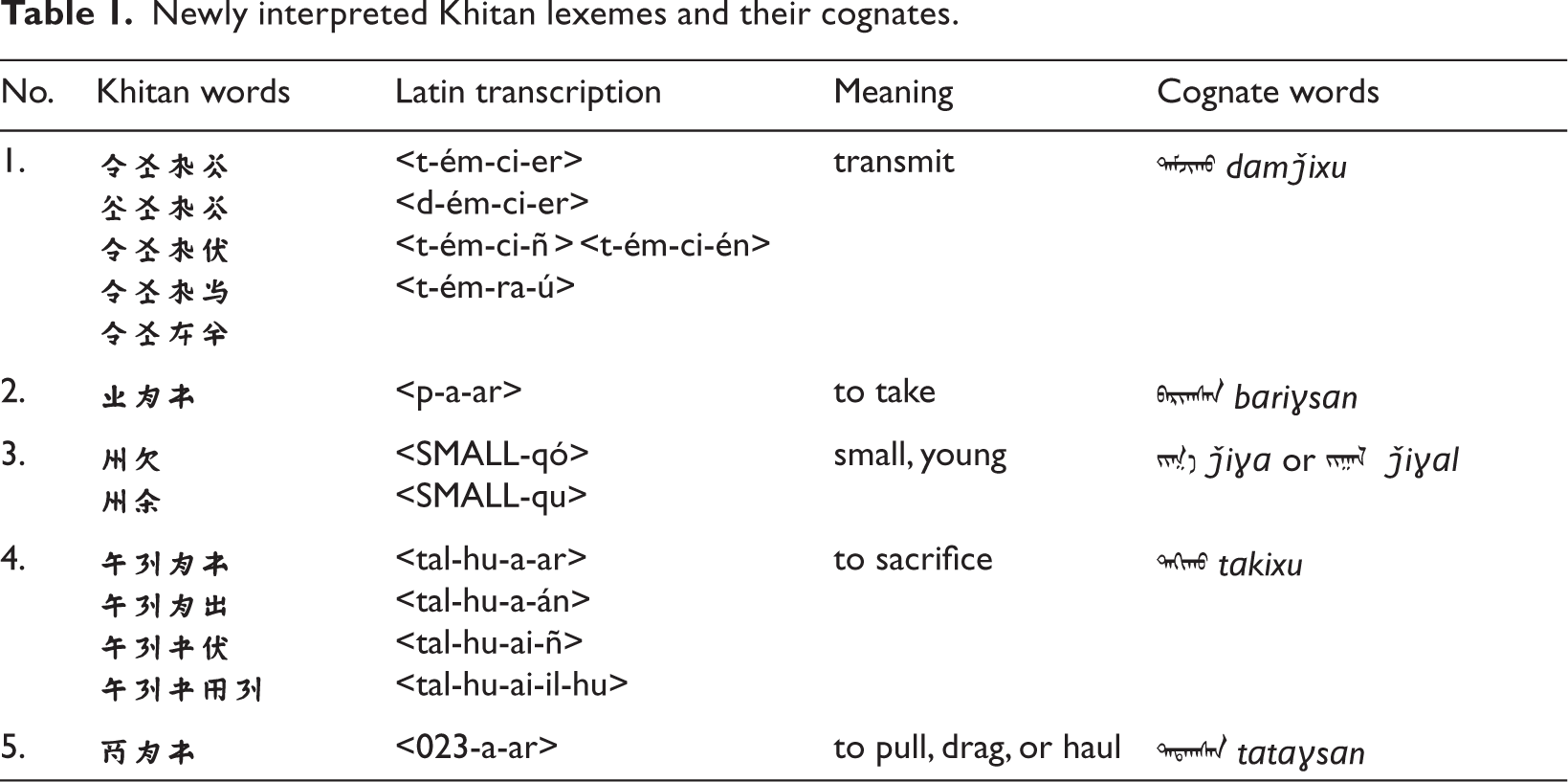
Building on prior scholarship and established decipherments, this article examines key expressions in the Epitaph of Yelü Yugulin Taishi (Khitan Small Script) and provides focused lexical interpretations and etymological analyses; the main findings are summarized in Table 1.
Footnotes
The abbreviations of epitaphs
Chao: 耶律抄只郎君墓志铭 Yelü Chaozhi Langjun Muzhiming Epitaph of Yelü Chaozhi Langjun Hu: 萧胡睹堇太师墓志铭 Xiao Hudujin Taishi Muzhiming Epitaph of Xiao Hudujin Taishi Jue: 耶律玦敞稳墓志铭 Yelü Jue Changwen Muzhiming Epitaph of Changwen Yelü Jue Lie: 萧迪烈郎君墓志 Xiao Dilie Langjun Muzhi Epitaph of Xiao Dilie Langjun Lin: 耶律于骨邻太师墓志铭 Yelü Yugulin Taishi Muzhiming Epitaph of Yelü Yügulin Taishi Song: 故宋魏国妃墓志 Gu Song Wei Guofei Muzhi Epitaph of the Late Imperial Consort of the States of Song and Wei Tai: 太叔祖哀册 Taishuzu aice Eulogy for the Imperial Grand Uncle Tie: 耶律贴不太师墓志碑 Yelü Tiebu Taishi Muzhibei Stele of Yelü Tiebu Taishi Xu: 许王墓志 Xuwang muzhi Epitaph of Prince Xu Yu: 大辽国尚父于越宋王墓志铭 Daliao Guo Shangfu Yuyue Song Wang Muzhiming Epitaph of Prince Song Shangfu Yuyue of Great Liao Zhi: 耶律智先太尉墓志铭 Yelü Zhixian Taiwei Muzhiming Epitaph of Taiwei Yelü Zhixian Zhong: 萧仲恭墓志 Xiao Zhonggong Muzhi Epitaph of Xiao Zhonggong
Grammatical abbreviations

Funding
The author disclosed receipt of the following financial support for the research, authorship, and/or publication of this article: This work was supported by the Key Project of the National Social Science Fund of China “Interpretation of Newly Discovered Inscriptions from the Liao Imperial Consort Clan and Research on Khitan Small Script Orthography” (grant number 21AYY023) and Research Initiation Project for Young Academic Talents of Inner Mongolia University Research on the Newly Discovered Epitaph of Yelü Yugulin Taishi in Khitan Small Script (Grant number 10000-23112101/260).
Declaration of conflicting interests
The author declared no potential conflicts of interest with respect to the research, authorship, and/or publication of this article.