







Abstract
The metalliferous intrusive complexes in the Khentii Uplift evolved post-collisionally in an intracontinental environment. Their felsic magmatic rocks are surrounded by a small marginal facies of more granodioritic to monzonitic composition and were attributed to the A2 type granites, based on discrimination diagrams using K, Na, Si, Nb, Y and Rb. These rare metal granites have elevated contents of fluorite, topaz and tourmaline and are characterised by the light rare earth element enriched minerals allanite-(Ce) and monazite (Ce) prevailing over the xenotime, which is the only host with heavy rare earth element enrichment in these Mongolian granites. Together with zircon, these heavy minerals also show up in the clastic apron around these granites under study, providing a clue to the temperature of formation when the intrusive bodies were emplaced, and moreover provide a tool for exploration in pegmatitic and granitic terrains. Albite alteration is associated with a moderate U–Th–Ti mineralisation and greisen bodies were enriched in Sn and W of subeconomic grade. Only cassiterite re-appears as a heavy mineral in alluvial–fluvial placer-type deposits around the granite stocks, whereas only W occurs in a wide range of limonite and leucoxene like minerals. Sn-, W-, Fe, Mn- and Ti-bearing chemical residues can be used as a short-range marker to pinpoint the loci of enrichment of Sn and W, whereas the aforementioned heavy minerals are applicable as long-range tracers for metalliferous A-type granites. The Pb–Cu–Zn mineralisation is rather homogeneous and of little value as an exploration tool. Three different stages characterised by REE-carbonates and kaolinite, metalliferous duricrust abundant in Sn, W and Ti and aluminium–phosphate–sulphate minerals developed under oxidising conditions. The way how fluids moved though the granitic rocks, either as per descensum or per ascensum fluids, cannot be determined precisely. Therefore epithermal processes cannot be ruled out and have been held responsible for this near-surface alteration zone superimposed on a high-temperature Sn–W mineralisation in the Late Triassic to Early Jurassic A-type granites. These intrusive rocks are related to an extensional regime of the Triassic Indosinian orogeny in southern China.
Keywords
Introduction
Rare metal granites are among the most sought after targets of exploration particularly for their commodities, e.g. Li, Cs, Ta, Nb and Sc that are necessary for the electronic industry. Even W and Sn are enriched in some of these felsic intrusive rocks so as to attract the attention of mining and exploration geologists. Whereas the term rare metal granite suggests these are rare species of mineralised rock, many studies of these peculiar metalliferous host rocks are based on the interest in granite-related ore mineralisation (Tischendorf, 1977; Kovalenko, 1978; Imeokparia, 1982; Ekwere and Olade, 1984; Gaupp et al., 1984; London, 1990; Cerny, 1991; Christiansen et al., 1993; Breaks and Tindle, 1997, 2002; Breaks et al., 2005; Selway et al., 2005). Some investigations focused on Sn and W in granites, placing great emphasis on the evolution of the magma leading to these granites (Olade, 1980; Hudson and Arth, 1983; Kempe and Plötze, 1993; Seltmann et al., 1995). There is only one comprehensive paper that deals with albite alteration and greisen in the Russian literature (Beus et al., 1962).
The present paper targeted the alteration zones of some granites and on their mineral association. The value of such a study is beyond the mineralogical boundaries into exploration for these rare metal deposits, the description of the lithology on a macroscopic scale, applicable as an ore guide; and is a focus of this paper. The area under consideration throughout this study is located in Mongolia, a large and sparsely populated country in the Central Asian Interior which has attracted great interest among exploration geologists especially by the new discovery of the Oyu Tolgoi porphyry Cu–Au–(Mo) deposit in the Gobi Desert of southern Mongolia (Kirwin et al., 2005). North of this exploration site, the Khentii uplift in Central Mongolia, known for its widespread Mesozoic granitic magmatism, forms part of the 1000 km long Mongol Okhotsk fold belt which extends from the Khangai mountain in Central Mongolia to the Pacific Ocean (Zonenshain et al., 1976). The Bogd uul, Modot, and Tsagaan davaa granites are situated near Ulan Baatar within this fold belt (Fig. 1). They were described as rare metal granites belonging to the Li–F facies by Kovalenko et al. (1971). Moreover, an insight into the regional geology of this fold belt is aimed as a side interest of this investigation.
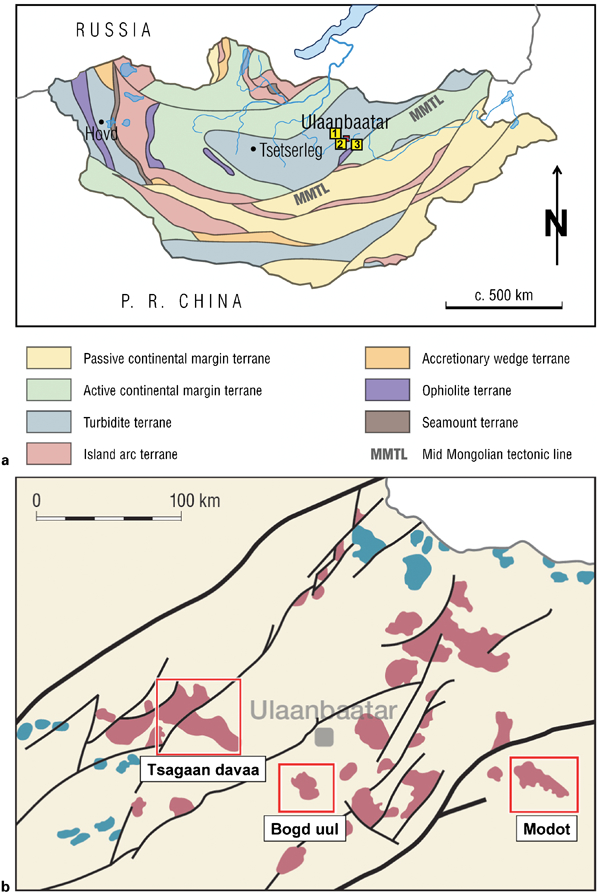
Mesozoic intrusions in the Khentii uplift and the position of the study areas in Central Mongolia
Methodology
Preparatory work in the laboratory involved heavy mineral separation carried out for each sample to the grain size fractions richest in heavy minerals (the 3–4 φ fraction) using sodium polytungstate of a density of 2·9 g cm–3 (Callahan, 1987). To prevent corrosion or even dissolution of acid-sensitive heavy-minerals (monazite, apatite), even diluted acids were not used in the preparation. An aliquot was taken prior to this preparatory work for chemical analysis of the whole rock composition.
Major and trace elements were analysed by X-ray fluorescence spectrometry (XRF).
Powdered samples were analysed using a PANalytical Axios and a PW2400 spectrometer. Samples are prepared by mixing with a flux material and melting into glass beads. The beads are analysed by wavelength dispersive XRF. To determine loss on ignition 1000 mg of sample material are heated to 1030°C for 10 min. After mixing the residue with 5·0 g lithium metaborate and 25 mg lithium bromide, it is fused at 1200°C for 20 min. The calibrations are validated by analysis of Reference Materials. Monitor samples and 130 certified reference materials are used for the correction procedures.
Mineralogical investigations involved thin section analyses which were supplemented by X-ray diffraction analysis and by SEM–EDX. The latter method is described in more detail in the succeeding paragraphs. No sputter coater was used prior to SEM–EDX analyses by means of a QUANTA 600 FEG equipped with a GEMINI EDX system because all analyses were carried out under low vacuum-chamber conditions (1 to 10 mbar).
X-ray diffraction patterns were recorded using a Philips X'Pert PW3710 Θ–2Θ diffractometer (Cu Kα radiation generated at 40 kV and 40 mA), equipped with a 1° divergence slit, a secondary monochromator, a point detector and a sample changer (sample diameter 28 mm). The samples were investigated from 2 to 80° 2Θ with a step size of 0·02° 2Θ and a measuring time of 3 s per step. For specimen preparation the top loading technique was used.
Geological setting
The Mesozoic granites under study cover about 50% of the Khentii uplift and make up more than 160 individual intrusive complexes, with the Early Mesozoic Bogd uul, Tsagaan davaa and Modot plutons among the major ones (Gerel et al., 2002; Badarch et al., 2002). The granites are very similar as to their lithology and mineral assemblages and thus only need to be exemplified by the Bogd uul granite (Fig. 2).
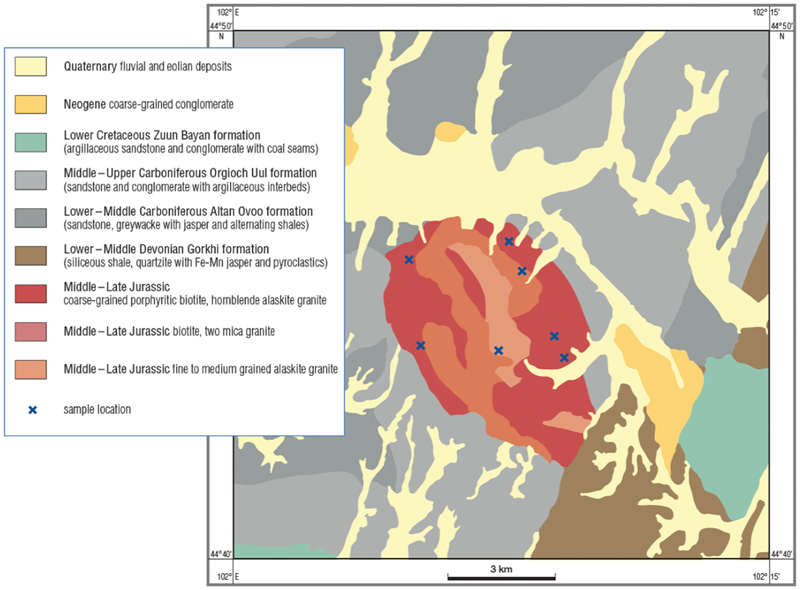
Geological setting of the Bodg uul granite
Kovalenko et al. (1984) and Koval et al. (1998) subdivided the Mesozoic magmatic rock into two suites based on radiometric age dating, mainly K–Ar and to a minor extent Rb–Sr and U–Pb dating. The early Mesozoic granites formed between 170 and 240 Ma and their Late Mesozoic successors in the period of time from 100 through 170 Ma.
The Bogd uul granite was intruded into the accretionary complex of the Gorhi Formation which consists of Late Silurian to Late Devonian radiolarian cherts that are, in some parts, underlain by oceanic island basalt and overlain by siliceous shale and turbiditic clastic-rock sequences (Kurihara et al., 2009). U–Pb isotopic analyses performed on zircon grains from the Bogd uul granite pluton indicate a Late Triassic to early Jurassic age of formation (Khishigsuren et al., 2003).
The Tsagaan davaa (Tuhum) pluton approximately 80 km E of Ulaan Baatar was intruded into the Shirguu Formation of Cambrian through Silurian sandstone, shale and greywacke. Radiometric age dating of the Tsagaan davaa granite using the K/Ar method yielded a data array from 180 to 245 Ma, corresponding to a Late Triassic to Early Jurassic.
The Modot Granite Massif gave an age interval of 199 to 135 Ma using the K–Ar method (Kovalenko et al., 1971). In its clastic apron the Bayanmod cassiterite placer deposit was emplaced.
Results
Lithology and petrography of the granites
The host rock lithology at Tsagaan davaa, Modot and Bogd uul, Mongolia, is predominantly granitic, of fine to coarse grain size and, in places, of porphyritic texture (Table 1, Fig. 3). The most common host rock lithology is an equigranular coarse-grained biotite-bearing granite (Fig. 3a). The more granodioritic marginal facies is also more porphyritic with large tabular crystals of K feldspar (Fig. 3b). The term leucogranite was used for biotite-free granites largely composed of quartz and alkaline feldspar only (Fig. 3c). Two alteration zones may easily be distinguished from each other. The albite alteration is massive and almost exclusively made up of albite with subordinate amounts of quartz (Fig. 3d). Muscovite is a rare constituent and not visible with the unaided eye. The greisen zones are equigranular fine- to coarse-grained and contain as rock-forming minerals only quartz and muscovite (Fig. 3e).
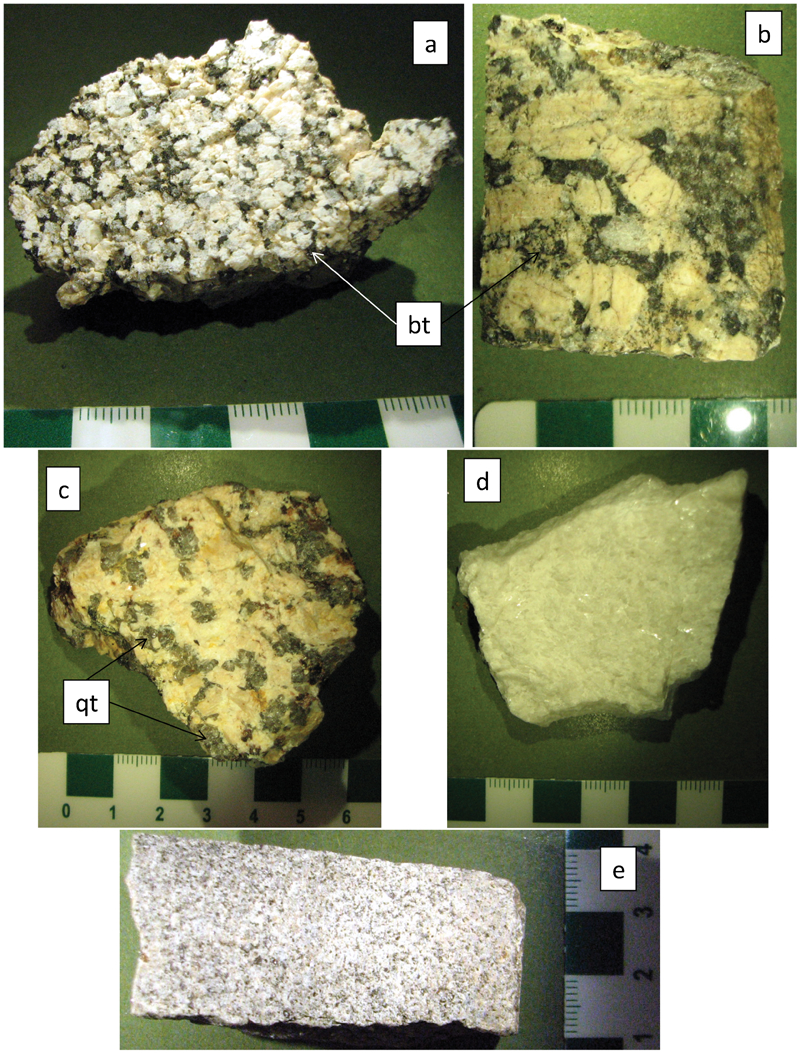
Specimens of the Mesozoic intrusions in the Khentii uplift on a macroscopic scale. One square on the scale measures 1 cm
Lithology of host rocks and alteration zones at Tsagaan davaa, Modot and Bogd uul, shown in context with whole rock chemical composition in a bipartite subdivision: rock-forming elements (SiO2 to F), ore-forming elements (Sn to Y)*
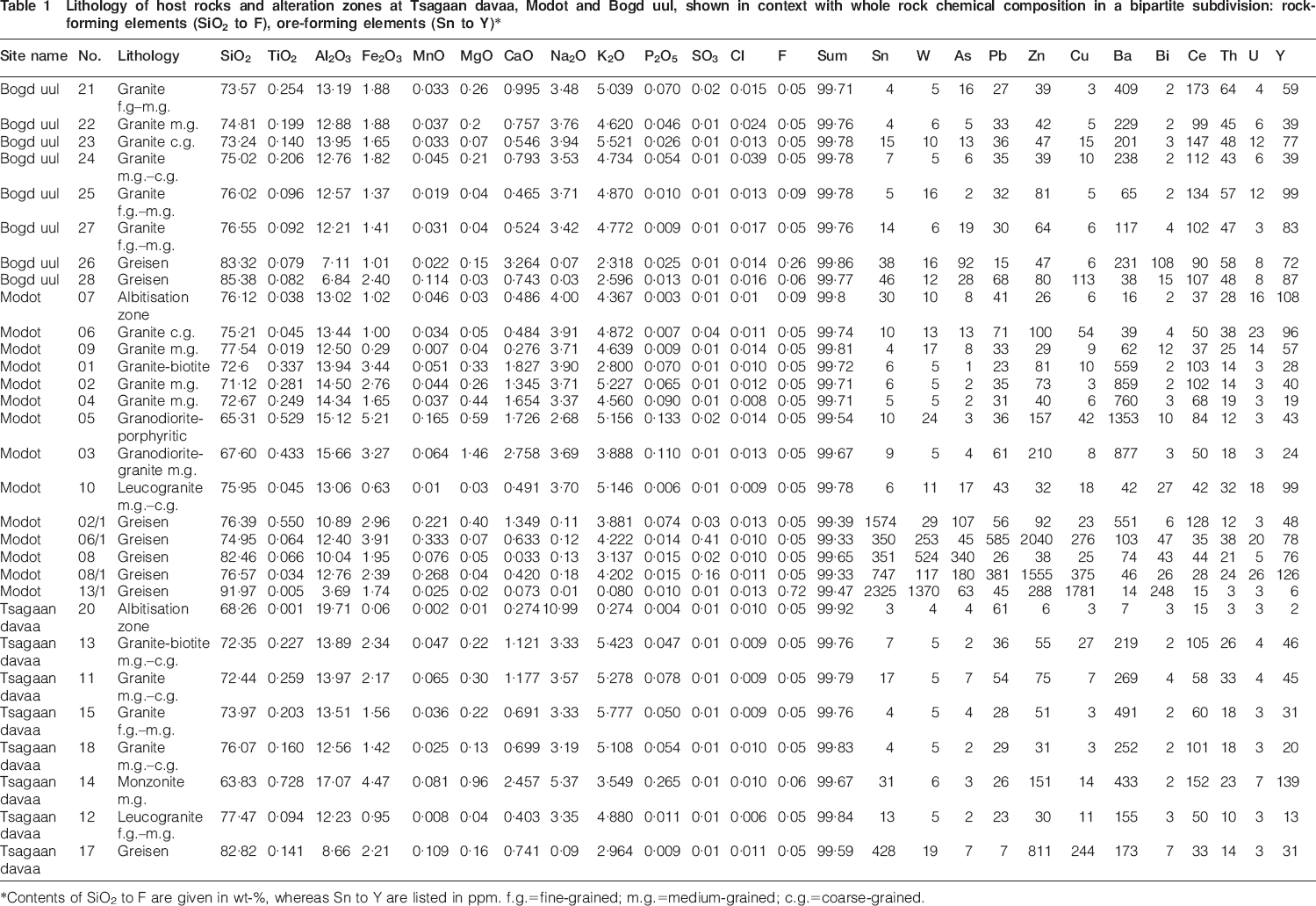
Contents of SiO2 to F are given in wt-%, whereas Sn to Y are listed in ppm. f.g. = fine-grained; m.g. = medium-grained; c.g. = coarse-grained.
Under the petrographic microscope, a fine-tuning of the aforementioned host rock lithology may be achieved. From the common biotite granite through the leucogranite K feldspar is dominant. In the leucogranite, orthoclase twinned on the Carlsbad Law with a varied spectrum of perthitic exsolution of albite occurs (Fig. 4a). Increasing amounts of chessboard albite may be encountered at the end of a mineral succession starting off with albite-oligoclase through to perthitic K feldspar (Fig. 4b). Thin twinning lamellae may be observed in the albite from the albite altered zone, which is younger than the aforementioned mineral associations (Fig. 4c). The petrography of the granodioritic rocks in the marginal facies stand out not only by widespread biotite, which is in places converted into Fe–(Mg) chlorite but also by the presence of euhedral rhomb-shaped crystals of titanite (Fig. 4d). Titanite is preceded by tabular crystals of Mn-bearing ilmenite present at subordinate amounts. The third member among the oxidic Ti minerals of the granitic suite is rutile. It is present as a cobweb of sagenite originating from the alteration of biotite into chlorite. Locally the Sn contents may amount to 2·2 wt-%. Schorl is the only boron-bearing mineral. The zones of greisen are very distinct and strongly correlated with the presence or absence of ore minerals. Greisen that is poor in Sn- and W-mineralisation is abundant in quartz and muscovite (Fig. 4e). Those which contain cassiterite are almost completely deprived of argillaceous material (Fig. 4f). Muscovite grew within stellate aggregates. The entire suite of rock-forming and ore minerals do not show any preferred strain-induced mineral growth.
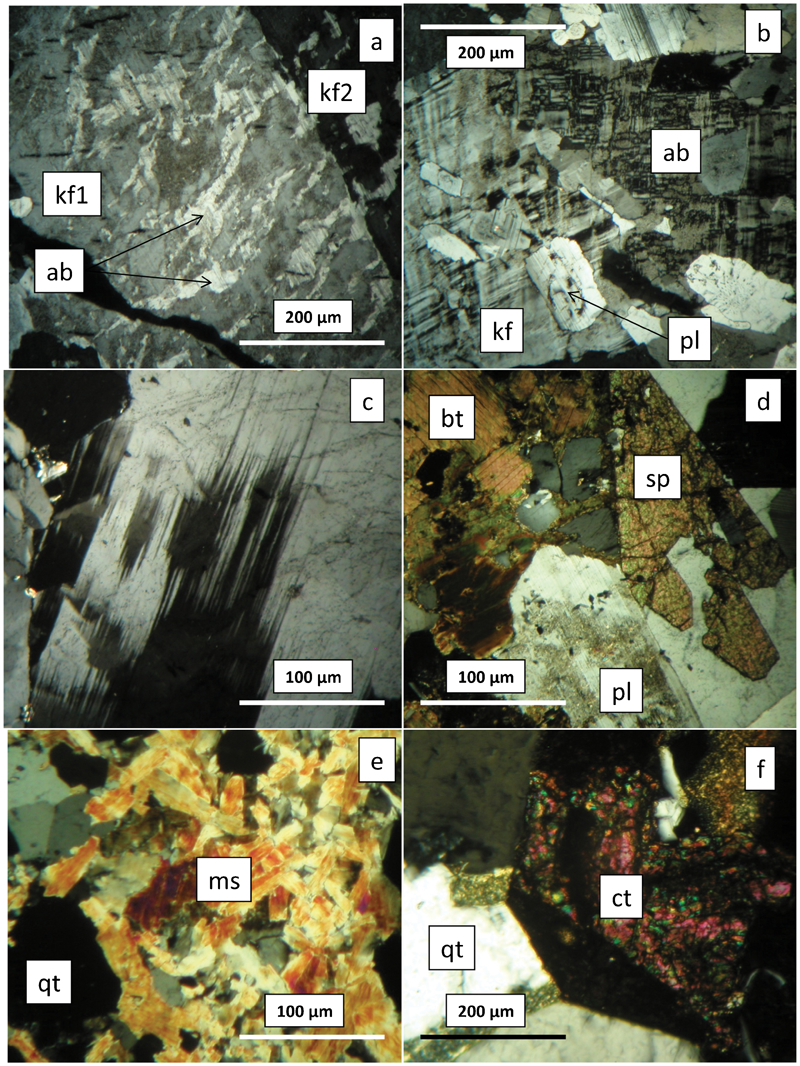
Micrographs of granitic host rocks and alteration zones
Disseminated ore mineralisation within the granites
The granitic igneous rocks described in the previous section host a disseminated mineralisation with a spectrum of minerals whose relative age of formation is illustrated by the horizontal bars (Fig. 5).
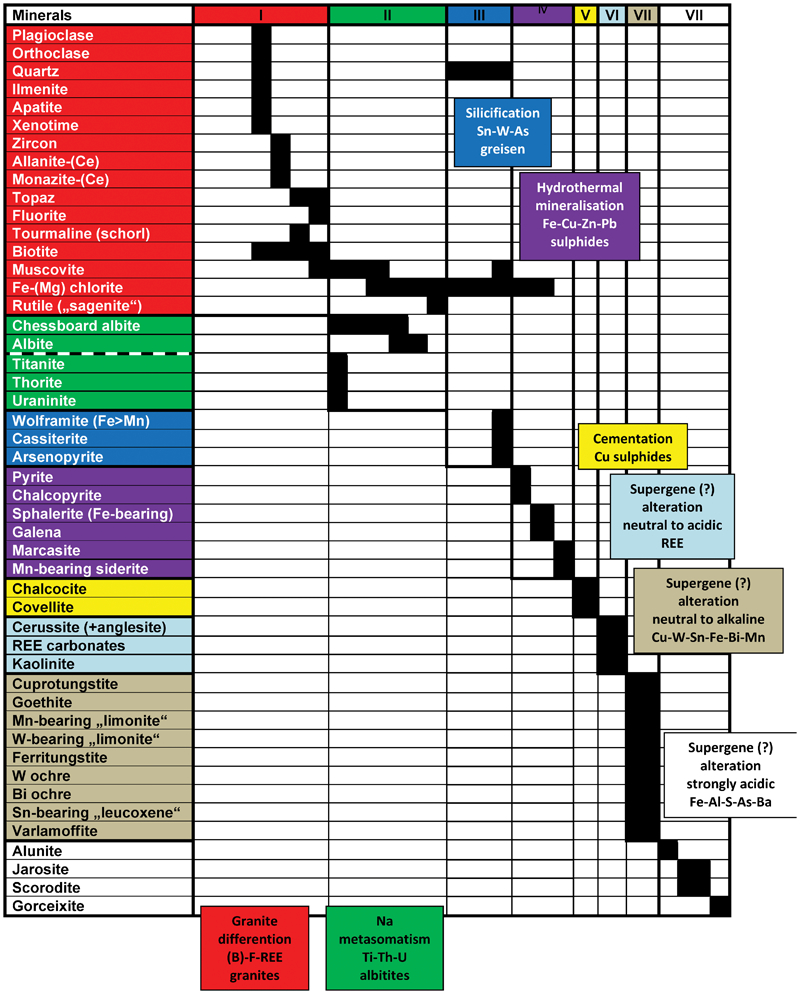
Synoptical overview of the succession of minerals developing during rock-forming processes, alteration, and hypogene and supergene ore mineralisation
Silicates
Zircon appeared very early in the succession of minerals during the intrusion of the granites and developed euhedral prisms. Based upon the presence and the size of crystal faces three distinct morphological types have been established. All crystals have an elongated prism dominated by the faces {100} and a well-shaped pyramid {101}. The major difference lies within the size of the crystal face {110}. Distinct zircon habits identified in these samples have been labelled in the common notation using the Miller indices. All subtypes are found side-by-side in a heavy mineral concentrate of the Modot granite (Fig. 6).
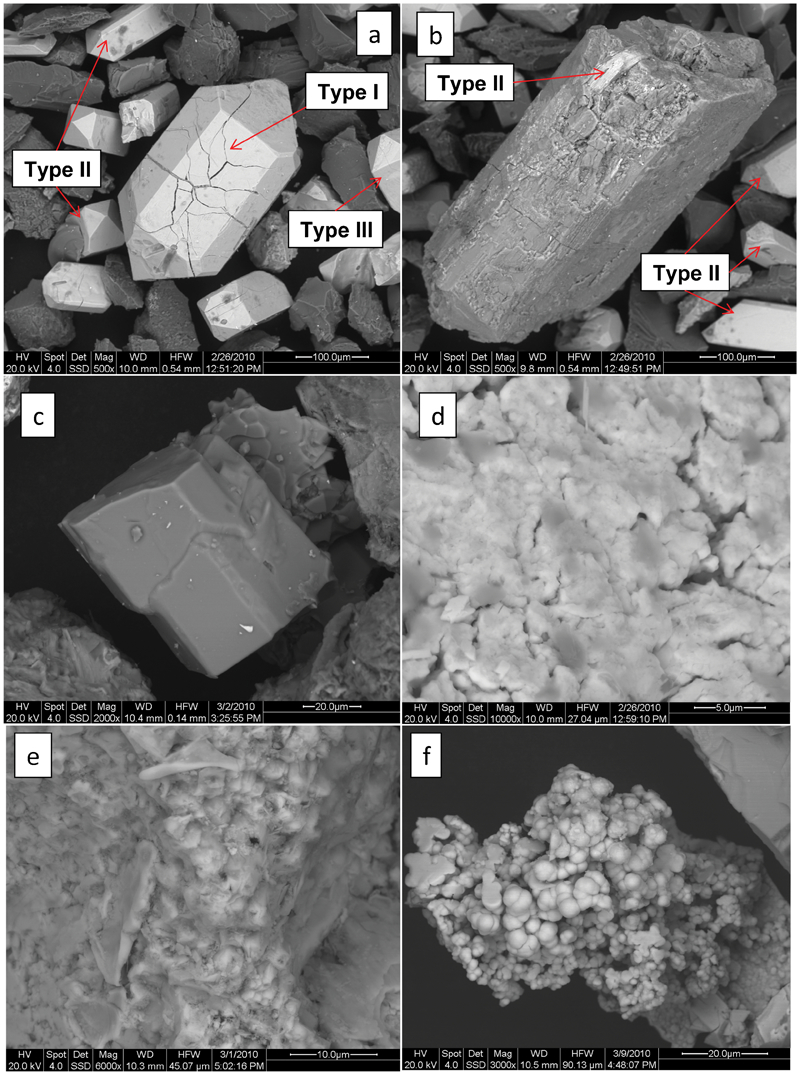
Disseminated mineralisation in the Khentii uplift. If not stated otherwise, the micrographs are obtained during SEM–EDX analyses
Type I may be described owing to its arrangement of crystal faces as {100}>{110}-type, type II as {100}>{110}-type while type III only developed the faces {100}. Albeit forming the largest single crystals of zircon, type I is less widespread than type III and type II which is the most common zircon morphology in the Mongolian samples. In Tsagaan davaa only type II and III morphologies were encountered among the zircon population and in Bogd uul type III prevails over type II. The Th-bearing analogue to zircon, thorite [ThSiO4] was spotted as a rare constituent and found intergrown with titanite. Another silicate bearing REE, allanite-(Ce) includes zircon (Fig. 6b). Its La contents are in the range 4·7 to 5·6 wt-% and its thorium contents as much as 3·8 wt-%. Topaz was only identified once closely associated with fluorite.
Phosphates
Phosphates showed up very early during the emplacement of granites and also appeared at the end of the mineralisation (Fig. 6). Apatite marks the onset of phosphate accumulation within the granite occurring as single hexagonal prisms either in mica or surrounded by zircon (Fig. 6c). It does not accommodate any other elements such as Mn in its lattice. Monazite (7·5–18·0 wt-%La, 14·9 wt-%Nd, 2·1–4·3 wt-%Th) formed later than xenotime (Fig. 5).
Oxides and hydroxides
Uraninite developed poorly-shaped cubes. It is intergrown with titanite and thorite, but does not accommodate Th into its crystal structure.
The most common oxide minerals are cassiterite and wolframite. Neither mineral is present in the disseminated mineralisation forming well-shaped euhedral crystals. All wolframite solid solution series investigated have abundant ferberite with an Fe/Mn ratio in the range 1·3∶1 to 11∶1.
Besides these oxide minerals a variable group of oxide-hydroxides formed throughout the granite massifs. These chemical compounds mainly occur in botryoidal structures or as earthy aggregates. Rarely can these chemical compounds precisely be described as a definite mineral due to their intimate intergrowth, poor crystallinity and the tiny particle size. Those oxide hydroxides enriched in Sn with subordinate Ti were described as Sn leucoxene (25·8 wt-%Sn, 14·4 wt-%Ti; Fig. 6e). When Fe was present alone or together with varying amounts of Mn in the chemical compound it was named Mn limonite (8·2–13·2 wt-%Mn, 43·0–50·0 wt-%Fe). Iron and tungsten occur together or without Mn in W limonite (46·7–66·5 wt-%Fe, 3·4–18·6 wt-%W) (Fig. 6f). Ferritungstite has Fe contents in the range 13·3 to 16·1 wt-%, and W contents in the range 46·7 to 54·4 wt-%, whereas in cuprotungstite Cu amounts to 45 wt-% and W to 30·1 wt-%). If only W or Bi occurred in oxide/hydroxides with no stoichiometric composition the chemical compounds were named W ochre (67·0 wt-%W) or Bi ochre (55·1 wt-%Bi) (Fig. 6d). All of them appeared very late in the mineral succession. Besides these chemical compounds bearing W and Bi, there are varlamoffite (27·9–32·3 wt-%Sn, 10·0–16·4 wt-%Fe) and cuprotungstite (Fig. 5).
Sulphides, sulphates and arsenates
The sulphide mineral assemblage in the granitic host rocks is rather homogeneous and composed of pyrite, chalcopyrite, pyrite covellite, chalcocite, galena, sphalerite and arsenopyrite. Sphalerite is enriched in Fe to amounts ranging from 11·8 to 12·8 wt-%Fe. The sulphide minerals are present in various mineral associations as anhedral grains (Fig. 5) and decomposed into sulphates, e.g. anglesite, and complex sulphates of the alunite- and jarosite group. Gorceixite is the only member of the aluminium–phosphate–sulphate (APS) mineral group present in the granites under study (Dill, 2001). Arsenopyrite decomposed into scorodite.
Carbonate minerals
Carbonate minerals are not very widespread and only manganiferous siderite was encountered together with wolframite. Cerussite is the end product of the decomposition of galena via anglesite (Fig. 5). Two REE carbonates parisite and roentgenite were found associated with kaolinite. As these minerals could not be proved by a second independent analytical method due to the small grain size both minerals were not listed in Fig. 5 by their individual names.
Lithochemistry and the chemical composition of the granite-hosted ore mineralisation
The basic lithochemistry of the three granites under study and their alteration zones is listed in Table 1, subdivided into major or rock-forming elements (SiO2 to F), elements making up the ore minerals (Sn to Cu), and then trace elements (Ba to Zr). Various cross plots and spider diagrams were applied to discuss the chemical variation throughout the emplacement and alteration of these Mongolian granites. The diagrams of Cox et al. (1979) with amendments of Wilson (1989) used the sum of alkaline elements and silica for the classification of plutonic rock types (Fig. 7). It lends support to the lithologically-based classification adopted in the section on ‘Lithology and petrography of the granites’ and shows all data points concentrated in the compartment on the right-hand side. A more detailed subdivision of the granites may be achieved by the cross plot designed by Maniar and Piccoli (1989) (Fig. 8a) and Le Maitre et al. (1989) (Fig. 8b). The data array covers the part of the peraluminous field only. Only sodium indicative of the process of albite alteration strongly deviates from this common trend. The greisen zones are enriched in Sn, W, Pb, Zn and Cu, with the most elevated contents reported from the Modot granite (Table 1). As and Bi are also enriched in this granite (Table 1). The geodynamic position may be concluded from the cross plot of Y+Nb vs Rb elaborated by Pearce et al. (1984; Fig. 9).
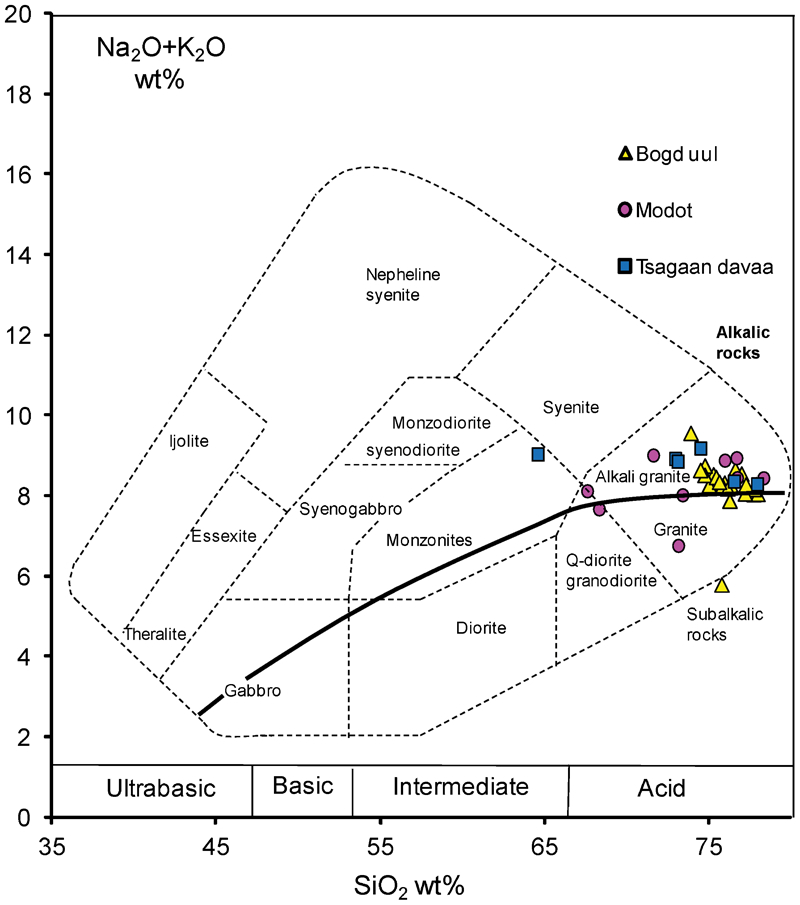
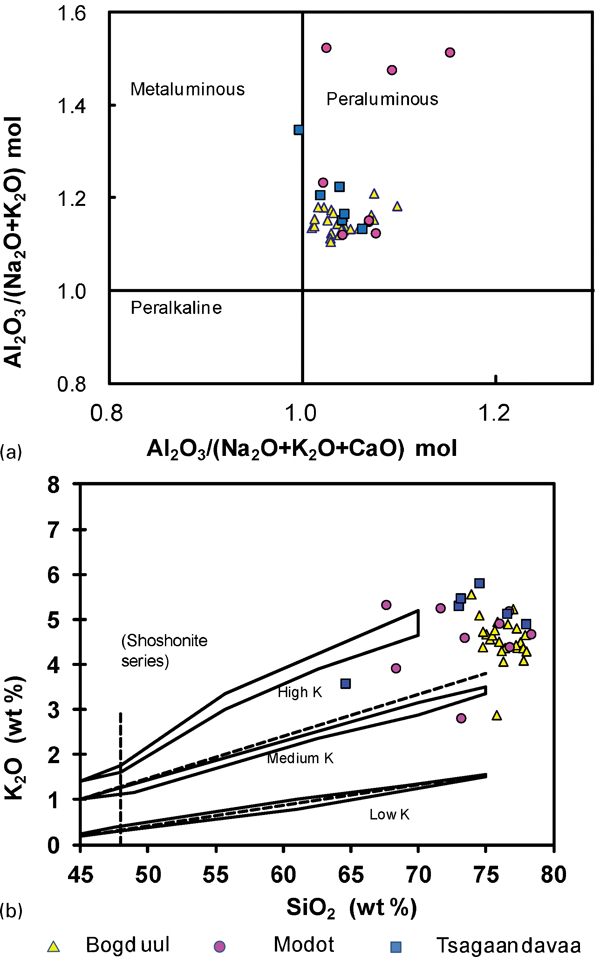
Chemical discrimination of plutonic rocks based upon
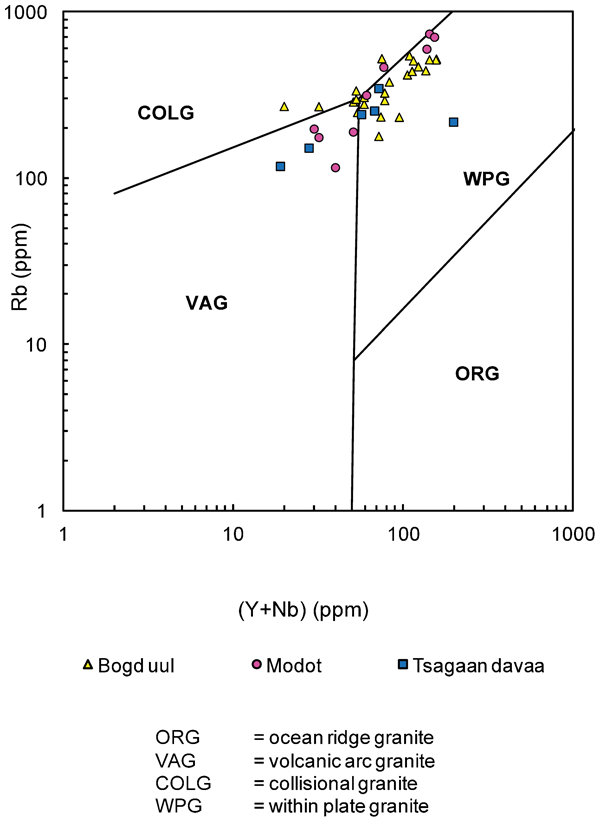
Y+Nb vs Rb diagram elaborated by Pearce et al. (1984) is to show the geodynamic setting of the granitic rocks
Discussion
Granite emplacement and differentiation (stage I)
Geodynamic setting and diagnostic elements of the host granites
Rare earth elements and yttrium are enriched and gave rise to light rare earth element (LREE)-bearing accessory minerals such as monazite and allanite as well as the most important HREE host xenotime. Barium, REE and yttrium are enriched in the host intrusive rocks but not in the ore zone itself (Table 1). Yet they may guide exploration geologists to the fertile granites and then as an ore guide.
The intrusive rocks belong to a series of strongly fractionated high-K, calc-alkaline and peraluminous granites (Fig. 8). The three plutons having formed post-collision in an intracontinental environment may be attributed to the A2 type (Eby, 1992, 2011). This type of granite may develop in two different ways, either by a differentiation of a continental tholeiite interacting with the continental crust to different degrees, or by direct melting of crust in the aftermaths of an early stage of melting. The peraluminous suite of granites (Fig. 8) differentiated into a small granodioritic to monzonitic residue, forming the marginal facies of the felsic association and a granitic magma forming the overwhelming part of the intrusive bodies (Fig. 7).
Crystal morphology – temperature of formation and ore guides
During this stage I, the major proportion of REE minerals (xenotime, monazite, allanite) and zircon developed (Fig. 5). The REE minerals and zircon may be used in two different ways. They may contribute to understanding the lithogenesis of this suite of metalliferous granites and as heavy minerals pertaining to the category of intermediate to high stability they can show up in the modern drainage system of the clastic apron of these granites, thereby providing a useful tool for exploration when targeting upon rare-element granites.
The morphological types of zircon were compared with reference types described by Pupin (1980), Bossart et al. (1986), Benisek and Finger (1993) to get an idea on the temperature of formation.
Type I displaying the crystal faces {100}>{110} formed at temperatures around 800°C and type II with a combination of faces characterised by the equation {100}>{110} developed at more elevated temperature at 850°C whereas type III showing only faces {100} reached a temperature of as much as 900°C. Type I is present in the Modot granite which has the highest concentrations of rare elements. Low temperatures of formation correlate with high quantities of rare elements such as W and Sn in the granites (Table 1). It is another example where crystal morphology of zircon takes a marker position for certain elements or for fertile host rocks. The zircon types observed in pegmatitic provinces with temperature between 500 and 600°C may simply be described as a zircon crystals compressed along the [001] axis with almost no prisms (Dill et al., 2012). Some types have a face combination {110}>{101} leading to an almost isometric shape of zircon which is well preserved in the modern fluvial-alluvial system draining into the granitic–pegmatitic provinces. As a result of this, these morphological types are cast as an ore guide for pegmatitic provinces and metalliferous granites worldwide (Pedersen et al., 1989; Roberts et al., 2006; Dill, 2007; Rosa et al., 2010; Dill et al., 2011). The pegmatitic stage is not developed in any of the granites under study and not surprisingly, the stubby type of zircon is missing from the clastic apron of the granites.
Monazite is indicative of an enrichment of LREE during the intrusion of these felsic plutonic rocks, but its shape cannot be applied in the same way as was done for zircon for exploration purposes. Hydrothermal monazite was investigated by Schandl and Gorton (2004). Orthite is widely known from ancient granitic massifs and has been reported among others by Chatterjee (1962). It may occur in the granites themselves and in its metamorphic wall rocks and formed very early in the host granites (Fig. 5). Even present in small amounts as an accessory HREE-bearing silicate in the host granite, it may be identified in the clastic apron proximal to the granites.
Fluorite and topaz resulted from abnormally high fluorine contents concentrated in the course of differentiation of these granites. Their value as an ore guide during stream sediment exploration for F-enriched granites is limited to the immediate surroundings of the granites measuring by a few kilometres, due to the perfect cleavage of fluorite and the low stability to abrasion of topaz.
Sodium metasomatism (stage II)
There was strong albite alteration associated with biotite during stage I. Titanite, minor thorite and uraninite formed part of this Na metasomatism (Fig. 5). Although this Na-dominated alteration has no special economic relevance within the Mongolian granite province as shown by the chemical distribution patterns, the set of minerals may be a tool for correlating this province in the central Asian Interior with mineral provinces elsewhere for genetic reasons (Table 1). Albitites occur in a wide range of terrains from meta-psammopelitic host rocks with low rare metal contents to uranium-enriched albitites (Carcangiu et al., 1997; Rubenach and Lewthwaite, 2002; Chaves et al., 2007). One of the largest deposits on Earth, the Bayan Obo REE–Nb–Fe deposit, Inner Mongolia, China, is known for its albitites (Fei et al., 2005). Albite alteration was regarded as closely linked to desilification of the initial granite, leading to what was given the term episyenite (Boulvais et al., 2007). In the French Pyrénées a significant gap exists between the age of intrusion of the Hercynian granites and the Cretaceous albite alteration, suggesting also a significant difference in the geodynamic setting of the emplacement of the granite and the albite formation. The Mongolian A-type granites have much in common with the albitites from the French Pyrénées and the Isle of Sardinia. Using the intensity of albite alteration as a yardstick for the interval between the collisional tectonic and the post-collisional albite alteration the time span was roughly 100 Ma. Silica-undersaturated alkaline rocks are more common to the A-1 than A-2 granites, as is the case with the Chilwa Province (Dill, 2007). The Mongolian A-2 granites were emplaced during the Jurassic in post-collisional extensional setting as a result of the Triassic Indosinian orogeny in southern China and probably signify deep-seated granitic bodies of greater economic relevance.
Silicification and As–Sn–W greisen (stage III)
During stage II, desilicification lead to the albitites, whereas shortly afterwards the silica was reconcentrated in a zone of silicification or greisen abundant in arsenopyrite, wolframite and cassiterite. Whereas wolframite and cassiterite are an integral part of the greisen zones, arsenopyrite does not form part of this mineralisation. It bridges the gap into stage IV, where sulphides are the characteristic minerals. Bi is also common in the greisen zone (Table 1). Both elements leading to arsenopyrite and bismuthinite are typical of high-temperature mineral assemblages. Whereas unaltered arsenopyrite has not been observed in this mineralising stage III, bismuthinite has decomposed and was converted into Bi ochre – see stage VII. Iron (ferberite) prevails over manganese (huebnerite) in the wolframite s.s.s. The FeO content of wolframite in these W–Sn deposits in Central Mongolia (FeOmin: 16·8 wt-%; FeOmean: 20·5 wt-%; FeOmax: 24·6 wt-%) is much higher than in granitic Sn–W–quartz veins in Portugal, which are in the range 16 to 17 wt-% (Neiva, 1992; Antunes et al., 2002). Buhl and Willgallis (1985) indicated that the Fe/Mn ratios can be used only as an approximation for the temperature of formation. We assume the temperature of formation was well below 400°C for the precipitation of wolframite s.s.s. The elevated contents of Fe in this s.s.s. are also reflected by the wide range of Fe–W compounds accumulated during stage VII.
Sulphidation and Fe–Cu–Zn–Pb veinlets and dissemination (stage IV)
The iron content in sphalerite cannot be used as a geothermometer, but may be used for constraining the temperature regime to a mesothermal level. The range of Fe contents obtained from analyses of the black sphalerite from granitic pegmatite of the Hagendorf-Pleystein province overlap with that from the study area in Mongolia (pegmatite: 11·4 to 16·8 wt-%Fe, sulphide stage in greisen: 11·8 to 12·8 wt-%Fe). At Hagendorf the lowermost temperature was determined using the Ti-in-quartz geothermometer of Wark and Watson (2006) which provides a tool to determine the quartz crystallisation temperature based on the temperature dependence of the Ti4+–Si4+ substitution and also help calibrate the Fe content in sphalerite. In the Mongolian deposit the temperature was below 430°C. The juxtaposition of marcasite and pyrite in this mineral assemblage attests to reducing conditions with pH values alternating around 5 (Murowchick and Barnes, 1986). The PCO2 is assumed to be very low within this granitic system using the data from Brookins (1987). Various calculations reveal that the stability fields of MnCO3 and FeCO3 only overlap each other around pH 5 at temperatures close to 300°C (Fig. 10).
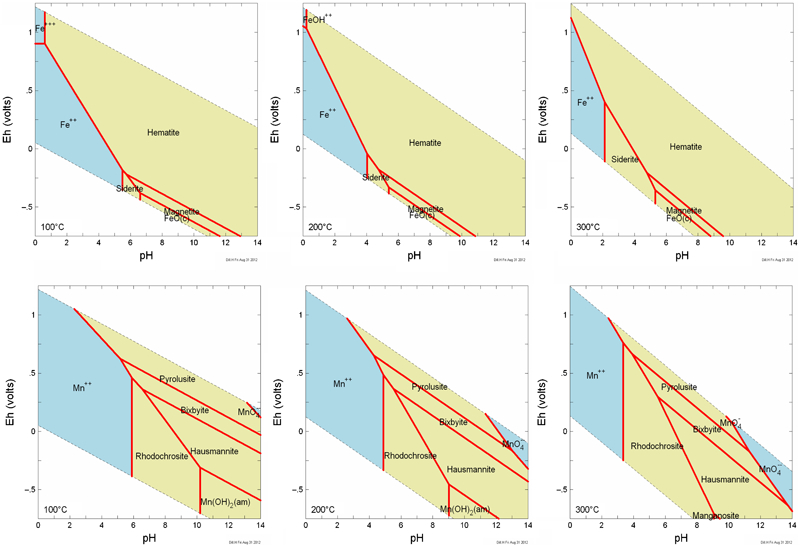
Stability of FeCO3 and MnCO3 in Eh–pH diagrams at different temperatures from 100 through 300°C with the dissolved species as logaHCO3− = −3, logaFe++ = −4 and logaMn++ = −4
Cementation (stage V)
Chalcocite and covellite are the most common representatives in the Cu–S system for the lowermost part of the gossan or zone of cementation, where reducing conditions are still maintained. This stage is already part of the supergene alteration under near ambient conditions.
Deep-seated weathering (stage VI)
Kaolinite, REE carbonates (parisite) and Pb carbonates (cerussite) plus Pb sulphate (anglesite) formed at the lowermost level of the oxidising zone (gossan). Kaolinite needs acidic conditions to form either from muscovite being depleted in K+ or from silica by an introduction of Al+++ (Fig. 11). Cerium carbonate is stable from pH 6 to pH 10 (Brookins, 1987). The same holds true for cerussite which evolved from anglesite at moderately acidic conditions around galena. The source of REE has to be sought among the REE phosphates xenotime and monazite which get decomposed when the pH becomes acidic. When the meteoric solutions during weathering return to near neutral or even mildly alkaline conditions REE phosphates are able to precipitate and also survive as heavy mineral in the clastic apron.
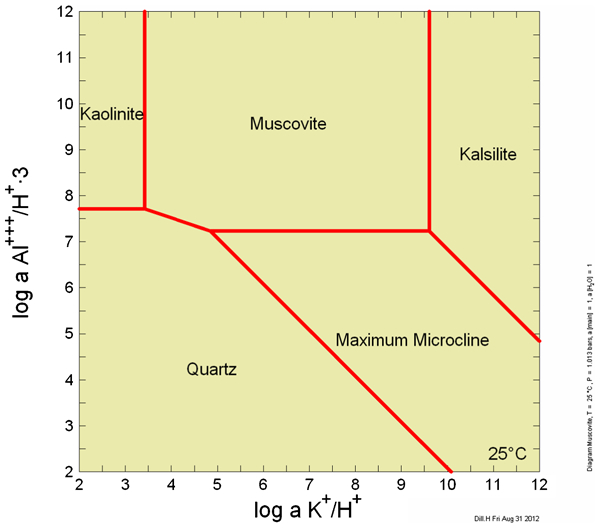
Stability diagram K+/H+ vs Al+++/H+3 to illustrate the chemical changes during stage VI
Intermediate and advanced level of weathering (stage VII+VIII)
Stage-VII-mineral assemblage is abundant in oxidic and hydroxidic minerals commonly found in the gossan of sulphidic ore deposits, where these minerals reflect a neutral to alkaline aqueous regime. The variable spectrum of qualifiers Sn, Ti, Fe, W and Cu in these chemical compounds has a parallel in other granite-hosted deposits bearing tungstates (Dill et al., 2008). Yet in this case one cannot rule out the likelihood that the peculiar oxidic mineralisation together with the APS mineral assemblage of stage VIII is a marker of another hypogene mineralisation closely resembling those derived from subaerial hot brine activities (Dill, 2001). As we miss reliable data for the temperature of formation the similarities between supergene and hypogene mineralisation can only be discussed but not proven one way or the other.
Summary and conclusions for exploration
The intrusive complexes under study in the Khentii Uplift evolved post-collisionally in an intracontinental environment ( Figure 1 Figs. 1 and 9). They may be attributed to the A2 type granites (Eby, 1992). Discrimination diagrams using K, Na, Si, Nb, Y, Rb, and Al clearly attest to this geodynamic attribution of felsic igneous rocks. The rare metal granites associated with a small marginal facies of more granodioritic to monzonitic composition are characterised by elevated fluorite, topaz and tourmaline (schorl) contents indicating high mobility of F and B in these granites and by increase amounts of LREE minerals with allanite-(Ce) and monazite (Ce) prevailing over those REE minerals abundant in HREE such as xenotime. Together with zircon, these minerals show up in the clastic apron surrounding these stocklike A-type granite massifs. Zircon on account of its peculiar morphological type provides a clue to the temperature of formation when the intrusive bodies were emplaced. Also, we can use zircon morphology as a tool for exploration in pegmatitic and granitic terrains using the clastic dispersion aureole.
Two different types of alteration zone developed in the aftermaths of the intrusion of the A2-type granites. Zones of albite alteration (or episyenitisation) are associated with a minor U–Th–Ti mineralisation, whereas zones of silicification, also called greisen, are enriched in Sn and W of subeconomic grade. Cassiterite and wolframite precipitated together with arsenopyrite. Only cassiterite re-appears among the heavy minerals in alluvial–fluvial placer-type deposits around the granite stocks. Both elements, Sn and W contribute to the formation of a wide range of mineral aggregates, named limonite and leucoxene on the basis of the identification of individual mineral species. Whereas the aforementioned heavy minerals can be used as a long-range tracer to the metalliferous A2-type granites (zircon–monazite/xenotime–allanite–topaz–fluorite, arranged in order of decreasing distance from the granite) the Sn-, W-, Fe, Mn- and Ti-bearing chemical residues can be applied as a short-range marker to pinpoint the loci of enrichment of Sn and W.
The base metal mineralisation is rather homogeneous and owing to its low preservation potential is of no relevance for exploration using the heavy minerals in the drainage system. Three different mineral assemblages characterised by REE-carbonates and kaolinite, metalliferous duricrusts abundant in Sn, W and Ti and APS minerals developed under oxidising conditions. Alternative fluid movements described here as per descensum (meteoric fluid) or per ascensum (hydrothermal fluid) cannot be determined precisely and epithermal concentration processes are likely to have contributed to the formation of this near-surface alteration zone. The ore mineralisation within the Khentii Uplift is categorised as a granite-related meso- to epithermal Sn–W mineralisation (Dill, 2010).
Footnotes
Acknowledgements
We are indebted to I. Bitz for her assistance during the separation of heavy minerals and grain size analysis and F. Korte for doing the chemical analyses with XRF. D. Weck has performed the X-ray diffraction analyses and D. Klosa carried out the SEM–EDX analyses in the laboratories of the Federal Institute for Geosciences and Natural Resources. H.-J. Sturm drafted Figs. 1 and 2. The senior author would like to express by this final work his gratitude to many of his colleagues when he was roaming the countryside in Mongolia. We acknowledge with thanks the review by Dr Simon Jowitt and Dr Greg Partington of Applied Earth Science (AES) for their comments to a first draft of this paper. We extend our gratitude also to Neil Phillips, editor-in-chief of AES for his comments and editorial handling of our paper.