







Abstract
In the present research, Fe–0·8%C–0·88%B steel powder compacts were produced using ferroboron. Thermal analysis, i.e. dilatometry and differential thermal analysis/thermogravimetry, was performed in Ar and N2 atmospheres, and the content of interstitial C, O and N was measured. In both atmospheres, boron activated the reduction of oxides above ∼665°C due to its high oxygen affinity. Mass gain in the range of 700–1200°C occurred in N2 atmosphere but not in Ar; the former came along with the uptake of 0·18% nitrogen from the atmosphere. Differential thermal analysis graphs indicate the formation of binary Fe–B eutectic liquid phase in N2 compared with ternary Fe–C–B liquid in Ar. It seems that the formation of boron nitride retards graphite dissolution in N2. Energy dispersive spectrometry linescans confirm the formation of BN during sintering in nitrogen atmosphere, but the mechanism is not yet clear. In both atmospheres, the formation of liquid phase was accompanied by mass loss.
Introduction
Liquid phase sintering is an important method to activate sintering processes. The aim is to achieve higher densities, rounding the pores, improving the mechanical properties and even probably conduct sintering at lower temperature and for shorter time. Therefore, liquid phase formation is an interesting and prominent phenomenon in both scientific research and industrial production. Transient or persistent liquid phase is formed through one component melting or eutectic reaction.1– 3 Some elements like phosphorus, silicon, copper, carbon and boron can be used to form those different liquids. 4 4,5 Benesovsky et al. 6 added FeB to iron powder in order to form the eutectic liquid given in the binary Fe–B phase diagram7 (Fe–3·74 wt-%B) at 1174°C and reported pronounced densification during sintering of the compacts but with loss of toughness. According to the phase diagram, boron has a unipolar solubility with iron,8 which makes the Fe–B system an ideal phase diagram for sintering enhanced through persistent liquid phase.9 At very low boron content (up to 300 ppm), a thin eutectic layer forms along the iron grain boundaries, and the diffusion path of the iron atoms is shortened.4 When adding higher boron content, a persistent liquid phase is formed, which remains segregated at the particle boundaries during the entire sintering cycle, and classical liquid phase sintering mechanisms, i.e. dissolution and rearrangement, contact flattening and solution reprecipitation, are active during sintering.10 Metallographic studies and secondary ion mass spectrometry analysis showed that in Fe–(0·03–0·6)B material, besides boride precipitation, a grain boundary network of boron and iron is formed at and above 0·15 wt-%B.1 Therefore, boron must be added to the green compacts in a precisely defined content because a further increase in boron content results in grain coarsening and formation of a continuous boride network at the grain boundaries,11 which is described to decrease the mechanical properties drastically; hence, adding very low contents of boron was prescribed by researchers for improving the mechanical properties. In addition, boron shows a strong chemical affinity to oxygen; in the sintering process, it reacts with chemically bonded oxygen on the surface of the powder particles, and it simultaneously activates the sintering process.12
The sintering atmosphere plays a major role for boron containing steels because in impure atmospheres, boron getters all of the remaining oxygen, leaving hardly any boron for liquid phase formation or reduction of oxide layers.13 It showed that the well known activating effect of boron is observed during sintering not only in vacuum but also in argon and in hydrogen, while sintering in N2 containing atmospheres results in rapid deactivation of boron through the formation of stable BN. In a hydrogen atmosphere, surface deboronising was observed to considerable depth. 14 14,15 Ar is chemically inert, but Ar trapped inside closed pores tends to inhibit further densification.16
Boron has been added to the iron base materials through various alternative boron sources like elemental B, 4 9 17 4,9,17,18 FeB, 1 6 1,6,19 NiB, 13 13,17 CrB2,17 Cr3B2,20 B4C (Ref. 18) and also hBN. 13 13,21
Dilatometric investigations revealed that dimensional changes are influenced not only by the amount of boron added but also by its form and even the presence of carbon supports shrinkage as compared with carbon free material (but also enhances embrittlement).16 A sharp peak of expansion and subsequent shrinkage of boron containing material indicate the eutectic reaction.22 With increasing carbon content, the temperature of maximum shrinkage rate decreased, thus showing a strong influence of carbon on the temperature of liquid phase formation.23 After forming of the liquid phase, part of the shrinkage occurs already during the heating stage, and it was reported that in Cr–Mo steel containing B and sintered at 1250°C, the main part of the shrinkage is carried out during heating.9
Previous research in boron containing steels was conducted mainly on microstructural and mechanical properties. However, in order to study the sintering process, using thermogravimetry (TG), differential thermal analysis (DTA) and dilatometry as well as chemical analysis is necessary to characterise the chemical, microstructural and dimensional changes taking place during the sintering procedure.24 Dilatometry is particularly useful in conjunction with DTA to precisely identify transition temperatures in solid and liquid states.25 Thermogravimetry is a highly constructive method to monitor thermal transitions accompanied by mass changes, such as decomposition, reduction, desorption, adsorption and vaporisation. It has been stated that following the sintering procedure by continuous heating at a uniform rate differs from the semistatic or static method like in industrial furnaces, in which the samples are held at a constant temperature for a required period of time, and also the fact that dilatometric runs are performed under rather ideal conditions (small specimens and pumping off the gasses generated);26 the former argument, however, ignores that the heating period is also of high relevance in industrial sintering.
In the present work, 4·88 wt-% of Fe–18%B ferroboron powder was admixed to Fe–0·8%C in order to produce the composition Fe–0·8%C–0·88%B. The material behaviour in the present study, thus, is comparable with the material containing 2%BN previously investigated,27 containing the same total amount of boron. Dilatometric runs and DTA/TG were conducted in Ar and N2 atmospheres, which act as activating and deactivating protective atmospheres respectively, and the sintered specimens were characterised by metallographic, mechanical testing and chemical analysis. It is obvious that a content of 0·88%B is too high for industrial applications but is well suited for a model material to study the effects of boron, and as stated, the obtained results are comparable with those from 2%BN containing material.
Experimental
Fe–0·8%C–0·88%B was prepared from water atomised iron powder grade (Höganäs ASC100·29) as a base powder, carbon was added by admixing 0·8% natural graphite Kropfmühl UF4 and boron, which acts as a sintering activator, was added through Fe–18%B master alloy. The ferroboron powder is shown in Fig. 1; evidently, it is relatively coarse (which is bad for the properties but beneficial for model studies). The powders were mixed in a tumbling mixer for 60 min. The mixtures were uniaxially compacted in a pressing tool with floating die at 600 MPa to standard unnotched Charpy samples (ISO 5754), with die wall lubrication being afforded.
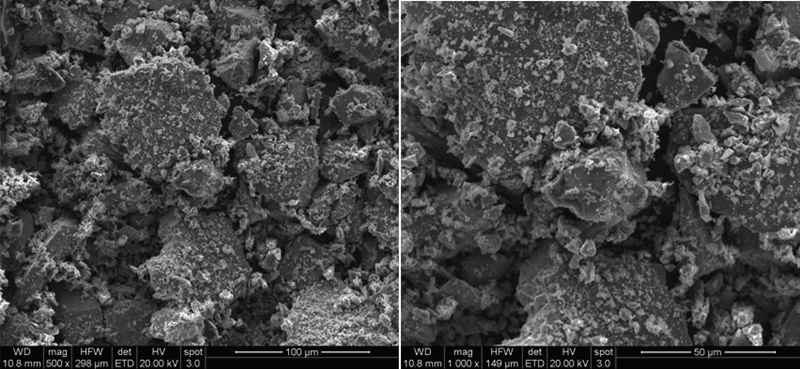
Images (SEM) of ferroboron Fe–18%B powder particles at two different magnifications
Dilatometric runs have been conducted in a Netzsch STA 402C dilatometer coupled to a quadrupole mass spectrometer (Netzsch Aeolos MS). The entire coupling system (entry, capillary transfer line and outlet) was kept at 300°C. Before each test run, the system was evacuated and flooded with high purity helium for three times. Then, the runs were performed by heating at 10 K min−1 up to 1200°C for both N2 and Ar atmospheres, soaking for 1 h and then cooling down at 10 K min−1. As reference materials, compacts of iron and plain carbon steel were also prepared to conduct dilatometric runs.
For DTA/TG investigations, small pieces were cut from the compacts and carefully crushed to form granulate of 0·5–1 mm particle size. Approximately 500 mg of the granulates each was filled into small alumina crucibles, which were placed in a simultaneous thermal analyser (Netzsch STA 449C Jupiter), also linked to the Netzsch Aeolos MS. Before each test run, the system was evacuated and flooded with high purity Ar for three times. Then, the runs were performed by heating at 20 K min−1 up to 1300°C, soaking for 30 min and then cooling down at 20 K min−1. The DTA and thermobalance signals were continuously recorded, and the respective signals of an empty run were subtracted in order to eliminate the influence of the apparatus characteristics. As atmospheres, gases of high purity Ar and N2 (99·999%) were used, with flowrates of 10 mL min−1 as protective gas (only running through the balance) and 50 mL min−1 as working atmosphere (in contact with the specimens). For identifying the degassing processes occurring during sintering, recorded intensities were evaluated. Green densities were calculated from the mass divided by dimensional volume of each sample. The sintered densities were measured using the Archimedes method (DIN ISO 3369).
Metallographic sections were prepared by standard grinding and diamond polishing, and the samples were etched with 1% nital reagent.16 The as sintered unnotched Charpy impact energy was measured at room temperature using a Charpy impact tester with Wmax = 50 J. The fracture surfaces were studied in an SEM FEI Quanta 200 in SE mode. Hardness tests were conducted on a hardness tester (EMCO M4U-025) with Vickers indenter and 30 kg force, i.e. HV30; both surface and core hardness were measured for each condition. The oxygen and nitrogen contents of the specimens were measured by carrier gas hot extraction (Leco TC400). The as sintered carbon contents were measured by combustion analysis (Leco CS230). Each value given is the mean of three parallel measurements. After dissolution of ∼0·5 g of the sintered part in aqua regia, the boron content of specimens sintered in Ar and N2 atmospheres respectively was measured by inductively coupled plasma–optical emission spectrometry (ICP–OES) method.
Results and discussion
Differential thermal analysis/thermogravimetry in solid state sintering
The DTA/TG graphs obtained in Ar and N2 atmospheres are shown in Figure 2 Figs. 2 and 3 respectively. Some physical, chemical and mechanical properties of those specimens sintered in N2 and Ar are shown in Table 1. Inasmuch as the initial and final points of the phase transformations exhibit poor repeatability, transformation temperatures are marked as onset and peak points, since the two latter ones are more independent of the sensitivity of the instrument.28 ‘Onset’ is defined by the contact point of the two tangent lines and is different from the ‘initial’ point at which the curve deviates from the existing trend (which is a gradual effect in most cases).
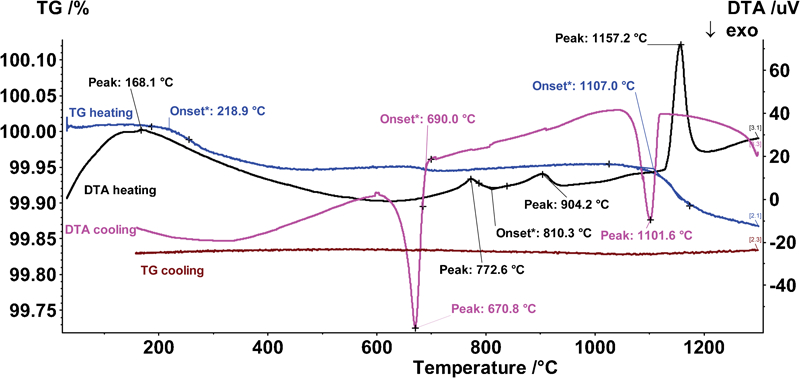
Graphs (DTA/TG) of Fe–0·8%C–0·88%B steel compacted at 600 MPa, Tmax of 1300°C and heating/cooling rate of ±20 K min−1 in Ar
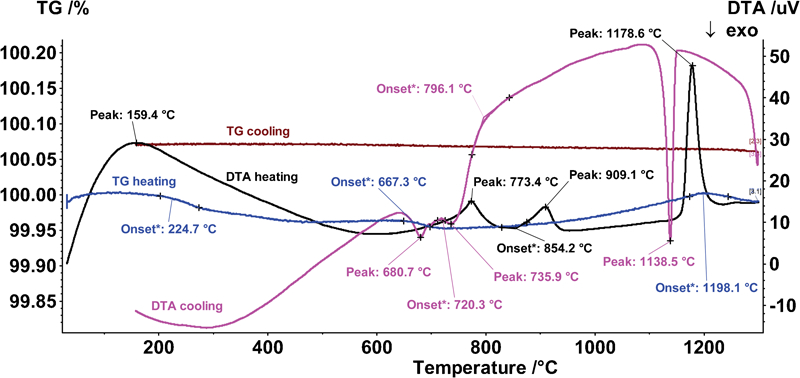
Graphs (DTA/TG) of Fe–0·8%C–0·88%B steel compacted at 600 MPa, Tmax of 1300°C and heating/cooling rate of ±20 K min−1 in N2
Physical, chemical and mechanical properties of boron containing steel sintered in dilatometer for 60 min at heating/cooling rate of ±10 K min−1 and Tiso of 1200°C for Ar and N2 atmospheres
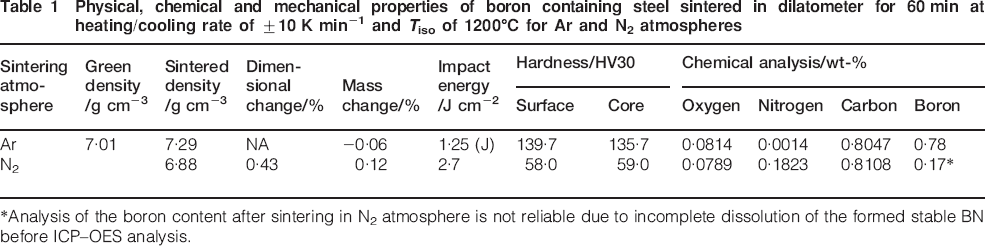
*Analysis of the boron content after sintering in N2 atmosphere is not reliable due to incomplete dissolution of the formed stable BN before ICP–OES analysis.
The first endothermic peak in both atmospheres (∼168°C for Ar and 159°C for N2), followed by a mass loss in the TG curve at ∼220°C, corresponds to the sample's dehydration at low temperatures. The second endothermic peak, close to 773°C for both atmospheres, displays the Curie point or transformation from ferromagnetic to paramagnetic state, almost independent of the carbon concentration, i.e. the same as with plain iron at 768°C. 29 29,30 The mass loss at ∼665°C in both atmospheres is due to the reduction of surface oxides, occurring at ∼65°C lower than in hBN containing material.28 In BN containing material, surface oxides are removed mainly by admixed graphite as reducing agent, while in the presence of ferroboron, due to the high affinity of boron to oxygen, oxide reduction takes place through reaction with boron. Since the ferroboron used is relatively coarse and the initial boron distribution thus is fairly inhomogeneous, it can be supposed that boron is rapidly distributed on the Fe particles by surface diffusion, which can be confirmed by comparing the grain boundary diffusions of boron and carbon in the iron base material, as given below.31
For Fe–0·0018%B (973–1373 K)


The peak temperature of α–γ endothermic transformation is above 905°C for both atmospheres; hence, in both atmospheres, α transformed to γ in the same temperature range as plain iron. With 0·8%C or eutectoid chemical composition, α should transform to γ close to the eutectoid point, which is definitely below 900°C. The results show that with the presence of boron, carbon dissolution in iron slows down, and therefore, the phase transformation occurred at a higher temperature than the expected range for eutectoid steel.
Formation of BN and liquid phase
In contrast to the expected reduction of surface and then internal oxides at and above 700°C in iron base powder compacts, TG shows very small mass loss phenomena at ∼665°C for both atmospheres without any noticeable mass loss or gain between 700 and 1100°C in Ar, while a mass gain in N2 is clearly visible from 700 to 1200°C. It seems that mass gain that is due to the formation of BN or oxidation from the atmosphere should be occurring in this temperature window; otherwise, the mass should be reduced at and above 700°C in TG curves for both atmospheres due to the reduction of surface and internal oxides. It is well known that nitrogen is soluble in the iron lattice to ∼0·001 wt-% at room temperature, and with increasing temperature up to 590°C, it increases to 0·11 wt-%.34 In boron free material, with increasing temperature and enhancing oxide reduction, part of nitrogen can be dissolved as interstitial element in the iron lattice, and interstitial solid solution increases at higher sintering temperatures. Gierl et al. 30 previously reported mass gain for plain iron powder in nitrogen atmosphere with an inflection in TG at ∼1180°C. Nitrogen, oxygen and carbon can occupy interstitial sites in the lattice of iron. In the material studied here, with 0·8%C, dissolution of carbon in the iron lattice restricts and slows down the diffusion rate of nitrogen into the interstitial sites. The nitrogen content shown in Table 1 indicates gaining ∼0·182 wt-% from the protective atmosphere. It is obvious that nitrogen at this level should participate to form a new compound. Therefore, it seems that with the presence of boron, the formation of BN as a new compound is more probable than the dissolution of nitrogen as interstitial element.
Figure 4 shows an energy dispersive spectrometry (EDS) linescan on the fracture surface of a specimen sintered in nitrogen atmosphere. The boron and nitrogen peaks at virtually the same positions confirm the formation of stable BN. The heterogeneous distribution of carbon certifies that graphite is retained as an admixed material and was not dissolved in the iron lattice. While EDS is not an appropriate method to characterise light elements such as carbon really quantitatively, the X-ray mapping presented in Fig. 5 confirms that graphite dissolution is inhibited even when sintering at 1300°C.
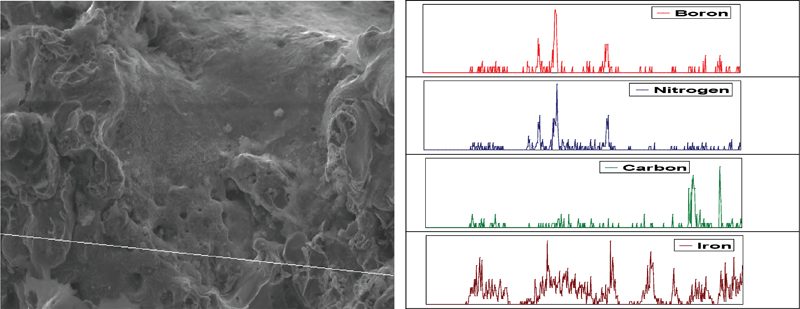
Energy dispersive spectrometry linescans for boron, carbon, nitrogen and iron on fracture surface of Fe–0·8%C–0·88%B steel, compacted at 600 MPa and heating/cooling rate of ±10 K min−1, sintered for 60 min at 1200°C in N2 atmosphere
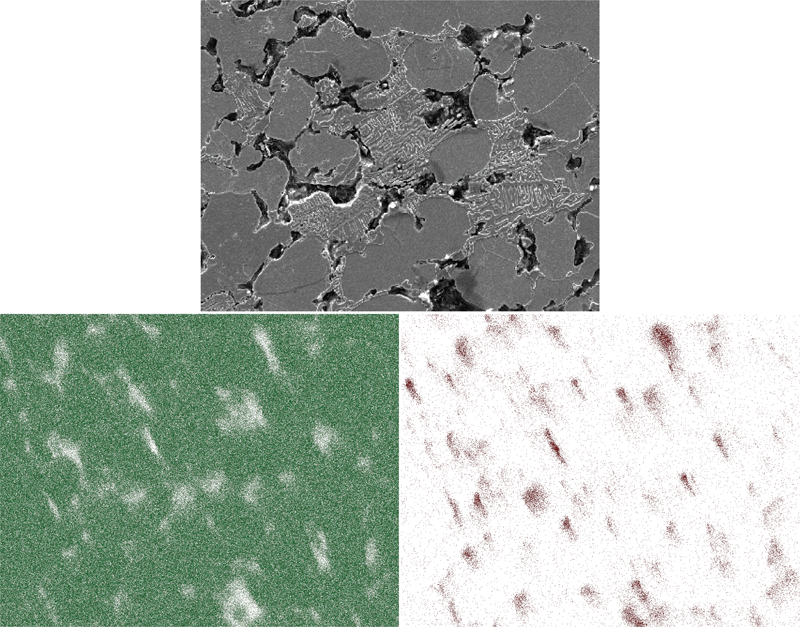
Micrographs with X-ray mapping of Fe (left) and C (right) of Fe–0·8%C–0·88%B, compacted at 600 MPa, heating/cooling rate of ±10 K min−1, sintered for 60 min at 1200°C in N2 atmosphere
The large endothermic peak in the final stages of the heating run is due to the formation of liquid phase in the temperature range of 1130–1157 and 1161–1177°C for Ar and N2 atmospheres respectively. The melting point in N2 atmosphere is close to the binary Fe–B eutectic (given at 1174°C in the phase diagram), while in Ar atmosphere, the melting point decreased to ∼1130°C owing to the effect of carbon to form a ternary eutectic at lower temperature. The mass loss observed at ∼1100 and 1200°C in Ar and N2 atmosphere coincides with the formation of liquid phase.
It can be assumed that boron diffuses very fast at the iron surface at or below 600°C; at ∼650°C, part of boron reacts with iron oxide, forming metallic Fe surfaces and B2O3. At higher temperatures (at least, however, below the usual dissolution temperature of C in Fe, i.e. 900°C), the remaining boron at the iron surfaces reacts with N2 from the atmosphere, forming passivating hBN layers that inhibit graphite dissolution.
Thermogravimetry in Ar and N2 atmospheres
The mass change at different stages of the TG run as extracted from TG curves is presented in Fig. 6. With progressive sintering, a downward trend is dominant in Ar atmosphere, but sintering in N2 is accompanied by a marked mass gain. A mass loss of at least ∼0·1 wt-% is expected after sintering at 1100°C through removal of surface and internal oxides in the range of 680–750 and 950–1100°C, 35 35,36 but here, in both atmospheres, the mass loss is <0·05 wt-% up to 1100°C. Further mass loss in Ar between 1100 and 1200°C occurs simultaneously with the formation of liquid phase and continues up to the end of the isothermal sintering stage. Mass gain is visible in N2 atmosphere between 700 and 1200°C, but it marginally decreases with the formation of liquid phase. In N2 atmosphere, the specimen gained some mass both during the isothermal stage and in the heating region between 700 and 1200°C. The complete TG cycle reveals a mass loss of ∼0·17wt-% in Ar and a mass gain of ∼0·07 wt-% in nitrogen, indicating that Ar acts as an inert atmosphere, just removing decomposition products from the environment, but N2 enhances passivity and forms stable BN, thus deactivating boron. Ar thus can be regarded as an ‘active’ atmosphere for boron liquid phase activation, although it is chemically inert, while the reactive N2 is actually a ‘passivating’ atmosphere here with regard to sintering.
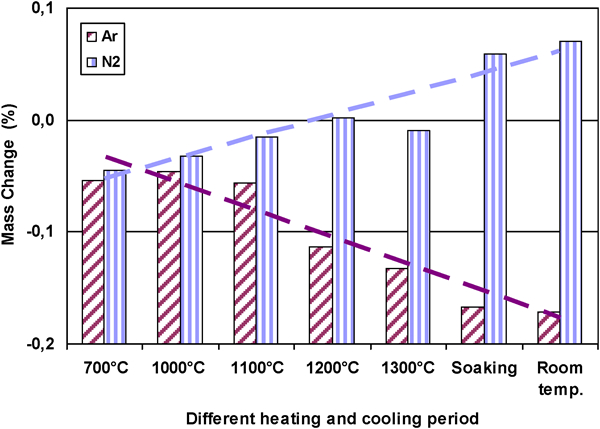
Cumulative mass change of Fe–0·8%C–0·88%B at different stages of sintering in Ar and N2 atmosphere (taken from TG graphs)
Differential thermal analysis during cooling
During cooling, the first exothermic peak for both atmospheres indicates solidification of the liquid phase between 1118 and 1102°C for Ar and in the range of 1148–1138°C for N2 atmosphere. The lower solidification temperature in Ar compared with N2 atmosphere is due to the formation of ternary eutectic at 1097°C.37
The longer and wider exothermic peak in Ar compared with N2 is due to the more liquid phase in case of the former atmosphere. The second large exothermic peak in Ar and two small ones in N2 atmosphere are due to the phase transformation from austenite to ferrite and cementite. In Ar atmosphere, the onset and peak transformation temperatures are 690 and 671°C respectively, but under N2 atmosphere, the onset of the γ–α transformation is at ∼796°C, i.e. 100 K higher than in Ar atmosphere. The delay of the γ–α transformation in Ar compared with N2 atmosphere is due to the presence of carbon as interstitial element, 38 38,39 and it seems that the only conceivable effect to prevent carbon dissolution in the matrix is the formation of very fine BN during sintering in nitrogen atmosphere; this must of course occur already at temperatures below those required for dissolution of carbon in the iron matrix. The BN formed decreases the contact surfaces between graphite and iron base powder particles, and the resulting lower combined carbon in the iron matrix shifts the chemical composition of the material to hypoeutectoid steel and forms proeutectoid ferrite from austenite during cooling.30 In Ar, austenite is transformed to ferrite and cementite at temperature relatively close to the eutectoid point, indicating pearlite formation through eutectoid reaction.
Observing two different slopes during the γ–α transformation in DTA was reported previously for BN containing steel, which indicated two onset temperatures. The first one is due to crossing the austenite/ferrite binary phase region and the gradual transition of γ–α, and the second one is the transformation of enriched austenite to pearlite through eutectoid transition.28 In the present study, two transformation temperature windows have been recognised in N2 atmosphere, the first one between 796 and 736°C indicates the formation of proeutectoid ferrite, and the very small and narrow window between 720 and 681°C represents the formation of pearlite, i.e. the resulting microstructure should consist of ferrite and a small amount of pearlite.
Dimensional changes
The physical and mechanical properties of those specimens (Charpy bars pressed at 600 MPa) sintered in N2 and Ar are shown in Table 1. The theoretical density of the mixed composition is 7·566 g cm−3, whereas the obtained green density was 7·01 g cm−3, which is ∼92·7% of the theoretical value. Sintering in nitrogen lowered the density by ∼1·9%, while under Ar atmosphere, the density increased by ∼4%. The dimensional change measured using a precision slide rule shows 0·43% expansion in N2 atmosphere, quite the same value as with dilatometry, while measuring the same property was impossible in Ar because of the distortion of the sintered sample. It was rounded compared with the rectangular shape of the green part. The heterogeneous distribution of ferroboron, and then disparate activation effect, i.e. strong densification in boron rich areas and poor densification in the lower boron areas, distorts the sample.18
Dilatometric runs in Ar and N2 atmospheres
Dilatometric runs are shown in Figure 7 Figure 8 Figs. 7–9 for both atmospheres. The onset and offset (peak maximum) temperatures of the α–γ and γ–α transformations are presented in Table 2, and dimensional changes in different stages of the heating cycle as extracted from dilatometric runs are presented in Table 3. Dilatometric runs were performed at 1200°C isothermal sintering temperature.
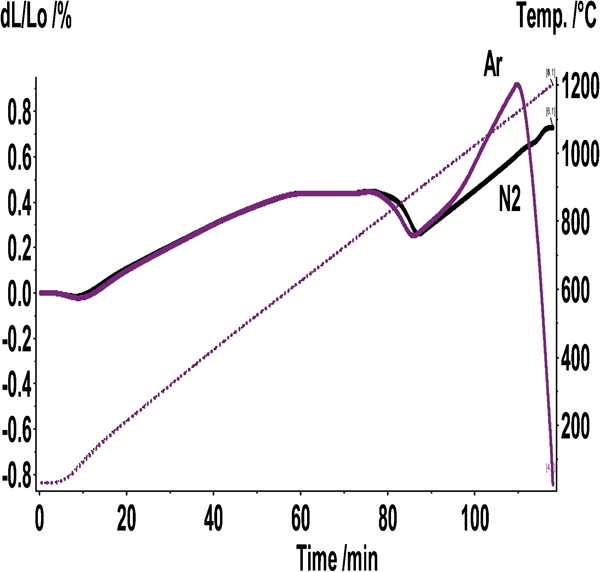
Heating stage of dilatometric run for both steels compacted at 600 MPa, sintered in Ar and N2, at Tiso of 1200°C and heating/cooling rate of ±10 K min−1
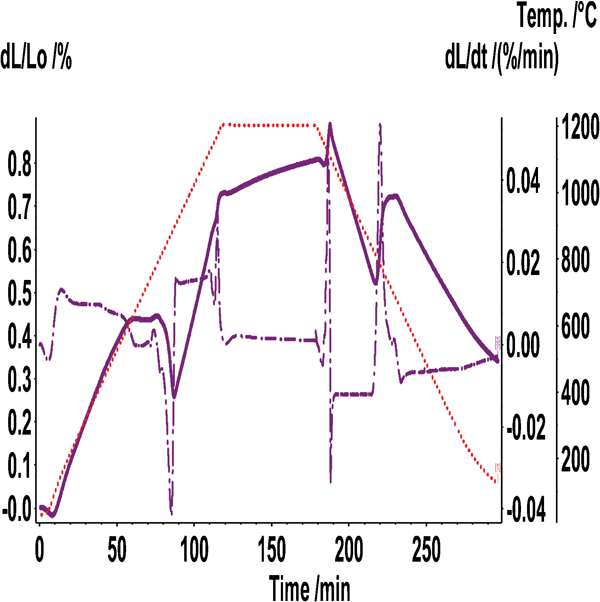
Dilatometric run of Fe–0·8%C–0·88%B steel compacted at 600 MPa, sintered in N2, at Tiso of 1200°C and heating/cooling rate of ±10 K min−1
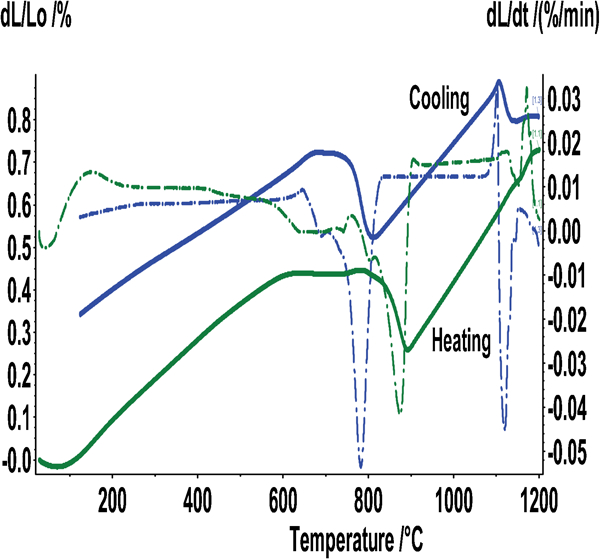
Heating and cooling stages of dilatometric run of Fe–0·8%C–0·88%B steel compacted at 600 MPa, sintered in N2, at Tiso of 1200°C and heating/cooling rate of ±10 K min−1
Onset and offset of α–γ and γ–α transformation temperature

*Extracted from DTA curve, as onset and peak temperature.
Dimensional changes in each stage of heating cycle

As the specimen was distorted during sintering in Ar, the in situ dimensional change is presented only for the heating run. Figure 7 shows the heating sections of the dilatometric runs in both Ar and N2 atmospheres. Both dilatometric runs show the same dimensional behaviour up to the α–γ offset temperature, 0·44% thermal expansion up to α–γ onset temperature and ∼0·18% contraction during the α–γ transformation.
In Ar atmosphere, the liquid phase formation can be recognised from shrinkage at ∼1122°C compared with 1130°C in DTA. Thus, although using different heating/cooling rates and crushed specimen in DTA/TG test but bulk material in dilatometry, almost the same temperature can be defined for liquid phase formation. It is well known that DTA evaluates the energy or temperature difference from phase transformation, while in dilatometry, secondary effects, which are expansion or contraction, are revealed. Shrinkage after liquid phase formation shows that part of the densification occurs already during heating. The recorded shrinkage from the α–γ offset temperature to the end of the heating period is ∼1·1%. Unfortunately, as the specimen was rounded compared with the rectangular shape in the green part, the dimensional behaviour cannot be presented the after heating section.
In contrast to the 0·84% shrinkage in Ar atmosphere during the heating run, the dilatometric run in N2 shown in Fig. 8 shows the passivity effect of nitrogen atmosphere. It is expected that the green compacts should be densified to some extent during isothermal sintering, but there is even 0·08% expansion in this stage, which supports the assumed deactivation effect of N2 atmosphere for boron containing steel.
The heating and cooling section is shown in Fig. 9; the higher temperature of the γ–α onset transformation in N2 compared with Ar, by ∼120°C, is in agreement with the formation of mainly ferritic microstructure. During cooling, both dilatometry and DTA indicate the formation of proeutectoid ferrite, and then austenite is enriched in carbon, resulting in a non-linear temperature dependence of the specific austenite volume. Finally, a very small amount of pearlite will probably be formed.30
Figure 10 Figures 10 and 11 represent comparative heating cycles of the dilatometric run for plain Fe, plain carbon steel, i.e. Fe–0·8%C and Fe–0·8%C–0·88%B steel sintered in both N2 and Ar respectively. Shifting of the α–γ transformation for boron containing steel towards higher temperature compared with plain carbon steel is visible for both atmospheres. Therefore, not only BN but also boron in nitrogen atmosphere (through formation of BN) can inhibit carbon dissolution in the iron matrix. In the N2 atmosphere between α–γ offset temperatures and 1200°C, the expansion is ∼0·48% for B containing material and 0·4% for plain Fe, i.e. a relatively similar expansion for both carbon free and Fe–C–B alloy systems was obtained. It means that the major part of admixed graphite is not dissolved during the heating cycle for the latter, and then the same expansion such as for plain iron is achieved. It seems that graphite dissolution in N2 is prevented completely by the formation of BN up to the isothermal sintering temperature. In Ar atmosphere, ∼0·68% expansion for both Fe–C and Fe–C–B alloy systems between α–γ offset and 1122°C (onset of the liquid phase in the latter) is due to the dissolution of graphite during the heating cycle.
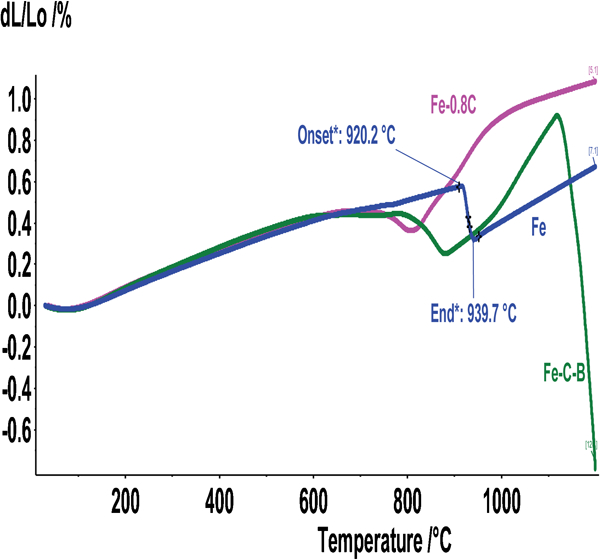
Heating cycle of dilatometric runs for plain Fe, Fe–0·8%C and Fe–0·8%C–0·88%B compacted at 600 MPa, sintered up to 1200°C in Ar at heating/cooling rate of ±10 K min−1
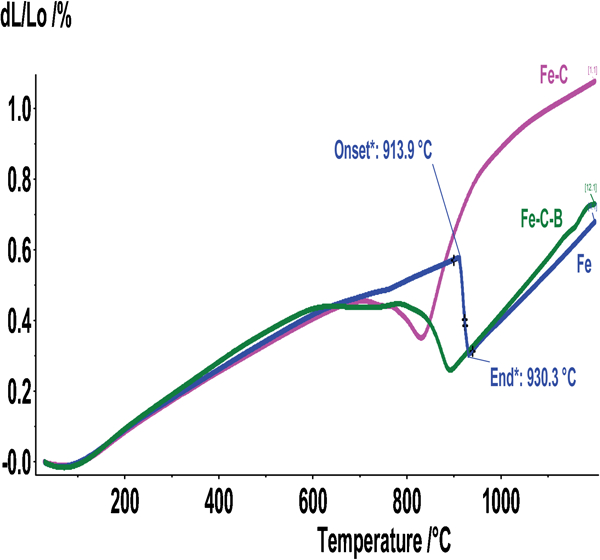
Heating cycle of dilatometric runs for plain Fe, Fe–0·8%C and Fe–0·8%C–0·88%B compacted at 600 MPa, sintered up to 1200°C in N2 at heating/cooling rate of ±10 K min−1
Microstructure, fractography and mechanical properties
The microstructures of specimens sintered in the dilatometer are shown in Figure 12 Figs. 12 and 13 for Ar and N2 atmospheres respectively. In Ar atmosphere, the microstructure is mostly pearlitic. A continuous network of boride eutectic is present along the pearlitic boundaries, indicating the previous persistent liquid phase that resulted in a sort of ‘heavy alloy microstructure’. If employing the rule of mixture and assuming that all carbon is contained as Fe3C phase40 with density of 7·694, the calculated total porosity is ∼5%. Rounded pores and relatively coarse pearlitic grains indicate high sintering activation of boron containing steel during sintering in Ar. The microstructure shows rounded pores with diameters varying between 15 and 100 μm. The reason is related in part to the broad particle size distribution of ferroboron powder, as shown in Fig. 1, with coarser ferroboron particles causing larger secondary pores after forming the liquid phase. Ar is insoluble in iron even at high temperatures, and it fills the pores during sintering and stabilises closed pores against shrinkage, thus inhibiting further densification. It seems that the continuous network of boride acts as a binder to join solid iron particles without any discernible solid–solid sintering necks. The closed pores mainly remained at the grain boundaries. The surface and core hardness are 140 and 136 HV respectively, virtually the same hardness level in both areas. The measured Charpy impact work was only 1·3 J. The continuous boride network with its restricted plastic deformation to failure results in a brittle material, as described as early as 1955.6
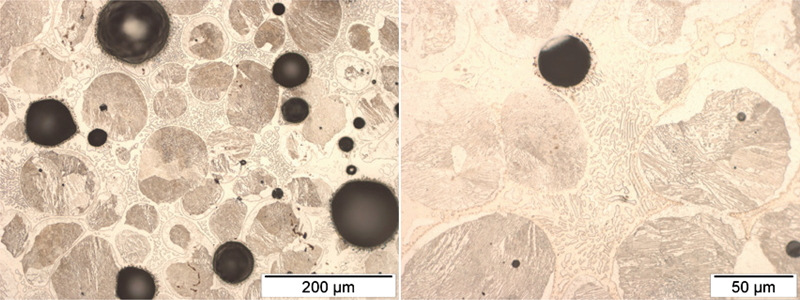
Microstructures of Fe–0·8%C–0·88%B steel, compacted at 600 MPa, sintered for 60 min at 1200°C under Ar atmosphere and at heating/cooling rate of ±10 K min−1
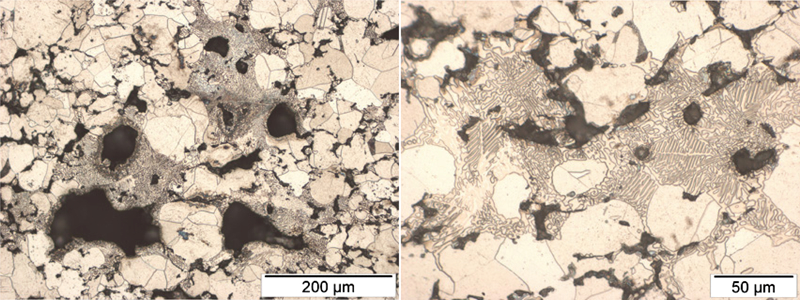
Microstructures of Fe–0·8%C–0·88%B steel, compacted at 600 MPa, sintered for 60 min at 1200°C under N2 atmosphere and at heating/cooling rate of ±10 K min−1
The microstructure of steel sintered in N2, presented in Fig. 13, in contrast, is almost fully ferritic, which is very uncommon for a steel containing 0·8%C (see Table 1, with dendritic structure of the eutectic solidified from the persistent liquid phase). According to the thermal analysis, a small amount of pearlite should be formed, but the section of the dilatometric specimen does not show any pearlite, maybe due to the lower heating/cooling rate in dilatometry. It is also possible that part of the dispersed or divorced pearlite is not distinguishable from the solidified liquid phase. A fully ferritic structure can only be attained if admixed graphite remains as such in the powder compact and is not dissolved in the iron lattice. This ferritic structure was reported previously for plain carbon steels41 and Mo prealloyed steel42 in the early stages of sintering, e.g. at 700°C, i.e. at temperatures at which carbon dissolution is not yet possible. The formation of BN not only reduces the amount of boron available to form liquid phase but also inhibits carbon dissolution in the iron lattice and results in weak sintering contacts.
The low Charpy impact energy of only 2·7 J cm−2 is due to the heterogeneous brittle liquid phase. A coarse and heterogeneous eutectic boride makes the material more brittle. The core and surface hardness is ∼59 HV.
The fracture surfaces of broken specimens prepared in both atmospheres are shown in Fig. 14. When sintered in N2 atmosphere, microductile fracture is dominant, including some cleavage facets of persistent liquid phase. However, with using flowing Ar as atmosphere, interconnected sintering contacts and isolated pores are observed. With the presence of continuous eutectic network and pearlitic grains, rugged intergranular and cleavage fracture mechanisms dominate.
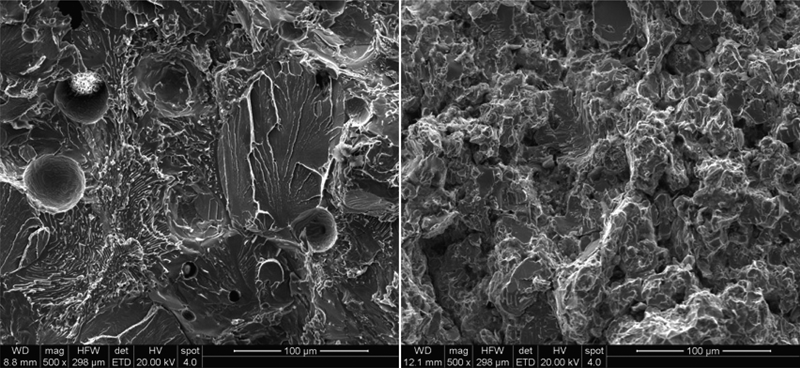
Fracture surfaces of Fe–0·8%C–0·88%B steel, compacted at 600 MPa, sintered for 60 min at 1200°C and heating/cooling rate of ±10 K min−1 in Ar (left) and N2 (right)
Conclusions
By thermoanalytical investigations into Fe–0·8%C–0·88%B steel, phase transformations and in situ mass and dimensional changes were characterised. The mass loss at ∼665°C for both atmospheres indicates oxide reduction. It can be assumed that boron diffuses very fast at the iron surface at or below 600°C; at ∼650°C, part of the boron reacts with the iron oxide, forming metallic Fe surfaces and B2O3. At higher temperatures (at least, however, below the usual dissolution temperature of C in Fe, i.e. 900°C), the boron at the iron surfaces seems to react with N2 from the atmosphere, forming passivating hBN layers that inhibit graphite dissolution.
The same level of combined carbon and admixed graphite in both atmospheres implies that graphite is not effective to reduce surface and internal oxides. A mass reduction of only 0·05% for both atmospheres up to 1100°C reveals that maybe in part some boron has been oxidised and formed oxide that evaporated from the environment.
With the presence of boron admixed as ferroboron, in both atmospheres, α transformed to γ in the temperature range of plain iron. In Ar, TG does not represent any mass loss between 700 and 1100°C, while mass gain is clearly visible in N2 atmosphere from 700 to 1200°C, consistent with 0·18 wt-% nitrogen pickup from the protective atmosphere, and the EDS linescan confirms the formation of BN in nitrogen atmosphere.
In DTA results, the longer and wider endothermic peak in Ar at 1150–1200°C confirms the formation of more liquid phase. The ternary Fe–B–C eutectic is recognised in Ar, while in N2 atmosphere, the melting and solidification temperatures are close to the Fe–B binary eutectic. In both atmospheres, mass loss occurs simultaneously with the formation of liquid phase. Carbon as interstitial element lowers the onset temperature of γ–α transformation in Ar to 690°C, which is ∼100°C lower than in N2. It can be stated that boron as ferroboron results in retarding of the carbon dissolution in both Ar and N2 atmosphere, but yet there is not any explanation for this surprising phenomenon.
Density is lowered by ∼1·9% during sintering in N2, while it increases by ∼4% in Ar. Densification in Ar came along with distortion, indicating that a large amount of boron had been present to form liquid phase (and that only insignificant fractions of B had been consumed by reaction with oxygen). Part of the densification in Ar atmosphere occurred already during the heating stage, simultaneous with the formation of liquid phase, i.e. ∼0·84% shrinkage during the heating run, while 0·08% expansion in N2 during the isothermal sintering stage supports that boron was deactivated by nitrogen and a stable BN was formed. It might be assumed that in the case of using finer ferroboron particles, deactivation would be much more pronounced.
The formation of marked sintering necks can be realised in Ar, with shrinkage starting already during the heating run. However, in N2 atmosphere, except generating some liquid phase, the formation of BN and preventing graphite dissolution indicate a quite small amount of stable sintering bridges.
Sintering in Ar produced mostly pearlitic microstructure. A continuous network of eutectic boride (previously persistent liquid phase) is distributed along the grain boundaries. Rounded pores and relatively coarse pearlitic grains show the high sintering activity of boron containing steel during sintering in Ar.
The microstructure of steel sintered in N2, in contrast, is almost fully ferritic, despite a carbon content of ∼0·8%, with the dendritic structure of the eutectic persistent liquid phase that is very inhomogeneously distributed, indicating that the small ferroboron particles lose their B through reaction with N2, while in the larger ones, it remains active to form the liquid phase.
The Charpy impact energy of <3 J cm−2 in both atmospheres indicates truly brittle material in Ar, because of the continuous network of boride, and in N2, owing to the very weak sintering contacts and brittleness of heterogeneous coarse eutectic boride.
Footnotes
Acknowledgements
The authors would like to thank Dr A. Limbeck and Mr C. A. Mukhtar for their support in performing the ICP–OES measurements.