







Abstract
The effects of neodymium rich rare earth elements [RE(Nd)] on microstructure and mechanical properties of as cast AZ31 magnesium alloy were investigated. The microstructures of as cast AZ31–xRE(Nd) alloys display a dendrite configuration, and the secondary dendrite spacing of the α-Mg phase was decreased with the increasing Nd content. The addition of RE(Nd) resulted in the formation of Al2Nd and Mg12Nd phases. Mechanical properties were improved significantly due to grain refinement and precipitation of intermetallic phases. When the amount of RE is 1·0 wt-%,The as cast AZ31 alloy reached its maximum tensile strength of 249 MPa at room temperature, yield strength of 169 MPa and elongation of 9·0%.
Introduction
As one of the lightest structural materials, magnesium alloy has been widely applied in various fields.1 As a wrought magnesium alloy, AZ31 has good deformation property. However, due to lower content of alloying elements, mechanical properties of AZ31 alloy are poor at room temperature. This limits, to a certain extent, its application.2 Improving the mechanical properties of AZ31 has become one of the most important topics in this field. Currently, studies on AZ31 alloy are mainly focused on its hot deformation performance during extrusion, rolling and forging.3 Few studies have been reported about the improvement of mechanical properties of AZ31 through alloying technology.4 Adding rare earth (RE) element is a way to improve the mechanical properties of Mg–Al alloys.5 Huang et al.6 studied the effect of Er on microstructure and mechanical properties of Mg–Al–Zn–Mn alloy. It was found that the Er added cast alloy consisted of α-Mg matrix, Mg17Al12 and Al3Er intermetallic phases. Addition of Er can effectively refine the microstructure of the cast alloy (the average grain size decreased from 57 μm down to 21 μm). Meanwhile, addition of Er also affects the morphology and distribution of Mg17Al12 phase. Thus, the ductility at room temperature was improved significantly for the Er added cast alloy. Besides Er, RE element Nd can also be used for improving the properties of magnesium alloy. However, systematic investigation on the effect of Nd on microstructure and mechanical properties of Mg–Al alloy is still lacking.
The present paper describes the results of Nd rich RE elements [RE(Nd)] addition to AZ31 alloy, especially the effects of Nd on microstructure and mechanical properties of the cast alloy, which is fundamental for the improvement of plastic deformation property of AZ31 alloy.
Experimental work
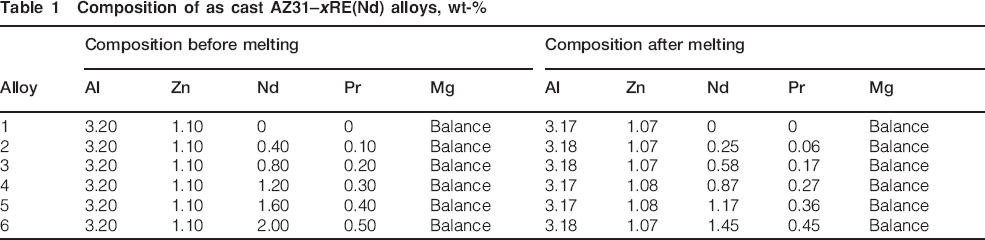
Experimental alloys with RE(Nd) addition levels of 0·5, 1·0, 1·5, 2·0 and 2·5% were prepared. Commercial AZ31 alloy was melted in a vacuum furnace (the manufacturer's name is Jinzhou City Zhongzhen Electric Furnace Limited Liability Company). Neodymium was introduced in the form of a RE(Nd) (Mg–80 wt-%Nd). Table 1 lists the compositions of six casts used in this study.
Composition of as cast AZ31–xRE(Nd) alloys, wt-%
The furnace is vacuumed to a pressure of ∼10−2 Pa and then protective Ar gas is blown into the system. This process is repeated three or four times to reduce the partial pressure of oxygen to a very low level. AZ31 alloy in the crucible is heated up to 720°C under Ar gas protection and the RE(Nd) (Mg–80 wt-%Nd) is introduced into the crucible through a special set-up.
The melt is well stirred to ensure the complete melting of the master alloy. Then, the melt is held for 5 min before being poured into a bar shape mould and cooled in the furnace. The cavity dimensions of the mould are φ30×200 mm.
The metallurgical samples are sliced from the same place of each casting. The contents of alloying elements are measured using inductive coupled plasma atomic emission spectrometry. Metallurgical examinations are carried out using scanning electron microscope (SEM). The phases in cast sample are identified using X-ray diffraction (XRD) instrument. The tensile tests are conducted at room temperature (20°C) using WDW-100 kN tensile machine. The shapes and sizes of samples are shown in Fig. 1.
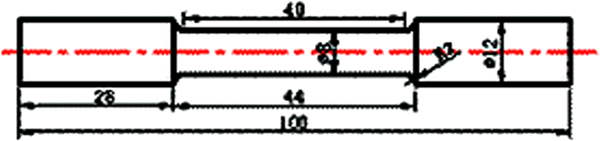
Shape and size of sample
Results
Microstructure
The microstructures of AZ31 cast alloys containing various amounts of RE(Nd) are shown in optical micrographs (Fig. 2). These microstructures indicate two features:
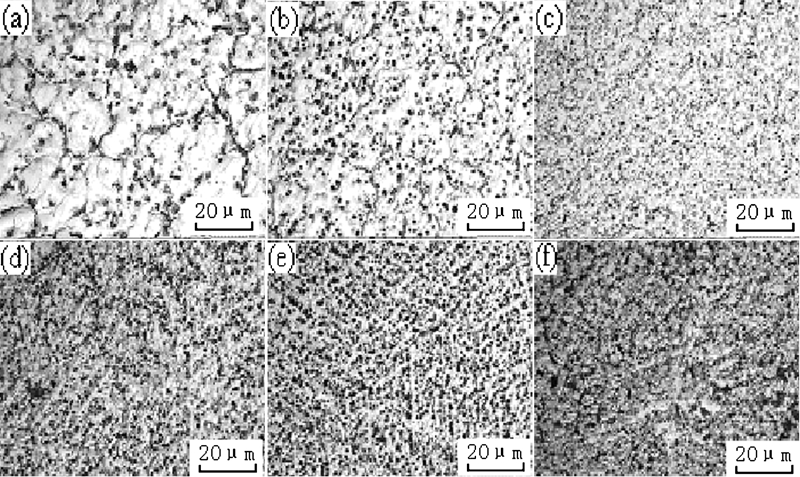
Microstructures of as cast AZ31–xRE(Nd) alloys
all as cast alloys present dendrite structures
the secondary dendrite spacing of the α-Mg phase decreases with the increasing Nd content.
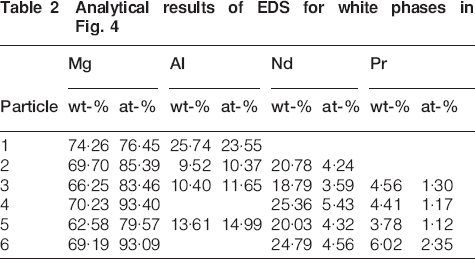
The SEM fractographs of the tensile fracture surface are shown in Fig. 3. There are only small amount of white particles in RE free AZ31 alloy as shown in Fig. 4a, which are identified as Mg17Al12 phase by XRD and energy dispersive analysis (EDS), as shown in Fig. 5 and Table 2. It is found from Fig. 4b that it appear some small block-like phases which are identified as Al2Nd phase by XRD and EDS analysis also presented in Fig. 5 and Table 2. Except for small block-like Al2Nd phase, the needle-like phase are also observed in RE(Nd) added alloys, and the amount of needle-like particles, which are identified as Mg12Nd phase by XRD and EDS analysis as shown in Fig. 5 and Table 2, increases with RE(Nd) addition rising. With the increasing RE(Nd) addition, the amount of Mg17Al12 phase disappears gradually, while that of Al2Nd and Mg12Nd phases are clearly risen.
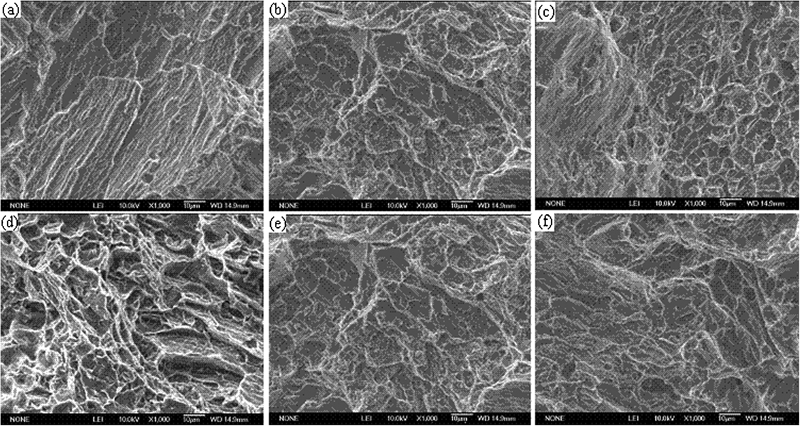
Tensile fracture surface of as cast AZ31–xRE(Nd) magnesium alloys
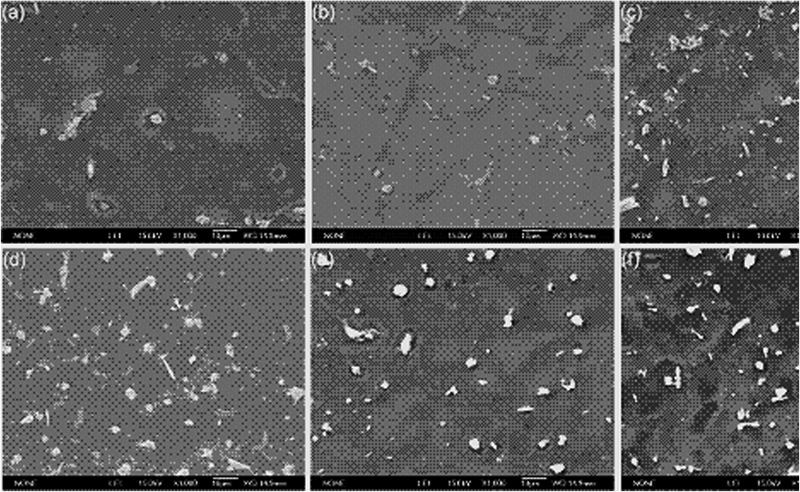
Images (SEM) of as cast AZ31–xRE magnesium alloys
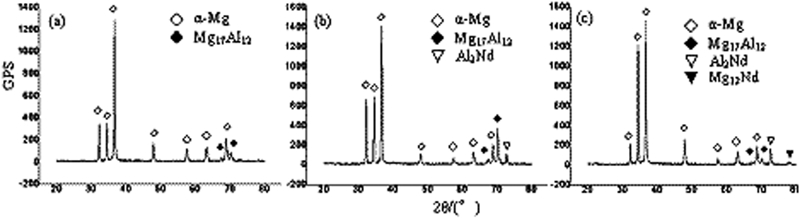
X-ray diffraction patterns of as cast AZ31–xRE magnesium alloys
Analytical results of EDS for white phases in Fig. 4
Mechanical properties
The RE(Nd) has an important effect on the mechanical properties of AZ31 alloy. The as cast ultimate tensile strength and elongation of the six studied alloys are shown in Table 3 and Fig. 6. The tensile testing results indicate that the tensile strength and elongation of AZ31 alloy can be improved with the addition of RE(Nd).
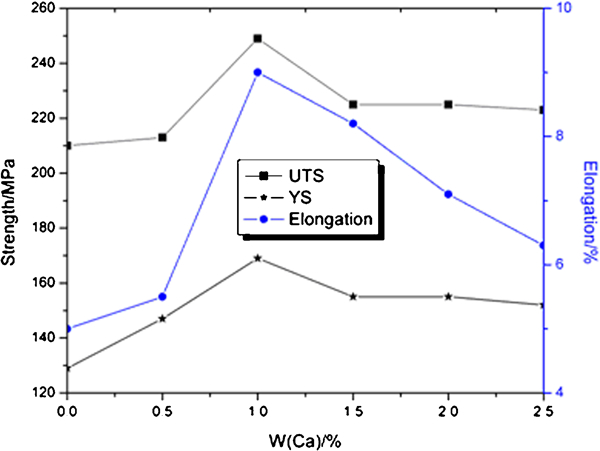
Tensile properties of as cast AZ31–xRE magnesium alloys room temperature
Tensile properties of AZ31–xRE(Nd) alloys at room temperatures
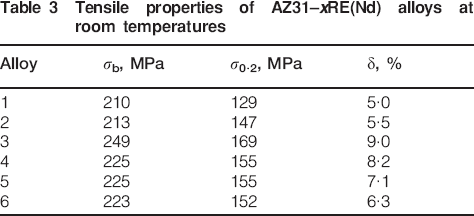
The tensile strength and especially elongation of AZ31 alloy increase gradually with increasing RE(Nd) addition. Optimum mechanical results are attained at a 1·0 wt-%RE addition, the maximum tensile strength, yield strength and elongation are 249 MPa, 169 MPa and 9·0% respectively, which increased by 15·7, 23·7 and 44·4% respectively, compared with RE free alloy. The tensile strength and elongation both drop slightly when RE content is over 1·0 wt-%.
The SEM images of the tensile fracture surface are shown in Fig. 3. Figure 3a shows the image of RE free AZ31alloy, it can be seen that the failure surface is mainly composed of cleavage planes and steps formed by secondary cleavage. On some planes, cleavage rivers consisting of steps can be seen, which exhibits the characteristic of cleavage fracture. Figure 3b–f shows the fractographs of the AZ31–xRE alloys, indicating that the RE addition results in the increasing quantity of the cleavage steps and dimpling, while the sizes of cleavage planes are decreased which can be attributed to the grain refinement by RE. Compared with Fig. 3a, AZ31–xRE show more characteristics of quasi-cleavage.
Discussion
The microstructures of AZ31–xRE(Nd) alloys exhibit dendrites and the secondary dendrite arm spacing decreases with the increasing addition of RE, as shown in Fig. 2. RE(Nd) is partitioned into the liquid ahead of the solidification front, causing a constitutional supercooling zone of liquid ahead of the interface. This gives rise to dendrites. The constitutional supercooling caused by the RE(Nd) enrichment in the liquid ahead of the solid/liquid interface promotes nucleation and hinders the fast growth of grain.7 Therefore, Nd induces a refinement effect on AZ31 alloys. The more the RE(Nd) content, the stronger the effect of constitutional supercooling is, so the secondary dendrite arm spacing declines with the addition of RE(Nd). The average secondary dendrite arm spacing has an important effect on the mechanical properties of alloys. 8 8,9 So the improvement in the tensile strength and the elongation of AZ31–xRE(Nd) alloys comes from the decrease of the average secondary dendrite.
The solid solubility of aluminium in magnesium at room temperature is about 2 wt-%, so that Mg17Al12 phase forms when aluminium content exceeds its maximum solid solubility in magnesium,10 such as the case of AZ31 alloy in Fig. 4a. After adding RE(Nd) in AZ31 alloy, the reaction of RE(Nd) and aluminium results in the formation of Al–Nd compounds and the decease in aluminium content in α-Mg matrix. Only the small block-like Al2Nd phase appears at the addition of 0·5%RE, and the block-like Al2Nd phase increases with Nd rising. When more RE is added, there emerged Mg12Nd compound in addition to Al2Nd, as shown in Fig. 4c. This is probably due to the existence of the excessive Nd after Al in the interdendritic liquid is consumed completely through the formation of Mg17Al12 and Al2Nd, and then the Mg12Nd is formed afterwards. The Al2Nd phases precipitate mainly at grain boundary and can restrain the movement of dislocation, which also plays an important role in the rising of the tensile strength.
When the RE content reaches 1·5 wt-% or more, the decreasing extent of the average secondary dendrite lessens. However, the size and quantity of the needle-like Mg12Nd phase increase distinctly. The presence of these bigger intermetallic phases could to a certain extent lead to an adverse effect on the strength and ductility of AZ31 alloy.
Conclusions
Block or needle-like Al2Nd and Mg12Nd intermetallic compounds formed in RE(Nd) alloyed AZ31 alloy. With the increasing amount of RE(Nd) in AZ31 alloy, both the amount and the size of these compounds increased.
The microstructure of AZ31−xRE(Nd) alloys exhibits dendrites and the secondary dendrite arm spacing decreases with the addition of RE(Nd).
The room temperature tensile properties of as cast magnesium alloy was improved by the addition of RE(Nd). The maximum tensile strength, yield strength and elongation are 249 MPa, 169 MPa and 9·0%, respectively when RE content is 1·0%, which increased by 15·7, 23·7 and 44·4% respectively, comparing with RE free alloy. The improvement of mechanical properties is attributed to the average secondary dendrite and precipitation of block-like Al2Nd intermetallic compounds.
Footnotes
Acknowledgements
This work was supported by National Basic Research Program of China Project (grant no. 90306014) and Key Laboratory Foundation of Shanxi Province (grant no. 2007031014).