Letter
 Open accessLetterFirst published 2026

Select search scope: search across all journals or within the current journal


1-20 of 21 articles
Open accessLetterFirst published 2026Open accessBook reviewFirst published 2026
 Open accessResearch articleFirst published 2026
Children and youth with physical disabilities face significant psychosocial challenges compared to their able-bodied peers. Medical specialty camps provide space where children can enjoy a typical camp experience alongside peers with similar conditions, offering programming and support tailored toward various levels of ability. This paper aimed to assess the impact of such camps on the psychosocial well-being of children with physical disabilities. A literature search performed in PubMed and Science Direct uncovered n = 33 research articles meeting the inclusion criteria. The existing literature consists of a mixture of qualitative and quantitative studies, collectively suggesting that medical specialty camps can lead to measurable improvements in children's quality of life, self-esteem, and self-perception, while also fostering positive social connections, enjoyment, belonging, and empowerment. However, questions remain about the long-term benefits of these camps, with extinguishing effects potentially being offset by follow-up programming. The absence of control data limits the strength of the conclusions that can be drawn. This review builds on the body of literature suggesting that medical specialty camps offer positive improvements to the lives of children and youth with illnesses and disabilities. Also, it suggests key components of effective research in this field, as well as avenues for future study.
Open accessResearch articleFirst published 2026, Celine de Mooij, Arend de Kloet , [...]
Young patients with acquired brain injury (ABI) often report diminished health-related quality of life (HRQoL) compared to healthy peers. Yet, this has not been investigated in a large multicenter outpatient-rehabilitation based cohort. Furthermore, a clear way to categorize HRQoL to better interpret scores is lacking, though this could be valuable for clinical use (i.e., for comparison with other populations).
This cross-sectional study used the PedsQL™ Generic Core Scales 4.0 questionnaire with 23 items to assess patients’ HRQoL, where lower scores mean a more diminished HRQoL. Children (8–12 years), adolescents (13–17 years), and young adults (18–25 years) with ABI, referred to a Dutch rehabilitation center, were included. Patient characteristics were analyzed using descriptive statistics and mean (standard deviation [SD]). HRQoL scores were calculated per age group and subsequently categorized using reference data(means, SDs) from healthy peers. HRQoL was categorized as 1 (‘better HRQoL than healthy peers’, > + 1SD), 2 (‘comparable HRQoL’, −1SD to +1SD), 3 (‘moderately diminished HRQoL’, −1SD to −2SD), or 4 (‘severely diminished HRQoL’, < −2SD).
Four hundred twenty-six young patients (aged 8–25 years) with ABI participated in the study; 233 were female (54.7%), and 334 had a diagnosis of traumatic brain injury (78.4%). Children, adolescents, and young adults had mean (SD) HRQoL total scores below age-specific Dutch healthy peer normative means (62.98 [14.39], 62.86 [16.82], and 59.34 [18.46], respectively). Based on the SD-based categorization using healthy peer reference data, 59% of children (55/93), 52% of adolescents (147/282), and 61% of young adults (31/51) were categorized in Category 4 (‘severely diminished HRQoL’ < −2SD relative to age-specific Dutch healthy peer norms).
Measuring and categorizing HRQoL in outpatient rehabilitation may facilitate clinically meaningful interpretation of PedsQL scores by benchmarking to healthy peers, supporting shared decision-making at referral in young patients with ABI.
Open accessResearch articleFirst published 2026Open accessReview articleFirst published 2026, Niamh Cushen, Jill G ZwickerWith medical advances, children with spinal muscular atrophy (SMA) now survive. Literature reporting on SMA rehabilitation approaches before and after disease-modifying treatments has not been reviewed.
Five databases and grey literature were systematically searched for pediatric reports with a SMA rehabilitation focus, published between 2000–2024. Two independent reviewers screened titles and abstracts; a third reviewer resolved disagreements. Rehabilitation interventions and outcomes were extracted and coded using the International Classification of Function (ICF) Category Tool and analysed using the ‘F-words for Childhood Disability’ as an interpretive framework.
With duplicates removed, 2621 reports were screened, 268 reviewed and 71 retained for detailed extraction. Authors described interventions directed at impairment (50%), functioning (15%), participation (8%), and environmental (27%) domains. Rehabilitation outcomes focused on impairment (42%), functioning (43%), participation (9%), and quality of life (6%) outcomes.
There is a trend in SMA rehabilitation to address impairments with hopes of translation to functional gains. Recommendations include applying the F-words framework, using individual goal-directed multi-disciplinary approaches, and considering the voices of children and families to broaden and re-imagine SMA rehabilitation.
Open Science Framework (https://osf.io/w47m8/)
This is a visual representation of the abstract.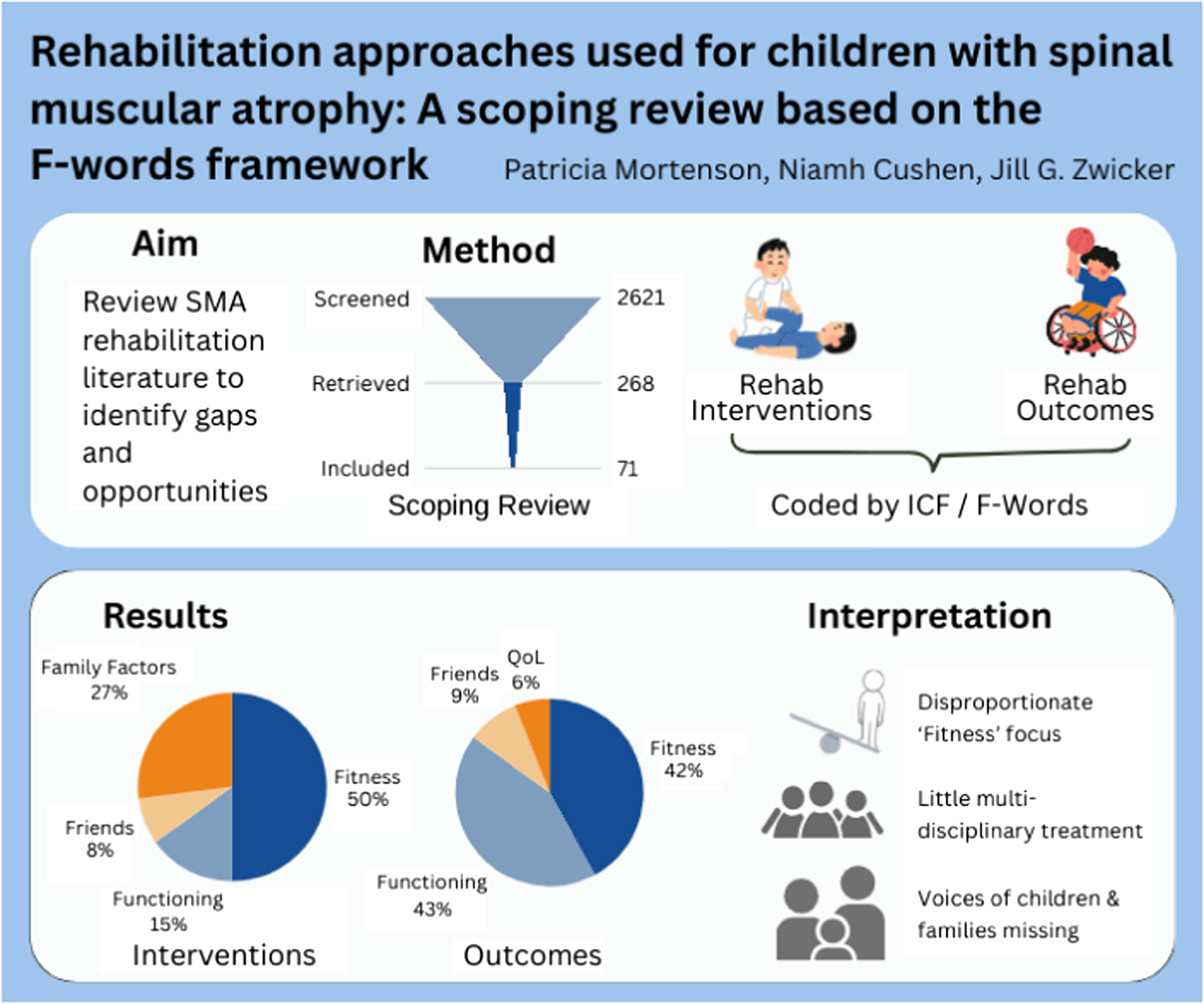
Open accessArticle commentaryFirst published 2026, Denesh Ratnasingam, Megan MachekThere are many obstacles that might be faced throughout medical training. We present three personal experiences (dealing with physical, family, and mental health) that led to significant challenges during our medical school, residency, and fellowship training. Afterwards, we describe different strategies and resources for medical trainees and professionals to overcome these personal and family challenges.
Open accessResearch articleFirst published 2026Duchenne muscular dystrophy (DMD) is a progressive X-linked neuromuscular disorder that reduces physical activity (PA) levels and leads to early loss of ambulation. The World Health Organization recommends promoting daily PA for children with disabilities. The primary aim of this study was to assess changes in PA level, physical function, and quality of life (QoL) after one year of a home-based exercise program in boys with DMD. Secondarily, it aimed to evaluate the suitability and safety of the exercise program for this patient group.
In this prospective longitudinal intervention study, 12 boys with DMD (ambulatory and non-ambulatory) participated in an individually tailored program combining strength and endurance training three times per week for one year. Another 11 boys with DMD served as a non-intervention comparison group. PA-levels were monitored using accelerometery. Secondary outcomes included upper-limb function, lung function, grip strength, endurance, and health-related QoL.
Light and moderate-to-vigorous PA-levels increased in the intervention group but declined in the non-intervention group. Sedentary time increased in both groups. No adverse events were related to the intervention. While upper-limb function declined, other measures remained stable, with a small improvement in QoL.
Home-based, moderate-intensity exercise appears to be beneficial and safe, and may sustain PA-levels, functional abilities, and QoL in boys with DMD.
Open accessResearch articleFirst published 2026, Nor Hanim Mohamad Hanapi, Poorani Anandakrishnan , [...]Dystonic cerebral palsy is a severely disabling condition that poses significant management challenges, compounded by multiple associated comorbidities and the limited availability of effective treatment options.
This study aimed to study the clinical characteristics, functional impact and caregivers’ priorities among children with dystonic cerebral palsy.
This was a cross-sectional observational study (n = 50) among children with dystonic cerebral palsy aged four to 18 years. The Hypertonia Assessment Tool and Barry-Albright Dystonia Scale were used to identify and measure the severity of dystonia. The Dyskinetic Cerebral Palsy Functional Impact Scale was used to assess the daily impact of dystonia and caregivers’ priorities.
Fifty children (70% male, mean age 8.6 years old) with majority functional status from level III to V across all functional classification systems were included. Significant correlation was observed between functional impact with dystonia severity scores (
Understanding the clinical characteristics, comorbidities, functional profiles and caregivers’ priorities is imperative in tailoring interventions to those most relevant and important for children with dystonic cerebral palsy and their families.
Open accessResearch articleFirst published 2026, Jodi M Kreschmer, Peace Asumadu , [...]Mothers of female youth with a physical disability experience stress as their child prepares for adulthood. Interventions that promote parental coping are needed to better support families. This study sought to identify the concerns and coping strategies of mothers of female youth with physical disabilities to inform a family-centered intervention.
One-on-one semi-structured interviews probed mothers’ concerns and coping strategies as their daughters with physical disabilities prepared for adulthood. Dual review of de-identified transcripts was used to identify relevant themes using interpretive phenomenological analysis.
Twenty-one mothers of daughters with physical disabilities participated. Five overarching themes describing mothers’ concerns for their daughters emerged. Mothers were concerned about barriers in helping their daughters 1) maximize independence in life skills, 2) achieve empowerment, 3) develop meaningful relationships, 4) maintain good health, and 5) successfully transition to legal adulthood. Mothers described coping strategies to address these concerns, including intentionality and persistence in teaching their daughters new skills, surrounding their daughters with affirming adults, and adapting their own goals.
Mothers’ concerns centered around how barriers, biases, and lived experiences challenged their life goals for their daughters. Nonetheless, they identified several coping strategies to overcome most of these concerns.
Open accessCase reportFirst published 2026, Denesh Ratnasingam, Kimberly C HartmanAn 11-year-old male with medulloblastoma underwent gross total resection of a posterior fossa tumor, complicated by post-operative pediatric cerebellar mutism syndrome (ppCMS), exhibiting mutism, emotional dysregulation, impaired volitional movement initiation, and ataxia.
While ppCMS's pathophysiology remains incompletely understood, prevailing hypotheses implicate cerebellothalamocortical dysregulation, functional diaschisis, and inhibitory-excitatory network imbalance. This case explores the use of lorazepam, a benzodiazepine that enhances GABA-A receptor activity, as a potential neuromodulator to facilitate recovery in ppCMS.
Tertiary care children's hospital.
Pharmacologic trials with bromocriptine, risperidone, and gabapentin yielded minimal benefit. However, administration of intranasal midazolam (5 mg) during radiation simulation resulted in transient resolution of mutism and improved initiation of movement. Based on this response, lorazepam (2 mg daily, 0.06 mg/kg) was initiated, leading to sustained improvements in speech, motor function, and therapy participation. Functional outcome assessments, including the WeeFIM, revealed a 40-unit gain within one week of lorazepam initiation compared to a 1-unit gain in the preceding week. Immediate regression was noted upon medication discontinuation and reintroduction resulted in subsequent recovery.
The differential response to benzodiazepines compared to other medications suggests potential for inhibitory-excitatory network imbalances. Future research should explore whether less sedating benzodiazepines, such as clobazam, or other GABAergic modulators could provide similar benefits without the cognitive side effects associated with lorazepam.
There is compelling evidence that benzodiazepine-mediated GABAergic modulation may facilitate CMS recovery by restoring cerebellothalamocortical network function. The observed improvements in motor initiation and speech fluency underscore the potential for pharmacologic neuromodulation as an adjunct to traditional rehabilitative therapies.
An 11-year-old male with medulloblastoma underwent gross total resection of a posterior fossa tumor, complicated by ppCMS, exhibiting mutism, emotional dysregulation, impaired volitional movement initiation, and ataxia. Amid ongoing neurorehabilitation, a pharmacologic trial with lorazepam led to a reproducible improvement in speech and engagement. Though transient, the response suggested reversible disruption within functional circuits rather than fixed structural damage. This case report uncovers latent functional capacity in ppCMS, which can help distinguish ppCMS from other overlapping neurologic or psychiatric conditions throughout the course of rehabilitation.
Open accessResearch articleFirst published 2026, Amanda Saenz, Rhoda Hijazi , [...]Children's media both reflects and shapes societal attitudes toward physical disability. Despite its potential impact on self-concept and stigma, longitudinal, data-driven analysis of these portrayals remains scarce. This study aimed to quantify longitudinal trends in the tone and framing of physical disability representation in children's media and to explore implications for pediatric rehabilitation.
A quantitative content analysis was conducted on 68 children's media productions (1933–2025) sourced from the Vanderbilt Peabody database. Content was filtered to age-appropriate ratings (G, PG, PG-13, TV-14). Three trained reviewers classified depictions of physical disability by clinical category (e.g., spinal cord injury, limb difference) and tone (Positive, Neutral, Negative) and coded for the presence of rehabilitation themes. Inter-rater reliability (κ = 0.83) was achieved. Statistical testing included Mann-Kendall trend analysis and Fisher's exact tests to compare pre-2000 vs post-2000 portrayals.
Positive portrayals increased significantly from pre-2000 (63%) to post-2000 (90%) (p = 0.01). A consistent upward trend across decades was confirmed (Z = 3.47, p < 0.01). Spinal cord injury was the most frequently depicted disability (40%); rehabilitation themes appeared in 24% of productions, more commonly post-2000. Productions with rehabilitation content were more likely to feature positive portrayals (94% vs 89%).
Over nine decades, children's media has shifted toward more affirming representations of physical disability, particularly after 2000. Findings suggest that pediatric rehabilitation providers can use positive media examples to reinforce therapeutic engagement, normalize assistive devices, and address stigma in age-appropriate ways.
Stories in children's movies and television can shape how young people see disability. To understand how these portrayals have changed over time, nearly a century of children's media was reviewed. Characters with physical disabilities were identified, including how they were presented and whether rehabilitation or recovery was part of their story. Portrayals of disabilities have become much more positive in more recent decades. Specifically, positive portrayals increased significantly from 63% pre-2000 to 90% post-2000. More recent productions also include more scenes that highlight rehabilitation and recovery. These shifts are important because positive images can help reduce stigma, encourage inclusion, and support the goals of pediatric rehabilitation.
 Free accessRetractionFirst published 2026
 Open accessCase reportFirst published 2026
A 16-year-old male with spastic quadriparesis secondary to cerebral palsy underwent baclofen pump placement in August 2024. During a routine refill in September 2025, a hard, non-mobile bump was noted over the pump's central port. Ultrasound revealed low acoustic density material with tubelike structures at the site. Pediatric neurosurgery suspected catheter dislodgement, and the refill was deferred. Surgery two days later revealed that the pump tubing had migrated ventrally and calcified near the refill port, though the pump remained well-secured. Scar tissue was excised, and the tubing was repositioned behind the pump.
It is estimated that 80–92% of patients diagnosed with cerebral palsy are affected by spasticity. Baclofen pumps are used when conservative treatments (e.g., bracing, therapy, oral antispasmodics, botulinum toxin) fail and require strict monitoring to ensure proper function. This case demonstrates an atypical baclofen pump catheter migration, where suspected dislodgement prevented the refill process, requiring surgical intervention. It underscores the importance of meticulous physical examination, ultrasound evaluation, and clinical judgment to prevent accidental catheter puncture during refills.
Routine follow-up with established care teams is essential for early detection of baclofen pump catheter dislodgement and to ensure proper positioning and function.
Open accessResearch articleFirst published 2026This pilot study aimed to compare the effects of face-to-face and telerehabilitation approaches on thoracic hyperkyphosis, back extensor muscle strength, and discomfort in children.
A randomized clinical trial was conducted in Türkiye with twenty children (aged 9–12 years) diagnosed with thoracic hyperkyphosis (thoracic kyphosis angle >40°). Participants were randomly allocated to a face-to-face rehabilitation group (n = 10) or a telerehabilitation group (n = 10) using the Fiziu Digital Exercise Platform. Both groups performed the same supervised exercise program three times per week for six weeks. Thoracic kyphosis angle (TKA), manual muscle testing (MMT) of the back extensors, and Visual Analog Scale (VAS) scores for discomfort were assessed pre- and post-intervention.
In the face-to-face group, significant improvements were observed in all outcome measures. TKA decreased by 2.00° (p < .001), MMT increased by 0.50 points (p = .037), and VAS decreased by 1.90 points (p < .001). In the telerehabilitation group, TKA also showed a significant reduction of 1.55° (p = .002), and VAS decreased significantly by 1.30 points (p = .009). Although MMT increased by 0.40 points in the telerehabilitation group, this change did not reach statistical significance (p = .072). No significant between-group differences were observed for any outcome at post-intervention (TKA p = .34; MMT p = .693; VAS p = .27).
Both face-to-face and telerehabilitation approaches improved posture, muscle strength, and discomfort in children with thoracic hyperkyphosis. Telerehabilitation using the Fiziu platform may be a practical and accessible alternative in pediatric rehabilitation.
Open accessResearch articleFirst published 2026Clinical manifestations of the post-acute sequelae of SARS-CoV-2, or long COVID, have been well-described. However, few pediatric studies explore the impact on everyday function. The objective was to describe functional outcomes for children and youth with long COVID.
A retrospective cohort study of individuals < 21 years of age with COVID-19 infection seeking care at 21 children's hospitals across the United States was conducted. Using a systematic chart review, children with confirmed long COVID were identified by clinician adjudication between March 2020 and December 2022. Outcomes were compared to children with COVID-19 infection without confirmed long COVID. Functional impairments included difficulty participating in school and extracurricular activities, new referrals to rehabilitative therapies, newly modified education plans, and new or worsening mental health symptoms. Descriptive statistics and logistic regression were used to evaluate these outcomes among children with and without long COVID.
Among 686 children with completed chart review, 651 (95%) had a COVID-19 diagnosis. Functional impairment was documented in 139 (21%) children, of which 59 had clinician-adjudicated long COVID. Compared to infected children without long COVID, children with long COVID had higher odds of school decline (OR 3.5, 95% CI 1.6–7.9,
Significant functional impairments exist among children and youth following SARS-CoV-2 infection and serve as a reminder to clinicians evaluating children with long COVID to explore everyday function. Future prospective studies with longer follow-up are underway.
Open accessResearch articleFirst published 2026This study aimed to assess pediatric rehabilitation medicine (PRM) physicians’ experiences with disability education and opinions regarding a structured curriculum during graduate medical education.
This was a mixed-methods, descriptive survey study of current PRM physicians including PRM attendings, PRM fellows, and Pediatrics/Physical Medicine and Rehabilitation residents. Respondents completed an electronic survey via REDCap. Survey topics included prior disability education, current institutional disability education, and future development of formal disability education. Responses were de-identified. Data was analyzed with descriptive statistics and thematic analysis.
Sixty-five PRM physicians completed the survey. Four themes emerged to describe disability education of PRM physicians: 1) There is a lack of structured disability education, 2) PRM physicians are leaders in caring for children with disabilities and should receive formal education, 3) Patient-centered experiences are considered a key part of the disability curricula, 4) Disability education can aid PRM physicians in advocacy.
Current disability educational experiences are variable amongst PRM physicians, and there is no standardized approach. The majority of PRM physicians surveyed in this study perceived current disability education practices as inadequate and were in favor of a formal curriculum.
Open accessResearch articleFirst published 2026, Alyssa LaForme Fiss, Mark Geil , [...]This study aimed to compare the immediate functional impact of wearing ankle foot orthoses (AFOs) designed using the Optimal Segment Kinematics and Alignment approach to Rehabilitation (OSKAR method) versus wearing standard ankle foot orthosis (AFO)-footwear in children with spastic diplegic cerebral palsy.
Ten participants, ages seven to 13 years, from local pediatric clinics in a large suburban area participated in the study. Each participant wore both types of orthoses in a randomized order. This was determined by participants choosing a sealed envelope containing a sticker indicating which orthosis to be worn for the first data collection. Participants were assessed using three functional outcome measures: 1) the Pediatric Balance Scale (PBS), 2) Standardized Walking Obstacle Course, and 3) the Six-Minute Walk Test. Non-parametric Wilcoxon signed rank tests were used to compare outcome scores between the two conditions.
Total scores on the PBS were significantly higher when wearing the OSKAR AFO-footwear combinations (AFOFCs) (
AFOFCs designed using the OSKAR method may improve functional balance and should be considered when determining the orthotic prescription. These exploratory findings emphasize the need for further investigation of the effectiveness of OSKAR AFOFCs in children with spastic diplegic cerebral palsy (CP).
Open accessResearch articleFirst published 2026Neuromuscular scoliosis (NMS) in children poses significant challenges, including postural instability, pain, mobility limitations, and respiratory issues. Sensory dynamic orthosis (SDO) garments provide dynamic compression and proprioceptive feedback aimed at improving alignment and function. This pilot study explored the feasibility and preliminary effectiveness of SDO garments in the management of NMS.
A single-group pre–post, multicentre pilot study was conducted in 30 paediatric patients who used the SDO® Advanced orthosis for six months. Radiographic outcomes (Cobb angle, coronal balance, pelvic obliquity) and functional assessments (FLACC-R scale, Barthel Index) were recorded at baseline and after the intervention. Caregiver-reported satisfaction and perceived functional changes were gathered through a custom-designed questionnaire.
Of the 30 participants, 25 completed the study (median age 13 [IQR 10–15]). Statistically significant within-subject reductions in Cobb angle were observed during SDO use at baseline (median difference −2.6°, p<0.001) and at final evaluation (median paired difference −4.0°, p<0.001). Similar within-subject improvements in coronal balance were observed at both time points (baseline median paired difference −2.1 cm, p<0.001; final −1.8 cm, p=0.005). Pelvic obliquity and Barthel Index scores showed no significant changes. Most caregivers reported slight to moderate improvements in functional domains and high satisfaction. No serious adverse events were observed, and adherence was high.
This pilot study suggests that SDO garments may contribute to short-term postural spinal alignment and balance during wear and perceived functional benefits in children with NMS. These preliminary findings support further research through controlled trials with longer follow-up to clarify clinical relevance and durability of effects.
Open accessResearch articleFirst published 2026This study aimed to characterize health literacy among adults with brachial plexus birth injury (BPBI) and identify challenges and opportunities to improve BPBI care for affected adults.
A prior multiphase, mixed methods outcomes study of adults with BPBI identified health literacy as salient factor needing further analysis. The current convergent mixed methods secondary analysis thus combined relevant quantitative and qualitative data from this prior study specifically to analyze health literacy in this population. Quantitative data included five scales of the Health Literacy Questionnaire (HLQ) (
Mean HLQ scores were midrange with wide standard deviations. Corresponding qualitative data tended to cluster at the negative and positive extremes. Negative health literacy experiences revealed opportunities for improving care for affected adults, while positive experiences provided examples to guide such improvement.
Health literacy varies among adults with BPBI. In this variability lie opportunities for improving overall care for affected individuals throughout the lifespan.